Buying at a Black Hills Auction
Stepping into the lively, sometimes chaotic, atmosphere of a Black Hills auction, especially when you're on the hunt for a new-to-you ATV or UTV, can be an exhilarating experience. The promise of a great deal, the thrill of the bid, and the sheer variety of machines passing across the block can be incredibly enticing. However, this unique buying environment also comes with its own set of challenges and potential pitfalls. This guide will walk you through everything you need to know to navigate buying an off-road vehicle at a Black Hills auction, from pre-bid research to getting that title in your hand, so you can ride off into the South Dakota sunset with confidence instead of regret.
The Allure and Risks of Black Hills Auctions
There's a certain romance to the auction block, especially in a place as iconic as the Black Hills. You might imagine snagging a fantastic machine for a song, hidden among a sea of forgotten treasures. But like any good adventure, there are twists and turns to prepare for.
Why Auctions Are Tempting for ATV Buyers
Let's be honest, the main draw of an auction is the potential for a deal. You see a quad or a side-by-side that typically goes for top dollar, and here it is, starting at a much lower bid. This sense of opportunity can be incredibly exciting. Auctions, particularly those in active areas like the Black Hills, often feature a wide array of vehicles, from well-loved workhorses to nearly new recreational machines. You might find a specific model you've been searching for, or stumble upon something completely unexpected that catches your eye.
The competitive energy of the bidding process itself is also a big part of the appeal. There's a rush that comes with raising your paddle, outmaneuvering other bidders, and ultimately winning the lot. For many, it's not just about the machine; it's about the experience. And when it works out, when you drive away with a solid machine for a fair price, it feels like a real victory. However, that potential victory hinges heavily on doing your homework and understanding the unique rules of the auction game.
The Inherited Challenges of Auction Purchases
While the allure is strong, it's crucial to approach an auction with a realistic mindset, recognizing the inherent challenges. Unlike buying from a dealership or a private seller who might offer test rides or detailed service records, auction purchases are almost always "as-is, where-is." This means what you see (or don't see) is what you get, with no warranties or guarantees. This can be a huge frustration if you discover a major mechanical issue a week after the sale.
Another significant hurdle is the often-limited time for inspection. At a busy auction, you might only have a few minutes, if that, to look over a machine before it rolls onto the block. This makes it incredibly difficult to spot hidden problems—a cracked frame, a failing transmission, or a deeply rusted component tucked away from plain view. Furthermore, information about the machine's history is often sparse. You might not know how many owners it's had, if it's been in an accident, or its maintenance history. The lack of detailed provenance can make it a risky gamble if you're not careful.
Perhaps the biggest headache for an auction buyer, particularly for an off-road vehicle that requires proper titling, revolves around the paperwork, specifically the title. Some machines might be sold with a clear title in hand, ready for transfer. Others might be sold with a "title pending," meaning the auction house is still working to secure it, which can lead to delays. And in some unfortunate cases, you might encounter machines sold with no title at all, which opens up a whole new can of worms for [South Dakota ATV Title for a Machine With No Papers]. Navigating these challenges successfully requires a sharp eye, careful research, and a clear understanding of South Dakota's titling laws.
Essential Due Diligence Before the Hammer Falls
To maximize your chances of a successful auction purchase in the Black Hills, a solid plan of attack is absolutely non-negotiable. Don't let the excitement of the moment blind you to crucial steps that can save you a lot of grief and money down the road.
Pre-Auction Reconnaissance: Researching the Auction and Machines
Before you even step foot onto the auction grounds, a significant portion of your due diligence should be completed. Start by researching the auction house itself. Are they reputable? Do they specialize in vehicles, or is it a general liquidation? Reviews and past experiences of other buyers can offer valuable insights. Most reputable auctioneers, especially those operating in established areas like Rapid City, Sturgis, or Deadwood, will have online listings or catalogs available days or even weeks before the event. This is your first opportunity to identify machines that pique your interest.
When reviewing these listings, pay close attention to the details provided: make, model, year, and any specific notes about its condition or known issues. Crucially, see if the listing mentions the title status. Does it say "title in hand," "clear title," or "bill of sale only"? This information is paramount. You can also use this pre-auction time to look up the market value of similar machines. Tools like NADAguides or Kelley Blue Book, while primarily for on-road vehicles, can give you a ballpark figure for ATVs and UTVs, helping you establish a maximum bid ceiling. If VINs are provided in the online listing, take the time to run a quick check. This is where [Checking a VIN Before a South Dakota Purchase] becomes an invaluable step, potentially revealing theft records, previous damage, or incorrect mileage that the auction house may not explicitly disclose. Remember, the more you know before you go, the better equipped you'll be to make an informed decision.
The Critical On-Site Inspection
The online research is good, but nothing replaces a thorough, in-person inspection of the machine. This is where you can truly get a feel for its condition. At the auction preview, even if time is limited, prioritize these checks:
- Visual Damage: Look for obvious signs of accidents, bent frames, cracked plastics, or unusual welds. Pay attention to the underside for dents or scrapes that could indicate hard off-road use.
- Fluids: Check for any leaks from the engine, transmission, or differentials. A clean, fresh leak might indicate a recent problem, while old, dried leaks could signal long-standing neglect.
- Tires: Assess tire wear. Uneven wear can suggest alignment issues or suspension problems.
- Suspension and Steering: Grab the handlebars or steering wheel and check for excessive play. Bounce the machine to test the shocks. Look for bent tie rods or control arms.
- Engine and Drivetrain: If allowed, try to start the engine. Listen for any knocking, tapping, or excessive smoke. Check if it goes into gear smoothly. Verify the four-wheel drive (if applicable) engages.
- VIN Plate: Ensure the VIN plate is intact and hasn't been tampered with. This is a crucial identifier and a red flag if it looks suspicious.
- Paperwork Availability: Ask the auction staff about the title for the specific machine you're interested in. Confirm if it's a clear title, salvaged title, or if it will be a "bill of sale only" transaction. This is where you need to be assertive, as title issues are common pain points.
Remember, auction houses are not typically mechanics. They often don't fully inspect or service the vehicles. It's up to you to be the detective. If you're unsure about something, it's always better to walk away from that particular lot.
Navigating Title Status and Paperwork
This is arguably the most critical and often most confusing part of buying at an auction, especially for an ATV or UTV in South Dakota. A clear title is essential for legal ownership and future resale. Without it, you could be facing significant hurdles when trying to register or title your machine later on.
Auction houses vary in how they handle titles. Some, especially those dealing in repossessions or government surplus, might have the title in hand, ready to transfer upon payment. These are generally the safest bets. Others might sell a machine with a "title pending," meaning they expect to receive the title shortly after the sale. While this isn't ideal, it can still work, provided the auction house has a solid reputation for delivering on these promises. Always get a clear timeline in writing for when you can expect the title.
The trickiest scenario is when a machine is offered with "bill of sale only," or if the title is missing or unobtainable. In South Dakota, titling an ORV is generally mandatory, so buying without a title can create a bureaucratic nightmare. If you find yourself in this situation, you'll need to understand the process for [South Dakota ATV Title for a Machine With No Papers]. This often involves a surety bond, multiple affidavits, and a waiting period, and it's not a path for the faint of heart. Always clarify the title status before you bid, and be prepared to factor in the potential time and cost of resolving any title issues. Even with a clear title, you'll still need a proper [A South Dakota Bill of Sale for an ORV], which an online service like LawDepot can help you create if the auction house doesn't provide a sufficiently detailed one. This document is your proof of purchase and a vital component of the titling process.
Auction Day Strategy and Post-Purchase Steps
You've done your research, inspected the machines, and you know what you're looking for. Now it's auction day in the Black Hills! Having a clear strategy and understanding the steps that follow can make all the difference between a smooth acquisition and a regrettable experience.
Setting Your Limits and Bidding Smart
Auction excitement is a powerful force, and it can easily lead you to overbid. This is why setting a firm maximum bid before you start bidding is absolutely crucial. Base this limit on your pre-auction research of the machine's market value, factoring in its condition and any potential repair costs you anticipate. Remember to account for additional fees that will be added to the hammer price. Most auctions include a "buyer's premium," which is a percentage added to your winning bid. You'll also be responsible for sales tax, such as [South Dakota's 4 Percent Excise Tax], and potentially other administrative fees. These can add a significant amount to the final cost, so calculate your true maximum bid with these additions in mind.
It's easy to get caught up in a bidding war, but resisting that urge is key. If the price goes above your pre-determined limit, let it go. There will always be other machines and other auctions. Use an online resource like LawDepot to generate a simple agreement to remind yourself of your limits if you're prone to impulse decisions. Furthermore, understand the payment methods accepted by the auction house. Some require cash, others a certified check, and many will accept credit cards with an additional processing fee. Be prepared to pay immediately after the auction, as most houses require full payment the same day or within a very short window.
Securing Your Purchase and Handling the Paperwork
Congratulations, the hammer fell, and you're the proud new owner of an ATV or UTV! The first immediate step is usually to settle your payment. Once paid, you'll need to arrange for pickup. Most auction houses have strict pickup deadlines, often within a day or two, due to limited storage space. Be prepared to trailer your new machine away promptly.
Then comes the critical paperwork. Ensure you walk away with every document the auction house can provide. This typically includes a detailed bill of sale. Make sure it accurately reflects the machine's VIN, the purchase price, and both the buyer's and seller's information. If the title was available, you should receive it at this time, signed over properly from the previous owner (or the auction house acting on their behalf). If the title is "pending," get a written commitment on when and how it will be delivered. If there was a lien on the machine that the auction house handled, ensure you receive a lien release document. Missing or incomplete paperwork at this stage can lead to major headaches down the road when you go to title the machine. Having a comprehensive [A South Dakota Bill of Sale for an ORV] is your primary proof of ownership, and if the auction house's document is generic, consider creating a more robust one through a service like LawDepot to protect your interests.
Titling Your Newly Acquired Machine in South Dakota
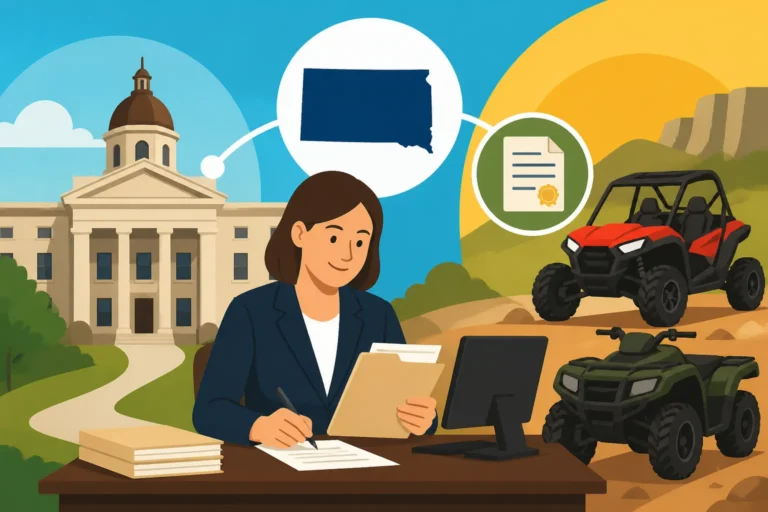
With your new-to-you ATV or UTV secured and all your paperwork in hand, the next crucial step is to officially title it in South Dakota. You'll need to head to your local [Titling at a South Dakota County Treasurer]. This is a fundamental part of the process for any off-road vehicle defined as an ORV in the state.
Here's what you'll typically need to bring:
- The signed-over title: If the machine had one. Ensure all sections are correctly filled out, including the odometer reading (if applicable to your machine), seller's signature, and buyer's information.
- Bill of sale: Your proof of purchase, clearly stating the sale price and VIN.
- [South Dakota's Title and Registration Application]: You can often get this form from the county treasurer's office or sometimes print it online.
- Identification: Your driver's license.
- Payment for fees: This will include the title fee, [South Dakota's 4 Percent Excise Tax] on the purchase price, and potentially a [South Dakota's $2 Technology Fee].
South Dakota has a specific deadline for titling your new acquisition: [South Dakota's Forty-Five Day Title Deadline] from the date of purchase. It's vital not to miss this window. If you do, you'll start incurring penalties. For every month or part of a month you're late, you'll face [South Dakota's 1 Percent a Month Penalty] on the excise tax due. If you wait even longer, [South Dakota's 10 Percent Penalty at Sixty Days] kicks in, adding a significant amount to your initial tax burden. These penalties can quickly eat into any savings you might have found at the auction. Make sure you understand [Why a County Treasurer Handles South Dakota Titles] and that they are your primary point of contact for this process.
| Pros of Buying at a Black Hills Auction | Cons of Buying at a Black Hills Auction |
|---|---|
| Potential for lower prices / good deals | "As-is" sales, no warranties |
| Wide variety of machines available | Limited inspection time |
| Excitement and thrill of the bid | Potential for hidden mechanical issues |
| Opportunity to find unique models | Title complications (missing, pending) |
| Quick transaction (if prepared) | Buyer's premiums and other fees stack |
| Opportunity to save on sales tax if price is low | No test rides allowed |
| Risk of emotional overbidding | |
| Strict payment and pickup deadlines | |
| Limited history/maintenance records |
By being proactive and understanding the process, you can successfully navigate buying an ATV or UTV at a Black Hills auction and enjoy your new machine on South Dakota's fantastic trails and open spaces.
Disclaimer
This article is for general informational purposes only and does not constitute professional advice. Laws, prices and regulations vary by location and change over time. Consult a qualified professional for guidance on your specific situation.