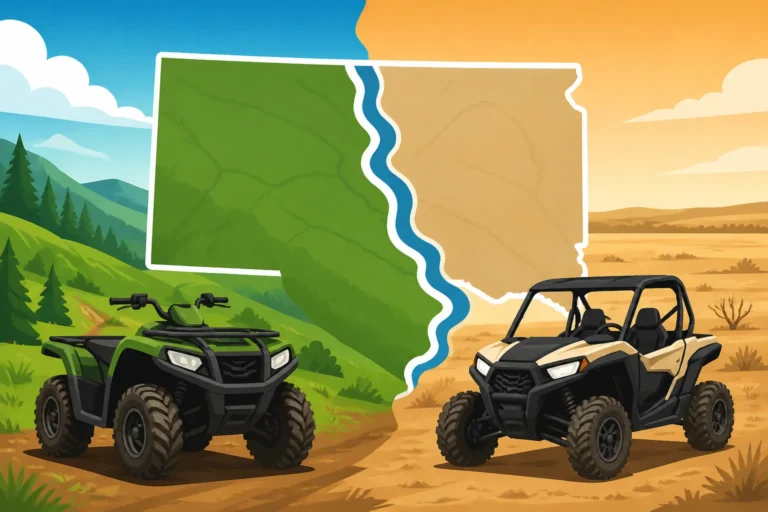
The Mickelson Trail’s Day Pass in South Dakota
A Mickelson Trail day pass can be part of a great Black Hills outing, but it does not give an ATV or UTV permission to ride the trail. That distinction is easy to miss when planning a trip around Deadwood, Hill City, or Custer. This guide explains what the pass is for, where motorized riding belongs, and how to avoid arriving at the wrong trailhead.
What the Mickelson Trail day pass covers
A trail pass is for using the recreation trail
The George S. Mickelson Trail is a rail-trail through the Black Hills, running between the Deadwood area and Edgemont. It is designed for nonmotorized recreation such as walking, bicycling, and horseback riding. A day pass is a way for eligible trail users to access the trail for a limited visit; it is not a permit to take a motor vehicle onto the route.
That distinction matters if you have an ATV or side-by-side on a trailer. A pass, decal, registration, or plate connected with another riding area does not change the Mickelson Trail’s access rules. If your plan is to ride the trail itself on a motorized machine, the safe assumption is that it is not allowed. For more on the distinction, see [Why South Dakota's Mickelson Trail Bans Machines].
A day pass does not replace vehicle permits
South Dakota has separate requirements for different places and types of riding. A Mickelson Trail pass relates to using the recreation trail. Motorized riding areas can have their own permit rules, while road use may involve separate registration, equipment, and legal-access requirements. Those permissions are not interchangeable.
For example, a permit for a designated motorized trail does not become a Mickelson Trail pass, and a Mickelson Trail pass does not authorize ATV or UTV use on motorized routes elsewhere. It is worth checking what each pass actually covers before paying or setting out. The guide to [South Dakota's Motorized Trail Permit] explains the separate motorized-trail system, while [How the Black Hills Motorized Trail Permit Works] covers how that permit relates to riding in the Black Hills.
Check the current pass rules before your visit
Pass requirements, purchase options, and any exemptions can depend on the trail rules in effect. Before heading out, check the South Dakota Game, Fish and Parks information for the Mickelson Trail, and confirm that you understand who needs a pass and which activities it covers. This is especially useful if your group includes people arriving by different means or planning different activities.
The pass question is separate from the vehicle-access question. Even if someone in your group has a valid trail pass for walking or cycling, that does not make the trail available to the ATV or UTV parked at the trailhead. If your group wants both a nonmotorized trail outing and a motorized ride, plan them as separate activities in separate places.
Why ATVs and UTVs cannot use the Mickelson Trail
The trail is a shared nonmotorized route
The Mickelson Trail follows a former rail corridor and is used by people traveling at very different speeds and with different needs. A person walking, a family cycling together, and a rider on horseback all share the route. Adding motorized traffic would change the experience and raise safety and surface-management concerns.
That is why an ATV or UTV cannot use the Mickelson Trail as a shortcut between towns, a way to reach another trail system, or a scenic route for a day trip. Having a quiet machine, traveling slowly, or staying on the edge of the route does not make motorized access acceptable. The trail’s rules apply to the route itself, not just to busy sections.
A nearby road or town does not create trail access
It can be tempting to look at a map, see a road close to the rail-trail, and assume the machine can cross over or follow the trail for a short distance. But proximity is not permission. A legal route on one side of the trail does not automatically authorize riding on the trail or using it to connect to another legal route.
This is particularly easy to misunderstand around popular Black Hills destinations, where roads, trailheads, communities, and recreation routes sit close together. Plan the ATV portion using routes specifically open to motorized use, and treat the Mickelson as a separate nonmotorized destination. [Why the Mickelson Trail Turns Machines Away] and [Why the Mickelson Was Built for Bicycles, Not Quads] provide more context on why the uses are kept distinct.
Seasonal snowmobile use does not mean ATV access
Some riders hear about winter motorized use associated with a trail and assume that any motorized vehicle can use it. That is not a safe conclusion. Seasonal snowmobile access, where permitted, is a specific use subject to its own conditions and rules. It does not create general permission for ATVs or UTVs.
Before relying on a seasonal exception, verify the exact route, dates, surface conditions, and vehicle type allowed. A sign or map that identifies snowmobile use should not be read as an invitation for a side-by-side or quad. When in doubt, contact the relevant land manager rather than testing the rule at the trail entrance.
Plan a motorized ride in a designated area instead
Choose a route that is actually open to ATVs and UTVs
The Black Hills offer motorized riding opportunities, but access depends on the particular route, vehicle dimensions, seasonal opening dates, and local restrictions. A route being visible on a general map does not guarantee that it is open to your machine. Start with official motorized-trail maps and land-manager information, then confirm the rules for the specific trail or road you want to ride.
A useful planning check is to compare your machine’s width with the route limits, identify the route’s operating season, and look for closures before leaving. The resources in [South Dakota Trail Maps and MVUMs] and [South Dakota Trail Conditions Before You Ride] can help you build that routine. If a route is closed or does not permit your machine, do not assume that a nearby connector or rail-trail can fill the gap.
Understand which permit applies to your ride
A motorized trail permit may be required for certain designated riding areas. Road use can involve different rules, and private land requires permission from the owner. These are separate questions: where you can ride, what vehicle you are using, and what permit or registration the route requires.
| Where you plan to go | What to check | Does a Mickelson Trail day pass authorize ATV or UTV use? |
|---|---|---|
| Mickelson Trail | Trail-user pass rules and permitted activities | No |
| Designated motorized trail | Vehicle eligibility, permit, season, and closures | No |
| Public road | Road-use rules, vehicle requirements, and signs | No |
| Private property | Permission from the landowner and any applicable rules | No |
If you are moving between a road and a designated motorized trail, make sure every segment of the route is legal for your machine. A trail permit does not necessarily authorize road travel, and road registration does not necessarily replace a trail permit. Reviewing [Where to Ride an ATV in South Dakota] before choosing a destination can help separate those questions.
Use mapping tools as planning aids, not permission
Digital maps can be helpful for visualizing distances, finding staging areas, and keeping track of a planned route. Some riders use onX Offroad to explore route options and organize a ride. That can make it easier to spot where a proposed loop approaches a community, a trailhead, or a change in land ownership.
Still, a line on a screen should not be treated as proof that a route is currently open or legal for your machine. Compare app information with official maps, posted signs, and land-manager notices. Check again before you ride, since closures, seasonal limits, and local restrictions can affect a route. Use onX Offroad as one planning aid alongside authoritative information, not as a substitute for it.
Planning a visit that includes both activities
Keep the Mickelson outing and the motorized ride separate
If your group wants to walk or cycle the Mickelson Trail and also ride ATVs or UTVs during the same trip, plan for two different destinations. One person might spend the morning on the rail-trail while another takes a machine to a designated motorized riding area, but the vehicle cannot use the Mickelson to connect the two activities.
This separate-planning approach can save time and frustration. Choose a legal motorized staging area first, then plan the nonmotorized trail visit around a suitable trail access point. If the group is meeting later, agree on a location reachable by lawful roads rather than assuming everyone can travel along the same route.
Choose trail access based on your group’s needs
The Mickelson Trail is long, so choosing a suitable access point and distance matters more than trying to cover everything in one visit. Think about who is coming, how long they want to be active, whether they are walking, cycling, or riding horseback, and how they will return to their starting point. A short out-and-back can work better than a one-way plan if you do not have transportation arranged at the other end.
For a mixed group, make the logistics explicit. Decide where the nonmotorized users will start and finish, where the ATV or UTV riders will stage, and how everyone will reconnect. A little coordination avoids the awkward moment when one part of the group is waiting at a trailhead while the other has discovered that the machine cannot follow the route.
Account for changing conditions and access details
The Black Hills can bring shifting weather, dusty roads, changing trail conditions, and busy periods around popular destinations. Check trail notices before you leave, confirm parking and staging arrangements, and allow time for the distance between separate riding locations. Do not assume a route will be open simply because it was open on a previous trip.
If the trip includes a motorized ride near Deadwood, compare your options with [South Dakota ATV Trails Near Deadwood]. For a broader look at motorized riding areas, [Where to Ride an ATV in South Dakota] can help you identify a destination that fits your machine and plans. Then verify the exact access rules with the responsible land manager before loading up.
Common Mickelson Trail pass and ATV questions
Can I buy a Mickelson Trail day pass and ride my ATV there?
No. The day pass is for eligible use of the recreation trail, not motorized access. Buying one does not allow an ATV or UTV onto the Mickelson Trail. If you want to ride a machine, find a designated motorized route and check its separate permit and access rules.
This is true even if the machine is registered elsewhere, has a South Dakota plate, or carries a motorized-trail decal. Those credentials may matter in other settings, but they do not override the Mickelson Trail’s nonmotorized-use restrictions. Keep the distinction clear before you travel, especially if your route planning app shows the rail-trail near a road or motorized trail.
Can I ride an ATV along the trail shoulder or use it to cross?
Do not assume that the shoulder, a short section, or a crossing is an exception. The fact that a machine can physically fit does not establish that the route is open to it. Follow posted restrictions and use only lawful routes for travel and crossings.
If a legitimate road crossing or access point is part of your trip, check the specific location and its signs rather than treating the entire corridor as a connector. A detour on an authorized road may be less convenient, but it is better than risking a citation, damaging the trail surface, or creating a conflict with people using the route on foot, bicycles, or horseback.
What should I do if a map shows a motorized route near the Mickelson?
Treat the map as a starting point, not a final ruling. Confirm that the route is open to your vehicle, check its width and seasonal restrictions, and make sure any required permit is valid for that location. If the map is unclear, consult the agency responsible for the land or route.
This extra check is worthwhile when a route appears to meet the Mickelson Trail or run alongside it. The nearby routes may have different owners, rules, and permitted uses. Keep your planned path on routes designated for your machine, and do not use the rail-trail to bridge a gap in your route.
Is the Mickelson Trail day pass the same as a Black Hills motorized-trail permit?
No. They serve different purposes. A Mickelson Trail pass relates to the recreation trail and its permitted users. A motorized-trail permit relates to eligible motorized riding in designated areas where that permit is required. Neither one should be treated as a substitute for the other.
Before you go, write down the name of the place you plan to use, the type of vehicle or activity, and the permit or pass that applies. That simple check is especially helpful when a trip includes both a nonmotorized visit and a separate ATV or UTV ride. It prevents the common mistake of buying one pass and assuming it covers every activity on the itinerary.
Disclaimer
This article is for general informational purposes only and does not constitute professional advice. Laws, prices and regulations vary by location and change over time. Consult a qualified professional for guidance on your specific situation.