Headlights and Brake Lights in South Dakota
It's incredibly frustrating when you want to take your ATV or UTV out on the open roads of South Dakota, but the nagging question of "is my machine even legal?" keeps holding you back. One of the biggest hurdles, and often the most confusing, revolves around proper lighting – specifically, headlights and brake lights. This comprehensive guide will illuminate exactly what South Dakota requires to ensure your off-road vehicle is safely and legally equipped for street use, helping you understand the rules and avoid unnecessary headaches.
The Essential Role of Lighting for South Dakota Road Use
When you think about the wide-open spaces of South Dakota, from the rolling prairie roads to the winding Black Hills routes, you probably imagine your ATV or UTV kicking up dust, soaking in the sun. But what happens when the sun dips low, or you need to traverse a stretch of pavement to get to the next trail? Suddenly, your machine's lighting goes from an optional accessory to a critical safety and legal requirement. For many riders, the transition from purely off-road adventures to mixed-use excursions can be a real head-scratcher, particularly when it comes to understanding the nuances of road-legal equipment.
Why Your Machine Needs Proper Illumination
Proper illumination isn't just about avoiding a ticket; it's about making sure you and your machine are visible to other drivers, and that you can clearly see the road ahead. Imagine cruising down a county road as dusk settles, or having to make an unexpected stop on a busy route. Without reliable, compliant headlights and brake lights, you become a hazard not just to yourself, but to every other vehicle sharing that road. South Dakota, like any state, has a keen interest in public safety, and that means mandating specific standards for any vehicle, including an ATV or UTV, that ventures onto its public roadways. This isn't just a suggestion; it's a legal expectation that helps keep everyone safe. Think about those long, straight stretches of highway where oncoming traffic can seem miles away, only to be upon you in seconds. Your lights are your first, and often only, line of communication with those drivers.
The Core Distinction: On-Road Versus Off-Road Lighting
It's crucial to understand that the lighting requirements for riding off-road in a designated area like the Black Hills National Forest are vastly different from those for cruising down Main Street in Spearfish. Off-road, you might get away with a light bar or a couple of auxiliary floodlights that illuminate a wide area, perfect for navigating technical trails at night. These lights, while incredibly powerful and useful in the backcountry, are often too bright or improperly aimed for road use, potentially blinding oncoming drivers. The key difference lies in the purpose of the lighting. Off-road lights are designed to help you see the terrain, while on-road lights are designed to help others see you and understand your intentions (like braking or turning), in addition to illuminating the path ahead within specific legal parameters. This is where many riders get into trouble, assuming their beefy off-road light setup will pass muster on the pavement. Unfortunately, it usually won't, and can even attract unwanted attention from law enforcement.
Decoding South Dakota's Headlight Requirements for ATVs
So, you've decided to make your ATV or UTV street legal in South Dakota. One of the very first things you'll need to sort out are those headlights. It’s not enough to just have a light; it needs to be the right kind of light, installed in the right way, and functioning at the right times. The state's regulations are designed to ensure consistency and safety across all vehicles sharing the road, meaning your side-by-side needs to mimic the essential functions of a standard car or motorcycle when it comes to forward illumination. This can be a bit of a curveball for machines primarily designed for mud and trails.
Brightness, Color, and Mounting Standards
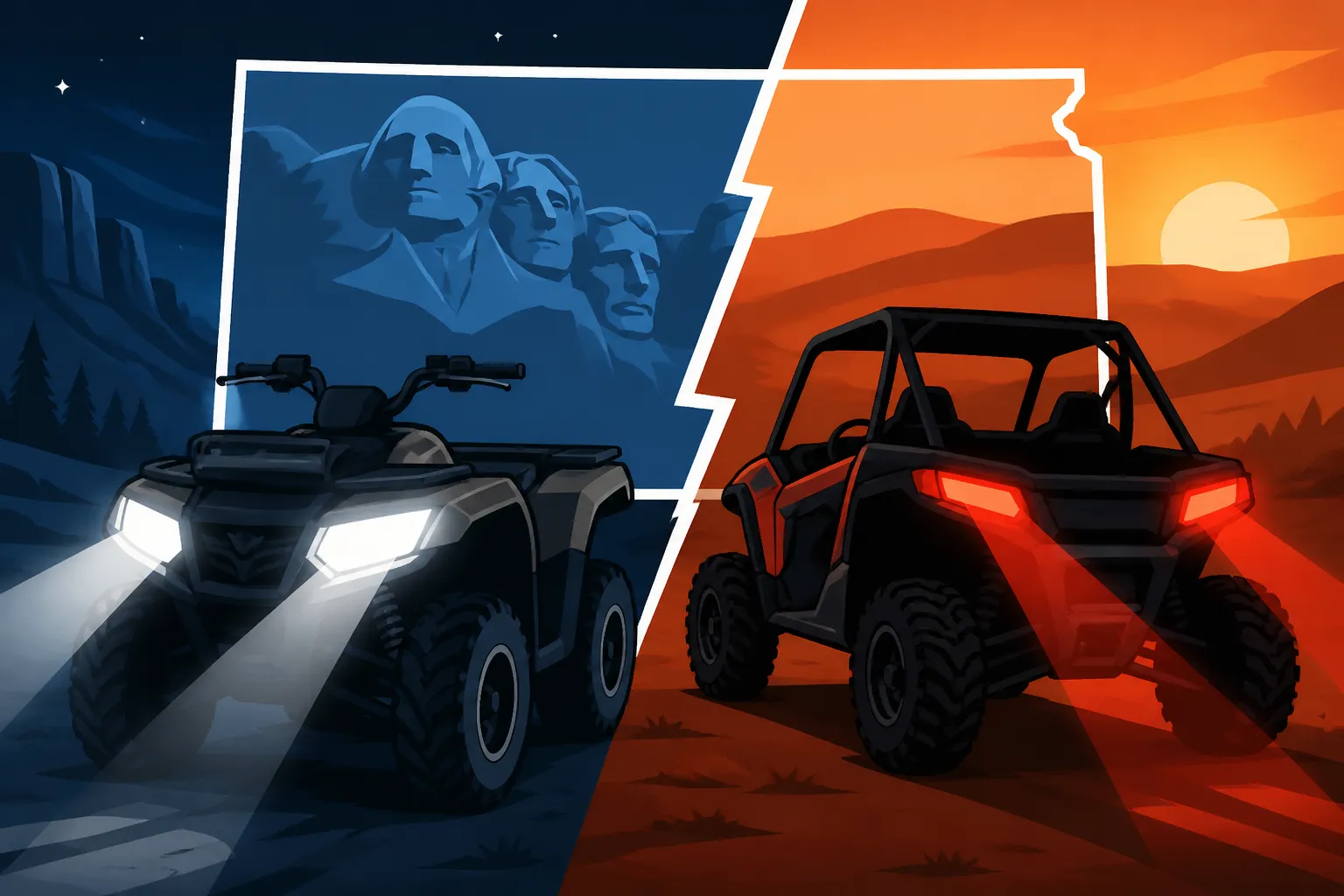
South Dakota's rules stipulate that any motor vehicle, including an ATV or UTV plated for road use, must be equipped with at least one, but generally two, white or amber headlights that emit a steady light. The key here is "steady" – no flashing or strobing lights are permitted for primary forward illumination. The light must be visible from a certain distance, typically 500 feet, under normal atmospheric conditions. Furthermore, they must be mounted at a specific height. While exact measurements can vary slightly, headlights are usually required to be mounted no lower than 24 inches and no higher than 54 inches from the ground to the center of the lamp. This height range is critical because it ensures the light beam is projected at an appropriate level to illuminate the road without excessively blinding drivers in oncoming traffic.
It's also important to consider high and low beams. Just like a car, your street-legal ATV or UTV needs to have both. The low beam should illuminate the road sufficiently for safe travel, while the high beam provides greater visibility for rural, unlit roads. However, you must be able to dim your high beams when approaching oncoming traffic or when following another vehicle, usually within 500 feet of an approaching vehicle or 200 feet when following. This is a common point of contention for riders who might have installed powerful aftermarket LED light bars. While fantastic for off-road visibility, many of these lack a proper high/low beam function that meets road-legal standards. Companies like SuperATV offer DOT-approved headlights specifically designed to meet these kinds of legal requirements, often providing a much-needed upgrade from stock off-road lights. Remember, the goal isn't just to see, but to be seen and to operate safely among other vehicles.
When Headlights Must Be Operational
This might seem obvious, but it's worth a deep dive: when do your headlights absolutely, positively need to be on? In South Dakota, the law states that headlights must be activated during the period from a half-hour after sunset to a half-hour before sunrise. This is your standard "nighttime driving" rule. However, the requirement extends beyond just those twilight hours. Headlights are also mandatory at any other time when there isn't sufficient light to render persons and vehicles clearly discernible on the highway at a distance of 500 feet ahead. This covers situations like fog, heavy rain, snowstorms, or even just heavily overcast days where visibility is naturally reduced. It’s better to err on the side of caution and turn them on if you have any doubt.
Ignoring these rules can not only be dangerous but can also lead to a roadside stop by a South Dakota Trooper. Imagine you're riding a gravel road that turns into a paved section just as a storm rolls in. If your lights aren't on, or if they're not compliant, you're looking at a potential ticket and a safety risk. For more details on what other equipment you might need, check out [Equipment a South Dakota Road Machine Needs]. The basic takeaway is that if you're on a public road or highway and visibility is anything less than perfect daylight, your headlights should be on and functioning correctly. This also ties into how your machine can even qualify for a plate in the first place; for example, [South Dakota ATV Engine Size for Plates] outlines a critical hurdle for some machines before they even get to the lighting requirements.
Understanding Brake Light Mandates for Street Legal Machines
Just as vital as seeing where you're going is letting those behind you know what you're doing. This is where your brake lights come into play. On a trail, tapping your brakes might just slow you down, but on a South Dakota highway, it's a critical signal to the driver behind you that you're reducing speed or coming to a stop. Many stock ATVs and UTVs come with some form of tail light, but not all are equipped with proper, road-legal brake lights that meet the state's stringent visibility and functionality standards. This can be a significant oversight for riders looking to legally plate their machine for street use.
Visibility, Functionality, and Red Light Rules
South Dakota law mandates that every motor vehicle, when operated on a highway, must be equipped with at least one brake light, emitting a red light visible from a distance of 500 feet to the rear in normal sunlight. This light must be activated when the service brake is applied. This means the light needs to be bright enough to cut through daylight conditions, not just dimly glow in the dark. Moreover, the color is strictly red. You won't see blue, green, or purple brake lights passing muster with a state trooper. The functionality aspect is also key: the light must come on every time you apply the brake pedal or hand lever. If it flickers, is intermittent, or simply doesn't activate reliably, it's not compliant.
Consider a scenario where you're riding a [South Dakota Rules for Riding a Gravel Road] and encounter an unexpected cattle guard. You hit the brakes, and the car behind you relies on your brake lights to react. If they don't see your lights, you're at risk of a rear-end collision. Sometimes, stock machines might only have a running tail light, which stays on constantly, but doesn't brighten when the brakes are applied. This is a common trap for new street-legal conversion enthusiasts. If your machine is in this category, you'll definitely need an upgrade. Companies specializing in off-road accessories, like SuperATV, offer wiring harnesses and LED brake light kits that can convert your tail lights into proper brake lights, ensuring you meet the 500-foot visibility requirement.
Beyond Just Stopping: Integrated Lighting Systems
While the primary function of a brake light is to signal deceleration, modern integrated lighting systems on ATVs and UTVs often combine tail lights, brake lights, and turn signals into a single, cohesive unit. When preparing your machine for South Dakota road use, it's worth considering such an integrated system. Turn signals, while not explicitly part of the "brake light" definition, are another non-negotiable component for street legality. An integrated LED light bar, for example, can serve as your running tail light, illuminate brighter as a brake light, and blink distinctly as a turn signal, all from one clean unit.
This comprehensive approach not only ensures compliance but also enhances safety. Imagine making a left turn onto a busy road. If your brake lights are separate from your turn signals, you're giving clear, distinct signals. If you only have hand signals (which are still legal but less visible, especially at night or with a passenger), you're increasing your risk. When evaluating options, look for systems that are designed for durability in off-road conditions but also carry a Department of Transportation (DOT) approval or similar certification, indicating they meet road-legal standards for brightness, color, and beam pattern. Investing in a robust, multi-functional lighting system can save you time, effort, and potential fines down the road. For more on what a trooper looks for, you might want to read [What a South Dakota Trooper Checks Roadside].
| Light Type | Required Color | Required Visibility | Function | Additional Notes |
|---|---|---|---|---|
| Headlights | White or Amber | 500 feet (front) | Illuminate road ahead, make vehicle visible. | Must have high/low beam, dimmable. Mounted 24-54 inches high. |
| Brake Lights | Red | 500 feet (rear) | Signal deceleration or stop. | Must activate with service brake. |
| Tail Lights | Red | 500 feet (rear) | Make vehicle visible from behind. | Continuously lit when headlights are on. Often integrated. |
| Turn Signals | Amber or Red | 100 feet (front/rear) | Signal intended direction of turn/lane change. | Required for road use. Often integrated with tail/brake lights. |
Navigating Aftermarket Solutions and Compliance Challenges
The world of ATV and UTV accessories is vast, and many riders love customizing their machines. When it comes to lighting for street legality in South Dakota, this customization can be a blessing or a curse. On one hand, aftermarket parts offer the opportunity to upgrade your lighting to meet or even exceed legal requirements. On the other hand, it's easy to get lost in a sea of options that look great but don't actually comply with state law. The challenge often lies in distinguishing between "off-road cool" and "road legal."
Choosing the Right Lights for Your South Dakota Ride
When you're shopping for headlights and brake lights to make your ATV or UTV street legal, the first thing to look for is a DOT (Department of Transportation) stamp or certification. This is usually a strong indicator that the light has been tested and meets federal standards for road use. Many off-road specific lights, while incredibly bright, are not DOT-compliant because they lack features like proper beam patterns for high/low beams or specific lumen output requirements for different light types. For example, a powerful LED light bar designed for trail illumination might be too diffuse or too intense in its main beam pattern to serve as legal headlights, and it almost certainly won't have a distinct high/low beam function.
For brake lights, look for dedicated units or integrated tail/brake/turn signal assemblies that are designed for vehicle applications. These will ensure the red light is sufficiently bright and visible from the required 500 feet. Remember, consistency is key; the light needs to activate every time you hit the brakes. Companies like SuperATV are known for producing a range of aftermarket parts, including lighting kits, that can help bridge the gap between off-road capability and street legality. They often specify which products are DOT-approved, taking some of the guesswork out of your purchase. Don't be shy about asking questions at your local powersports dealer or accessory shop; they often have experience with street-legal conversions and can guide you toward compliant products.
Common Pitfalls and How to Avoid Them
One of the most common pitfalls riders encounter is mistaking aesthetic appeal for legal compliance. Just because a light looks cool or is super bright doesn't mean it's street legal. Many riders install auxiliary LED pods or light bars that are fantastic for lighting up a dark trail but are completely illegal for use as primary headlights on public roads. These types of lights often don't have the required beam cutoff, meaning they scatter light too broadly and can blind oncoming drivers. The rule of thumb: if it's not specifically designed and marked for road use, it probably shouldn't be your primary illumination on pavement.
Another trap is neglecting proper wiring and installation. Even the best DOT-approved lights won't do you any good if they're not wired correctly. Faulty connections can lead to intermittent operation, which is just as dangerous (and illegal) as having no lights at all. Ensure all wiring is properly insulated, secured, and connected to the correct circuits (e.g., brake light circuit for brake lights, headlight circuit for headlights). If you're not comfortable with electrical work, it's always best to have a qualified mechanic or powersports technician handle the installation. Investing a little extra in professional installation can save you a lot of grief and potential [South Dakota Fines for Illegal ATV Road Use] down the line. Remember, getting your machine street legal means meeting all the requirements, including other essentials like [A Rear-View Mirror for South Dakota Road Use] and [A Horn on a South Dakota Road Machine].
The Legal Ramifications of Non-Compliant Lighting
It’s easy to dismiss lighting requirements as just another bureaucratic hoop to jump through, but in South Dakota, failing to meet these standards can have real, tangible consequences. Beyond the immediate risk to your safety and the safety of others on the road, there are legal penalties that can quickly turn a fun ride into a costly headache. Understanding these ramifications can be a powerful motivator to ensure your ATV or UTV is properly equipped before you venture onto any public road.
Fines, Penalties, and Roadside Enforcement
Operating a vehicle, including a street-legal ATV or UTV, on South Dakota roads without proper or functioning headlights and brake lights is a traffic violation. The specific penalty can vary depending on the exact nature of the offense and whether it's a primary or secondary infraction, but generally, it will result in a fine. These fines can stack up, especially if you're found to be non-compliant with multiple equipment regulations. For instance, if your headlights aren't working, and your brake lights are out, you're looking at multiple violations. Repeated offenses can lead to more severe penalties.
South Dakota law enforcement officers, including state troopers and county sheriffs, are trained to spot equipment violations. A non-functioning headlight, an improperly aimed light bar, or brake lights that don't illuminate reliably are all red flags that can prompt a roadside stop. During such a stop, an officer will likely conduct a thorough check of your machine's other road-legal equipment, potentially uncovering additional issues. This means that a minor lighting oversight could spiral into a more comprehensive inspection and a stack of tickets. For a general understanding of what law enforcement looks for, check out [What a South Dakota Trooper Checks Roadside]. It’s always best to perform your own pre-ride check before hitting the pavement, especially when riding [South Dakota Rules for Riding After Dark].
Ensuring Your Machine is Always Ready for the Road
The best way to avoid fines and ensure safety is proactive maintenance and regular checks. Make it a habit to walk around your ATV or UTV before every ride that involves public roads.
- Headlights: Turn them on (both high and low beams) and ensure both are working correctly and properly aimed. Check for any cracks or damage to the lenses.
- Brake Lights: Have a friend stand behind your machine while you press the brake pedal/lever. Verify the brake lights illuminate brightly and consistently. Test all brake controls (foot and hand, if applicable).
- Tail Lights: Confirm your running tail lights are on when your headlights are activated.
- Turn Signals: Test both left and right turn signals, front and rear, to ensure they flash properly.
Beyond these visual checks, keep your lights clean. Mud, dust, and grime can significantly reduce light output and visibility, even if the bulb itself is functioning perfectly. A quick wipe-down can make a big difference. Also, be mindful of any modifications you make. If you're adding accessories, always double-check that they don't interfere with the visibility or functionality of your required lights. For example, some large cargo boxes or aftermarket bumpers could inadvertently block tail or brake lights. Ensuring your machine is always road-ready means consistent attention to detail, not just when you're initially converting it. Remember, street legality isn't a one-and-done process; it's an ongoing commitment to safe and compliant riding. [South Dakota Street Legal ATV Requirements] is a great resource for the full picture.
Disclaimer
This article is for general informational purposes only and does not constitute professional advice. Laws, prices and regulations vary by location and change over time. Consult a qualified professional for guidance on your specific situation.