Why Leaving a Ranch Gate Open Costs You Access
There's nothing quite like the freedom of exploring South Dakota's vast and beautiful landscapes on your ATV or UTV. But as you navigate those winding prairie two-tracks or forest trails, you're bound to encounter gates. It's a common moment of hesitation for many riders: do I close it? Leave it open? This guide dives deep into why leaving a ranch gate open is far more than a simple oversight, and how it can permanently slam the door on future riding opportunities for you and your fellow enthusiasts.
The Foundation of Access: Permission and Trust
Riding off-road in South Dakota, especially outside of designated public lands, often means traversing private property. Unlike some western states where public lands are vast and contiguous, South Dakota features a significant patchwork of private ranchland and farms. Understanding the sanctity of private property and the trust landowners extend is paramount to responsible riding.
Understanding Private Property Rights in South Dakota
In South Dakota, private property rights are taken very seriously. This isn't just a quaint custom; it's enshrined in law. When you see a fence line, a gate, or "No Trespassing" signs, those are clear indicators of private ownership. Accessing private land, whether for hunting, fishing, or off-road riding, absolutely requires explicit permission from the landowner. It's not enough to assume; you must actively seek and receive permission. Without it, you are trespassing, which carries legal consequences.
Think about it from a rancher's perspective. Their land is their livelihood, their home, and their sanctuary. They often work tirelessly to maintain it, manage their livestock, and protect their resources. When they grant permission for someone to ride on their property, they are extending a significant gesture of trust. This trust is built on the expectation that you, as a rider, will respect their land, their rules, and their operations. For more on navigating this, you might find [Riding Private Ground in South Dakota] and [South Dakota Landowner Permission Rules] helpful.
The Unspoken Contract: Respecting Landowner Operations
When a landowner gives you the green light to ride, it's essentially an unspoken contract. They're allowing you onto their property with the understanding that you won't disrupt their daily operations or cause any problems. Gates are almost always part of those operations. They're not just decorative; they serve critical functions:
- Livestock Control: The primary reason for most gates is to keep cattle, horses, sheep, or other livestock contained within specific pastures. An open gate means animals can wander into neighboring properties, onto public roads, or mix with other herds, leading to countless headaches and potential losses for the rancher.
- Boundary Marking: Gates delineate property lines, pasture rotations, or areas that are off-limits for various reasons (e.g., active crop fields, sensitive wildlife habitats, or private residences).
- Security: Some gates are simply there to secure the property, preventing unauthorized access and deterring theft or vandalism.
Imagine a rancher who has meticulously planned their grazing rotation, moving hundreds of head of cattle from one pasture to another, relying on a specific gate to hold them. If that gate is left open, their entire system can be thrown into chaos. Animals could escape, requiring hours of costly labor to round them up, not to mention the stress and potential injury to the livestock. This disruption is precisely why respecting gates is non-negotiable.
The Immediate and Long-Term Consequences of Open Gates
The act of leaving a gate open might seem minor in the moment, especially if you don't immediately see any livestock. However, the repercussions can be significant and far-reaching, impacting not just the individual landowner but the entire riding community.
Livestock Management and Financial Loss
The most direct and immediate consequence of an open gate on ranchland is the escape of livestock. This isn't just an inconvenience; it can be a serious financial blow to a rancher.
- Round-Up Costs: Finding and retrieving escaped livestock can be incredibly time-consuming and expensive. Ranchers might need to hire extra help, use fuel for vehicles, or even employ aircraft in vast, rugged terrain. Every hour spent tracking down wandering animals is an hour not spent on other vital ranch duties.
- Health and Safety Risks: Escaped animals can wander onto busy roads, posing a danger to drivers and themselves. They can also mix with other herds, potentially spreading disease or causing genetic mixing that the rancher did not intend. This can devalue their stock or compromise breeding programs.
- Loss or Injury: Animals that escape might get lost, injured, or fall prey to predators. In some cases, they might even be stolen. The economic impact of losing a single animal can be substantial, let alone an entire herd.
These aren't hypothetical scenarios; they are real, recurring problems for South Dakota ranchers. The gate you left open could directly lead to these very real losses. Consider what you might encounter when crossing a gate or a cattle guard by reading [Crossing Cattle Guards on a Ranch Road].
Trespassing, Liability, and Legal Repercussions
An open gate isn't just a problem for livestock; it creates a host of legal issues for the landowner and can put you, the rider, in hot water.
- Expanded Trespass: When a gate is left open, it can inadvertently invite others to enter the property who do not have permission. This increases the landowner's vulnerability to further trespass, theft, or vandalism, making their property harder to secure.
- Landowner Liability: In some situations, an open gate could be argued to imply an invitation, potentially increasing the landowner's liability if an unauthorized person enters and gets injured. This is a burden no landowner wants.
- Legal Action Against Riders: If your actions lead to livestock escaping and causing damage, or if you are found to be trespassing (even if you had permission but breached the terms by leaving a gate open), you could face legal consequences. South Dakota has clear [South Dakota Trespass Rules for Riders], and violations can lead to fines, particularly for repeat offenders or significant damages. In extreme cases, a breach of trust could escalate into a Class 2 Misdemeanor, which nobody wants to contend with after a fun day of riding.
Here's a quick look at how the short-term convenience of an open gate stacks up against the long-term impact:
| Aspect | Rider's Short-Term Perspective | Landowner's Long-Term Reality |
|---|---|---|
| Gate Closing Effort | Minor inconvenience, takes a few moments | Essential for livestock control, property security, risk mitigation |
| Time Saved by Not Closing | A few seconds | Hours/days of lost time, effort, and expense |
| Perceived Impact | "Probably doesn't matter, no animals around" | Direct threat to livelihood, safety, and property integrity |
| Future Access | Unaffected (rider assumes) | Highly likely to be revoked for all riders |
| Legal Risk | Low (rider assumes) | Elevated liability, potential for legal action/damages |
| Community Relations | Unaffected (rider thinks it's a private matter) | Severely damaged, impacts reputation of all riders |
Erosion of Trust and Future Access Bans
This is the absolute heart of why leaving a ranch gate open is so detrimental. It's a fundamental breach of trust. When a landowner grants permission, they're trusting you to be responsible and respectful. Leaving a gate open shatters that trust.
Once trust is broken, it's incredibly difficult to regain. A rancher who has experienced the stress and financial burden of an open gate is highly unlikely to grant permission again, not just to the specific offender, but often to any ATV/UTV rider. Word travels fast in rural communities. News of a disrespectful rider or an incident involving an open gate can quickly spread, leading many landowners to simply close their properties to all recreational access to avoid future problems.
This means that a single careless act can deny access for countless other responsible riders who cherish these lands and actively seek to be good stewards. It creates a negative perception of the entire off-road community, making it harder for everyone to secure permission in the future. Building a relationship with a landowner for access is a process, and maintaining that access relies entirely on upholding that trust. Learning how to properly approach landowners for permission is detailed in [Getting a Rancher's Permission in South Dakota].
Best Practices for Riding on or Near Private Land
Responsible riding is all about awareness, respect, and clear communication. Adhering to a few simple best practices can make all the difference in maintaining good relationships with landowners and ensuring continued access to beautiful riding areas.
"Close the Gate" – A Universal Rule
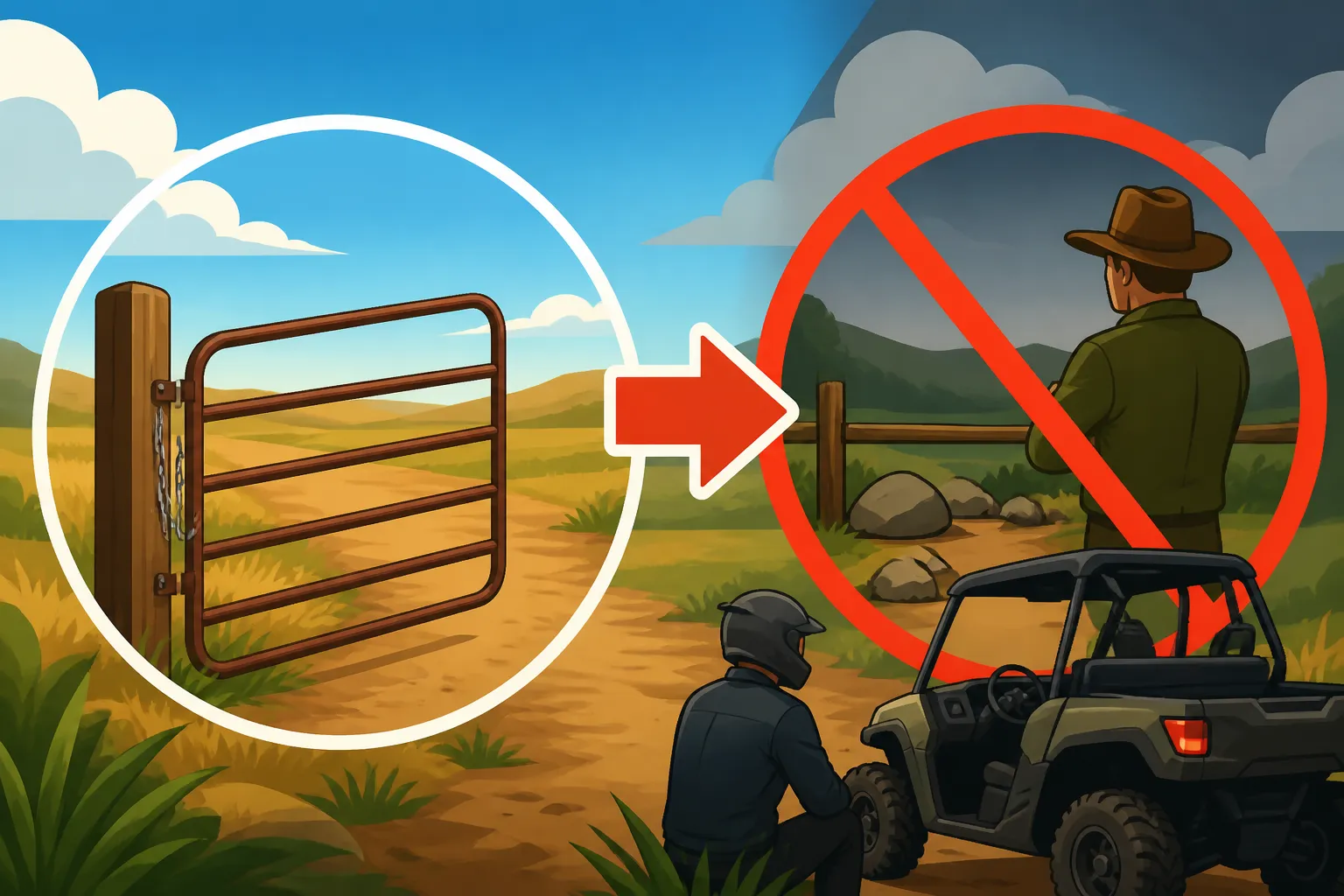
This rule is straightforward and should be etched into every rider's mind: If you open a gate, close it securely behind you. If a gate was closed when you arrived, leave it closed. If a gate was found open, leave it open.
There are rare exceptions, such as if a landowner explicitly tells you to leave a specific gate open. But without that direct instruction, the default should always be to return the gate to its original state, ensuring it is properly latched and secured. Don't assume a gate is open for your convenience; it's likely open for a specific ranching purpose. Double-check latches, chains, or wire closures to make sure they're secure enough to hold livestock. A gate that looks closed but isn't latched is just as bad as one left wide open.
Communicating and Confirming Access Rules
The best way to avoid misunderstandings is through clear and open communication with the landowner before you even hit the dirt.
- Ask Specific Questions: When obtaining permission, don't just ask if you can ride. Ask about specific routes, areas that are off-limits, and, crucially, the protocol for gates. "Are there any gates I should be aware of? Should I close all gates behind me?" are excellent questions to ask.
- Carry Permission: If possible, carry a written note or contact information for the landowner. This can be invaluable if you encounter someone else on the property or if there's a question about your presence. The guidance in [Written Permission From a South Dakota Ranch Owner] can help here.
- Confirm Boundaries: Review a map with the landowner to clearly understand where you are permitted to ride and where the boundaries of their property lie. This helps prevent accidental trespass into unauthorized areas.
Being a Good Steward of the Land
Being a responsible rider extends beyond just gates. It's about being a good steward of the land you're privileged to ride on.
- Leave No Trace: Pack out everything you pack in. Don't leave trash, broken parts, or anything else behind. The goal is to leave the land looking as good, or better, than you found it.
- Stay on Designated Paths: Stick to established trails or routes the landowner has approved. Going off-trail can damage fragile ecosystems, disturb wildlife, or destroy crops.
- Respect Wildlife: Give wildlife a wide berth. Don't chase or harass animals. Remember, you're a visitor in their habitat.
- Be Prepared: Ensure your machine is in good working order and you have the necessary gear for your ride. Breaking down in a remote area can cause issues for the landowner if they have to assist in recovery. Equipping your machine with durable SuperATV accessories like winches or heavy-duty bumpers can also demonstrate a commitment to being prepared and responsible, especially when navigating remote ranch roads where a breakdown could cause issues for landowners. These types of accessories are designed to handle tough conditions and help prevent you from getting stuck or damaging your machine, which in turn means less potential disruption for the property owner.
Navigating South Dakota's Unique Landscape
South Dakota's landscape presents a particular challenge and responsibility for ATV and UTV riders, especially regarding the intersection of private and public lands. Understanding this unique context is key to responsible access.
The Interplay of Public and Private Land
Unlike some states with vast, unbroken tracts of public land, much of South Dakota outside of the Black Hills National Forest is a mosaic of public and private ownership. What looks like an open prairie for miles could be dozens of privately owned ranches, interspersed with smaller parcels of state or federal land. This means that a trail that starts on public property might quickly cross into private ground.
- Unmarked Boundaries: Often, the boundaries between public and private land are not clearly marked, especially in remote areas. This makes landowner permission even more critical, as it's easy to accidentally stray onto private property without realizing it. Many rural roads, including those referred to as [Riding a Prairie Two-Track], often pass through or alongside private land, emphasizing the need for heightened awareness.
- Section Lines: South Dakota has a historical grid of section lines, many of which are undeveloped. While some of these might be considered public access points, it's a complex issue, and assuming access without local knowledge or explicit permission is risky, as they almost always abut private property.
- Check Maps and Ask: Always consult detailed maps (like MVUMs for Forest Service land) and, most importantly, ask local residents or landowners if you're unsure about land ownership or access rules. A brief chat can save you a lot of trouble.
The Ranching Culture and Community Impact
Ranching isn't just an industry in South Dakota; it's a way of life and a cornerstone of the state's culture and economy. Respect for landowners and their operations is deeply ingrained in the fabric of rural communities.
- Community Reputation: The actions of a few riders can quickly shape the reputation of the entire ATV/UTV community within these tight-knit rural areas. If a few riders are irresponsible, word travels fast, and all riders—even those who are highly respectful—can find themselves unwelcome. This collective consequence is why individual responsibility is so crucial.
- Local Resources: Many South Dakota communities rely on tourism, including off-road recreation. Local businesses, outfitters, and guides often have established relationships with landowners and understand the local etiquette. Consulting them can provide valuable insights and ensure you're riding respectfully. Furthermore, maintaining a good relationship with the local community is critical. If you're out on the trails and need to make a repair, having reliable components can mean the difference between a quick fix and a lengthy recovery. Using high-quality parts, such as those offered by SuperATV, not only enhances your riding experience but also reduces the likelihood of breakdowns that could burden local resources or landowners.
- Long-Term Relationships: Building and maintaining positive relationships with landowners is an investment in future access. By being consistently respectful and responsible, riders can help foster a climate of cooperation that benefits everyone. Just as ranchers care for their land, riders must care for their relationships with the people who own it. Following rules for road use and being mindful of other traffic can help build a positive image for the entire riding community, as outlined in [South Dakota Rules for Riding a Ranch Road]. If you ever have an encounter with law enforcement, knowing what to expect, as noted in [What a South Dakota Trooper Checks Roadside], is also part of being a prepared and respectful rider.
Leaving a ranch gate open in South Dakota is never a minor oversight. It's a direct breach of trust that can have immediate and severe consequences for the landowner's livelihood and long-term implications for the entire off-road riding community. By understanding the importance of private property rights, respecting ranching operations, and adhering to simple rules like "close the gate," you can help ensure that South Dakota's breathtaking landscapes remain accessible for generations of responsible riders to come. Your actions on the trail have a ripple effect, and choosing responsibility is choosing to preserve access for everyone.
Disclaimer
This article is for general informational purposes only and does not constitute professional advice. Laws, prices and regulations vary by location and change over time. Consult a qualified professional for guidance on your specific situation.