Crossing Cattle Guards on a Ranch Road
Ranch roads in South Dakota, particularly those crisscrossing vast private lands, often present a unique feature: the cattle guard. For ATV and UTV riders, encountering these can sometimes be a moment of hesitation. How do you cross them safely? Are there specific rules? This guide is here to unravel the mysteries of cattle guards on South Dakota ranch roads, providing you with the knowledge to navigate them confidently, respectfully, and without a hitch on your off-road machine.
Understanding Cattle Guards and Ranch Roads in South Dakota
Before we even talk about crossing, let's get a clear picture of what we're dealing with. South Dakota is a state known for its sprawling ranches and agricultural landscapes, and where there are open ranges, there are often ingenious solutions to keep livestock contained without the constant hassle of opening and closing gates.
What Exactly is a Cattle Guard?
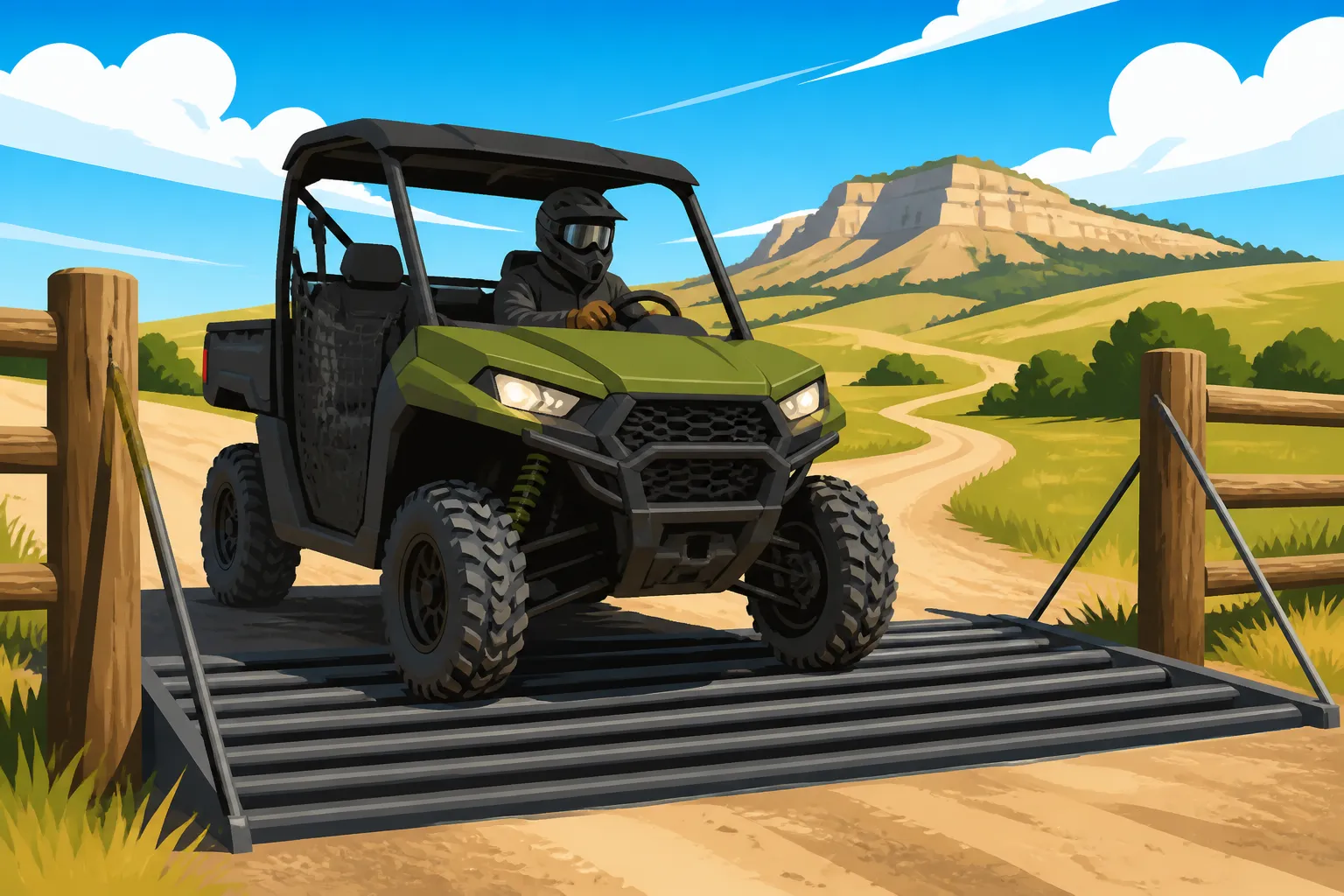
A cattle guard, sometimes called a stock gap, is essentially a type of road barrier that prevents cattle or other livestock from crossing while allowing vehicles to pass over freely. Imagine a series of parallel bars, pipes, or concrete beams set into the ground across a roadway, with open spaces in between. The design is simple yet effective: animals are instinctively wary of stepping on the uneven, unstable-looking surface, fearing they might get a hoof caught or slip. This natural aversion keeps them on their designated side of the fence line.
These guards are a staple on ranch roads because they eliminate the need for a physical gate that vehicles would constantly have to stop, open, drive through, and close. For busy ranch operations, this saves an immense amount of time and effort. You'll find various types, from the classic steel pipe designs to more robust pre-cast concrete units. Regardless of the material, their fundamental purpose remains the same: a passive barrier against hoofed animals.
The Nature of South Dakota Ranch Roads
South Dakota's ranch roads are as diverse as its landscape. Many are private thoroughfares, owned and maintained by the ranchers themselves. Some might be well-graded gravel, others nothing more than a faint two-track winding through pastureland. In certain areas, public access easements might crisscross private land, allowing passage but still requiring a high degree of respect for the underlying property.
The crucial takeaway here is that you are often on private property when riding these roads. This isn't like a designated public trail in a national forest. Landowner permission isn't just a suggestion; it's an absolute necessity. Without it, you are trespassing, and that can lead to serious consequences, not to mention a damaged reputation for all off-road riders. Understanding the condition of these roads is also key – they can be rough, muddy, sandy, or heavily rutted, especially after rain or during certain times of the year. This demands your full attention and a machine capable of handling varied terrain, perhaps even benefiting from aftermarket parts like those from SuperATV that enhance durability or ground clearance. Remember to always seek and obtain [Written Permission From a South Dakota Ranch Owner] before venturing onto any private ranch land.
Safe and Responsible Crossing of Cattle Guards on Your ATV/UTV
Now that we know what a cattle guard is and where you'll find them, let's talk about the actual act of crossing one safely on your ATV or UTV. This isn't a complex maneuver, but it requires a careful, deliberate approach to avoid damage to your machine or, worse, injury to yourself.
Pre-Crossing Assessment and Approach
Your first step when you see a cattle guard ahead is to significantly reduce your speed. Treat it like a stop sign, or at least a yield sign. This isn't the time for speed or showing off. As you slow down, visually inspect the guard. Look for any damage to the bars or supports, loose components, or debris that might have accumulated on or around it. Mud, snow, or ice can make the surface incredibly slippery, turning a routine crossing into a dangerous slide.
Also, consider the width and depth of the guard in relation to your machine. Most ATVs and UTVs are designed to clear standard cattle guards, but it's always wise to assess. Approach the guard straight on, aligning your machine so your tires will pass directly over the bars without excessive angle. Approaching at an angle can cause a tire to drop into a gap, potentially causing damage to the tire, rim, or even control arms.
The Crossing Technique
Once you've assessed the guard and positioned your machine, maintain a slow, steady speed as you roll over it. The key here is consistency – no sudden acceleration, no abrupt braking. Keep your hands firmly on the handlebars or steering wheel, and your feet inside the footwells or on the floorboards. Resist the urge to stand up or lean excessively; maintain a balanced riding posture.
Focus your gaze on the path immediately ahead of your front tires, rather than staring directly down at the bars of the cattle guard. This helps you maintain your direction and react to any unexpected bumps or shifts. For riders who frequently encounter rough ranch roads and need extra confidence in clearance and stability, aftermarket suspension components can be a game-changer. While not strictly for cattle guards, a high-clearance suspension lift or durable A-arms from a brand like SuperATV can give you that extra peace of mind when navigating varied terrain, including the approaches to cattle guards. Your tire pressure can also play a subtle role; ensure it's appropriate for the terrain you're on, providing both traction and a bit of cushion.
Post-Crossing Checks and Continued Awareness
After successfully rolling over the cattle guard, don't just speed off immediately. Take a moment to check your machine for any visible damage. Give your tires a quick scan, and listen for any unusual noises that might indicate a bent rim or a suspension component that took a hit. It's rare for a properly crossed cattle guard to cause damage, but a quick check is always prudent.
Once you're clear, remember where you are: on a ranch. Be aware of your surroundings, especially for livestock that might be on the other side of the guard. Cattle, horses, or sheep could be grazing nearby or even crossing the road further down. Resume your normal riding speed only when you are completely clear of the cattle guard and the immediate vicinity, and you've assessed that the path ahead is safe. Remember, respecting the land and its inhabitants is paramount, especially when riding on private ground. For more on navigating these specific terrains, check out [South Dakota Rules for Riding a Ranch Road].
Legalities and Etiquette for Ranch Road Riding in South Dakota
Riding on ranch roads isn't just about safe machine operation; it's deeply entwined with legal obligations and proper etiquette. Neglecting these can not only get you into trouble but also jeopardize access for all riders in the future.
The Criticality of Landowner Permission
Let's be unequivocally clear: in South Dakota, riding an ATV or UTV on private ranch land without explicit permission from the landowner is trespassing. This isn't a gray area; it's a direct violation of property rights. While some ranch roads may appear open, and some might even have public easements, always assume private land unless you have confirmed otherwise.
The best practice is to obtain written permission. This removes any ambiguity and protects both you and the landowner. A simple conversation can often lead to a handshake agreement, but a written note detailing the scope of access (which roads, which dates, what activities) is ideal. When you do get permission, respect its boundaries. Don't venture off the agreed-upon routes or onto fields that haven't been specified. Remember, earning trust is key to continued access. More detailed guidance can be found in [South Dakota Landowner Permission Rules].
Sharing the Road and Protecting the Land
Once you have permission, your responsibility shifts to being a respectful and considerate user of the land. Ranch roads are working roads, not just recreational trails. You might encounter ranch vehicles, farm equipment, other recreational users, or even livestock being moved. Always yield to ranch operations, especially if they involve working animals or large machinery.
Stay strictly on designated roads or two-tracks. Riding off-route can damage crops, disturb livestock, or harm sensitive ecosystems. [South Dakota Rules for Riding Off a Route] are there for a reason, even on private land. If you encounter a gate near a cattle guard, or if there's a bypass gate, always leave it as you found it. If it was closed, close it behind you. If it was open, leave it open. Forgetting this simple rule can have severe consequences, as highlighted in [Why Leaving a Ranch Gate Open Costs You Access]. It's not just about the gate; it's about respecting the entire operation.
Finally, practice "Leave No Trace" principles. Pack out everything you pack in, and perhaps even pick up any litter you find. Minimize dust by slowing down, especially near homes or working areas. Keep noise levels down. Your actions reflect on the entire ATV/UTV community. Ensuring your machine is well-maintained, perhaps with quality parts from SuperATV, not only enhances your ride but also minimizes potential issues like oil leaks or excessive noise that could impact the environment or disturb landowners.
When to Avoid Crossing
There are times when, despite a cattle guard's presence, you should reconsider crossing. If a cattle guard appears damaged, unstable, or has missing bars, it's a hazard. Trying to cross it could result in serious damage to your machine or an accident. Similarly, if visibility is extremely poor due to heavy fog, driving rain, or deep snow that completely obscures the guard, it's safer to find an alternative.
Sometimes, you might find a bypass gate right next to a cattle guard. If you have permission to use this gate, and if the cattle guard looks particularly treacherous (e.g., covered in a thick layer of ice), using the gate might be the safer option. However, always remember the "leave it as you found it" rule for gates. Your safety and the preservation of access should be your top priorities. If you are ever unsure about crossing, it's always better to err on the side of caution.
Potential Hazards and Troubleshooting
Even with the best preparation and technique, riding ranch roads and crossing cattle guards isn't entirely without potential pitfalls. Knowing what to watch for and how to react can make all the difference.
Common Issues and How to Address Them
One of the most common fears when crossing a cattle guard is getting stuck. This can happen if a tire drops too far into a gap, or if your machine's clearance isn't quite enough for a particularly deep or wide guard. If you find yourself momentarily hung up, resist the urge to violently accelerate. Instead, try a gentle rocking motion. If equipped, a winch can be invaluable in these situations. If you're riding with others, a gentle push might free you. If all else fails, and you're truly stuck, you'll need to call for help – which is why always telling someone your route and expected return time is a golden rule for off-road riding.
Damage to tires, rims, or suspension components, while less common with proper technique, can occur if you hit a guard at an odd angle or if a bar is bent. Inspect immediately. A punctured tire can sometimes be patched roadside if you carry a repair kit, but bent suspension parts will likely require a slow, careful return to civilization or a recovery vehicle. Speaking of parts, knowing where to get quality replacements, such as those offered by SuperATV, can minimize downtime should you need to repair or upgrade after an unexpected encounter with rough terrain.
Slippery conditions, like ice, snow, or thick mud on the guard itself, present a serious hazard. If you encounter these, extreme caution is necessary. If there's a bypass gate you have permission to use, that's often the safest option. Otherwise, proceed at an absolute crawl, maintaining a perfectly straight line, and be prepared for your tires to lose traction. In some cases, it might even be safer to dismount and walk the machine over if conditions are truly treacherous.
Preparing Your Machine for Ranch Riding
To minimize these potential issues, proper machine preparation is key. Regular maintenance on your ATV or UTV is non-negotiable. Check your tires for proper inflation and wear – off-road treads are crucial for the varied surfaces you'll encounter. Ensure your brakes are in excellent working order, as controlled stops are vital. Inspect your suspension for any worn components that could compromise stability.
Carrying a basic tool kit (wrenches, tire repair kit, zip ties, duct tape), a small first-aid kit, and perhaps even a recovery strap or small winch can be invaluable. Even if you're riding with friends, being self-sufficient in case of a minor breakdown or getting stuck is always a good idea. Knowing your machine's capabilities and limitations will help you avoid situations where a cattle guard, or any other ranch road obstacle, turns into a major problem.
| Practice | Safe Cattle Guard Crossing | Unsafe Cattle Guard Crossing |
|---|---|---|
| Approach Speed | Slow and controlled, almost to a crawl. | Fast, aggressive, or without reducing speed. |
| Visual Check | Inspect for damage, debris, mud, ice, or snow on the guard. | No visual inspection; assuming the guard is clear and safe. |
| Alignment | Approach straight on, ensuring tires are aligned to pass over the bars. | Approaching at a sharp angle, risking tires slipping into gaps or catching on bars. |
| Crossing Speed | Maintain a slow, steady, consistent pace over the guard. | Sudden acceleration, abrupt braking, or attempting to "jump" the guard. |
| Body Position | Hands firmly on controls, feet inside the machine, balanced posture. | Standing up, leaning excessively, or having limbs outside the machine. |
| Focus | Looking ahead to the path beyond the guard, not directly down at the bars. | Staring at the bars, causing target fixation and potential loss of direction. |
| Post-Crossing | Check machine for damage, remain aware of livestock, resume speed when clear. | Speeding off immediately without checking or being aware of surroundings. |
| Environmental | Exercise extreme caution in slippery conditions (ice, mud, snow); use bypass if available and permitted. | Attempting to cross slippery guards without extra caution, increasing risk of losing traction. |
| Landowner Respect | Always have permission, stay on designated routes, leave gates as found. | Riding without permission, going off-route, leaving gates open. |
Disclaimer
This article is for general informational purposes only and does not constitute professional advice. Laws, prices and regulations vary by location and change over time. Consult a qualified professional for guidance on your specific situation.