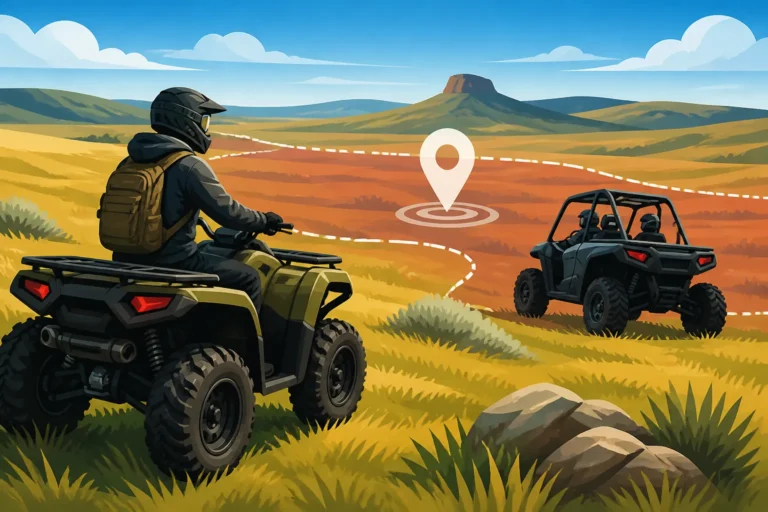
Trails Open May 15 to December 15
South Dakota’s May 15 to December 15 riding season can be confusing: some Black Hills motorized trails open in mid-May, others stay closed until later, and weather or land-management closures can change a planned route. This guide explains how to read the seasonal dates, check access before you haul your ATV or UTV, and plan a ride that fits the trail’s actual opening window.
What the May 15 to December 15 season means
The dates are a riding window, not an all-trails guarantee
The May 15 to December 15 season is a useful starting point for planning rides on seasonal motorized trails in the Black Hills. It does not mean every trail is open on May 15, that every route stays open until December 15, or that all South Dakota riding areas use the same schedule. A trail’s access can depend on its designation, local management rules, weather, and temporary closures.
That distinction matters when you have already booked a cabin, arranged time off, or loaded a machine onto a trailer. A route that appears open on a general map may be in a later-opening group, temporarily closed, or restricted to machines within a particular width limit. Treat the seasonal window as a planning framework, then confirm the specific route before setting out.
For broader context on how the season is divided, see [South Dakota's May to December Trail Season]. The related guide [Trails Open August 15 to December 15] is especially useful if a route you hoped to ride is not included in the earlier opening period.
Why the opening and closing dates matter
Seasonal dates help manage access during parts of the year when trails may be vulnerable to damage or when conditions make riding unsafe. In the Black Hills, spring can bring lingering snow, thawing ground, and muddy sections even after a calendar date says a trail may be open. A machine can leave deep ruts in soft soil, and a wet stretch can turn an easy ride into a recovery problem.
The closing date deserves just as much attention as the opening date. A ride that begins comfortably before the end of the season may still be a poor plan if you expect to finish near dusk, travel a long loop, or cross between trail systems. Leave room for a slow section, a wrong turn, a mechanical issue, or an unexpected closure rather than planning around the final possible riding day.
Think of the published season as one part of your decision, not permission to ignore conditions. If the ground is saturated, snow is accumulating, or a closure notice applies, postponing the ride is usually safer than trying to squeeze in one last trip.
How to confirm a trail is open
Start with the official map and route information
Before choosing a route, identify the specific trail or road you intend to ride and check the relevant official travel map or motor vehicle use map. These maps help distinguish routes open to motorized use from routes that are closed, limited, or designated for a different kind of recreation. Read the map key and notes carefully; a colored line by itself does not tell the whole story.
A map downloaded earlier in the season may not reflect a temporary closure or a changed access condition. Check for current notices from the land manager as close to your trip as practical, especially after major storms, heavy rain, wildfire activity, or early snowfall. Keep a map available offline as well, because phone coverage can be unreliable in parts of the Hills.
For help understanding the map types and their role in trip planning, see [South Dakota Trail Maps and MVUMs]. You can also review [South Dakota Trail Closures to Check] before loading up. Apps such as onX Offroad can be useful as a supplementary way to explore routes and organize a ride, but they should not replace current official maps and closure notices.
Check each route segment, not just the trailhead
A common planning mistake is to confirm that a trailhead is accessible and assume every route connected to it is open. A loop can include multiple trail segments, roads, or junctions with different dates, designations, or restrictions. If even one connecting segment is closed, the route you planned may not work as a loop.
Trace your intended route junction by junction. Check the opening period for each segment, whether the route allows your machine’s width, and whether you need to turn back rather than continue onto a restricted route. This is particularly important for wider side-by-sides: the trail system may include routes with different width limits, so “the area is open” does not necessarily mean your machine can travel everywhere in it.
A simple way to avoid a last-minute scramble is to mark a primary route and a shorter backup before leaving home. Compare both with the relevant official information, then check for notices again before you depart. Keep the trip flexible enough that a closed segment changes your plan—not your safety margin.
| Planning detail | What to confirm | Why it matters |
|---|---|---|
| Seasonal dates | Whether the specific route is in the May 15 opening group or a later group | The wider season does not apply uniformly to every trail |
| Route designation | Whether motorized use is allowed on that segment | A visible route is not automatically open to ATVs or UTVs |
| Machine width | Any width restriction for the trail | A legal route for one machine may not fit a wider side-by-side |
| Temporary closures | Current notices, including weather or fire-related closures | Conditions and management needs can change access |
| Permit and equipment | Required riding permit and machine requirements | Open access does not remove other riding obligations |
| Backup plan | An alternate open route or a shorter ride | A closure is easier to handle when you have options |
Plan around spring and late-season conditions
Spring riding can be muddy even after a trail opens
The first weeks of the season can be appealing: there may be fewer riders, the air is cool, and the Black Hills are waking up after winter. But an opening date does not promise dry, firm ground. Snowmelt, shaded north-facing slopes, and recent rain can leave a route soft long after the more exposed areas look ready.
Look for conditions, not just calendar dates. If a trail has standing water, deep mud, or a surface that deforms under tires, choose a different route or delay the ride. Riding through soft ground can widen ruts and damage the trail, and it can also make a machine harder to control. A shallow-looking muddy patch may conceal a rut or slick rock underneath.
Spring plans benefit from a shorter route and a flexible start time. Check the forecast and recent local conditions, carry suitable recovery and communication gear, and avoid committing to a long loop until you know how the ground is holding up. For more on the impact of wet conditions, see [Why Weather Closes a Black Hills Trail] and [South Dakota Riding in Spring].
December riding calls for a conservative plan
The December 15 end of the season can feel distant when autumn days are mild, but high-elevation routes can get winter conditions earlier than nearby towns. Snow, ice, wind, and short daylight hours can change a familiar trail into a much more demanding ride. A forecast for Rapid City or Sturgis may not describe conditions on a shaded route or higher section of the Hills.
Plan to finish well before dark and choose a route that leaves room to turn around. Cold weather can affect battery performance, tire grip, and the comfort of passengers, while snow can hide rocks, ruts, and trail edges. Carry clothing for the conditions you could encounter on the route, not only what feels comfortable at the trailhead.
If an early storm arrives or a closure is posted, do not assume the season’s usual end date overrides it. Check notices before departure and again if conditions are changing. The practical end of a safe riding season can come before the final date on the calendar.
Match the route to your ATV or UTV
Check width limits before choosing a side-by-side route
Trail access is not only about whether a route is open. Some trails have width restrictions, and a wide UTV may be excluded from routes a narrower ATV can use. Measure your machine at its widest point, including the outside edges of the tires, and compare that measurement with the applicable trail designation. Do not rely on the model name or brochure description alone.
This can make a big difference to a group ride. If one person brings a wider machine, the group may need a route that accommodates every vehicle, rather than splitting up at a junction or discovering the restriction after the ride has started. Confirm width limits for the complete route, including connectors and any alternate segments you might use.
Review [South Dakota Trail Width Limits] when planning around machine size. If you use a digital app such as onX Offroad to scout a route, treat it as a planning aid and verify restrictions against official information before riding.
Choose distance and difficulty with conditions in mind
A route that looks short on a map can take longer than expected when it includes rocky sections, steep climbs, mud, or frequent stops. Add time for navigation, breaks, and changing conditions. If you are riding with children, newer riders, or passengers, a shorter route with simple turnaround options can be a better day than a long loop chosen only for its mileage.
The machine matters, too. A stock ATV or UTV may handle a route differently from a modified machine with different tires, clearance, or recovery equipment. Be honest about the experience and capability of everyone in the group, and avoid treating a difficult trail as a test of who can push through. Turning around is a sound decision when the route becomes more demanding than expected.
A useful plan includes a primary route, a shorter fallback, and a clear point where the group will reassess. Tell someone where you intend to ride and when you expect to return. Carry water, basic repair supplies, and a way to navigate if cell service drops, rather than assuming a phone will solve every problem.
Prepare for permits, maps, and unexpected closures
Sort out permits and riding rules before departure
Trail access may require a permit, and the rules can depend on where you ride and what kind of machine you bring. Do not assume that a vehicle plate, a permit for another location, or a rental agreement automatically covers every trail. Confirm what applies to your planned riding area and make sure the decal or other proof is handled as required.
If you are visiting from out of state, check whether your machine’s registration and permit status meet South Dakota requirements. The guide [South Dakota's Motorized Trail Permit] explains the permit topic in more detail, while [South Dakota Rules for Visiting Riders] can help you identify questions to resolve before traveling. Verify the applicable requirements for your specific route rather than relying on a friend’s experience from a different area.
Build permit checks into your trip checklist, alongside helmets, protective gear, fuel, and machine inspection. That way, you are not trying to resolve paperwork at the trailhead after driving several hours. Rental riders should also ask the outfitter which permits, maps, and equipment are included and what remains their responsibility.
Keep a backup plan when conditions change
Even careful planning cannot eliminate every surprise. A closure might appear after rain, a trail may be blocked, or a snowstorm may make travel unsafe. Save the contact details or notices relevant to the riding area, keep your map accessible offline, and agree in advance on what the group will do if the route is not passable.
A backup does not have to mean another long ride. It could be a shorter open route, a return to the staging area, or a decision to spend the day somewhere else. If the only alternative involves riding on a closed route or continuing into unsafe conditions, the sensible choice is to stop. The ride is not worth risking injury, damaging the trail, or creating a difficult recovery situation.
Before leaving, share your route and expected return time with someone who is not riding with you. If your plan changes, update them when possible. That small step can matter if a machine breaks down, the group gets delayed, or weather forces you to take a different way back.
Disclaimer
This article is for general informational purposes only and does not constitute professional advice. Laws, prices and regulations vary by location and change over time. Consult a qualified professional for guidance on your specific situation.