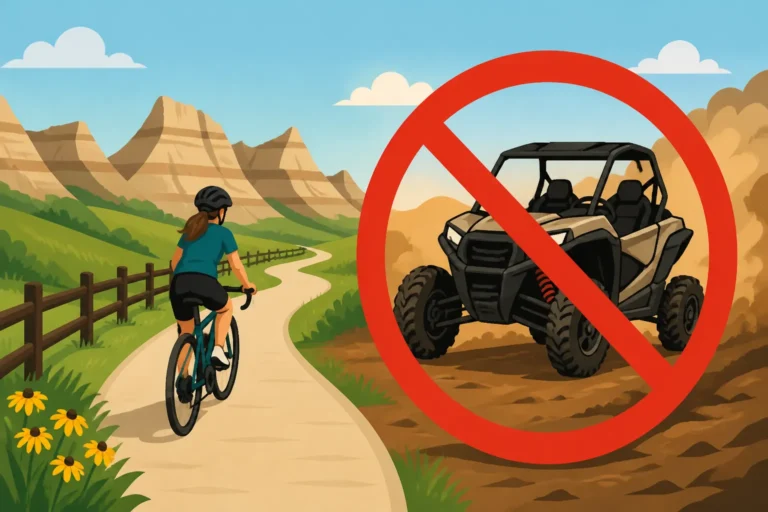
South Dakota Riding in Spring
Spring riding in South Dakota can be a little misleading: a sunny day in Rapid City or Hill City does not mean the Black Hills’ motorized trails are open, dry, or ready for traffic. Seasonal dates, muddy ground, lingering snow, and changing closures all affect the plan. This guide explains how to check access, choose a spring ride, and prepare for conditions before you unload your ATV or UTV.
Understand when South Dakota trails open in spring
Early spring is not the same as riding season
In the Black Hills, spring arrives gradually. Town streets may be clear while shaded forest roads still hold snow, and a trail that looks dry at the entrance can turn muddy or soft farther along. Even when the weather feels comfortable, motorized routes may remain closed until their seasonal opening date.
Many Black Hills motorized trails have a season that runs from May 15 through December 15, while some routes open later in the summer. Those dates are a useful planning guide, not permission to ride every route on the calendar’s opening day. Local closures, weather, maintenance, and posted signs still matter. For an overview of the seasonal dates, see Trails Open May 15 to December 15 and Trails Open August 15 to December 15.
A practical example: you are visiting from Sioux Falls over a warm April weekend and see clear roads near Hill City. That does not mean a nearby forest trail is open. Before loading your machine, check the current route status and the date restrictions for the exact riding area you have in mind. If access is not clear, wait for confirmation rather than treating a passable-looking entrance as an invitation.
Why spring closures protect the trail
Spring thaw can leave soil saturated beneath a surface that looks firm. Tires press into soft ground, carve ruts, and push water into new channels. Those tracks can remain after the trail dries, making the route rougher for later riders and increasing the work needed to repair it.
This is especially important on steep or narrow routes. A UTV may be able to power through a muddy section, but that does not mean it can do so without damage. Spinning tires can widen ruts, displace gravel, and leave a route harder for other users to navigate. Turning around at a muddy spot is often the responsible choice, even when it means shortening the day.
Spring closures can also be tied to more than trail surface conditions. Crews may need time for maintenance, and access can be affected by snow, fire danger, construction, or other local issues. Check South Dakota Trail Closures to Check before departing, and check again on the day of your ride. A route’s usual opening pattern cannot override a current closure notice.
Choose a riding area that fits your spring plans
Plan around the Black Hills season
The Black Hills are a popular base for ATV and UTV trips, but the riding network is not one uninterrupted system. Routes differ in width, seasonal access, difficulty, and the type of vehicle they allow. A machine that fits one trail may be too wide for another, so planning by destination alone is not enough.
Start with the specific riding area and route, not just the nearest town. If you are staying in Rapid City, for example, the Black Hills may look close on a map, but the drive to a suitable trailhead and the route’s opening status still need to be considered. [South Dakota ATV Trails Near Rapid City] can help you explore the area, while [South Dakota ATV Trails Near Hill City] is a useful related topic if your plans center farther west.
Spring is also a good time to keep the itinerary flexible. Instead of committing to one long loop, identify a primary route and a backup option that is open and appropriate for your machine. If the first choice is closed, wet, or unexpectedly snowy, you can shift to the backup without riding around looking for an entrance that might be accessible.
Compare options before you load the machine
A short, accessible outing can be a better spring choice than a full-day route through higher or more shaded terrain. When comparing possible rides, think about trail status, surface conditions, distance from your lodging, machine width, and where you can safely turn around. A route that sounds ideal in summer may be a poor match for a thawing week in spring.
| Planning question | Why it matters in spring | What to do |
|---|---|---|
| Is the route officially open? | Seasonal dates and temporary closures can prevent access. | Check the current notice for the exact route or area. |
| Has the ground dried out? | Wet soil can rut easily and make travel unpredictable. | Look for recent conditions and be prepared to turn back. |
| Does the route fit your machine? | Width limits can rule out some UTVs and wider ATVs. | Measure your machine and confirm the route’s limits. |
| Is there a lower-risk backup? | Weather and closures can change your plan. | Choose another open route before leaving your lodging. |
| Can you reach the trailhead safely? | Snow, mud, or poor road conditions may affect access roads. | Check the approach as well as the riding route. |
Do not treat the table as a substitute for local route information. It is a planning checklist: the final decision should be based on the rules and conditions for the particular area you intend to ride.
When mapping your day, onX Offroad can be useful for keeping routes and waypoints organized. Use it as a planning aid rather than as the final authority on whether a route is open or legal. Compare what you see in the app with current official maps, posted signs, and closure notices.
Check maps, permits, and route rules
Use official maps alongside digital tools
A map can help you understand where routes connect, but it may not show every temporary closure or seasonal restriction. For Black Hills riding, consult the relevant Forest Service Motor Vehicle Use Map, often called an MVUM, and confirm that the route is open to your vehicle. The map’s designations and any current notices are more important than a line that simply appears on a phone screen.
Digital mapping tools can still make the day easier. You can save a route, mark a trailhead, note a fuel stop, and keep a backup route ready. onX Offroad can help organize those details, especially when you are comparing a few possible areas. Before you leave, download or save what you need for offline use if your route may pass through places with limited service.
Keep track of map dates and route information. A saved track from a previous summer may not reflect this spring’s opening status, and a route someone shared online may cross a closed segment or a route with a different vehicle restriction. For more on planning with maps, see South Dakota Trail Maps and MVUMs. Once you reach the trailhead, posted signs and barricades take precedence over an old saved route.
Confirm which permit applies
Permit questions can feel confusing because a visitor may encounter different rules for different lands and uses. A South Dakota permit, a Forest Service trail permit, a vehicle plate, and an access rule for a particular riding area are not necessarily interchangeable. The right requirement depends on where you ride, what kind of machine you are using, and how that location manages access.
Before the trip, identify the land manager for the area and check its instructions. If you will ride designated motorized trails in the Black Hills, verify the applicable trail permit requirements and how the permit must be displayed. Do not assume that a permit for one riding area covers another, or that a permit replaces the need to follow seasonal closures and route restrictions.
It is also worth sorting out permits before reaching the trailhead, rather than hoping to resolve the details in a parking area with weak cell service. Save confirmation or application information where you can find it, and make sure each machine in your group meets the applicable requirement. If your trip includes more than one kind of public land, confirm the rules for each location separately.
Prepare for mud, cold, and changing weather
Expect conditions to vary across one ride
Spring weather in the Black Hills can change quickly, and conditions may differ between exposed roads, shaded timber, and higher elevations. A morning can start cold, warm up in the afternoon, and still leave the trail damp where sunlight has not reached the ground. Recent rain or snowmelt can make an otherwise familiar route feel very different from a dry-season ride.
Plan clothing in layers, and bring waterproof outerwear even if the forecast looks promising. Pack gloves, eye protection, water, food, and a warm layer that will still be useful if you are delayed. For a UTV, secure loose items so they do not shift over rough terrain. For an ATV, make sure your gear is accessible without requiring you to unload half the machine at the trailhead.
Build extra time into the day. Muddy sections, cautious travel, and short daylight hours can make a route take longer than expected. If your plan depends on finishing a long loop before a specific closing time or before dark, pick a shorter option instead. A relaxed ride with time to turn around is safer than trying to make up time on unfamiliar ground.
Turn back when the trail is too soft
There is no shame in deciding that a route is not ready. If tires are sinking, the trail is developing deep ruts, or water is collecting in the track, stop and assess rather than trying repeated passes. Spinning through the same spot usually makes the damage worse and can leave your machine stuck in a more difficult position.
A simple spring rule helps: if you are unsure whether the ground can handle the machine, do not use the machine to find out. Turn around at a safe, legal location and choose another activity or route. Avoid creating a new path around a muddy section; riding off the designated route can damage vegetation and may violate area rules.
If you do get stuck, avoid escalating the problem by applying heavy throttle. Clear the area of bystanders, use recovery equipment only if you know how to do so safely, and avoid standing near a tensioned strap or cable. On a group ride, agree in advance that anyone can call for a turnaround without pressure to continue. That small conversation can prevent a minor muddy spot from becoming a costly recovery.
Make a safer and more enjoyable spring ride
Set expectations for the group
A group’s pace is only as good as its least experienced rider, its slowest machine, and the trail conditions. Before leaving the staging area, confirm the route, planned stops, communication method, and turnaround point. Make sure everyone knows that a closed sign, an unsafe crossing, or deteriorating ground means the group changes plans.
Spring is a good season to keep the ride modest. A shorter outing gives everyone time to adjust to changing surfaces and reduces the chance of being caught far from the trailhead when conditions worsen. If children or new riders are coming along, choose a route that matches their comfort and skill rather than making the trip about covering distance.
Carry basic items that can solve small problems: a first-aid kit, tire repair supplies suited to your machine, a charged phone, water, and a way to share your planned route with someone who is not riding. In remote areas, do not count on uninterrupted cell coverage. Tell someone where you expect to ride and when you expect to return.
Respect other users and local access
Spring brings more than ATV and UTV riders to the Black Hills. Hikers, bicyclists, horseback riders, wildlife, and road traffic may all be present, depending on the area. Slow down when visibility is limited, approach other users carefully, and leave room for them to pass. Dust may be less of a concern on a wet day, but mud and spray can still affect other trail users.
Stay on routes open to your machine and do not bypass gates, barricades, or closure signs. A route that looks like an easy detour may cross private property, a closed segment, or land with different rules. If an area is crowded or the surface is deteriorating, choosing another route is often the best way to protect both the trail and your trip.
Finally, leave the staging area and trail as you found them. Pack out trash, avoid blocking access roads, and secure your trailer so other visitors can use the parking area. Good spring etiquette helps keep routes in better condition and makes it easier for everyone to share the riding season.
Build a flexible spring itinerary
For a spring trip, plan the day in layers: a main route, a nearby alternative, and a no-ride option if conditions or closures make both unsuitable. That does not mean expecting the worst. It means avoiding the frustration of arriving at a trailhead only to discover that the route is closed or too soft to ride responsibly.
Use a simple sequence before departure:
- Confirm the seasonal opening date and current closure status for your chosen route.
- Check the official map and vehicle-width rules.
- Confirm permits and access requirements for the land you will use.
- Review the weather and recent precipitation, including conditions at higher elevations.
- Tell someone your plan and set a reasonable turnaround time.
- Recheck signs and conditions at the trailhead before unloading.
If your plans are based around a particular town, look at nearby route options rather than assuming the closest trailhead is the right one. A mapped alternative can save the day, but it still needs to be open and appropriate for your machine. onX Offroad can help keep your planned route and backup options together; check official information before relying on either option.
Spring riding in South Dakota is rewarding when you give the season room to be unpredictable. Check access before you go, ride only routes that are open and suitable, and turn around when the ground is too wet. A little flexibility can protect the trails and save your weekend from becoming a long, muddy recovery.
Disclaimer
This article is for general informational purposes only and does not constitute professional advice. Laws, prices and regulations vary by location and change over time. Consult a qualified professional for guidance on your specific situation.