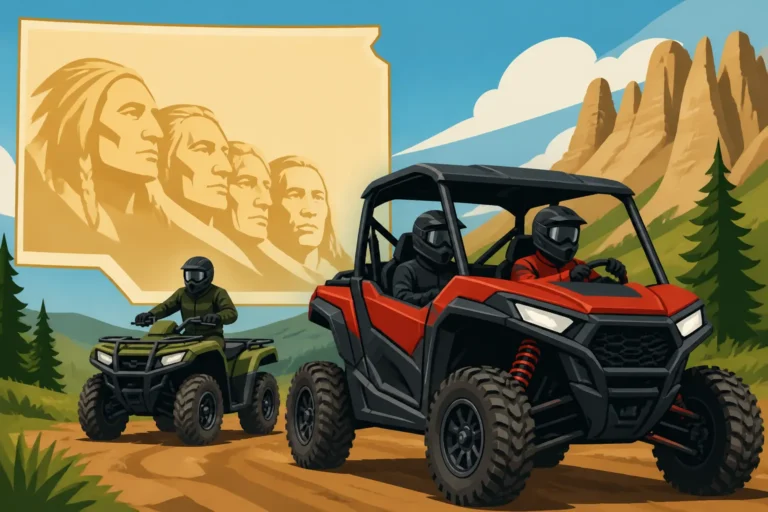
Custer State Park and a Plated Machine
A plated ATV or UTV can make it easier to travel on roads where motor vehicles are allowed, but it does not automatically grant access to every road, trail, or open patch of ground inside Custer State Park. The key is knowing what the plate covers, where park rules apply, and when a separate entrance license or trail permit matters.
What a plate does and does not allow in Custer State Park
A plate is not permission to ride anywhere
A valid plate can establish that a machine meets the registration requirements for the kind of road use it is approved for. It does not, by itself, make an ATV or UTV legal on every route in the park. Road access depends on the road’s status and posted restrictions, as well as the machine’s equipment and the rules that apply within Custer State Park.
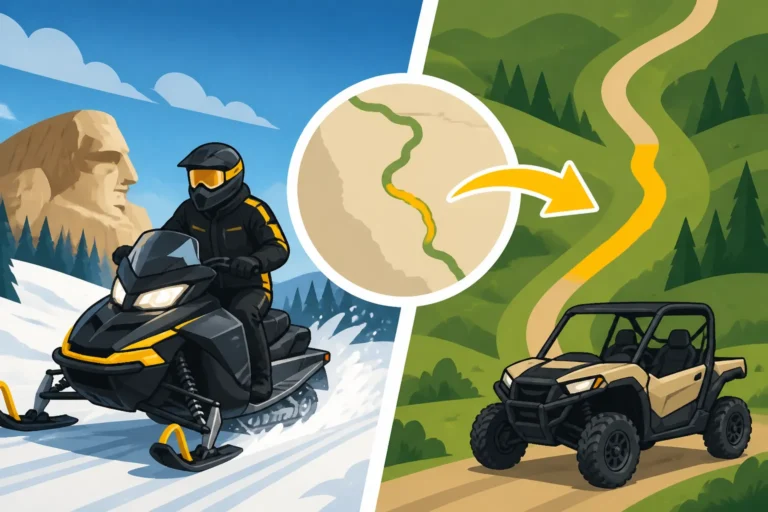
That distinction can be easy to miss when planning a Black Hills ride. A map may show a road, a trail, and a nearby connecting route as if they form one continuous ride. In practice, those segments can fall under different management rules. A public road inside the park is not the same thing as a National Forest motorized trail just outside the boundary, and neither is permission to drive across grass or into a closed area.
A useful starting point is to read [Riding Into Custer State Park With a Plate] alongside the park’s current road and vehicle information. Think of the plate as one part of your eligibility—not as a park-wide pass. Check the route, any signs at the entrance, and any vehicle restrictions that apply to that particular road before setting off.
State park roads are different from off-road areas
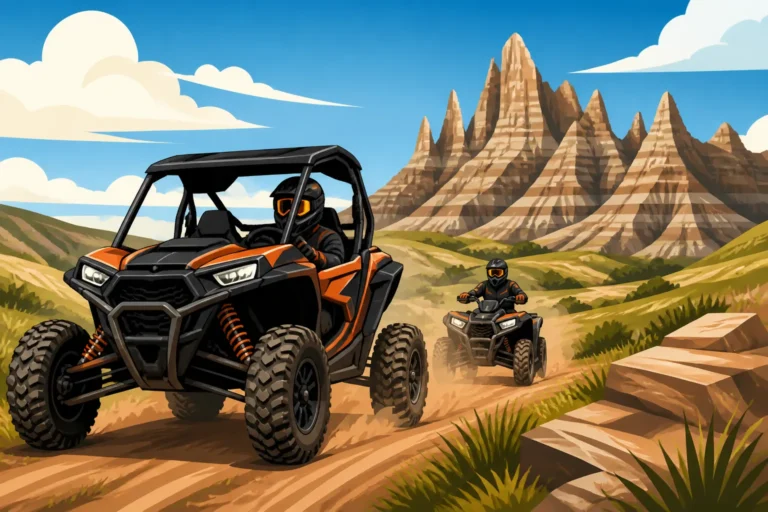
Custer State Park is best known for scenic drives, wildlife viewing, and access to places such as Sylvan Lake and the Needles area. It is not a general-purpose ATV trail network. If you bring a plated machine, plan around roads where motor vehicles are permitted rather than assuming that trails, shoulders, meadows, or pull-offs are open for riding.
The difference matters even when a route looks inviting. A dirt surface does not automatically mean “off-road trail,” and a grassy opening beside a road is not automatically a legal place to drive or park. Follow signs and barriers, remain on authorized routes, and do not cut across vegetation to get around a closure or reach a viewpoint.
For a broader picture of the legal distinctions, see [South Dakota Rules for Riding a State Park Road] and [South Dakota Rules for Riding a State Park]. Those topics help frame the question to ask at each point: Is this a road open to my kind of vehicle, or am I looking at a route where motorized use is not allowed?
A plate does not replace a park entrance license
A common planning mistake is to treat a road-legal plate as if it covers park entry. It does not. Park access and vehicle registration serve different purposes: the plate relates to the machine’s road-use status, while the park’s entrance requirements apply to entering and using the park.
That means a visitor should plan for both questions before the trip: Is the machine legal for the road I intend to ride, and do I have the required park access authorization? The answer to one does not automatically answer the other. For background on how those obligations fit together, read [South Dakota's Park Access Fee and a Plate] and [What Custer State Park Entry Adds to Your Day].
This distinction also helps when a ride begins outside the park. A rider may need to meet one set of requirements on public roads, another for a designated trail system, and a separate park-entry requirement after crossing into Custer State Park. Treat each area as its own jurisdiction rather than assuming that one decal or document covers the whole outing.
| Where you plan to ride | What a plate may help establish | What to check separately |
|---|---|---|
| A public road in or near the park | That the machine is registered for applicable road use | Whether the road is open to that vehicle, required equipment, posted restrictions, and park entry requirements |
| A designated National Forest motorized trail | Road-use status may matter on connecting public roads | Trail access rules, the required permit, trail width limits, and seasonal closures |
| A park trail, meadow, or closed area | A plate does not create access | Whether motorized use is specifically allowed; do not assume it is |
| A road with a sign or vehicle restriction | A plate may not override the restriction | The sign’s meaning, machine dimensions, closure status, and any local direction |
Preparing a plated ATV or UTV for park roads
Confirm the machine is genuinely road legal
Before loading up, confirm that the machine’s registration and plate are valid for the intended use. “It has a plate” can mean different things in casual conversation: a current plate from the rider’s home state, a South Dakota plate, a plate attached to a different vehicle type, or a registration that does not authorize the planned road use.
South Dakota has rules that affect which machines can be plated and what equipment they need for road use. Engine size, vehicle type, lighting, mirrors, and other requirements can matter. If the machine is registered out of state, do not assume that its status automatically settles every South Dakota requirement. Start with [South Dakota Street Legal ATV Requirements] and [What South Dakota Requires to Plate an ATV], then check the rules that apply to your specific machine and registration.
This is especially important for UTVs and modified machines. A windshield, lift, tire change, or added accessories may not be the only consideration; the underlying registration class and required road equipment still matter. If there is any doubt about whether the plate authorizes road use, resolve that before arriving at the park entrance rather than trying to sort it out beside a busy scenic route.
Check dimensions and posted vehicle restrictions
A machine can be road legal and still be unsuitable for a particular road. Custer State Park’s scenic routes include narrow sections and tunnels, so vehicle dimensions can become a practical issue. This is especially relevant for wide side-by-sides, tall machines with roofs or racks, and vehicles carrying cargo that changes their overall height or width.
Do not rely on a rough guess based on how the vehicle looks in the driveway. Measure the machine at its widest and tallest points, including accessories, and compare those measurements with posted restrictions or official route information. If a sign sets a limit or directs certain vehicles to use another route, follow it. A plate does not override a physical clearance restriction.
For a UTV, route planning should include more than asking whether it will fit through a tunnel. Consider passing space, tight turns, parking areas, and the amount of traffic likely on a scenic road. If the route feels uncomfortable or a restriction is unclear, choose another authorized road rather than testing the limit in a crowded spot.
Inspect lights, tires, brakes, and basic safety gear
Road use brings different demands from a slow trail ride. Check that lights work, tires are in good condition, brakes respond properly, and mirrors and other required equipment are present and secure. Pack any protective gear required by law or sensible for the ride, and consider how exposed you will be to wind, dust, sun, and sudden changes in weather.
Do a quick pre-trip check with the machine loaded as you intend to ride it. Loose cargo can shift on a bumpy road or during a sharp turn, while an unsecured helmet or water bottle can become a distraction. Bring water, a charged phone, and a paper or offline route backup; cellular coverage can be inconsistent in parts of the Black Hills.
A plated machine is not necessarily built for every road condition you may encounter. Gravel, washboard, steep grades, and traffic can make a route tiring even if it is legal. Ride at a speed that lets you respond safely, keep a comfortable following distance, and be ready to yield or pull off only where stopping is permitted and safe.
Planning a route through and around the park
Separate the park drive from National Forest riding
Many visitors want to combine Custer State Park with a longer Black Hills ride. That can be a rewarding plan, but it is important to map the change in land manager and rules. Custer State Park is not the same jurisdiction as the Black Hills National Forest, even where the landscapes appear continuous and roads connect nearby recreation areas.
A route that begins on a park road may later reach a National Forest road or a designated motorized trail. Each segment can have its own access rules, seasonal status, vehicle limits, and permit requirements. The park entrance license does not automatically authorize riding on National Forest trails, and a trail permit does not replace park entry requirements. [Why a Plate Does Not Replace a Trail Permit] explains why those permissions should be treated separately.
This is where careful map checking saves a frustrating detour. onX Offroad can help riders visualize route options and understand where mapped roads and trails sit in relation to one another. Still, use it as a planning aid rather than final permission: confirm land boundaries, closures, and current access rules with the relevant land manager before riding.
Use official maps to verify every transition
Online maps can make a route look straightforward, but the boundary between a state park, National Forest, private land, and other public land may not be obvious on the ground. A route line is not proof that a machine is allowed there. Check the official map or notice for the area and look for signs at the actual junctions.
For rides that leave the park, review [South Dakota Trail Maps and MVUMs] and [South Dakota Trail Closures to Check]. Motorized-use maps and closure notices can identify routes that are open only to certain vehicle types or during certain seasons. A route that was open on a past trip may not be open now, particularly after weather damage, maintenance work, or a seasonal closure.
Use more than one source when the route is important to your day. Compare the map with the land manager’s current information, note the exact roads you plan to use, and have a conservative alternate route. onX Offroad may be useful for seeing your position relative to mapped roads, but it should not be the only basis for deciding that a road or trail is open.
Build in time for traffic, wildlife, and stops
Custer State Park is a destination in its own right, not just a shortcut between trail systems. Scenic drives can be busy, and visitors often stop suddenly to watch wildlife or take photographs. Leave enough time to travel calmly, pull over only where it is safe and permitted, and avoid pressure to rush through a narrow section because another vehicle is behind you.
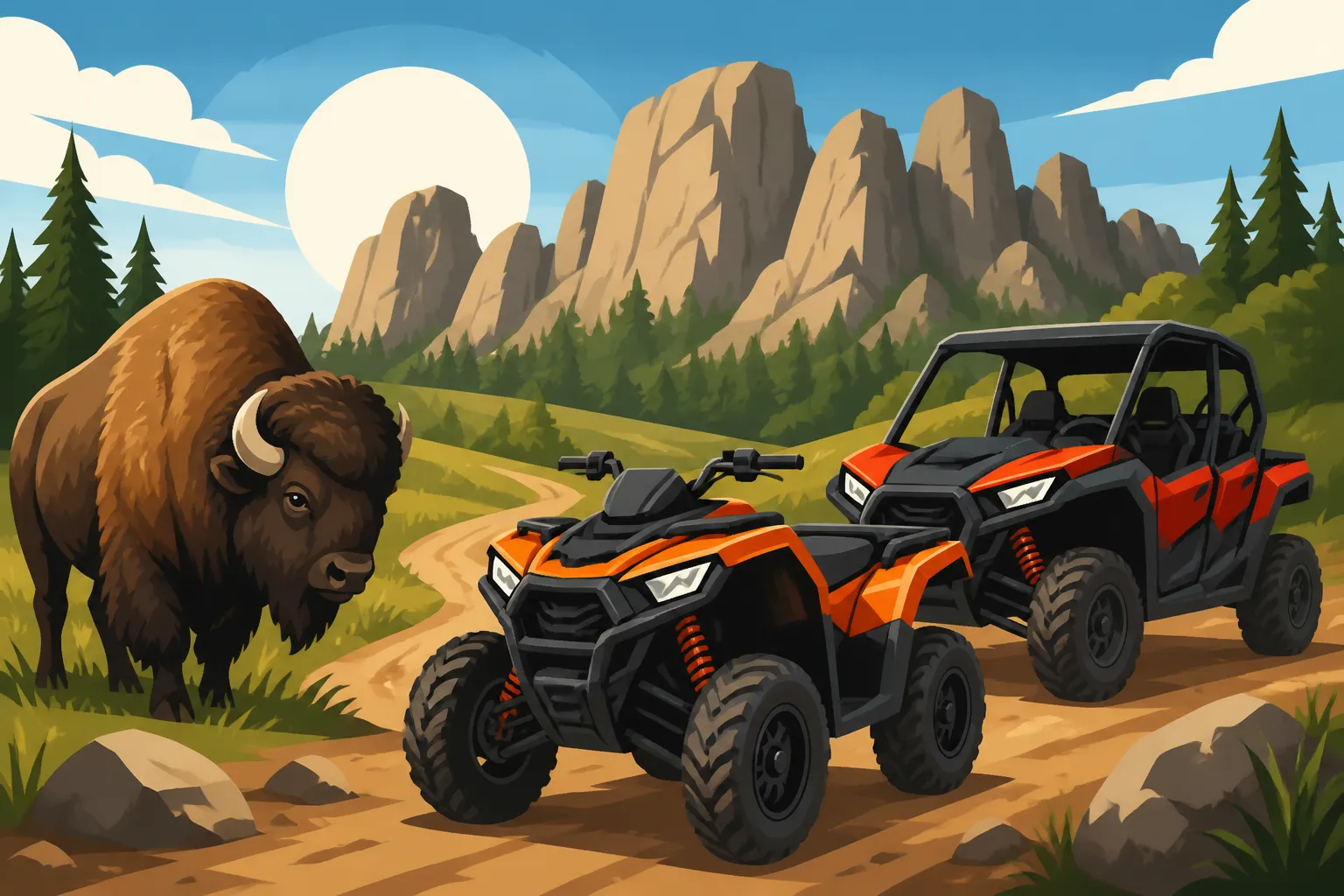
Wildlife encounters are part of the experience, but they can also create unpredictable road conditions. Bison and other animals may be close to the roadway, and traffic can slow or stop with little warning. Keep a safe distance, follow park instructions, and never try to move closer for a better view. A machine that is easy to maneuver on a trail can still be vulnerable in a crowded line of vehicles or near large wildlife.
If your priority is a long, uninterrupted motorized trail ride, consider making the park a separate sightseeing day and planning trail riding elsewhere. That approach reduces the temptation to treat every connecting road as an off-road route and gives you more time to enjoy the park without watching the clock.
Riding responsibly inside Custer State Park
Stay on authorized roads and respect closures
The simplest way to avoid an access problem is to remain on routes that are open to your machine. Do not ride around gates, pass a closure sign, or use an informal track because it appears to connect with a public road. A route can be closed for safety, resource protection, maintenance, or another reason, and the closure applies even if the ground looks firm and passable.
Keep an eye out for temporary directions as well as permanent signs. Conditions can change after storms, during construction, or when wildlife and visitor activity require extra caution. If a sign is unclear, stop somewhere safe and contact park staff rather than guessing. Continuing until you reach a barrier can leave you with a difficult turnaround or a violation.
The same care applies to parking and stopping. Use designated areas and avoid blocking traffic, access points, or emergency routes. If a pull-off is full, continue to a legal stopping place instead of squeezing the machine onto vegetation or leaving it where other drivers cannot see it.
Keep wildlife viewing safe for animals and riders
A quiet ATV or UTV may make wildlife seem closer than it is, but it does not make an approach harmless. Do not follow animals, crowd them, or use the machine to position yourself for a photograph. Give wildlife room to move away and follow posted instructions, especially where animals are near roads or visitor facilities.
Riders should also resist the urge to stop in a lane or make a sudden U-turn when an animal appears. Signal clearly where possible, move to a safe and legal stopping place, and let other road users know what you are doing. A group should agree in advance that the lead rider will pull off safely rather than having each person stop wherever they happen to be.
Keep food, trash, and loose items secured. A wildlife-focused park visit means sharing space responsibly, not just getting a close view. If a situation feels crowded or an animal’s behavior seems agitated, move away calmly and follow park staff directions.
Be considerate of other visitors
A plated ATV or UTV can share a park road with cars, motorcycles, bicycles, and other visitors. Keep noise and speed under control, avoid unnecessary revving, and give people on foot a wide berth in parking and roadside areas. A machine’s compact size does not make it easy for others to anticipate its movement.
When riding in a group, keep the group together without forming a long, tightly packed line that makes passing or turning difficult. Agree on safe stopping points before departure, and avoid stopping on blind curves or near tunnel entrances. If you need to regroup, choose a designated area with enough room for every machine.
The park experience is often slower and more stop-and-go than a dedicated trail ride. Expect that. Patience is part of riding there, particularly during busy periods when scenic stops and wildlife viewing create backups. If that pace does not suit the group, schedule the ride at a quieter time or choose a different area for the motorized portion of the trip.
A practical checklist before you go
Confirm access, paperwork, and route details
Before leaving home, check that the plate and registration belong to the machine you are bringing and cover the intended road use. Review the required equipment for your vehicle type, including lighting and mirrors where applicable, and make sure everything is working. If the registration is from outside South Dakota, verify the rules for visiting riders rather than assuming that home-state registration settles every question.
Then confirm your route from beginning to end. Mark where you enter Custer State Park, which roads you plan to use, and whether the plan crosses into another public-land area. Check park entry requirements, road restrictions, and current closures. If the route includes designated trails outside the park, confirm the separate permit rules that apply there.
Keep essential information accessible rather than buried under luggage. Save the route for offline use, carry a paper backup if practical, and note where you can safely turn around. onX Offroad can help with orientation and route planning, but compare its map view with official information and posted signs.
Pack for a scenic road day, not just a trail ride
A day in Custer State Park can involve more stops, traffic, and exposure than a loop on a dedicated trail. Bring water, weather-appropriate layers, eye protection, and a way to secure small items. Check the forecast and be prepared for conditions to change between lower elevations and exposed areas of the Black Hills.
For a group, set expectations before riding. Decide who leads, who brings a first-aid kit, what to do if someone becomes separated, and where the group will regroup if traffic divides it. Make sure every rider knows that the plan is to stay on authorized roads and that nobody should improvise a shortcut around a closure.
Allow more time than the map suggests. Scenic stops, wildlife traffic, narrow sections, and parking can all slow the day. A relaxed schedule makes it easier to obey restrictions and enjoy the park rather than treating the route as a race to reach the next trailhead.
Know when to choose another riding area
If your machine does not meet applicable road requirements, if its dimensions conflict with a posted restriction, or if your goal is to ride technical off-road trails, Custer State Park may not be the right place for that part of the trip. Choose a suitable riding area where motorized access is expressly allowed, and confirm its trail rules before unloading.
That does not mean a plated ATV or UTV has no place in a Custer visit. It can be useful for traveling on permitted roads and experiencing the park’s scenic routes, provided the machine and rider meet the applicable requirements. The key is to plan for the park as a road-and-sightseeing destination, not assume it offers unrestricted trail riding.
When there is uncertainty, pause and verify before turning onto the route. A few minutes spent checking a map, sign, or park rule is much easier than discovering a restriction after you have committed to a narrow road or crossed into a different management area.
Disclaimer
This article is for general informational purposes only and does not constitute professional advice. Laws, prices and regulations vary by location and change over time. Consult a qualified professional for guidance on your specific situation.