Ice on a North-Facing Forest Road
A shaded forest road can look dry from the trailhead and turn slick around the next bend. In the Black Hills, north-facing slopes may hold ice long after nearby sunny ground has thawed, making an ordinary ATV or UTV ride unexpectedly risky. This guide explains how to spot lingering ice, plan for it, ride cautiously, and decide when turning around is the safer call.
Why north-facing forest roads hold ice
Shade, elevation, and changing temperatures
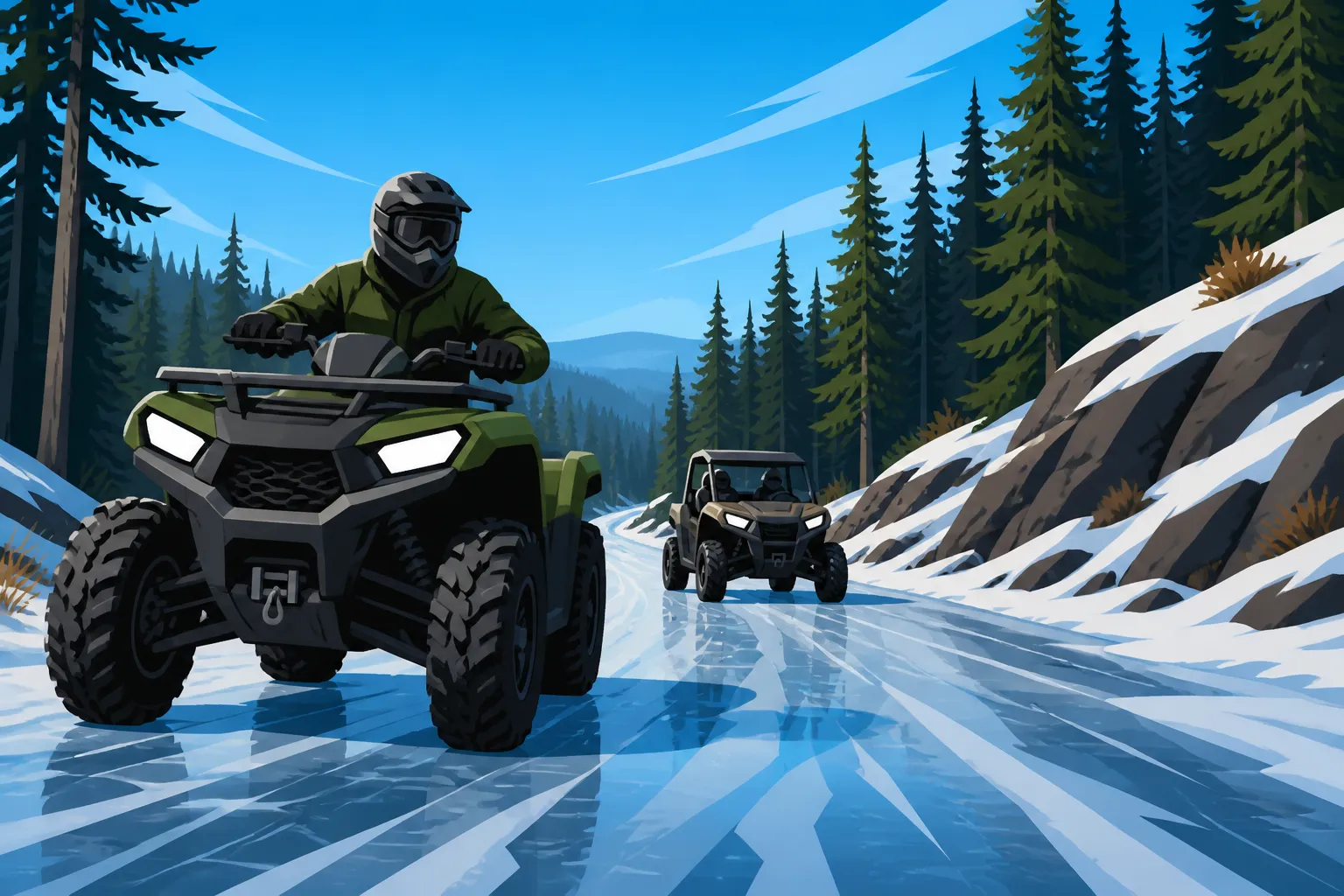
A north-facing slope receives less direct sunlight than a south-facing one, especially when trees or rock walls add more shade. After snow melts on an exposed stretch, a shaded road can remain frozen. The contrast can be deceptive: you may ride across damp gravel, round a bend, and meet a hard, slick patch before you have much room to slow down.
Elevation and local terrain matter, too. Cold air can settle in low spots, while narrow cuts and wooded hollows may stay shaded for much of the day. A road that has thawed near a town or an open staging area may still have ice farther into the hills. Conditions can also change during a single ride as sunshine warms exposed ground and shaded ground stays cold.
The surface itself can be difficult to read. Dark, wet-looking patches may be water, mud, or clear ice over packed snow. Frozen ruts can guide a tire in one direction and then abruptly release it onto a slicker surface. Even a thin layer of meltwater can make ice harder to recognize, so don’t assume a road is safe just because you can see gravel at the edges.
The road can change from one bend to the next
Forest roads are not uniform. A sunny ridge, a shaded cut, and a damp drainage crossing may all be part of the same route. The road can also change where it curves beneath trees or passes between steep banks. A bend limits how far ahead you can see, leaving less time to react if the surface changes suddenly.
Treat visible conditions as a snapshot, not a promise about the rest of your route. A report from another rider may be useful, but their experience could come from a different road, time of day, elevation, or vehicle. Check South Dakota Trail Conditions Before You Ride and South Dakota Trail Closures to Check First before setting out, then be prepared to reassess once you’re on the ground.
How to plan an ATV or UTV ride when ice is possible
Check the route and current access information
Start by confirming that the road or trail you intend to use is open to your machine. A line on a map does not necessarily mean the route is open to motorized travel, and seasonal conditions can affect access. Use official land-management information and maps alongside your preferred navigation app. For Forest Service routes, South Dakota Trail Maps and MVUMs can help you understand designated motorized access and route limits.
onX Offroad can be useful for reviewing a planned route and keeping track of where you are, especially when multiple roads meet in wooded terrain. Use it as a planning aid, not as the final word on closures or current surface conditions. Check applicable Forest Service or other land-manager notices as well, and confirm that you have the right permit for the riding area and route. [South Dakota Rules for Riding Federal Land] offers more background on riding on federal ground.
Before leaving, tell someone where you plan to ride and when you expect to return. Download maps or save the route in advance if you may lose cell service. Choose a turnaround point that makes sense for the group, rather than relying on everyone to decide after the road becomes icy. A shorter route with a clear exit can be a better choice than a long loop with few easy places to turn around.
Match the ride to the group and the machine
Think honestly about who is riding and what their experience is. A confident rider may still struggle to judge traction on unfamiliar ice, while a newer rider can feel pressured to keep up with a group. If your route includes shaded slopes or uncertain conditions, choose a conservative pace and make sure no one is expected to ride beyond their comfort level.
Check the machine before loading it. Tires should be in suitable condition, and steering, brakes, lights, and other basic equipment should work properly. Bring warm layers, water, food, a charged phone, and a way to contact help if the trip runs late. In winter-like conditions, small delays can become uncomfortable quickly, particularly if a machine has a problem in a remote area.
Keep the group together and agree on simple signals for slowing down or stopping. Leave enough space between machines that each rider can react without feeling rushed. If you’re using onX Offroad to follow the route, make sure the person navigating can check the map without taking attention away from safe operation. A quick stop in a safe place is better than trying to study a screen while moving.
How to ride cautiously on an icy forest road
Read the surface before committing
Slow down before entering a shaded bend, dip, or narrow road cut. Look as far ahead as visibility allows, and scan for changes in color, sheen, texture, and tire tracks. Tracks can show where someone has traveled, but they do not prove that the route has good traction. The other vehicle may have different tires, weight, or equipment, and its tracks may have frozen over since it passed.
If you can stop in a safe place before the questionable section, get a better look from there. Avoid stepping onto a surface you suspect is icy without taking care; it may be slippery on foot as well. Don’t accelerate hard, brake abruptly, or make a sharp steering correction on slick ground. Smooth, deliberate inputs give you a better chance of keeping control than sudden changes.
Be particularly cautious on sloped sections. A machine can slide sideways even when the rider is trying to travel straight, and a UTV’s weight and momentum can make a loss of control serious. Avoid trying to power through a section simply because the group behind you is waiting. Give the next rider room, and stop the group where everyone can wait safely.
| What you see | What it could mean | A cautious response |
|---|---|---|
| A shiny or glassy patch in shade | Possible ice or meltwater over ice | Slow well before it and assess from a safe stopping place |
| Frozen tire ruts | The road may steer the tires or pull the machine | Approach gently and avoid abrupt steering or braking |
| Wet gravel beside a frozen center strip | The surface may have thawed unevenly | Do not assume the whole road has the same traction |
| A shaded bend with limited visibility | Ice or an obstruction may be just out of sight | Reduce speed before the bend and leave room to stop |
| A steep or narrow icy section | Little space may be available to recover from a slide | Turn around if you cannot pass safely and confidently |
Know when to turn around
Turning around is not a failure. It is a sensible response when the road is more slippery than expected, when visibility is poor, or when the group does not have a safe way to proceed. If there is a clear, stable place to stop and turn, use it rather than attempting a tight maneuver on an icy slope. Don’t block a road or create a hazard for other users while regrouping.
If a machine begins to slide, avoid making a sudden correction that could worsen the movement. Stay focused on keeping the vehicle stable and use smooth control inputs. The safest response depends on the machine, terrain, and situation, so there is no single maneuver that works for every slide. If the route ahead requires crossing a patch you cannot assess or manage safely, retreat while you still have a safe route back.
A route may also become unsuitable because of someone else’s situation. A rider who is cold, nervous, tired, or struggling with control is a reason to pause and reconsider the plan. Don’t let a schedule, a scenic destination, or the fact that you have already ridden several miles make the decision for you. The return trip may be harder if the surface freezes again as temperatures drop.
Staying within road and trail rules
Confirm the route is open and appropriate for your machine
Before riding, confirm that your route is designated for motorized use and open to your vehicle. Forest roads and motorized trails can have different rules, and access can vary by route. Consult the relevant land-manager information rather than assuming that a road is open because it appears on a general map. The Black Hills National Forest in South Dakota is a helpful starting point for understanding the riding area and its managed routes.
Machine width can matter on designated trails. Check your vehicle’s width against the route rules before setting out; How South Dakota Measures Trail Width explains why the measurement matters. If you’re planning a longer ride across different route types, verify the rules for each segment instead of treating the entire trip as one continuous, unrestricted route.
A navigation app can help you follow your plan, but conditions and access rules still need to be checked. onX Offroad may help you see route connections and your location, while official maps and notices help establish whether a route is open and permitted for your machine. If a sign, gate, or closure notice conflicts with a line on your screen, follow the posted restriction and do not ride around a closure.
Make the return trip part of the decision
It’s easy to focus on whether you can get through an icy patch now and forget that you must travel back over it later. Shade may remain, temperatures may fall, and the surface may refreeze after a period of thawing. Consider the return route before continuing deeper into the forest, especially if the road is narrow or has limited places to turn.
Set a firm turnaround time that leaves room for a slower ride back. Keep enough daylight for the return, and don’t count on an open road being easier in the dark. Use South Dakota Rules for Riding After Dark to review rules that may apply to your ride, but remember that legal lighting does not make an icy road safe.
If you reach a point where you cannot continue without risking a slide or losing control, stop in a safe place and reassess. A change of plan may mean retracing a known route, waiting for conditions to improve, or seeking help. Make the decision early, while you still have space and a safe way to act on it. The best ride is not always the one that reaches the planned destination; sometimes it is the one where everyone and every machine make it back safely.
Disclaimer
This article is for general informational purposes only and does not constitute professional advice. Laws, prices and regulations vary by location and change over time. Consult a qualified professional for guidance on your specific situation.