A Quad That Only Works a South Dakota Ranch
You've got a quad or UTV that's practically a member of your family on your South Dakota ranch. It hauls feed, moves cattle, fixes fences, and helps with countless chores. But amidst all that hard work, you might be wondering: does this dedicated machine even need a title if it never leaves your property? This guide is here to untangle the specific rules for titling an ATV or UTV that exclusively works a South Dakota ranch, explaining when you need a title and when certain exemptions might simplify the process, giving you peace of mind about your invaluable workhorse.
Defining Off-Road Vehicles and Agricultural Exemptions in South Dakota
Before we dive into titles, it's crucial to understand how South Dakota legally classifies these machines, especially when it comes to ranch use. The state has specific definitions for what constitutes an "off-road vehicle" (ORV), which includes many ATVs, UTVs, and side-by-sides. However, these definitions often come with important carve-outs for vehicles used primarily in agricultural or utility operations.
What South Dakota Considers an Off-Road Vehicle
Generally, South Dakota defines an ORV as any motorized vehicle manufactured for off-highway use, weighing 2,000 pounds or less, and having a width of 62 inches or less, designed to travel on four or more low-pressure tires. This definition encompasses the vast majority of consumer ATVs and many UTVs. The state's intent is to regulate machines used for recreation or general transportation off paved roads. You can find a more comprehensive breakdown in [What South Dakota Counts as an Off-Road Vehicle]. If your quad fits these general parameters, it's typically considered an ORV in the eyes of the law, which is the starting point for titling discussions.
However, the "off-road vehicle" label isn't always the end of the story for ranch machines. Many UTVs, for example, might technically fit the weight and width criteria but are also clearly designed and marketed for utility tasks. This is where the distinction between a recreational ORV and an agricultural or utility vehicle becomes vital.
When Farm Vehicles Sit Outside the Standard Definition
Here's where it gets interesting for ranch owners: South Dakota law often makes specific exceptions for vehicles primarily used for agricultural purposes. Essentially, if your ATV or UTV is being used for legitimate farm or ranch work, like hauling hay, checking fences, spraying crops, or transporting tools and equipment on your own land, it might be viewed differently than a machine bought purely for trail riding on public lands.
The law recognizes that these machines are essential tools for a working farm or ranch, and subjecting them to the same titling and registration requirements as purely recreational vehicles doesn't always make sense. For example, if your UTV is exclusively moving feed bags around the pasture or bringing supplies to a remote corner of your property, it falls squarely into utility use. This distinction is critical because it can influence whether certain fees or requirements, such as the [South Dakota Nonresident ORV Permit], even apply to your machine, though a title remains a separate issue.
Why a Title Is Almost Always Required for Ownership Proof
Even if your trusty quad never leaves the dirt roads and pastures of your ranch, a title remains an incredibly important document. While some exemptions exist for registration or permitting for agricultural vehicles, the need for a title as proof of ownership is a fundamental principle that generally applies across the board for all motor vehicles, including ATVs and UTVs.
The Baseline Need for Proof of Ownership
Think of a title as your machine's birth certificate and deed rolled into one. It's the legal document issued by the state that establishes who the rightful owner of the vehicle is. Without it, proving you own your quad can become a significant headache, especially in situations that are already stressful.
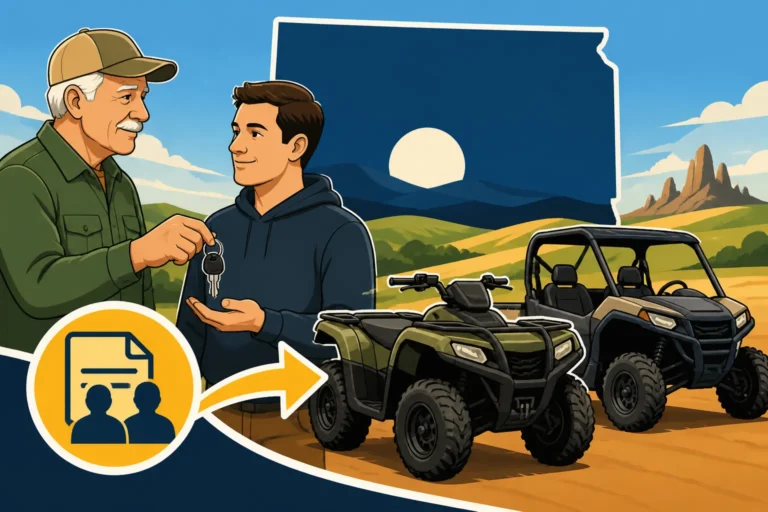
Consider these scenarios: What if your ranch machine is ever stolen? The first thing law enforcement will ask for is proof of ownership. Without a title, tracing your machine, or even proving it was yours, becomes a monumental task. Or what if you decide to sell your quad or UTV down the road, perhaps upgrading to a newer model? Buyers, whether private individuals or dealers, will invariably demand a clear title to ensure they're purchasing a machine free of liens or ownership disputes. Even if you're gifting it to a family member, a title transfer formally makes them the new legal owner. [South Dakota ATV Title Transfer] explains this process in detail.
Distinguishing Titling from Registration and Permits
It's common for people to conflate "titling" with "registration" or "permits," but they are distinctly different legal concepts.
- Titling establishes legal ownership. It’s a one-time process for each owner (unless the title is lost or damaged).
- Registration (or licensing) is typically an annual process that allows a vehicle to be operated on public roads or public lands, often involving license plates or decals.
- Permits (like the [South Dakota Nonresident ORV Permit]) grant specific usage privileges, often for a limited time or specific areas.
For a South Dakota ranch machine, the key takeaway is this: while your agricultural use might exempt you from needing an annual registration plate to drive on public roads, or a trail permit to ride on public trails, it usually does not exempt you from the fundamental requirement of having a title as proof of ownership. The state wants to know who owns what, regardless of where it's being operated.
When an Un-titled Machine Becomes a Problem
While you might operate a ranch quad for years without issue if it never leaves private land and nothing goes wrong, the absence of a title creates a hidden vulnerability. If you ever need to borrow against your machine, use it as collateral, or if it's involved in an accident, legal disputes can arise quickly. Proving your legitimate ownership without a title can be incredibly difficult, often requiring a complex process to establish a chain of custody or prove abandonment, which can be far more expensive and time-consuming than simply getting the title in the first place. This is why, even for a machine that only works a South Dakota ranch, obtaining a title is highly recommended as a safeguard for your investment.
The South Dakota Titling Process for Ranch ATVs and UTVs
So, you've established that even your ranch-only machine needs a title. Now, what does that process actually look like in South Dakota? Fortunately, the titling procedure for ATVs and UTVs is fairly standardized, whether your machine is destined for the open trails or the back forty. The primary difference for ranch vehicles might be which additional registrations or permits you choose not to pursue, rather than the titling itself.
Required Paperwork for Any ATV or UTV Title
When you're ready to title your quad or UTV, you'll generally need to gather a few key documents. The most important piece of paper is the Manufacturer's Statement of Origin (MSO) if the machine is new, or the previous owner's properly assigned title if you're buying it used. Without one of these, proving where the machine came from can be a real challenge.
Beyond that, you'll need:
- A completed [South Dakota's Title and Registration Application].
- Proof of the purchase price, often in the form of a [A South Dakota Bill of Sale for an ORV]. Even if you're just writing up a simple agreement for a private sale, using a template from a service like LawDepot can ensure all necessary details are included.
- Your identification, such as a driver's license.
- The Vehicle Identification Number (VIN) of the machine. Make sure to do a [Checking a VIN Before a South Dakota Purchase] to avoid any surprises.
This paperwork serves to establish the machine's identity, its value for tax purposes, and the legal transfer of ownership to you. Even if your machine is only going to see ranch duty, these foundational documents are non-negotiable for securing a title.
Where to Title Your Machine and What Fees to Expect
In South Dakota, all ATV and UTV titling (and registration) happens at your local [Titling at a South Dakota County Treasurer] office, specifically the county treasurer for the county where you reside. This is different from some states where you might go to a DMV or Department of Revenue directly for vehicle services. The county treasurer's office is your one-stop shop for getting the title in your name.
When you head to the treasurer's office, you'll encounter a few standard fees:
- The Title Fee: This is the core cost for issuing the title itself.
- Excise Tax: South Dakota levies a [South Dakota's 4 Percent Excise Tax] on the purchase price of the machine. This applies whether you're buying new or used, and whether it's for ranch use or recreation.
- Technology Fee: There's also a [South Dakota's $2 Technology Fee] that helps fund the state's vehicle information system.
- Solid Waste and Patrol Dollars: A small portion of your title fee, often just a dollar or two, goes towards [South Dakota's Solid Waste and Patrol Dollars].
It's important to remember that these fees are generally assessed regardless of the intended use of the vehicle. An ATV bought for ranch work will still be subject to the excise tax and basic title fees, just like a recreational one. The good news is, for a ranch-only machine, you typically won't be paying for annual license plates or trail permits if it truly never leaves your property.
Handling Private Sales for Ranch Quads
Many ranch ATVs and UTVs are purchased through private sales, whether from a neighbor, a local farmer, or an online marketplace. When you're [Titling a Machine Bought Privately in South Dakota], the process is much the same as buying from a dealer, but with a few extra responsibilities for you, the buyer. You'll need to ensure the seller properly signs and dates the existing title, transferring ownership to you.
Crucially, you'll want a well-documented bill of sale, even if it's just a simple handwritten one. However, to ensure it's legally sound and covers all bases, using a professional template, perhaps one downloaded from a legal document service like LawDepot, can be incredibly beneficial. This bill of sale should clearly state the purchase price, the VIN, and that the machine is sold "as-is," protecting both parties. The county treasurer will use this bill of sale to verify the sale price for excise tax calculation. Failing to provide adequate proof of sale can complicate the process, potentially delaying your title.
Beyond the Title: Other Considerations for Ranch Machines
With your ranch quad or UTV titled, you've taken the essential step for establishing legal ownership. However, for machines that operate exclusively on private land for agricultural or utility purposes, there are other important aspects to consider that differ from those used on public trails or roads. These considerations mostly revolve around what you don't need, and what best practices will still protect you.
No Need for Public Land Permits or Road Registration
One of the biggest advantages of a machine truly dedicated to ranch work is that it often circumvents the need for various public-use fees and registrations. If your ATV or UTV never leaves your private property, you generally won't need to purchase a [South Dakota's Motorized Trail Permit] to ride forest trails, nor will you need to license it with a motorcycle plate for road use.
This exemption is a significant cost and paperwork saver. The moment your ranch machine crosses a fence line onto public land or a county road (even to get from one part of your ranch to another, if it involves public access), these rules change, and you might then need proper registration or permits. But for a strictly ranch-bound machine, enjoy the freedom from these additional requirements. Just be absolutely certain of your property boundaries and avoid any temptation to take a "quick spin" down the road without the proper licensing.
The Importance of a Solid Bill of Sale, Even on a Ranch
Even if your machine is exempt from some state fees due to its agricultural use, a comprehensive bill of sale is still a paramount document. We touched on this during the titling process, but its importance extends further. When you buy or sell a ranch machine, this document acts as your clear record of the transaction. It protects you from claims of fraud, clarifies the terms of the sale, and ensures both parties understand what's being transferred.
A well-crafted bill of sale should include:
- The date of the transaction.
- Full names and addresses of both buyer and seller.
- A detailed description of the ATV/UTV, including make, model, year, and VIN.
- The agreed-upon purchase price.
- A statement that the machine is sold "as-is" (if applicable).
- Signatures of both parties.
Using a template, perhaps from a reputable source like LawDepot, can help ensure you don't miss any critical details that could prove problematic down the line. Even if you're just drafting a simple document yourself, make sure these core components are included. It's not just for the state; it's for your own peace of mind and legal protection.
| Feature / Requirement | Standard ORV (Recreational) | Ranch / Agricultural ORV (Private Land Only) |
|---|---|---|
| Title Required? | Yes | Yes (Proof of Ownership) |
| Excise Tax? | Yes | Yes |
| Technology Fee? | Yes | Yes |
| Annual Road Registration? | Yes (If Street Legal) | No (If Private Land Only) |
| Public Trail Permit? | Yes (If Using Public Trails) | No (If Private Land Only) |
| Bill of Sale Recommended? | Highly Recommended | Absolutely Essential |
| County Treasurer Process? | Yes | Yes |
Timely Titling and Avoiding Penalties
South Dakota law generally gives you a specific window to title your newly acquired vehicle after purchase. [South Dakota's Forty-Five Day Title Deadline] is usually the standard. Even for a ranch machine, adhering to this deadline is crucial. Missing it can result in late fees and penalties.
The state imposes a [South Dakota's 1 Percent a Month Penalty] for titles processed after the 45-day window, and this can escalate to a [South Dakota's 10 Percent Penalty at Sixty Days]. These penalties apply to the excise tax amount, not just the title fee, so they can add up quickly. While your machine might not be going on public roads, the titling timeline is still enforced to ensure prompt and accurate record-keeping of vehicle ownership across the state. It's always best practice to get your paperwork submitted to the county treasurer as soon as possible after purchasing your ranch quad or UTV.
In the end, while your South Dakota ranch quad or UTV might lead a simpler, more rugged life compared to its trail-riding cousins, the need for a title remains. It’s your legal safety net, protecting your investment and ensuring you have clear proof of ownership. Handle that one piece of paperwork, and you can focus on the important work your machine was made for.
Disclaimer
This article is for general informational purposes only and does not constitute professional advice. Laws, prices and regulations vary by location and change over time. Consult a qualified professional for guidance on your specific situation.