How a Quad Runs Above 6,000 Feet
A quad that feels strong near Rapid City can seem sluggish on a climb above 6,000 feet, especially when it is carrying riders and gear over Black Hills rock and gravel. That change is often normal: thinner air means less oxygen for the engine. This guide explains what to expect, how altitude affects different machines, and how to plan a safer South Dakota ride.
Why a Quad Feels Different Above 6,000 Feet
Thinner air means less engine power
As elevation rises, air pressure and air density fall. A naturally aspirated engine therefore takes in less oxygen with each intake cycle than it would at a lower elevation. Since an engine needs oxygen to burn fuel, the reduced air supply can mean less power.
The change may be easy to miss on a flat stretch, then obvious when you ask the quad to climb, accelerate quickly, or carry extra weight. A machine that pulls comfortably on an open road near Rapid City may feel less responsive on a steep section in the higher Black Hills. The effect varies by engine, condition, fuel system, temperature, load, and riding style, so there is no single performance change that applies to every quad.
A useful rule of thumb is that naturally aspirated engines can lose a few percent of their power for every 1,000 feet of elevation gained. Treat that as a rough estimate, not a promise about what your particular machine will do. A worn air filter, old spark plug, heavy cargo load, or poorly maintained belt can make a high-elevation ride feel even more demanding.
Fuel injection helps, but does not erase altitude
A fuel-injected quad can adjust its fuel delivery as air conditions change, which often helps it run more smoothly than a carbureted machine that has not been adjusted for elevation. But fuel injection cannot put more oxygen into thin air. Even when the engine is running properly, it may not make the same power at elevation that it does at lower altitude.
Carbureted machines can be more sensitive to changing elevation because their fuel mixture may not suit the thinner air. If your quad runs poorly, do not assume that an adjustment is automatically needed—or make one based only on a general rule. Check the owner’s manual and ask a qualified technician about the specific model, especially before changing jets or other settings that could affect engine operation, emissions compliance, or warranty coverage.
The difference can show up in everyday riding. A carbureted quad that idles roughly, hesitates under acceleration, or runs unusually rich may need inspection. A fuel-injected machine that feels less powerful on a climb but starts and runs normally may simply be responding to the thinner air and added workload.
Terrain can make the power loss feel bigger
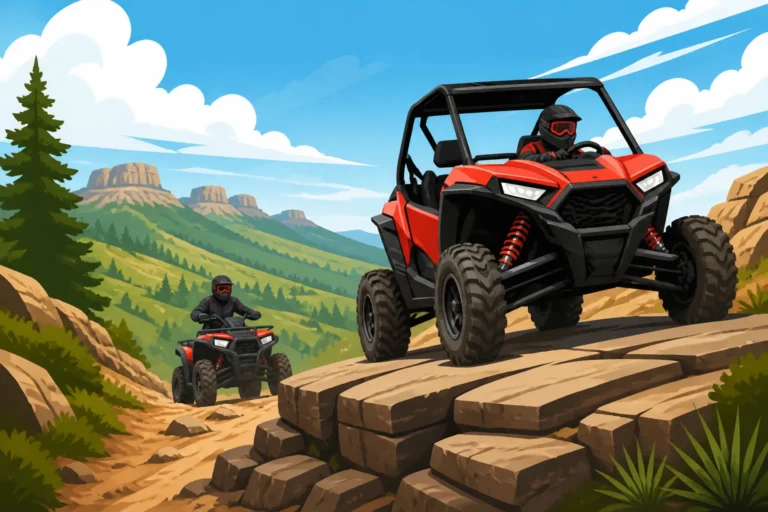
Elevation is only part of the experience. Hills, loose rock, tight turns, and repeated stop-and-go riding all ask more of the engine and drivetrain than a smooth, level route. If you are climbing slowly over rough ground, the quad may feel as though it has lost more power than it would on an open road.
Load matters too. A passenger, storage box, tools, water, and camping gear all add weight. That extra load can turn a manageable climb into a situation where the engine has to work harder and the rider needs more room to maneuver. Before heading into steep terrain, think about whether every item you are carrying is necessary.
For route expectations, compare elevation and terrain rather than relying on a trail’s distance alone. [South Dakota Trails With Long Climbs] can help you think about the difference between a short, steep effort and an easier stretch of similar length. A trail that looks modest on a map may feel demanding when it combines elevation gain, rough surfaces, and a fully loaded machine.
What to Notice on the Trail
Changes in throttle response and climbing
At higher elevations, you may notice slower acceleration, less pull when climbing, or a need to use lower gearing more often. A quad that responds promptly at lower elevation might need more deliberate throttle input on a hill. Avoid reacting by holding the throttle wide open for long stretches, particularly if the machine is struggling or the surface is loose.
Choose a suitable gear before a climb when your machine allows it, keep a steady pace, and leave enough space to stop or turn around safely. If the quad cannot climb a section without excessive wheelspin, overheating, or repeated stalls, do not keep forcing it upward. Back off, reassess the route, and use a safe turnaround point where permitted.
A change in performance does not always mean an engine problem. Still, sudden or severe symptoms deserve attention. Knocking, repeated stalling, unusual smoke, warning lights, a strong fuel smell, or a rapid loss of power are reasons to stop somewhere safe and inspect the machine rather than continuing to push it.
Heat, cooling, and the CVT belt
An engine and its drivetrain can work hard on a long climb, especially when the quad is moving slowly, carrying weight, or repeatedly stopping and starting. Air-cooled engines rely on airflow, while liquid-cooled machines rely on a functioning cooling system. In either case, check the machine before riding and take warning signs seriously. If a temperature warning appears or the engine begins to run abnormally hot, stop safely and follow the manufacturer’s guidance.
Many ATVs and UTVs use a continuously variable transmission, or CVT, with a belt. Long periods of heavy throttle at low speed can put extra stress on the belt. Use a suitable low range where the manufacturer recommends it, avoid lugging the engine, and take a break if the machine’s behavior suggests the drivetrain is getting too hot. Never open or handle hot components on the trail.
Before a trip, check the belt and service items listed in the owner’s manual. A belt in poor condition may fail at the worst possible moment: far from the trailer, on a climb, or where a safe recovery is difficult. If you are unfamiliar with the machine’s maintenance needs, a pre-trip inspection is more useful than trying to troubleshoot a drivetrain problem on a remote route.
Use symptoms to decide whether to stop
It helps to distinguish expected altitude-related sluggishness from signs that something is wrong. The table below is a practical guide, not a substitute for the machine’s manual or a mechanic’s inspection.
| What you notice | Possible explanation | Sensible response |
|---|---|---|
| Gradually weaker acceleration as elevation rises | Less oxygen available to a naturally aspirated engine | Reduce load and pace; use appropriate gearing |
| Rough idle or hesitation, especially on a carbureted machine | Fuel mixture, maintenance, or another engine issue | Stop safely and consult the manual or a technician |
| Temperature warning or unusual heat | Cooling problem or excessive engine load | Stop safely and let the machine cool as directed |
| Burning smell or belt-related noise | Possible drivetrain or belt stress | Ease off, stop in a safe place, and inspect only when safe |
| Sudden power loss, smoke, or repeated stalling | A mechanical fault may be involved | Do not keep riding; arrange help if needed |
If you are unsure whether a symptom is normal, choose caution. Continuing uphill to “see if it clears” can turn a minor concern into a breakdown or leave you stopped in an unsafe location.
How to Prepare for a High-Elevation South Dakota Ride
Check the machine before leaving
Start with the basics: inspect tires, brakes, steering, lights, fluids, air filter, and the belt or chain as applicable. Look for loose cargo and make sure tools and recovery gear are secured. For a liquid-cooled machine, check the cooling system according to the owner’s manual. For any machine, make sure scheduled maintenance is up to date rather than assuming the quad will handle a hard ride because it performed well on a shorter outing.
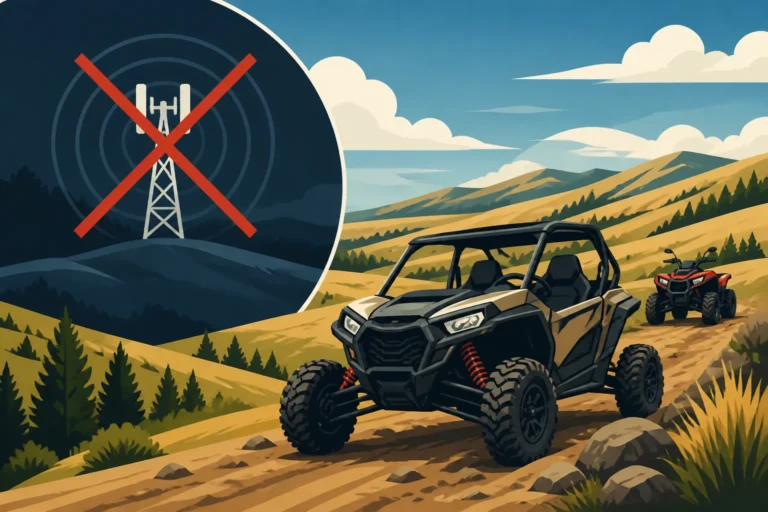
Pack for the route, not just the forecast at the trailhead. Weather and temperatures can change across the Black Hills, and a ride that starts comfortably may become cold, wet, or windy at higher elevations. Carry water, appropriate layers, basic tools, and a way to contact help where coverage allows. Tell someone your general plan and expected return time.
If the machine will be working hard or carrying a passenger, do a short shakedown ride before committing to a remote loop. Pay attention to throttle response, temperature, braking, and any new noise. This gives you a chance to spot a problem closer to your vehicle or a service location.
Plan around elevation, access, and changing conditions
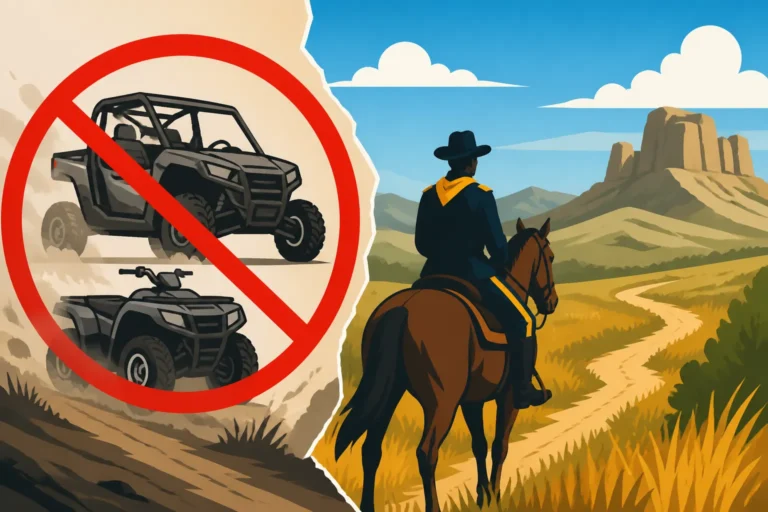
A route-planning app such as onX Offroad can help you review terrain and route details before you leave, but it should not replace official access information. Use current Forest Service maps and notices to confirm that a motorized route is open and permitted for your machine. A line shown on a map is not, by itself, permission to ride there.
Check [South Dakota Trail Maps and MVUMs] and [South Dakota Trail Closures to Check First] as part of your planning. If you use onX Offroad to look at a route, compare what you see with official maps and closure notices before riding. Keep your route within designated motorized routes and obey posted signs, even when a trail looks passable beyond a closure.
Elevation profiles can help you anticipate where a machine may work hardest. onX Offroad may be useful for reviewing a planned route, but map detail and conditions can change, so confirm access separately and carry a backup navigation option. Download or save the information you need before entering areas where cell service may be unreliable.
Fuel planning matters as well. Higher workload, detours, and slow travel can affect how far a machine gets on a tank. Do not assume that a fuel stop shown near a route will be open or available when you arrive. [South Dakota Trails With Fuel Nearby] offers a useful starting point for planning, but call ahead or verify your own options before relying on a particular stop.
Adjust your riding style to the machine
Give yourself extra time on steep or rocky sections. Use smooth throttle inputs, avoid sudden acceleration on loose surfaces, and keep enough distance from the rider ahead to respond if they slow or stop. If your quad is struggling, reduce speed and load rather than trying to compensate with aggressive throttle.
For a group ride, agree on a pace that suits the least powerful or most heavily loaded machine. Keep riders in sight where practical, establish a regrouping point, and make sure everyone knows what to do if a machine needs to stop. If one rider has a carbureted quad that is running poorly, it is better to pause and reassess than to pressure them to keep up.
A route that is appropriate for an experienced rider on a light quad may be a poor choice for a newer rider or a heavily loaded UTV. Review [South Dakota Trail Difficulty Ratings] and consider whether the terrain, elevation gain, and machine width are a good match for everyone in the group. If a climb feels beyond the machine’s ability, turning around is a sound decision—not a failure.
Building a Better Black Hills Ride
Match the loop to your quad and your group
Before choosing a route, consider the machine’s condition, engine type, tires, load, passenger count, and the experience of the riders. A light ATV with one rider may handle a route differently from a loaded side-by-side carrying several people. The same trail can feel easy in dry conditions and significantly harder after rain or when loose rock shifts under the tires.
Think in terms of effort, not just mileage. A short route with repeated climbs may require more from the quad than a longer, gentler loop. For a first high-elevation ride, choose a route with straightforward navigation and realistic turnaround options. [South Dakota Trail Difficulty Ratings] and [South Dakota Trails With Overlooks] can help you weigh terrain and destinations while planning.
Do not plan every minute around reaching a particular overlook or endpoint. If the engine is running hot, the group is tiring, or conditions have changed, shorten the ride. A flexible plan makes it easier to turn a challenging day into a safe one.
Respect traction, width, and trail conditions
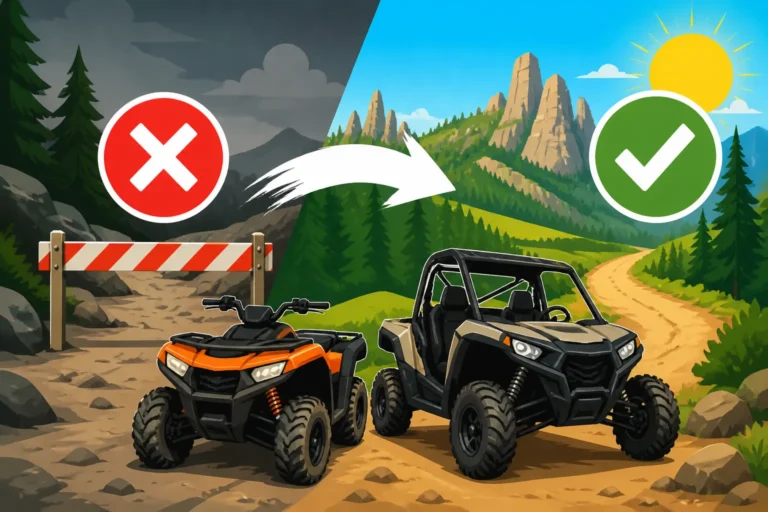
Reduced power is only one piece of the puzzle. Tires, ground clearance, wheelbase, and machine width affect where a quad can travel and how it handles obstacles. Check trail-width requirements before setting out, especially if you are riding a wide UTV. Never assume that a route is open to every machine simply because another vehicle has used it.
Rocky and gravelly sections also call for suitable tires and careful speed. [Tire Choice for Hills Rock and Gravel] can help you think through traction needs for the Black Hills. Even with suitable tires, avoid abrupt steering or braking on loose surfaces, and do not leave the designated route to bypass an obstacle.
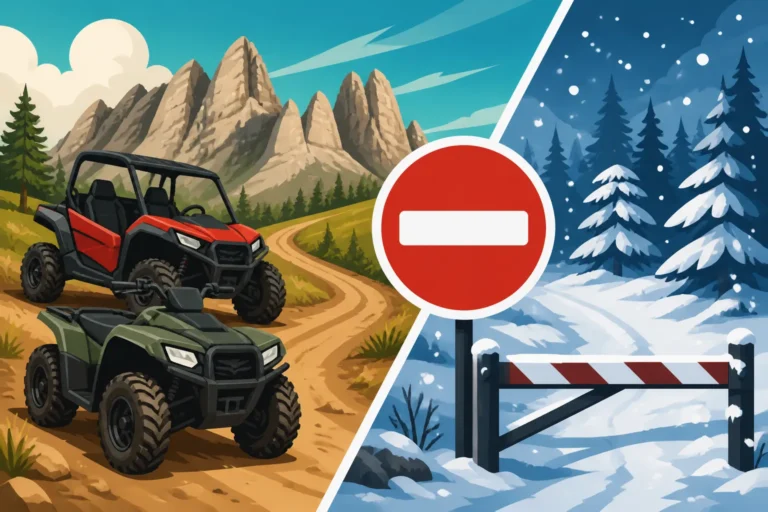
Rain, snow, and seasonal closures can change a route’s condition or accessibility. Check official notices close to departure, read any posted trailhead information, and turn back if the route is closed or unsafe. onX Offroad can be one part of your planning routine, but posted restrictions and official motorized-use information take priority.
A simple plan for the day
A practical high-elevation ride plan does not need to be complicated. Before leaving, confirm the route is open, review the elevation and terrain, check the machine, and agree on a turnaround time. Carry enough water and basic supplies, and do not count on cell coverage or a nearby fuel stop.
During the ride, watch for gradual changes in engine response as elevation increases. Use sensible gearing, take breaks during demanding sections, and stop if the machine shows signs of overheating or mechanical trouble. If the quad feels weaker but is running smoothly, adjust your expectations and ride within its limits. If symptoms are sudden, severe, or unfamiliar, treat them as a possible mechanical problem.
The Black Hills can reward a well-planned ride with dramatic views and memorable terrain, but altitude makes it important to know your machine and leave room for changing conditions. A little preparation—and the willingness to turn around—can make the difference between a satisfying day outdoors and a long, avoidable recovery.
Disclaimer
This article is for general informational purposes only and does not constitute professional advice. Laws, prices and regulations vary by location and change over time. Consult a qualified professional for guidance on your specific situation.