Meeting Traffic on a One-Lane Ranch Bridge
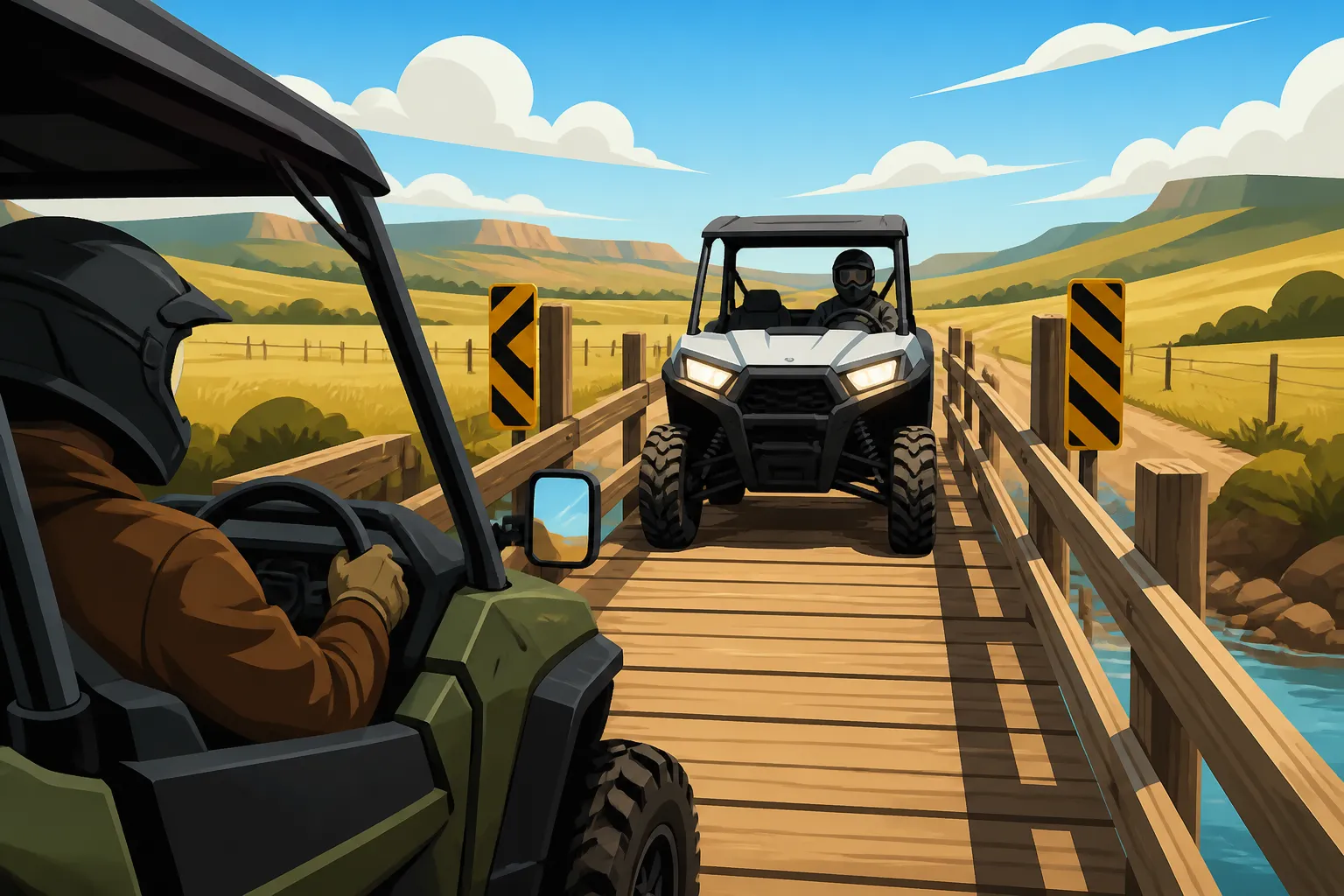
A narrow ranch bridge can turn an ordinary South Dakota ride into a tense standoff: a pickup is coming the other way, there is no room to pass, and the bridge edges may be exposed or soft. This guide explains how to approach, yield, and cross safely, while helping you check whether your route and machine are allowed there in the first place.
Before You Reach a One-Lane Ranch Bridge
Confirm that you are allowed to use the route
A bridge on a ranch road is not automatically open to ATV or UTV traffic. It may lie on private property, a public road right-of-way, or a route with restrictions. Before riding, confirm that the landowner or route manager permits your access. A bridge you can physically reach is not necessarily a bridge you have permission to cross.
Ask about more than the general route. Check whether the permission covers the bridge itself, whether there are seasonal closures, and whether livestock or ranch work could affect access. If you are riding on a grazing lease or through land managed by someone else, permission from one person may not be enough. [Written Permission From a South Dakota Ranch Owner] and [Who You Ask Before Riding a Grazing Lease] are useful starting points for sorting out access.
If the bridge is part of a public road, separate questions still apply: Is your ATV or UTV allowed on that road, and does it meet the requirements for that kind of road use? A route that is open to regular vehicles does not necessarily mean every off-road machine may use it. Review [South Dakota Rules for Riding a Ranch Road] and [South Dakota Rules for Riding a Gravel Road] before planning a route that connects private ranch roads with public roads.
Look at the bridge before you commit
Slow down well before the bridge entrance. From a safe stopping point, look for posted signs, gates, damaged decking, washed-out approaches, loose boards, standing water, cattle, and limited room to turn around. A narrow bridge can hide its far end behind a rise, trees, or a bend, so do not assume you can see the entire crossing from the approach.
Pay attention to the surface and edges. A bridge that is wide enough for your machine on paper may still leave little room for a tire to drift. Wet wood, mud, gravel, frost, or a steep approach can make a careful crossing more difficult. If you cannot see the bridge condition clearly, or if the approach is unstable, stop somewhere safe and assess it on foot only if you can do so without stepping into traffic or onto an unsafe structure.
A useful rule is to decide before entering: either the bridge is clear and suitable for your machine, or you turn around. Do not ride onto it to “see if it feels okay.” If another vehicle appears while you are already on the bridge, the lack of space may leave you with no safe way to correct a poor decision.
How to Meet Oncoming Traffic Safely
Stop on the approach, not on the bridge
If you see a vehicle approaching a one-lane bridge, stop before the entrance and give the driver room to cross. Choose a spot that is firm, visible, and far enough from the bridge that the other vehicle can maneuver without being crowded. Avoid stopping on a steep slope, near a soft shoulder, or where your machine blocks a gate or driveway.
Make your intentions easy to read. Keep your machine controlled, face toward the approaching traffic where practical, and avoid sudden movement. If you are riding with others, have the group stop together in a safe place rather than allowing riders to bunch up at the bridge mouth. A loose line of ATVs can make it harder for a driver to judge who will move first.
Do not assume that a small ATV should squeeze past a truck, tractor, or trailer on a narrow bridge. Even if the machines might fit, the other driver may not be able to see your clearance, and the bridge edges may not support a wheel. When in doubt, wait until the other vehicle has fully crossed and cleared the approach.
Let one vehicle cross at a time
A one-lane bridge is a space-sharing problem, not a contest over who gets there first. If the other vehicle is already on the bridge, wait. If both parties arrive at nearly the same time, stop before entering and communicate clearly. A wave can help, but do not rely on a vague gesture if the driver’s intent is unclear. Wait for the bridge to be fully clear before starting across.
Be especially cautious around larger or less maneuverable vehicles. A ranch pickup with a stock trailer, a tractor, or a loaded truck may need extra room and may not be able to back up easily. Give the driver time to cross without trying to direct them from a blind spot. If you are not sure whether they have seen you, remain stopped rather than edging forward.
If your group is traveling together, do not follow the first rider onto the bridge unless you have enough visibility and space to confirm that the entire crossing is clear. Keep enough distance to stop without crowding the rider ahead. For mixed groups with ATVs and UTVs, set the crossing order before reaching the bridge and make sure nobody tries to pass on the approach.
| What you see | Safer response |
|---|---|
| A vehicle is already crossing | Stop before the bridge and wait until it has cleared the far approach |
| Traffic approaches from the other side | Stay off the bridge and allow the other vehicle to cross first |
| You cannot see the far end | Wait for a clear view or choose another route |
| The bridge or approach looks damaged | Do not enter; turn back and report the hazard to the responsible person |
| A vehicle stops but its intention is unclear | Remain stopped and communicate before either vehicle moves |
Making the Crossing Without Rushing
Prepare your machine and passengers
Before you leave, check that your tires, brakes, steering, and lights are in good working order. On a narrow bridge, a small mechanical problem can become a serious one because there may be no room to pull over. Carry the essentials for your ride, but avoid overloading a machine in a way that affects handling or makes it difficult to control on a confined surface.
Make sure passengers understand the plan. Ask them to stay seated, keep hands and feet inside the machine, and avoid shifting their weight suddenly. A passenger leaning outward to look at the edge can affect balance and distract the driver. If you are riding alone, keep your attention on the crossing rather than trying to film or take a photo while moving.
Visibility equipment can help you be seen on a shared route, but it does not give you the right to use a road or bridge where your machine is not allowed. If you are equipping an ATV or UTV for permitted road use, check the applicable equipment rules before buying or installing accessories. Riders comparing mirrors or other fitment options may come across SuperATV; confirm that a chosen part fits your exact machine and does not conflict with the requirements for your intended use. For the broader road-use checklist, see [South Dakota Equipment List for Road Use] and [South Dakota Mirror Requirement].
Cross slowly and steadily
Once the bridge is clear and you have decided it is safe to proceed, use a controlled, steady pace. Avoid abrupt acceleration, hard braking, or sharp steering corrections. Keep your eyes on the usable path ahead, not fixed on the drop beside you. A smooth crossing gives you more control than trying to hurry across before another vehicle appears.
Stay centered where the bridge design and surface allow, while leaving enough clearance from rails, posts, and other structures. Do not assume that the center is always safest if the deck is damaged or uneven; the bridge condition matters. If you encounter a hazard partway across, do not make a sudden turn or stop unless stopping is the safest available option. Make small, deliberate corrections and keep the machine under control.
If a vehicle appears unexpectedly while you are crossing, do not try to squeeze around it. Continue only if the bridge is clear enough for you to complete the crossing safely. If you cannot, stop where you can remain stable and communicate with the other driver. In some situations, backing up may be riskier than waiting, especially on a narrow deck or a sloped approach. Avoid improvising a maneuver that could put a wheel over an edge.
Common Mistakes and Better Choices
Do not treat a wave as proof that the crossing is safe
Drivers sometimes wave an ATV forward out of courtesy, but a gesture cannot tell you whether the bridge is structurally sound, whether the far end is clear, or whether the driver has judged the available width correctly. You are responsible for assessing your own machine and route. If you cannot confirm that the crossing is safe, wait or turn around.
Likewise, do not assume the other driver can see you. A UTV may sit below the driver’s sightline in a pickup, and dust, glare, rain, or a blind curve can reduce visibility. Approach slowly, make yourself visible, and stop well before the bridge rather than depending on eye contact at the last moment.
Never use the bridge as a place to pass another ATV in your group. Keep the group orderly and cross one machine at a time when space or visibility is limited. If you need to regroup, do it on a wider, stable area away from the bridge entrance.
Know when turning back is the right call
Turning around is often the safest choice if the bridge is damaged, the approach is too narrow, the deck is slick, or you cannot establish who should cross first. It can feel frustrating to retrace part of a ride, especially when the bridge appears to be the only route forward. But a few extra minutes are better than a machine stuck sideways on a bridge or a rider forced into a risky recovery.
If the bridge is on private ranch property, report a hazard to the landowner or person who granted access. If it is on a public route, use the appropriate local reporting channel rather than assuming someone else has already done so. Do not move barriers, bypass a closed gate, or ride around a sign to get to the other side.
For a future trip, plan an alternate route before leaving. Mark likely narrow crossings, confirm access, and identify safe places to turn around. If your machine is intended for road use, make sure it meets the requirements that apply to the route rather than relying on appearance alone. [Are ATVs Street Legal in South Dakota?] and [South Dakota Rules for Crossing a Highway] can help distinguish road-use questions from the separate issue of crossing a private ranch bridge.
If you use accessories to improve visibility or prepare your machine for the route, treat them as support—not permission or protection from every hazard. For example, a mirror from a supplier such as SuperATV may help you monitor traffic in some setups, but it cannot replace stopping before a blind one-lane crossing. And while a SuperATV accessory may be suitable for a particular ATV or UTV, verify fitment and intended use before relying on it for a road-related ride.
Disclaimer
This article is for general informational purposes only and does not constitute professional advice. Laws, prices and regulations vary by location and change over time. Consult a qualified professional for guidance on your specific situation.