South Dakota Rules for an Electric Machine on Trails
Electric ATVs and UTVs avoid fuel and engine noise, but that does not automatically give them different trail access in South Dakota. The difficult part is figuring out whether your machine counts as an off-road vehicle, whether it needs a permit, and which routes allow its size and type. Here’s how to check those details before unloading.
How South Dakota’s trail rules apply to electric machines
For trail access, the key question is generally what kind of vehicle you have and where you plan to ride—not whether it burns gasoline. An electric quad or side-by-side designed for off-road use may be treated as an off-road vehicle for access and permit purposes. But the label “electric” alone does not settle its legal classification.
A two-wheel electric dirt bike, a four-wheel electric ATV, and a heavier electric utility vehicle may be treated differently under particular rules. Their design, intended use, equipment, and the land manager’s requirements can all matter. If the machine is an unusual model, check its owner’s manual and ask the relevant agency or land manager how it is classified before relying on a general answer.
The same caution applies to engine-size rules. A gas engine has a displacement measured in cubic centimeters; an electric motor does not. That difference may matter for road plating or licensing rules, but it does not necessarily create a trail exemption. Do not assume that a machine with no stated engine displacement is automatically allowed on every trail, or automatically barred from all of them. For background on this separate issue, see How the Engine Size Rule Applies to Electric ATVs.
A useful starting point is to separate three questions:
- What is the machine? Identify whether it is an ATV, UTV, dirt bike, or another type of motor vehicle.
- Where will you ride? A designated motorized trail, a forest road, a state-managed riding area, and private ground can have different rules.
- What does that route allow? Check for vehicle-type, width, seasonal, permit, and closure restrictions.
The distinctions matter because permission to ride one kind of route does not carry over to another. A machine that is allowed on a road may not be allowed on a nearby trail. Likewise, permission to ride on private land does not automatically cover public trails.
South Dakota’s motorized-trail permit rules are especially relevant to riders planning to use designated trails in the Black Hills area. Check South Dakota’s Motorized Trail Permit and Do You Need a Permit on a Black Hills Trail? for the permit details that apply to your planned ride. Treat the permit as a separate access requirement, not as proof that your machine can use every route.
Permits, plates, and route permission are separate
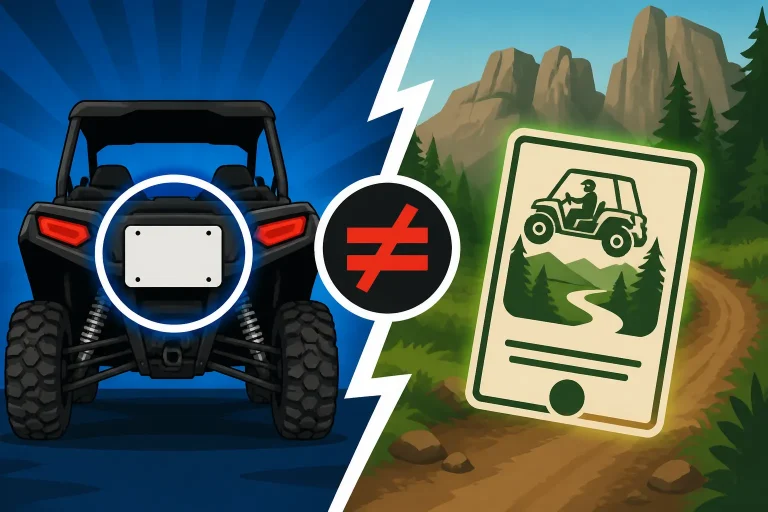
An electric machine may need a trail permit even if it has a plate, and a plate does not by itself establish that a particular trail is open to it. Permit rules depend on the place and type of riding. Before you go, confirm the current requirements for the specific area and machine rather than relying on the vehicle’s registration status alone. Why a Plate Does Not Replace a Trail Permit
Think of these as separate checks:
| Check | What it answers | What it does not prove |
|---|---|---|
| Trail permit | Whether the required permit is in place for that riding area | That the route is open to your machine |
| Plate or registration | Whether the machine meets applicable registration or road-use requirements | That it may use a designated trail |
| Route designation | Which vehicle types may use the route | That required permits or equipment are in place |
| Width measurement | Whether the machine fits a route’s width limit | That the trail is open during your visit |
| Current closure information | Whether you can ride the route now | That other nearby routes have the same status |
For a trip on designated Black Hills motorized trails, confirm whether the permit must be displayed on each machine and where the decal should go. If you are bringing more than one electric vehicle, do not assume a single permit covers the group. Permit requirements can be tied to the vehicle rather than the number of riders.
The type of permit available, application process, fees, and display instructions can change. Check the current official information before purchasing or traveling. If your machine’s classification is unclear, ask the permit provider or the relevant land manager to confirm it in writing when possible. Give them the make, model, number of wheels, intended use, and any stated vehicle dimensions; simply saying “electric ATV” may not be enough to resolve an unusual case.
Out-of-state registration also should not be treated as a universal substitute for a South Dakota trail permit. Reciprocity may apply in one context but not another. A machine’s home-state plate could help establish that it is registered for road use, while a local trail permit may still be required for a particular trail system. Verify both requirements separately if you are visiting from outside South Dakota.
Road-use rules are another separate matter. A plated electric machine’s ability to travel on certain roads does not mean that it can leave the road and enter any nearby trail. Before planning a connecting route, check whether the road segment and trail segment each permit your vehicle. For the wider rules governing federal land, see South Dakota Rules for Riding Federal Land.
Width, vehicle type, and seasonal access
For many riders, width is one of the most practical limits to check before a Black Hills trip. A side-by-side that is too wide for a particular trail cannot use that trail simply because it is electric, quiet, or properly permitted. Measure the machine as directed by the land manager; do not rely only on the model’s advertised width or a rough visual estimate. Details on the local limits are covered in South Dakota Trail Width Limits.
This matters especially when accessories change the vehicle’s overall dimensions. Wider tires, wheel spacers, aftermarket bodywork, or other modifications may affect how a machine fits a route’s limit. If the official rule uses a particular measurement method, use that method. When in doubt, contact the land manager before traveling rather than trying to judge a tight fit at the trailhead.
Trail designation matters just as much as width. A route may be open to some types of motorized vehicles but not others. A single-track intended for motorcycles, for example, should not be assumed to accept an electric quad. Conversely, a route marked for certain off-road vehicles is not automatically open to every UTV. Check the map legend and route restrictions, not just the word “motorized.”
Seasonal dates and temporary closures can also affect the plan. A route that appears on a map may be closed during part of the year, after weather damage, or because of another temporary restriction. Do a current check before leaving home, and look again at posted notices when you arrive. South Dakota Trail Maps and MVUMs can help you understand route designations, while South Dakota Trail Closures to Check is useful for planning around changing conditions.
Use this comparison as a quick planning screen:
| Machine or situation | What to confirm before riding |
|---|---|
| Electric ATV | Off-road vehicle classification, permit, route designation, and any width limit |
| Electric UTV | Vehicle type allowed, measured width, permit, and route restrictions |
| Electric dirt bike | Whether the route allows motorcycles and whether the machine meets applicable requirements |
| Modified electric machine | Overall dimensions, vehicle classification, and whether the changes affect eligibility |
| Out-of-state electric machine | South Dakota trail permit requirements as well as home-state registration status |
| Machine with a road plate | Whether the trail still requires a separate permit and whether the route allows that vehicle |
A quiet motor does not change the posted route designation. Nor should riders assume that lower noise permits travel on a closed route or off a marked trail. Stay on routes open to your vehicle type, and follow signs and gates even when a route looks passable.
Range, charging, and a practical pre-ride check
Electric power adds planning questions that do not replace the legal checks. Range can vary with terrain, temperature, load, riding style, tire pressure, and how much climbing the route involves. A route that looks short on a map may use more battery than expected if it includes steep grades, soft ground, or repeated stops and starts.
Do not plan a ride around the machine’s best-case range figure alone. Check the manufacturer’s guidance and leave a reserve for detours, slower travel, and unexpected conditions. If there is no reliable place to recharge on your route, plan the ride so the machine can return without depending on an unconfirmed charging option. Carrying a portable charger is useful only if you can safely use it and have permission to charge at the location.
Cold weather can reduce usable battery range, and heat or heavy loading can affect performance as well. Before a longer ride, consider how elevation changes, passengers, cargo, and trail conditions may affect the machine. For a UTV, factor in the weight of everyone aboard and any gear. For a quad, consider whether the route has steep climbs or sections where turning back could be difficult.
A simple pre-ride checklist helps keep the practical and legal questions together:
- Identify the machine accurately. Have the make, model, vehicle type, and dimensions available.
- Confirm permit requirements. Check whether the intended trail system requires a permit for this machine, and follow current display instructions.
- Check registration separately. If you plan to use roads, confirm the machine’s road status and applicable requirements; do not treat that as trail approval.
- Review route designations. Confirm that the routes allow your vehicle type and width.
- Check dates and closures. Look for current seasonal restrictions, weather closures, and posted notices.
- Plan battery range conservatively. Account for terrain, temperature, passengers, cargo, and a reasonable reserve.
- Follow land manager instructions. Use marked routes and obey signs, gates, and any additional local conditions.
If the machine has a conversion kit or a configuration that differs substantially from the manufacturer’s standard model, explain that clearly when asking about eligibility. A general answer about electric ATVs may not apply to a homebuilt vehicle or one modified from another category. You can also check South Dakota ATV Safety Course Requirements if you are unsure whether training or age-related rules apply to the riders in your group; do not assume that the machine’s electric power changes those requirements.
The safest working assumption is straightforward: electric power does not grant special access. Confirm the machine’s classification, secure any required permit, and verify that each route allows its vehicle type and dimensions. Then plan the battery range and check for closures. That approach avoids the two most common planning mistakes: treating a plate as a trail permit, and treating an open trail as open to every machine.
Disclaimer
This article is for general informational purposes only and does not constitute professional advice. Laws, prices and regulations vary by location and change over time. Consult a qualified professional for guidance on your specific situation.