Private Ground Access for South Dakota Riders
Private land can offer a quieter place to ride in South Dakota, but a visible track, open gate or familiar-looking ranch road is not an invitation. The key is to confirm who controls the ground, get permission before unloading, and understand what that permission does—and does not—allow. These steps help you arrange access without mistaking private property for public riding land.
Permission comes before the ride
In South Dakota, seeing a route across private ground does not tell you whether you may ride it. A track might be a ranch road, a route used by invited guests, or a path that crosses several properties. Even if the entrance is unfenced or no sign is posted, do not treat that as permission.
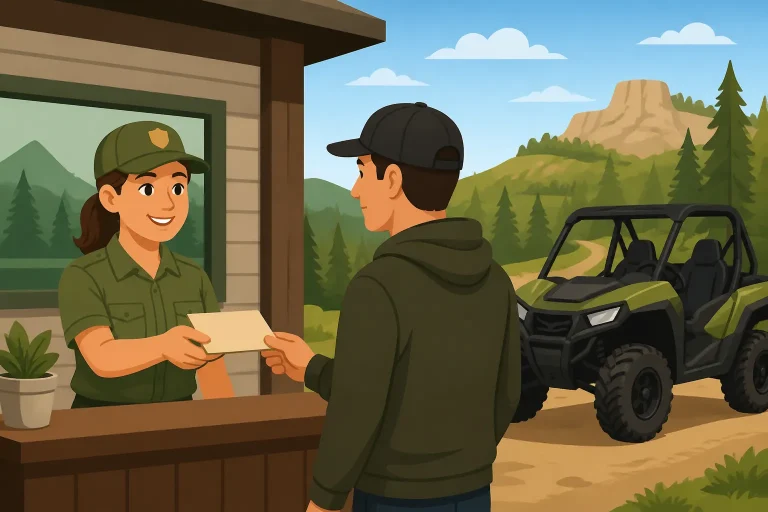
Get approval from the landowner or someone authorized to grant access before you ride. If you are unsure who owns or manages a parcel, ask before entering rather than trying to sort it out from the seat of your machine. The basics are covered in [South Dakota Rules for Riding Private Property] and [South Dakota Landowner Permission Requirements].
Permission should be clear about the specific land and activity. Someone who allows you to park on a property has not necessarily agreed to let you ride there. Someone who authorizes a walk or a hunt may not have authorized ATV or UTV use. Ask directly about riding, routes, dates, the number of machines, and any limits.
A useful rule is: if the person who controls the land has not clearly said you may ride, do not ride there. That applies even when:
- The route appears to connect two public roads.
- You see other riders on the property.
- A gate is open or a fence is down.
- The ground looks unused.
- You have permission to use a nearby parcel.
- A map shows a road or trail but does not identify it as open to public motorized use.
Permission should come from the person with authority
A neighbor, tenant, worker or hunting guest may know the property well, but that does not automatically mean they can invite you to ride it. Ask the landowner or the person responsible for access, and make sure that person has authority to approve motorized use.
For leased land, ask who controls the specific area and who can authorize ATV or UTV riding. A tenant may have access for a particular purpose without having the right to invite others to drive across the property. If the land is part of a grazing lease or another public-land arrangement, additional rules may apply. Who You Ask Before Riding a Grazing Lease explains why identifying the right decision-maker matters.
Permission also has boundaries. Approval for one field, ranch road or weekend does not necessarily cover another parcel or a later trip. If you plan to return, confirm whether the permission is ongoing or limited to the occasion.
A “yes” should cover the details that matter
A brief conversation can prevent misunderstandings. Before you ride, confirm:
- Where: Which parcel, roads or routes are included? Are there areas you must avoid?
- When: What dates or hours are acceptable? Is access limited by weather, livestock work or hunting activity?
- Who: How many riders and machines are included? May you bring guests?
- How: Are there speed, noise, route or group-size limits?
- What else: May you park, unload, camp, carry a passenger or bring a dog?
- Changing conditions: Should you call before each visit to check whether the route is still open?
You do not need to turn every friendly invitation into a formal contract. But the more specific the arrangement, the less likely you are to misunderstand it. If the owner gives you a route or marks a boundary, follow those directions rather than taking a convenient-looking side track.
How to arrange access responsibly
A good access request is specific, easy to answer and respectful of the owner’s time. Explain who you are, what you want to do, how many machines will be involved and when you hope to ride. Mention whether you plan to bring a trailer or guests. Do not assume that a landowner who permits one rider will accept a large group.
A practical way to ask
- Identify the land and contact the right person. If you do not know the owner, use reliable property information or ask locally for a contact. Do not enter first to look for someone.
- Describe the ride plainly. Say whether you want to ride an ATV, UTV or both, and whether the plan is a short visit or a longer route.
- Ask about permitted routes and limits. Confirm where to ride, where not to ride, and whether there are restrictions on speed, noise, passengers, parking or timing.
- Check for other land interests. Ask whether a tenant, lessee, agency, livestock manager or another party also controls access.
- Confirm the conditions before setting out. Weather, livestock movement, maintenance work or a change in ownership can affect permission.
- Follow the conditions and leave the property as agreed. Close gates only as instructed, avoid disturbing livestock, pack out rubbish and report damage or a problem promptly.
If the property is large or the route crosses multiple ownerships, ask the owner to identify the boundary and the approved route. A road that appears to continue across a parcel may not be included in the invitation. GPS tracks, online maps and advice from another rider can help with orientation, but they do not grant access.
Written permission can prevent confusion
For a casual ride with a clear, direct invitation, a conversation may be enough to establish what the owner allows. Written confirmation is useful when the arrangement involves a group, repeated visits, a long route, a rental machine or several parcels. A text or email can record the date, route and conditions without making the process complicated.
A useful written note identifies the land, the riders or group, the permitted activity, the dates and any restrictions. It should also make clear whether guests may join and whether access can be withdrawn. Written permission does not override law or other land-use rules, but it can reduce disputes about what was agreed. See Written Permission From a South Dakota Ranch Owner for more on what to clarify.
Do not treat a photo of an old message, a previous season’s approval or a vague “you’re probably fine” as unlimited access. If the owner’s instructions are unclear, ask again before riding. A polite follow-up is better than putting the landowner in the position of having to stop an unauthorized ride.
When the owner says no—or does not respond
A lack of response is not permission. If you cannot reach the owner, choose a location where access is clearly authorized. If the owner declines, accept the answer and do not return through another entrance or ask a different person on the property in hopes of getting a different response.
Access can also be revoked. If the owner asks you to stop or leave, do so calmly and promptly. Do not argue that you have used the route before or that another rider said it was open. Past access does not guarantee future access.
Land boundaries, roads and grazing leases
South Dakota has a mix of private property, public land, leased land and roads that may cross between them. A route’s appearance does not establish its legal status. A track may be private even if it looks like a maintained road, while a public route may have restrictions on motorized use. Confirm the land status and allowed use before riding.
A road across private land is not automatically a public ATV route
Some roads provide access to property or connect with public roads, but that does not mean they are open for recreational motorized riding. Road access rights, road maintenance and permission to ride an ATV or UTV are separate questions. Do not assume that a route is open because it is named on a map or because cars use it.
The same caution applies to section lines, field roads and two-tracks. A visible route can cross land under different ownership, and a path that is open in one place may end at a private boundary. Stay on the route the owner approved and turn back if you are unsure where it goes.
Permission to cross a private parcel may also be narrower than permission to ride around on it. If the owner has allowed access only to reach another area, use the agreed route and do not stop to explore adjoining ground. If the route is blocked, ask before detouring.
Grazing leases need a separate check
A grazing lease can create confusion because the person using the land for livestock may not own it. The public-land owner, the leaseholder and an agency may all have relevant interests. Do not assume that permission from one party settles every question.
Before riding on land associated with a grazing lease, identify the managing authority and ask what rules apply to motorized recreation. The lease may authorize livestock use without authorizing recreational ATV or UTV access. Likewise, a landowner’s permission may not be enough if the parcel is managed under separate public-land terms. [South Dakota Rules for Riding a Grazing Lease] provides a related overview.
If you have permission to ride only on a private ranch, stay within that property and the route approved by its owner. Do not continue onto an adjacent lease, public parcel or forest route because the tracks appear connected.
Fences and gates are boundaries, not invitations
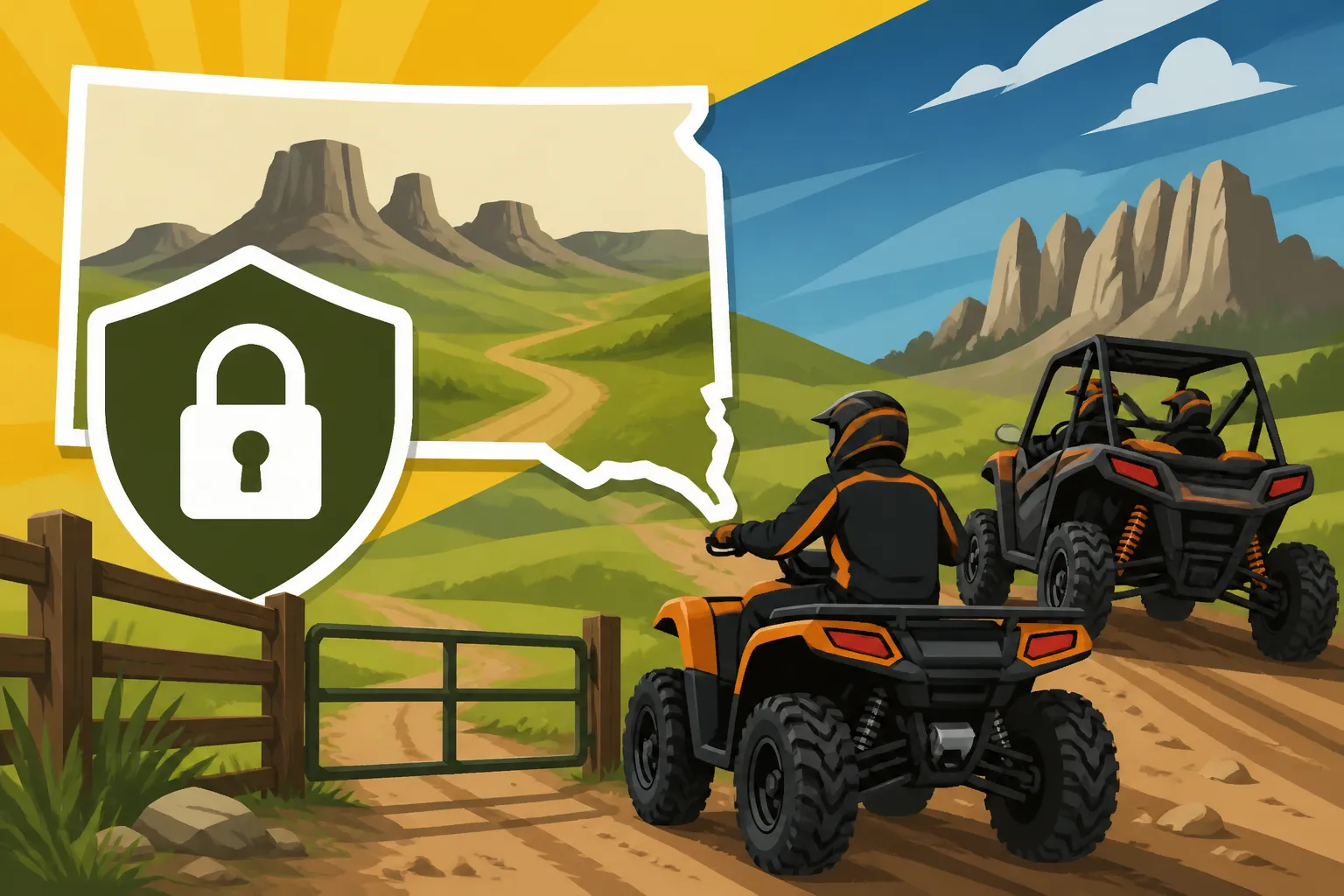
A gate left open may have been opened for livestock, equipment or another authorized user. It does not show that the property is open to the public. If you have permission and the owner gives you gate instructions, follow them exactly. Ask whether a gate should be left as found or closed behind you; practices can differ depending on livestock and the arrangement.
Do not ride around a gate, cut a fence, squeeze through a barrier or use a different entrance to avoid asking. A marked boundary, closed gate or posted notice is a clear reason to stop and confirm access. Even without a sign, private land still requires permission.
If you accidentally cross a boundary, stop as soon as it is safe, retrace your route if that will not cause further damage, and contact the owner or manager. Do not keep riding in the hope that the route will eventually return to ground where you have permission.
Permits, plates and other requirements on private ground
Permission to ride private land answers one question: whether the landholder allows you to be there. It does not automatically settle other requirements for your machine or the route you take to reach the property.
For example, a riding permit for a designated public trail system and a landowner’s permission are not interchangeable. A trail permit does not authorize access to private land, and an invitation to ride a ranch does not authorize use of a public trail that requires its own permit. Why a Plate Does Not Replace a Trail Permit explains this distinction in the context of trail riding.
If your trip is limited to private ranch ground, a public trail permit may not apply in the same way it does on designated motorized trails. But confirm the rules for the exact place you intend to ride, especially if the route connects with public land, a designated trail or a managed recreation area. When Ranch-Only Riding Needs No Trail Permit addresses this situation.
Separate the land-access question from the vehicle-use question
Before riding, check these issues independently:
| Question | What to confirm |
|---|---|
| May you enter the property? | Permission from the owner or authorized manager |
| Where may you ride? | Approved roads, fields, routes and boundary limits |
| Is any public trail included? | Whether that trail is open and whether a separate permit is required |
| How may you reach the property? | Whether the access road is public, private or subject to restrictions |
| Does your machine need a plate or other paperwork? | Requirements that apply to the machine and how it is being used |
| Are there additional land-use conditions? | Restrictions from an agency, lease, event organizer or property manager |
This separation is useful because one “yes” does not answer every question. A landowner might permit riding on a private field but not on a road outside the property. A machine may be welcome on private ground but still need to meet requirements for a public road used to reach that ground.
Public roads and public riding areas are different from private land
Do not use public roads, shoulders or other rights-of-way as though they were part of a private riding route. Road use can involve separate equipment, licensing and operating rules. A private-land invitation does not waive those rules. Before a road segment becomes part of your plan, confirm that the machine and rider can legally use it.
Public recreation areas also have their own restrictions. A trail may be closed, limited by machine width or available only during an operating season. A private owner cannot grant access to public land that they do not control. If a planned ride crosses from private ground to a public area, check the rules for each segment before you leave. [South Dakota Rules for Riding Off a Route] is relevant when an approved route meets a restricted public riding area.
Do not rely on the owner’s permission as a substitute for checking trail closures or land-manager notices. Access may change because of maintenance, weather, fire conditions, wildlife management or other operational needs. If you are unsure whether a route is public or private, pause and verify rather than following tire tracks.
Protecting access and handling common problems
Private access depends on trust. A landowner who permits riding is allowing visitors onto working ground, not handing over control of it. Courteous behavior makes future visits more likely and helps avoid conflicts with livestock, equipment operators, neighbors and other riders.
Ride in a way that respects the property
Stay on the approved route. Avoid cutting across crops, driving through wet ground, spinning tires, making new tracks or riding close to livestock. Do not assume that a dry-looking field can handle a machine without damage. If you are uncertain about ground conditions, ask before riding.
Keep noise and group size within the limits the owner set. Slow down near buildings, animals and people. Do not bring additional riders or machines without approval, and do not invite others to use the property on your behalf unless the owner has agreed.
Leave gates, barriers and equipment as instructed. Do not move farm machinery, enter buildings or use facilities unless you have permission. Pack out rubbish, avoid starting fires unless expressly allowed, and report any damage or safety issue as soon as you can.
If permission is unclear or a conflict arises
If two people give different instructions, stop and contact the person who controls access. Do not choose the answer that gives you the most freedom. If an owner, tenant or manager tells you that your route is not allowed, leave the area using a safe route and sort out the confusion later.
If a machine breaks down, a rider is injured or conditions make the approved route unsafe, contact the landowner when possible and explain the situation. Do not create a new route across adjoining property without permission simply because it is shorter or easier. In an emergency, prioritize immediate safety, then notify the relevant people as soon as practical.
For a planned group ride, identify one person to communicate with the owner and share the conditions with everyone before the group arrives. Make sure each rider understands the route, gate instructions, parking area and any limits. A single rider ignoring the agreement can put access at risk for the entire group.
If you want to ride again
Ask before your next visit, even if the owner previously said yes. This is especially important when several weeks have passed, the group has changed, weather has altered the ground or livestock are present. Treat permission as specific to the situation unless the owner clearly says otherwise.
If an owner provides ongoing access, clarify how to give notice before each ride and how to contact them if plans change. Respect a request to pause access, whether it is temporary or permanent. A reliable rider is someone who follows instructions, not someone who assumes a past invitation remains valid indefinitely.
For a wider look at permission and land access, see Getting a Rancher’s Permission in South Dakota. If your intended ride includes a public trail or motorized recreation area, check its requirements separately before you load the machines.
Frequently Asked Questions
Can I ride across private land if there is no fence or sign?
No. An unfenced parcel or missing sign does not by itself grant permission. Contact the owner or authorized manager and get approval before riding.
Does permission from a neighbor let me ride a ranch road?
Only if the neighbor has authority to grant access to that road and the owner’s permission covers your use. Confirm who controls the property and which route is included.
Does a trail permit let me ride on private land?
No. A trail permit does not replace the landowner’s permission. It applies to the places and activities covered by that permit, not every route that looks rideable.
Do I need a public trail permit if I ride only on private ranch land?
A permit for a designated public trail system generally concerns use of that system, not private ranch riding. Confirm the rules for the precise land and route, particularly if you will connect to a public trail or managed area.
Is permission from a grazing leaseholder enough?
Not necessarily. A leaseholder may not control every kind of access, and public-land or agency rules may apply. Find out who manages the land and what authorization is required for motorized recreation.
Disclaimer
This article is for general informational purposes only and does not constitute professional advice. Laws, prices and regulations vary by location and change over time. Consult a qualified professional for guidance on your specific situation.