Renewing a Trail Permit for the Next Season
Renewing a trail permit for another South Dakota ride can be confusing because the state nonresident off-road vehicle permit and the Black Hills National Forest Motorized Trail Permit are separate. The right renewal depends on where you plan to ride and what permit you already have. Here’s how to identify the permit, renew or replace it, and check your machine before heading out.
First, identify which permit is expiring
South Dakota has more than one permit requirement that can matter to an ATV or UTV rider. The state nonresident off-road vehicle permit and the Black Hills National Forest Motorized Trail Permit serve different purposes. Renewing one does not automatically renew or replace the other.
The South Dakota Department of Revenue says nonresident off-road vehicle permits are valid for one year. That permit is for eligible nonresidents; South Dakota residents cannot purchase the nonresident off-road decal. If you’re unsure which document you have, South Dakota’s Nonresident Annual Permit explains the state permit and who it applies to.
The Forest Service requires a Motorized Vehicle Use Trail Permit for motor vehicles traveling on motorized use trails in the Black Hills National Forest in South Dakota. A vehicle with a valid state license plate generally does not need that Forest Service permit for other eligible roads, but the Forest Service says a plate does not remove the permit requirement on designated motorized trails. See How the Black Hills Motorized Trail Permit Works and Why a Plate Does Not Replace a Trail Permit if your riding plans include forest roads and trails.
| Permit or document | What it applies to | What to check before riding |
|---|---|---|
| South Dakota nonresident off-road vehicle permit | A qualifying nonresident’s off-road vehicle under the state permit rules | Whether the permit is still valid, and whether the required decal and expiration sticker are displayed |
| Black Hills National Forest Motorized Trail Permit | Motor vehicles using motorized trails in the Black Hills National Forest in South Dakota | Whether your route uses a designated motorized trail and whether the Forest Service permit is current |
| Home-state hard license plate | Street legality for an out-of-state OHV under South Dakota’s rules | Whether the plate was issued by your home state’s DMV and your machine meets applicable requirements |
| Title | Ownership documentation | Whether the machine is titled; a title is not the same as a permit or plate |
The Forest Service permit is tied to use of designated motorized trails, not simply to having an ATV or UTV in the Black Hills. The Forest Service says its Motor Vehicle Use Map is the official map showing roads, trails, and areas open to public motorized travel. Check the map and current Forest Service information before choosing a route; a permit does not authorize riding on a closed trail or outside a designated route.
If you plan to ride only on a route where your valid state plate means the Forest Service permit is not required, don’t assume that the same answer applies to designated motorized trails. If your plan includes both types of routes, check the requirements for each part of the trip.
There is a separate reciprocity detail for Wyoming. The Forest Service says trail users must display a Wyoming State ORV Permit on their vehicles because the Black Hills National Forest partners with the Wyoming State Trails Program, and a Black Hills National Forest Trail Permit is not required for OHVs using trails in Wyoming. That arrangement does not mean a South Dakota nonresident permit and a Forest Service trail permit are interchangeable.
Renewing the South Dakota nonresident permit
For a nonresident who needs the state off-road vehicle permit, the South Dakota Department of Revenue says applications can be renewed online through the my605Drive portal or processed in person or by mail through any local county treasurer’s office. The renewal process is a good time to verify that the documents and machine details you submit are complete.
Gather the required documents
The South Dakota Department of Revenue says applicants must provide a copy of their driver’s license and proof of their Social Security number. Applicants must also provide either a home-state ownership document or proof of insurance. Check that the copies are clear and that the information matches the person and vehicle for which you’re applying.
The Department of Revenue also lists a Power of Attorney requirement when an authorized agent signs a title and registration application. That rule concerns the title and registration application; don’t assume that a person renewing a permit on your behalf can sign every related document without checking the applicable requirements.
Before submitting, confirm that you’re applying for the permit that fits your residency and riding plans. The state nonresident decal is not available to South Dakota residents. If you are a resident, or you are dealing with a title or plate question rather than a permit renewal, see South Dakota Nonresident ORV Permit Requirements and South Dakota ATV Title Paperwork for the relevant distinctions.
Choose an application method and plan ahead
The my605Drive portal is an online option for renewing a nonresident off-road vehicle permit. The application can also be processed in person or by mail through a local county treasurer’s office, according to the South Dakota Department of Revenue. Choose the method that gives you time to correct an incomplete application or deal with a mailing delay.
For online applications, the South Dakota Department of Revenue advises submitting at least two weeks before a planned trip. Treat that as a minimum planning window, not a guarantee that a decal will arrive by a particular day. If you’re riding soon, confirm current processing and delivery details with the portal or county treasurer before relying on a mailed decal.
According to the South Dakota Department of Revenue, as of November 2026, the nonresident off-road vehicle permit costs $50, and decals mailed to applicants have an additional $2.50 mailing fee. Check the Department of Revenue or county treasurer for current figures when you apply, since costs can change.
If you plan to apply by mail, allow time for the application and decal to travel in both directions. Keep a record of what you submitted and how you sent it. For online applications, save the confirmation or other application record so you can follow up if you need to ask about its status.
Check the decal when it arrives
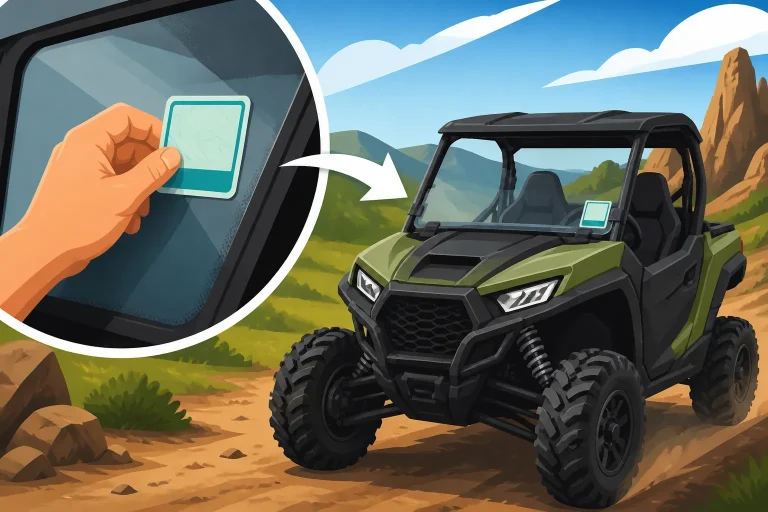
The South Dakota Department of Revenue says the permit decal must be placed on the rear of the off-road vehicle in an easily visible location. The expiration sticker must be placed on the decal for the permit to be valid. Don’t rely on an old sticker or assume that an application confirmation substitutes for the required decal.
Once the decal arrives, check that it is for the correct vehicle and that the expiration sticker is attached. Mount it where it can be seen, following the placement requirement. If a decal is missing, damaged, or unclear, contact the county treasurer or the Department of Revenue rather than trying to make an old permit appear current.
Renewing the Black Hills trail permit
If your next ride includes motorized trails in the Black Hills National Forest, check the Forest Service permit separately from the state permit. The Forest Service says Motorized Trail Permits can be purchased from Black Hills National Forest offices, local vendors, online, or the visitor center. Its permit sales support maintenance of the Forest’s motorized trail system.
For the current purchasing options, see Where to Buy a Black Hills Trail Permit. The Forest Service lists local vendors in and around the Black Hills, but locations and availability can change. Confirm that a seller currently has the permit before making a special trip.
A Forest Service trail permit requirement can apply even when the machine has a valid state plate. Conversely, the state nonresident off-road vehicle permit does not, by itself, meet the Forest Service requirement for a designated motorized trail. Check both permits against your route rather than relying on a single decal or plate to cover every kind of riding.
Use the Motor Vehicle Use Map to plan where you can ride. The Forest Service identifies that map as the official map for designating public motorized routes and areas on the National Forest. A route visible on a general-purpose map is not necessarily open to your machine. Check for closures and restrictions before departure, especially if you are returning to a route you rode in an earlier season.
If you are changing the trip plan, review the permit rules again. The Forest Service says vehicles with a valid state license plate do not need a Motorized Trail Permit unless they are using a designated motorized trail, while unlicensed OHVs on forest roads designated Open to All Vehicles need a valid Black Hills Motorized Trail Permit. The difference makes route classification and the machine’s licensing status important.
Keep in mind that riding areas outside the National Forest can have their own rules. For example, South Dakota Game, Fish, and Parks says riding in the Oahe Downstream Off-highway Area is restricted to designated areas only. A Forest Service permit should not be treated as permission to ride anywhere else.
Before you leave for the next ride
A permit renewal is only one part of trip preparation. Check the permit’s validity and display, your machine’s title and plate status, and the route-specific rules. The South Dakota Department of Revenue says off-road vehicles must be titled even though they may not be registered and licensed for highway use. A title establishes a different kind of documentation than a permit, so having one does not replace the other.
For street use, the South Dakota Department of Revenue says out-of-state OHVs must have a hard license plate issued by their home state’s DMV to be street legal. It also says four-wheeled OHVs must meet a minimum engine classification of 200 cc and two-wheeled OHVs a minimum of 120 cc; electric four-wheeled OHVs are permitted to meet the street-legal engine classification requirements. These rules concern street legality, not whether a machine has a trail permit for a designated motorized trail.
A practical pre-trip check can help catch paperwork issues before you travel:
- Confirm whether you need the state nonresident permit, the Black Hills National Forest Motorized Trail Permit, or both.
- Check the permit’s expiration details instead of assuming it follows a calendar season.
- Gather the driver’s license copy, Social Security number proof, and home-state ownership document or proof of insurance required for the state nonresident application.
- Allow the recommended processing time if you are applying online and need a decal mailed to you.
- Make sure the expiration sticker is on the state decal and that the decal is visible on the rear of the machine.
- Check the Motor Vehicle Use Map and current Forest Service information for your intended route.
- Confirm any street-use requirements separately if you plan to ride on a road.
If something does not match—such as a permit issued for a different machine, an unclear expiration sticker, or a route whose status you cannot verify—contact the agency or county treasurer responsible for that requirement before setting out. It is easier to resolve a documentation question at home than at a trailhead.
Sources
- South Dakota Department of Revenue — Off-Road Vehicles | South Dakota Department of Revenue (checked November 3, 2026)
Disclaimer
This article is for general informational purposes only and does not constitute professional advice. Laws, prices and regulations vary by location and change over time. Consult a qualified professional for guidance on your specific situation.