Sticking a Permit to a Windscreen
A permit decal can be easy to misplace when your ATV or UTV has a windshield, especially if you are sorting out a South Dakota permit and a Black Hills trail permit at the same time. The right spot depends on the permit and the vehicle. Here’s how to tell which decal you have, where the South Dakota decal belongs, and what to check before you ride.
Where to place a South Dakota permit decal on a windscreen
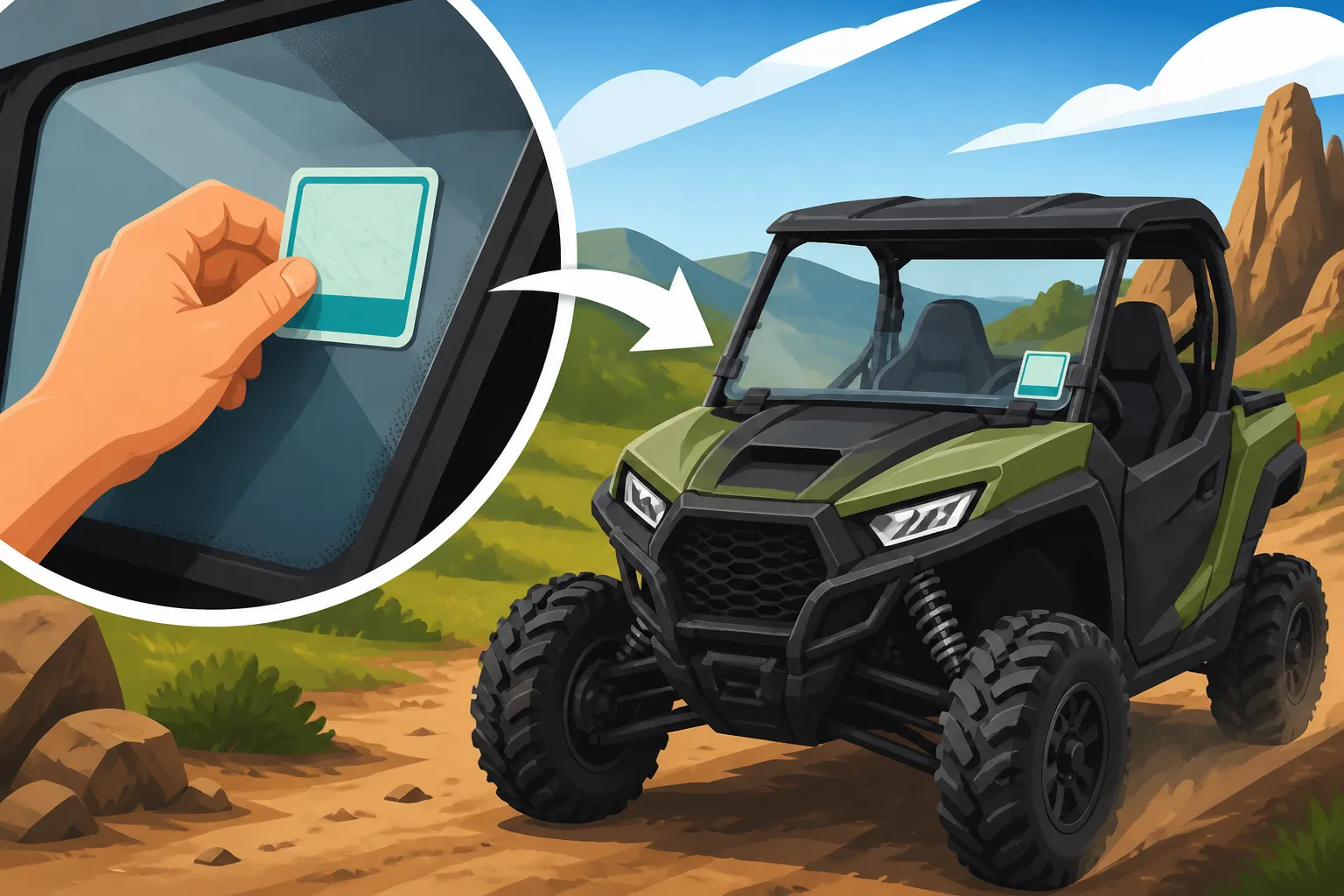
South Dakota’s placement instructions give a general location and a specific one for vehicles with a windshield. The South Dakota Department of Revenue says the decal must be placed on the rear of the off-road vehicle in an easily visible location. For a vehicle equipped with a windshield, however, the department designates the driver’s side of the front windshield as the proper location.
For a windshield-equipped ATV or UTV, use the driver’s side of the front windshield for the South Dakota permit decal. That vehicle-specific instruction is more useful than the general rear-location instruction when you are deciding where to stick it. If your machine has no windshield, use the rear location and make sure the decal is easily visible.
The placement rule matters because a decal tucked behind a seat, covered by cargo, or placed somewhere hard to see may not meet the stated location requirement. Don’t guess based on where another rider has put a sticker: first identify which permit you’re displaying, then follow the instruction for that permit and machine.
The South Dakota nonresident ORV decal also needs its expiration sticker attached to be valid, according to the South Dakota Department of Revenue. Keep the expiration sticker with the decal, and check that both are in place before you head out. A permit application or proof of purchase is not a substitute for displaying the required decal.
Before applying the decal, read any instructions that came with it. Confirm that you have the right sticker, identify the driver’s side, and choose a spot on the front windshield where the decal will be visible. Avoid placing it where a passenger, accessory, or other object will hide it. If the permit’s instructions appear to conflict with the vehicle-specific placement rule, ask the issuing agency how to display that particular permit rather than improvising.
For a closer look at the placement instruction, see Why a Windscreen Decal Goes on the Driver Side. If you are still sorting out which state decal applies to your machine, South Dakota’s Nonresident ORV Permit explains the purpose of the nonresident permit.
Tell the state permit apart from a Black Hills trail permit
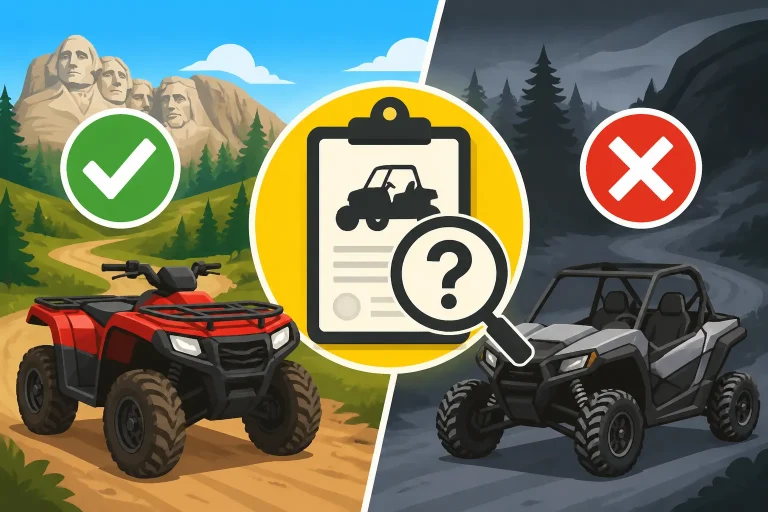
South Dakota’s nonresident ORV permit and the Black Hills National Forest Motorized Trail Permit are separate permits. They cover different requirements, so one decal does not automatically take the place of the other. That distinction is important when you are deciding what to stick on the windshield and what to carry or display for a planned route.
According to the South Dakota Department of Revenue, a nonresident off-road vehicle permit is valid for one year. The department also says that using U.S. Forest Service trails requires a separate permit in addition to the state permit. The Forest Service requires a Motorized Trail Permit for motor vehicles using motorized trails in the Black Hills National Forest in South Dakota.
| Permit or requirement | What it covers | Practical check |
|---|---|---|
| South Dakota nonresident ORV permit | The state’s nonresident off-road vehicle permit requirement | Display its decal in the correct location and attach the expiration sticker |
| Black Hills National Forest Motorized Trail Permit | Motorized use trails in the Forest, and certain unlicensed OHVs on designated Forest roads | Check whether your route requires it, even if you already have a state permit |
| Home-state plate | Street legality for an out-of-state OHV on South Dakota roads, subject to applicable requirements | Confirm your plate is a hard plate issued by your home state’s DMV |
The Forest Service draws an important distinction between roads and trails. Vehicles with a valid state license plate do not need a Forest permit unless they are on a designated motorized trail. Unlicensed OHVs on Forest roads designated as Open to All Vehicles need a valid Black Hills Motorized Trail Permit. Check the official Motor Vehicle Use Map before riding; the Forest Service identifies that map as the official map for roads, trails, and areas open to public motorized travel.
This is why looking only at the sticker on your windshield can leave you with the wrong answer. A state permit may satisfy the state requirement but not the Forest Service trail requirement. Likewise, a Forest permit is not a replacement for a state permit that applies to you. For details about the Forest permit, see South Dakota’s Motorized Trail Permit and Where South Dakota Trail Permits Are Sold.
The Forest Service sells Motorized Trail Permits through Forest offices, local vendors, online, and the visitor center. If you plan to purchase from a local vendor, confirm that the location is convenient and that it has the permit available before relying on it. The Forest Service says permit sales support maintenance of the Forest’s motorized trail system.
The Forest Service also says the Black Hills has over 3,800 miles of roads and trails for motorized vehicles, with over 700 miles of system trails designated for OHVs and available with a valid Motorized Trail Permit. Those figures describe a large riding area, not blanket permission to ride anywhere. Use the Motor Vehicle Use Map to verify that your planned route is open to your vehicle and that you have the right permit.
The rules can differ by riding area, too. South Dakota Game, Fish, and Parks says vehicles inside designated OHV areas do not require a vehicle license or park entrance license. But off-road vehicles operated in parks or campgrounds must have a South Dakota license and a park entrance license, and operators must hold a valid driver’s license. Check the rules for the specific place you intend to ride instead of assuming a permit decal covers every requirement. South Dakota Rules for Riding Federal Land offers more context on riding public land.
Check the decal and paperwork before the trip
A little preparation prevents common problems: applying the wrong decal, missing its expiration sticker, or arriving at a trail without a separate Forest permit. Use this checklist before leaving.
- Identify your vehicle and permit. Confirm whether you need the South Dakota nonresident ORV permit, a Black Hills National Forest Motorized Trail Permit, or both. A Forest trail permit is a separate requirement for motorized use trails.
- Check the application requirements. According to the South Dakota Department of Revenue, nonresident permit applicants must provide a copy of their driver’s license and proof of their Social Security Number. Online applications should be submitted at least two weeks before a planned trip so the decal has time to arrive.
- Allow for mailing if you apply online. The South Dakota Department of Revenue says mailed decals are subject to an additional mailing fee. Check with the department for the current amount and application details before submitting.
- Inspect what arrives. Make sure you have the permit decal and the expiration sticker. The South Dakota Department of Revenue says the expiration sticker must be placed on the decal for the permit to be valid.
- Place the state decal according to the vehicle. For a windshield-equipped vehicle, use the driver’s side of the front windshield. Without a windshield, the stated general location is the rear of the vehicle, where it is easily visible.
- Check the route and Forest permit. Use the Motor Vehicle Use Map to confirm that the roads, trails, or areas on your route are open to motorized use. If you will use a designated motorized trail in the Black Hills National Forest, make sure you have the required Forest permit.
- Confirm road-use status separately. The South Dakota Department of Revenue says out-of-state OHVs must have a hard license plate issued by their home-state DMV to be street legal in South Dakota. The department also specifies a minimum engine classification of 200 cc for four-wheeled OHVs and 120 cc for two-wheeled OHVs; electric four-wheeled OHVs may meet the four-wheel engine-classification requirement. A trail permit alone does not make an OHV street legal.
The state permit is not available to everyone. South Dakota residents cannot purchase the nonresident off-road decal, according to the South Dakota Department of Revenue. If you are a resident, or if you are unsure how your home-state registration applies, check the state’s requirements rather than treating the nonresident decal as a general ride permit. South Dakota Nonresident ORV Permit Requirements covers the application side, while Does South Dakota Honor Out-of-State Registration? is useful for checking the role of an out-of-state plate.
For a final check, compare the sticker on the machine with the requirements for the place you’re riding. If you’re headed to a Forest motorized trail, verify the Forest permit and the route on the official map. If you’re using a South Dakota nonresident permit, confirm that the expiration sticker is attached and that the decal is visible in the correct location for your vehicle. Keeping the two permit systems separate makes it much easier to spot what is missing before the trip.
Sources
- South Dakota Department of Revenue — Off-Road Vehicles | South Dakota Department of Revenue (checked November 3, 2026)
- USDA Forest Service — Black Hills National Forest | OHV Information | Forest Service (checked November 3, 2026)
- Forest Service — Black Hills National Forest | Off-Highway Vehicles (OHV) | Forest Service (checked November 3, 2026)
Disclaimer
This article is for general informational purposes only and does not constitute professional advice. Laws, prices and regulations vary by location and change over time. Consult a qualified professional for guidance on your specific situation.