Carrying a Spare Can on a Hills Loop
A spare fuel can can turn a long Black Hills ride into a more flexible day, but carrying gasoline on an ATV or UTV adds real safety and planning issues. Choose a suitable container, secure it correctly, and check route access and fire restrictions before you leave. A spare can is a backup, not a substitute for estimating your machine’s range.
Decide Whether a Spare Can Is Worth Carrying
Start with the ride, not the container. Look at the route distance, expected pace, elevation changes, terrain, and places where you could safely turn back. A machine that uses little fuel on a short, level ride may burn noticeably more on a long route with climbs, loose surfaces, frequent stops, or a passenger and cargo. A route that appears close on a map can also take longer than expected.
Estimate fuel use from your own machine’s history when possible. Check the owner’s manual for tank capacity and fuel guidance, then consider a recent ride on similar terrain. Leave a margin rather than planning to arrive back with the tank nearly empty. If you are unsure how far the machine will go, shorten the route or plan a suitable fuel stop instead of relying on a spare can to rescue an overambitious loop.
A spare may be useful when:
- Your planned loop is near the machine’s practical range.
- The route has limited opportunities to reach fuel.
- You are traveling with a group whose machines have different ranges.
- You have already checked that the container can be carried securely on your machine.
- The land manager and, if applicable, rental company allow the arrangement.
A spare may be unnecessary on a short ride with a comfortable fuel margin. Extra fuel also adds weight and another item that must be secured, inspected, and handled properly. If the container shifts, leaks, or gets in the way, the backup can create a problem rather than solve one.
| Planning question | What to check |
|---|---|
| How much fuel will the route use? | Your machine’s recent consumption on similar terrain, not just its rated capacity |
| Where could you refuel? | Confirm that fuel is actually available along the planned route; do not assume a trailhead has it |
| Can the can be carried safely? | Check the machine’s manual, available mounting points, and the container manufacturer’s instructions |
| Is the route open? | Check current trail maps, notices, seasonal conditions, and closures |
| Does the ride require a permit? | Confirm the applicable requirements for the land and route you plan to use |
| Are you renting? | Ask the outfitter about fuel containers, mounting, and contract restrictions before pickup |
When planning a Black Hills route, check Planning Fuel Across a Hills Loop alongside Black Hills Trail Conditions Before You Ride. A route that is open on a map may still be affected by temporary closures or conditions that change your fuel needs.
Choose and Secure a Suitable Container
Use a purpose-made portable fuel container intended for gasoline. Do not use a water jug, drink bottle, household container, or unmarked can. A container designed for fuel is made to hold it and has a closure and spout intended for that use. Follow its label and instructions, and check local rules or land-manager requirements before taking it onto public land.
A container should be in good condition: no cracks, damaged seams, loose cap, deteriorated seal, or signs of leakage. If it has been stored for a long time, inspect it before the trip. A cap that seems secure at home may loosen when the vehicle bounces over rough ground.
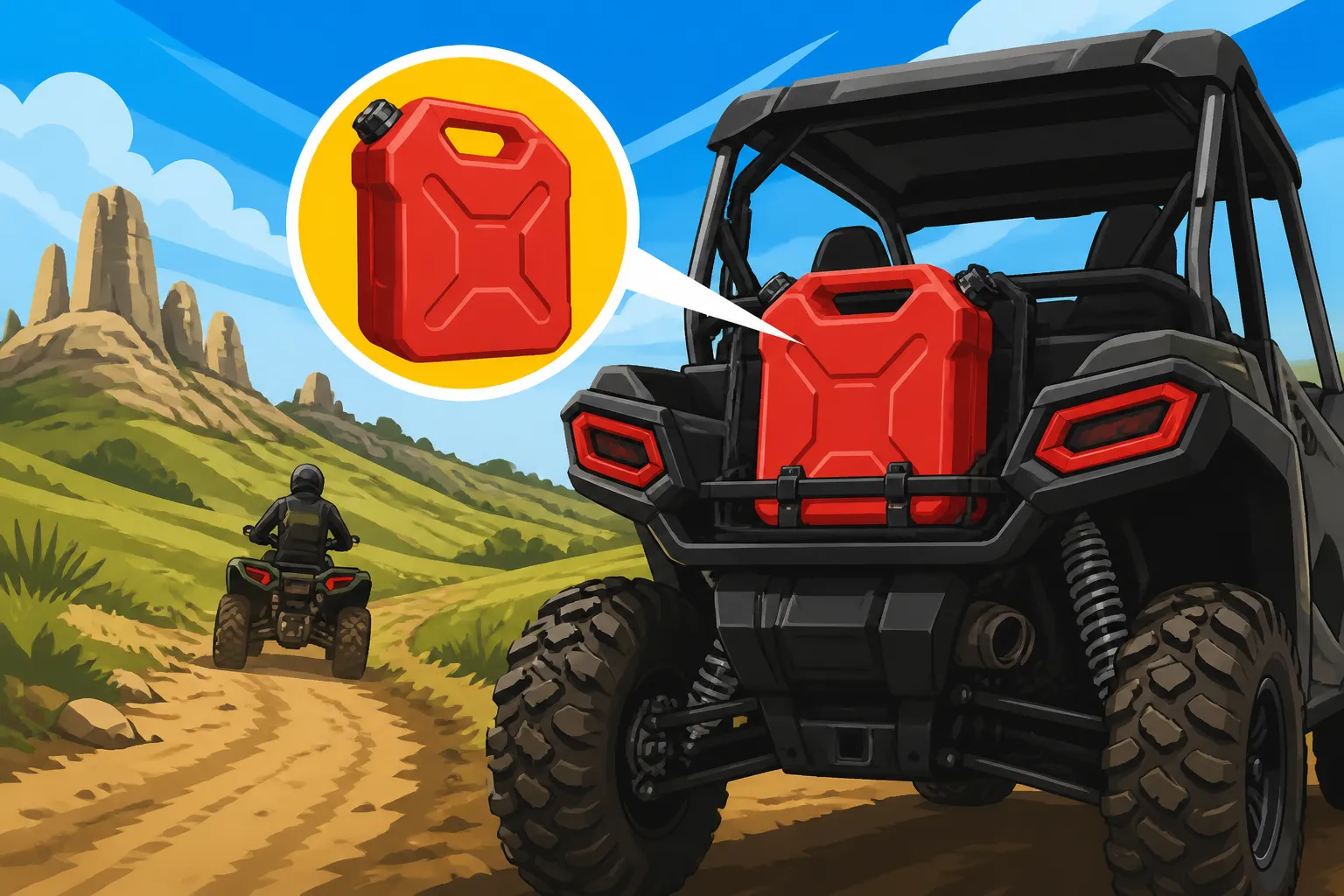
The safe mounting location depends on the machine and the container. Follow the vehicle manual and the container maker’s directions. The can should be held firmly in the intended position, kept upright where its design calls for that, and protected from contact with hot surfaces or sharp edges. Avoid placing it where it could interfere with steering, controls, lights, visibility, passengers, or access out of the vehicle. Do not assume that a cargo rack is a safe fuel-can mount simply because the can fits on it.
Use a purpose-built holder or other secure mounting arrangement suitable for the equipment. Check the restraint before leaving and again during a break. A loose container can fall off, strike the machine, or spill fuel. If you cannot secure the can without obstructing the vehicle or putting it near heat, do not carry it that way. Rework the setup or change the fuel plan.
Keep gasoline out of an enclosed passenger space. Fuel vapors can build up, and a spill inside a cab or near riders creates an avoidable hazard. Do not carry a can where people may kick it, sit on it, or shift it while riding. If the machine’s manual does not clearly support an arrangement, ask the dealer or manufacturer rather than improvising.
Before departure, consider a short test on private property or another appropriate area. Check that the container remains secure over bumps and does not rub against the vehicle. Recheck it after the first part of the ride, especially if the route is rough. For a rental, do not add a rack or alter the machine without the outfitter’s permission.
Some riders look for containers and mounts through general retailers such as Amazon, but the listing alone does not establish that a product fits a particular ATV or UTV or is appropriate for a specific ride. Confirm the container’s intended fuel type, mounting compatibility, condition, and instructions before buying or using it.
Handle Fuel Carefully on the Ride
A spare can is useful only if it remains intact and is handled with care. Before loading, make sure the cap and any spout are closed as directed. Do not overfill the container; follow its marked fill guidance and allow the space its design requires. Keep it away from cigarettes, open flames, sparks, and other ignition sources.
If you need to transfer fuel, stop in a safe, well-ventilated place away from other riders and ignition sources. Turn the engine off and follow the machine and container instructions. Avoid refueling near a hot exhaust or engine. If fuel spills, stop and address the spill safely before restarting or continuing; do not leave contaminated material on the trail. Never pour leftover gasoline onto the ground or into a drain.
A hand pump or spout can make transfer easier if it is designed for the container and used according to its instructions. Keep the cap and spout clean, and store them so dirt cannot enter the fuel system. Dust and debris are common concerns on an off-road ride, and a dirty transfer can create problems after the ride even if the container did not leak.
A spare can is not permission to ride farther than the route allows or to continue through a closure. Carrying fuel does not replace a trail permit or make a closed route legal. For requirements that apply to the trail system, see How the Black Hills Motorized Trail Permit Works. For broader rules on public land, South Dakota Rules for Riding Federal Land is a useful companion. If your machine is registered out of state, also confirm the applicable road and permit requirements; Riding South Dakota With an Out-of-State Plate addresses that separate question.
Fire restrictions deserve particular attention during dry conditions. Check current notices for the land you will visit and follow any restrictions on fuel handling, equipment, or access. Rules can depend on the location and conditions, so do not rely on a previous trip as proof that the same setup is permitted now. Review Fire Closures in a Dry Black Hills Summer and South Dakota Rules for Carrying Fuel before setting out.
Build the Fuel Plan Around Access and the Machine
A sensible fuel plan has several parts: enough fuel for the intended loop, a reserve that suits the route, and a way to stop if conditions change. Do not treat a spare can as guaranteed range. A detour, slow terrain, weather, or a closed route can change the day’s fuel requirement. Make sure everyone in the group understands the turnaround point and what to do if one machine begins using fuel faster than expected.
Before the ride:
- Check the machine’s fuel guidance and inspect its tank, cap, and fuel system.
- Estimate consumption for terrain and riding conditions similar to the planned route.
- Identify possible fuel stops and verify they are accessible and operating.
- Check the route’s current status, permit requirements, and any restrictions on carrying fuel.
- Secure the can according to the machine and container instructions.
- Tell the group where the reserve is carried and agree on when to turn back.
Keep the machine’s own fuel gauge or other reliable fuel information in view. Do not wait until the warning light comes on or the engine begins to falter before making a decision. If the fuel level is lower than expected, turn around while there is still a safe margin. A reserve is for uncertainty, not a reason to ignore an early warning.
For a UTV, account for passengers and cargo when choosing where the can goes. A full vehicle can have less available cargo space and different handling than an unloaded one. For an ATV, the mounting arrangement needs particular care because cargo can affect balance and control. In either case, make sure the load does not block access to emergency equipment or interfere with the way riders get on and off.
If you rent, ask the outfitter before bringing a spare can. The rental may already have a fuel plan, or the company may prohibit extra fuel or require a specific mounting method. A rental agreement can also set conditions on where the vehicle may be ridden and how it must be returned. Check South Dakota Rules for a Rented Machine and read the actual rental terms before adding equipment. Do not assume that a machine’s included permit or decal covers every route or land type.
After the ride, remove the can as directed and store it in a safe, approved location. Inspect the mount and container for damage or leakage, and clean off fuel residue without washing it into a storm drain or waterway. If the can is damaged, do not keep using it simply because it held fuel during the trip.
A good Hills-loop fuel plan is conservative: know the machine’s likely range, confirm the route is open, secure any spare fuel properly, and turn back before the reserve becomes essential. If you cannot carry a can safely or confirm that it is allowed, choose a shorter loop or arrange a verified fuel stop instead.
Disclaimer
This article is for general informational purposes only and does not constitute professional advice. Laws, prices and regulations vary by location and change over time. Consult a qualified professional for guidance on your specific situation.