Buying a Permit at a Black Hills Forest Office
Buying a permit at a Black Hills Forest office can be a convenient way to get ready for a ride, but it helps to know which permit you need. South Dakota’s off-road vehicle permit and the Black Hills National Forest Motorized Trail Permit are separate requirements. Here’s how to sort them out, what to check before you go, and what to have ready.
Know which permit you are buying
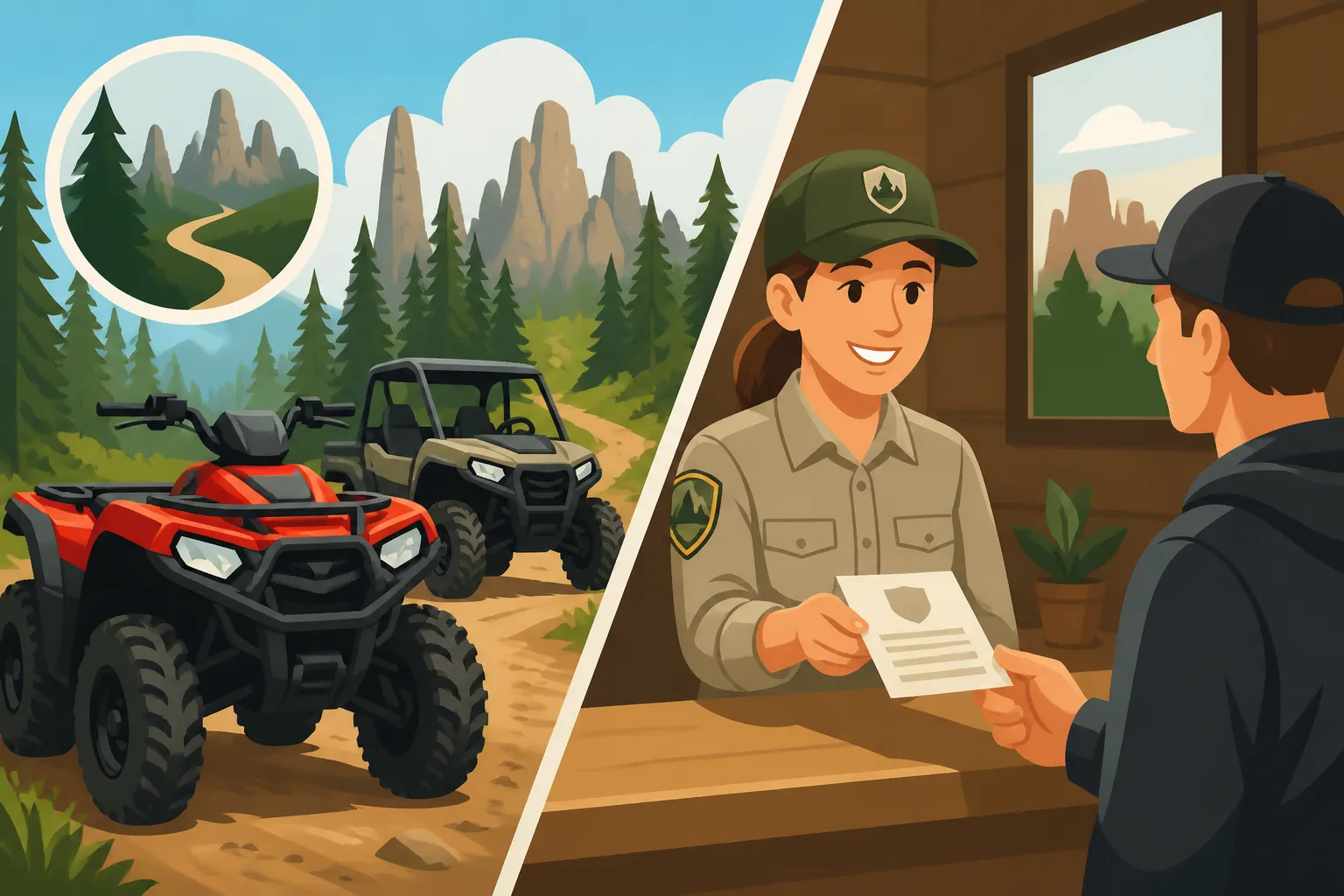
The Black Hills National Forest Motorized Trail Permit is required for motor vehicles using motorized trails in the Forest. The Forest Service says permits are available at Black Hills National Forest offices, local vendors, online, and the visitor center. Buying from a Forest Service office is one option, but it is not the only place to get one.
The Forest permit is not the same as South Dakota’s nonresident off-road vehicle permit. South Dakota’s Department of Revenue administers that state permit; the Forest Service’s Motorized Trail Permit applies to motorized use trails in the Black Hills National Forest. A state decal does not replace a Forest permit when one is required, and a Forest permit does not take the place of state requirements that apply to your machine.
That difference matters most when you are deciding where you plan to ride:
| Where you plan to ride | What to check |
|---|---|
| A motorized use trail in the Black Hills National Forest | The Forest Service says a Motorized Trail Permit is required. |
| A Forest road marked Open to All Vehicles, using an unlicensed OHV | The Forest Service says a valid Black Hills Motorized Trail Permit is required. |
| A Forest road, with a valid state license plate | The Forest Service says a permit is not needed unless you are driving on a designated motorized trail. |
| A designated motorized trail, with a valid state license plate | The Forest Service says the permit is still required. |
| A trail in Wyoming | The Forest Service says a Black Hills National Forest Trail Permit is not required for OHVs using trails in Wyoming. Wyoming’s State ORV Permit must be displayed on vehicles using the relevant trails under the Forest Service’s partnership with the Wyoming State Trails Program. |
If you are still unsure which requirement applies to your route, start with South Dakota Trail Permits Explained and Do You Need a Permit on a Black Hills Trail?. For the specific Forest permit, How the Black Hills Motorized Trail Permit Works explains why a state plate and a trail permit are not interchangeable.
What to do before visiting a Forest office
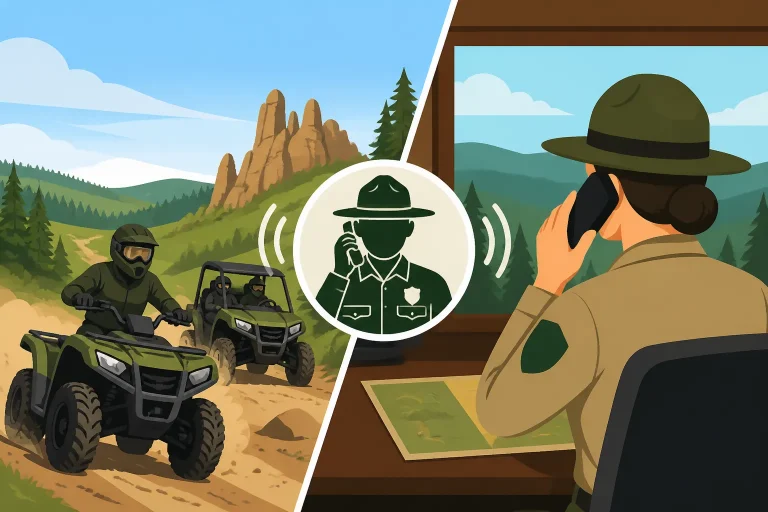
A Forest office can be a practical place to ask questions and purchase the Motorized Trail Permit, but do a little preparation first. The Forest Service lists offices as a purchase option; that does not establish that every office has the same hours, services, or availability. Check with the office before making a special trip, and confirm that it can sell the permit you need.
Use this process to avoid arriving at the counter with the wrong plan:
- Identify your route. Check whether you will use a designated motorized trail, a Forest road, or both. The permit rules differ according to where and how the OHV is used.
- Check the official map. The Forest Service identifies the Motor Vehicle Use Map as the official map for roads, trails, and areas open to public motorized travel on the National Forest. It is available free from local Forest Service offices, local vendors, and online. Use it to check whether your planned route is open to your vehicle type.
- Confirm the office’s permit service. Contact the Forest office you intend to visit and ask whether it sells the Motorized Trail Permit and when you can purchase it. Check the current office information rather than assuming a particular location is open or has permits available.
- Ask which permit applies to your machine and route. If you have a state plate, an out-of-state plate, or a machine that is not licensed for highway use, explain that when you ask. It can help clarify whether you need the Forest permit, a state permit, or both.
- Keep the permit information with your ride plan. Check the Forest Service’s current instructions for displaying the permit and follow them before heading onto a motorized trail.
The Forest says its Motorized Vehicle Use Map is the official reference for public motorized travel. A general road map or a route suggestion from another rider may not show the same access restrictions. Check the map for the roads and trails you intend to use, and look for signs or closures that affect access. The map is also useful for planning around trails that do not allow motor vehicles. For example, the Black Hills National Forest says the ’76 Trail explicitly prohibits motor vehicles.
If you are choosing a Forest office because it is near your ride, confirm the location rather than relying on an old itinerary or search result. The Forest Service also lists local vendors and online purchasing as alternatives. The page Where to Buy a Black Hills Trail Permit can help you compare those options.
Don’t confuse the Forest permit with South Dakota’s state permit
The Forest permit is only one part of planning if your machine or residence brings South Dakota’s off-road vehicle rules into play. South Dakota requires off-road vehicles to be titled, even if they are not registered and licensed for highway use, according to the South Dakota Department of Revenue. That title requirement is different from the Forest trail permit requirement.
For nonresidents, the South Dakota Department of Revenue says the nonresident off-road vehicle permit is valid for one year. As of November 2026, the department lists its cost as $50. Applicants must provide a copy of their driver’s license and proof of their Social Security Number. South Dakota residents cannot buy the nonresident decal. These are state-permit rules, not the purchase requirements for the Black Hills National Forest Motorized Trail Permit.
If you plan to apply for the state permit online, the South Dakota Department of Revenue recommends submitting the application at least two weeks before your trip. The department also says decals mailed to applicants are subject to an additional $2.50 mailing fee. That mailing charge concerns the state decal; it does not tell you the price or delivery arrangements for the Forest permit. Check the Forest Service for current Motorized Trail Permit details.
The difference is especially important for riders visiting from another state. The South Dakota Department of Revenue says out-of-state OHVs must have a hard license plate issued by their home state’s DMV to be street legal in South Dakota. The department’s engine-classification requirements also apply: four-wheeled OHVs must meet a 200 cc minimum, while two-wheeled OHVs must meet a 120 cc minimum. Electric four-wheeled OHVs are permitted to meet the street-legal engine classification requirements. Those state road-use rules do not remove the Forest permit requirement for a designated motorized trail.
In practical terms, check your status in separate steps:
- State title and road-use status: Review the rules that apply to your machine and home-state documentation. Does South Dakota Honor Out-of-State Registration? covers the state side of the question.
- State nonresident decal: If you need it, follow the South Dakota Department of Revenue’s application and documentation requirements. See South Dakota Nonresident ORV Permit Requirements.
- Forest trail access: Check the Motor Vehicle Use Map and obtain the Forest permit if your route requires it.
- Permit display: Follow the Forest Service’s current display instructions for its permit. For the state decal, the South Dakota Department of Revenue says it must be placed on the rear of the off-road vehicle in an easily visible location, with the expiration sticker attached to the decal for the permit to be valid.
A valid state plate can change whether you need a Forest permit on a particular Forest road, but it does not exempt you from the permit on a designated motorized trail. If that distinction is relevant to your route, Why a Plate Does Not Replace a Trail Permit is a useful next read.
Plan the ride as well as the purchase
Getting the permit at a Forest office does not by itself confirm that every road or trail you hope to use is open. Use the Motor Vehicle Use Map to plan a legal route, then check for current restrictions and closures before setting out. The Forest Service says the Black Hills offers over 3,800 miles of roads and trails for motorized vehicles, including over 700 miles of system trails designated for OHVs and available for riding with a valid Motorized Trail Permit. Those figures describe the Forest’s broader network; they do not mean every route is open to every machine.
There are currently 21 designated motorized trailheads on the Forest, according to the USDA Forest Service. A trailhead can make a useful starting point, but confirm its access and facilities before relying on it. For instance, the USDA Forest Service says Antelope Springs Trailhead is used primarily by motorized vehicles and day-use motorized trail users, and that potable water is not available at the site. Bring what you need rather than assuming water or other services will be there.
Also distinguish a Forest motorized trail from a designated OHV area managed by another agency. South Dakota Game, Fish, and Parks says vehicles inside designated OHV areas do not require a vehicle license or a park entrance license. That does not establish the rules for a Forest trail; the Forest Service’s permit requirements still apply to motorized use trails in the Black Hills National Forest. Check the rules for the specific land manager and riding area, rather than treating every off-road route as part of one permit system.
If your trip includes camping, account for the Forest’s separate occupancy limit. The USDA Forest Service sets a 14-day limit for camping and occupancy in the Black Hills National Forest. That is not a trail-permit duration; it is a camping and occupancy rule. For route planning, South Dakota Trail Maps and MVUMs can help you understand why the official map matters, while South Dakota Trail Closures to Check First is useful when you are checking access before leaving.
A quick pre-ride checklist
Before you head to the Forest office or onto a trail, make sure you can answer these questions:
- Is your route on a designated motorized trail, a Forest road, or both?
- Does the Forest Service’s Motor Vehicle Use Map show the route as open to your machine?
- Does your machine need a Forest Motorized Trail Permit for that route?
- Do South Dakota title, plate, or nonresident permit rules apply to your machine?
- Have you confirmed the office’s hours and permit availability?
- Have you checked for closures and trailhead conditions?
- If camping, have you planned around the Forest’s occupancy limit?
The most reliable approach is to treat the Forest permit, any South Dakota state permit, and your route access as separate checks. Buying at a Forest office can help you get the Forest permit and clarify questions, but it cannot substitute for checking state requirements or confirming that a trail is open.
Sources
- South Dakota Department of Revenue — Off-Road Vehicles | South Dakota Department of Revenue (checked November 3, 2026)
- USDA Forest Service — Black Hills National Forest | OHV Information | Forest Service (checked November 3, 2026)
- Forest Service — Black Hills National Forest | Off-Highway Vehicles (OHV) | Forest Service (checked November 3, 2026)
Disclaimer
This article is for general informational purposes only and does not constitute professional advice. Laws, prices and regulations vary by location and change over time. Consult a qualified professional for guidance on your specific situation.