Waiting Two Weeks for the Post
A South Dakota trip can be planned well in advance and still go sideways if a required permit decal has not arrived. The key is to separate the state nonresident off-road vehicle permit from the Black Hills National Forest trail permit, then build enough time into your plan for the mailed decal and check what your route requires.
What the two-week lead time covers
The two-week wait is about applying early for a South Dakota nonresident off-road vehicle permit when you plan to receive its decal by mail. According to the South Dakota Department of Revenue, online permit applications should be submitted at least two weeks before the planned trip. That is a minimum lead time for applying, not a promise that your decal will arrive on a particular day.
The permit is relevant to nonresident riders using an off-road vehicle in South Dakota. According to the South Dakota Department of Revenue, the nonresident permit is valid for one year. Its cost is $50, and decals mailed to applicants have an additional $2.50 mailing fee, as of November 2026. Check the Department of Revenue for current requirements and costs before applying.
A permit application also involves more than entering vehicle information. According to the South Dakota Department of Revenue, applicants must provide a copy of their driver’s license and proof of their Social Security Number. Gather those documents before starting so you do not lose time tracking down paperwork after beginning the application.
It helps to think of the wait as a planning buffer, not a delivery estimate. Submit the application early enough to allow for processing and mailing, and leave extra room if your travel dates are fixed. If the decal has not arrived close to departure, contact the relevant official office to confirm your options rather than assuming an email receipt, application confirmation, or proof of payment is a substitute for the physical decal.
For eligibility and application details, see South Dakota Nonresident ORV Permit Requirements. For the cost and mailing charge, South Dakota Nonresident ORV Permit Cost and South Dakota ORV Permit Decal Mailing cover the related questions.
Do not confuse the state permit with a Forest Service permit
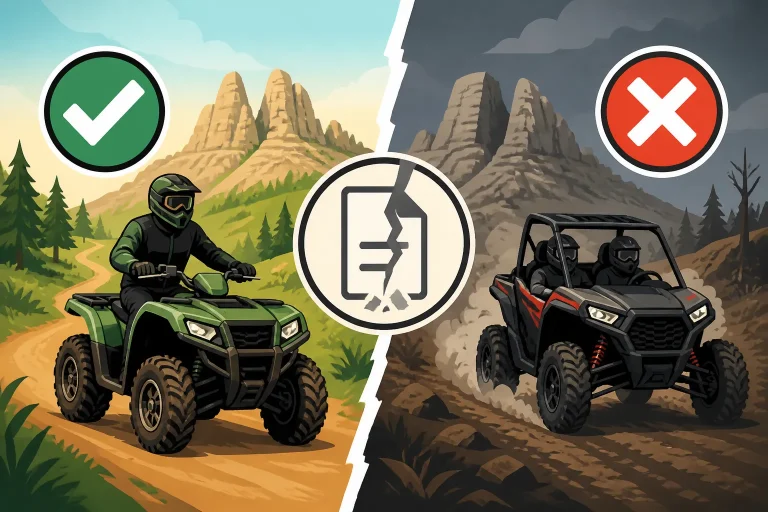
A South Dakota nonresident off-road vehicle permit and a Black Hills National Forest Motorized Trail Permit are separate requirements. Getting one does not automatically satisfy the other.
According to the South Dakota Department of Revenue, using U.S. Forest Service trails requires a separate permit in addition to the state permit. The Forest Service also requires a Motorized Vehicle Use Trail Permit for motor vehicles traveling on motorized use trails in the Black Hills National Forest in South Dakota. Plan for each permit based on where you intend to ride, rather than treating a single decal or receipt as proof of permission everywhere.
The Forest Service offers its motorized trail permit through Forest Service offices, local vendors, online sales, and the visitor center. Forest Service permit sales support maintenance of the motorized trail system. That means there may be a local way to obtain the Forest Service permit even if you applied online for the state permit, but buying a trail permit locally does not replace the state nonresident permit.
Unlicensed off-road vehicles also need a valid Black Hills Motorized Trail Permit on forest roads designated as open to all vehicles, according to the Forest Service. A vehicle with a valid state license plate generally does not need that permit on forest roads, but the Forest Service says the permit is still required on a designated motorized trail. Check your route and vehicle status rather than assuming a plate covers trail access.
For a practical breakdown of the forest requirement, read South Dakota Motorized Trail Permit. If you need to find a purchase option near your route, Where to Buy a Black Hills Trail Permit can help you plan that part separately.
| What you are arranging | What it covers | What to check |
|---|---|---|
| South Dakota nonresident off-road vehicle permit | The state permit for eligible nonresident off-road vehicle use | Application documents, decal mailing, and permit validity |
| Black Hills National Forest Motorized Trail Permit | Required use of applicable motorized trails and certain forest roads | Whether your route is on a designated motorized route and where to buy the permit |
| Home-state plate | Street legality for an out-of-state OHV in South Dakota, if it meets the requirements | Whether the plate is a hard plate issued by your home-state DMV and whether the machine qualifies |
Build a trip plan around the decal, not just the application
Start by identifying the places you intend to ride. The Black Hills National Forest is not the same as a designated state OHV area, and riding on public land does not mean every road or trail is open to every machine. The Forest Service’s Motor Vehicle Use Map is the official map for roads, trails, and areas open to public motorized travel on the National Forest. It is available free through local Forest Service offices, local vendors, and online.
Use that map to decide whether your planned route includes motorized trails, forest roads, or other designated riding areas. Then confirm the permit required for each part of the route. If your itinerary includes Forest Service trails, arrange the Forest Service permit as well as the state permit. A route that changes during the trip can change which permit rules apply.
The decal itself needs to be usable and visible when you ride. According to the South Dakota Department of Revenue, the state permit decal must be placed on the rear of the off-road vehicle in an easily visible location. The expiration sticker must also be placed on the decal for the permit to be valid. Once it arrives, check that both pieces are present and follow the placement instructions before you travel. Do not leave this step until you reach the trailhead.
Keep your application information and permit details accessible while traveling, but do not treat paperwork as a replacement for a required decal. If the decal is delayed, verify the official rules before setting out. A retailer’s receipt or a screenshot might help you explain what happened, but do not assume it grants riding access.
This is also a good point to review the vehicle’s status. South Dakota distinguishes titling from highway registration: according to the South Dakota Department of Revenue, off-road vehicles must be titled even though they may not be registered and licensed for highway use. For an out-of-state OHV to be street legal, the Department of Revenue requires a hard license plate issued by the owner’s home-state DMV. See Does South Dakota Honor Out-of-State Registration? for the distinction between a home-state plate and a trail permit.
The vehicle also has to meet South Dakota’s classification requirements to be street legal. According to the South Dakota Department of Revenue, four-wheeled OHVs need a minimum engine classification of 200 cc, and two-wheeled OHVs need a minimum engine classification of 120 cc. Electric four-wheeled OHVs are permitted to meet the street-legal engine classification requirements. A trail permit does not make a vehicle street legal, and a street-legal plate does not eliminate every trail-permit requirement.
If someone else will sign the title and registration application on your behalf, the South Dakota Department of Revenue requires a Power of Attorney document for the authorized agent. More on the distinction between a title and road use is available in Do You Need a Title for an ATV in South Dakota? and South Dakota Rules for Riding Federal Land.
If your permit is not in hand before departure
Do not assume that applying at the last minute will solve the problem. The state recommends submitting online at least two weeks before the planned trip, and the decal is mailed to applicants. If you apply later, you have less time for processing and delivery. The official guidance does not guarantee that an application submitted closer to departure will result in a decal arriving before you leave.
If you have already applied and the decal is missing, check the application details and contact the appropriate state office for the current status and instructions. Ask directly whether there is an approved alternative for your situation. Avoid relying on advice from a seller, rental counter, or another rider unless it has been confirmed by the agency responsible for the permit.
You may still be able to buy the separate Black Hills National Forest permit from a Forest Service office, an authorized local vendor, online, or the visitor center. That can take care of the Forest Service requirement, but it does not make up for a missing state permit. Keep the two questions separate: whether your state nonresident permit is valid, and whether you have the Forest Service authorization for the roads or trails you plan to use.
Your location matters, too. South Dakota residents cannot purchase the nonresident off-road decal, according to the South Dakota Department of Revenue. And if your ride includes a park or campground rather than a designated OHV area, additional rules may apply. South Dakota Game, Fish, and Parks says off-road vehicles operated in parks or campgrounds must have a South Dakota license and a park entrance license, and operators must hold a valid driver’s license. Vehicles inside designated OHV areas do not require a vehicle license or park entrance license.
Do not assume a permit makes every route open. Riding in the Oahe Downstream Off-highway Area is restricted to designated areas, according to South Dakota Game, Fish, and Parks. The agency also says off-highway vehicles are prohibited from snowmobile trails during the snowmobile season. In the Black Hills, use the Motor Vehicle Use Map and follow posted closures and route designations.
A simple pre-departure check can prevent a frustrating arrival:
- Confirm that the state nonresident permit application is complete and that the required documents were provided.
- Check the application or contact the responsible office if the decal has not arrived.
- Confirm that the decal and expiration sticker are present and that you know where to place them.
- Identify whether your route uses Black Hills National Forest motorized trails or forest roads with a permit requirement.
- Arrange the separate Forest Service permit if your route requires it.
- Verify that the vehicle meets any street-use requirements if you plan to ride on roads.
- Check the official map and current route conditions before unloading.
The safest plan is to apply early, budget time for mailing, and verify both permits before the trip. A decal delay should prompt a check with the agency, not an assumption that one permit, plate, or receipt stands in for another.
Sources
- South Dakota Department of Revenue — Off-Road Vehicles | South Dakota Department of Revenue (checked November 3, 2026)
Disclaimer
This article is for general informational purposes only and does not constitute professional advice. Laws, prices and regulations vary by location and change over time. Consult a qualified professional for guidance on your specific situation.