Does a Wyoming Plate Work in the Black Hills?
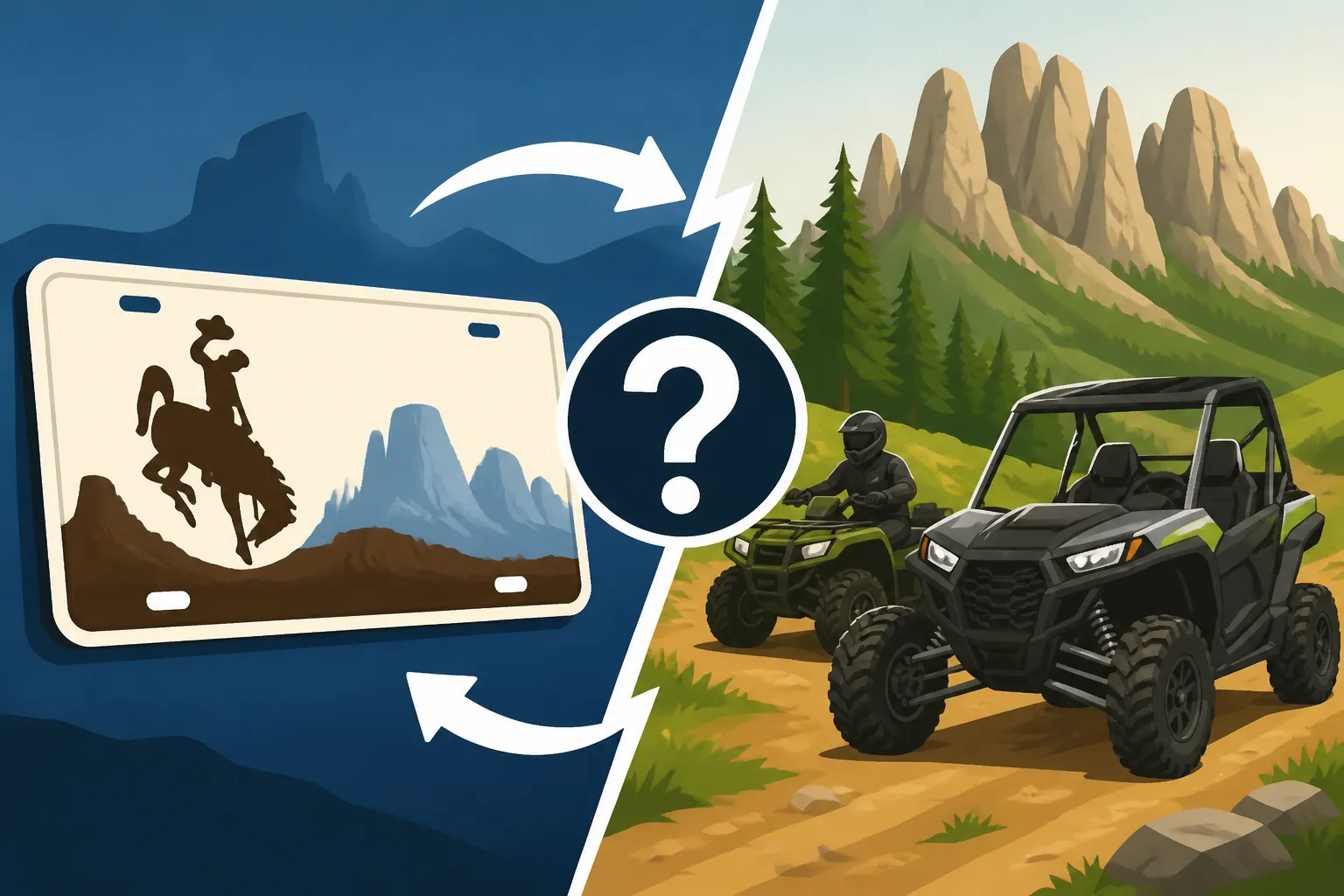
A Wyoming plate may let an ATV or UTV use certain roads in the Black Hills, but it does not automatically grant access to every forest road or trail. The key distinction is between a hard plate issued by Wyoming’s DMV, a state off-road permit, and a Black Hills motorized trail permit. Which one you need depends on where you ride and whether the route is a road or a designated trail.
The short answer: a plate helps, but it is not a trail pass
A valid hard license plate issued by your home state can establish that an out-of-state off-highway vehicle is licensed for street use in South Dakota. According to the South Dakota Department of Revenue, an out-of-state OHV must have a hard plate issued by its home-state DMV to be street legal. The vehicle must also meet South Dakota’s engine-classification requirements: at least 200 cc for a four-wheeled OHV or 120 cc for a two-wheeled OHV. Electric four-wheeled OHVs can meet the four-wheeled classification requirement.
That answers only part of the question. A Wyoming plate is not a blanket pass for Black Hills National Forest routes. According to the Forest Service, a vehicle with a valid state license plate generally does not need a Black Hills Motorized Trail Permit on forest roads designated Open to All Vehicles, but a permit is required when using a designated motorized trail.
| Where you plan to ride | What a Wyoming plate does | What to check |
|---|---|---|
| A forest road designated Open to All Vehicles | A valid state plate generally means no Black Hills Motorized Trail Permit is needed for that road. | Confirm the road is open to your vehicle and your machine is legally plated. |
| A designated motorized trail in the South Dakota portion of the forest | The plate does not remove the motorized-trail permit requirement. | Get the applicable trail permit and verify the route on the official map. |
| A route in the Wyoming portion of the forest | A Wyoming plate and a Wyoming State ORV Permit are not the same credential. | Follow the Wyoming permit rule for the route; the Forest Service says a Black Hills National Forest Trail Permit is not required for OHVs using trails in Wyoming. |
| A South Dakota state OHV area or park | Forest rules do not automatically determine the requirements there. | Check the area’s own license and entrance requirements before unloading. |
The important distinction is not simply whether the machine has a plate. It is also the route designation and which state’s rules apply at that location. For a broader explanation of the state system, see South Dakota Trail Permits Explained and Out-of-State Plates on South Dakota Roads.
Plate, state permit, and forest permit are different things
It is easy to treat “registration,” “plate,” and “permit” as interchangeable, but they serve different purposes. A plate is evidence that the machine has a state-issued license for road use. A nonresident OHV permit is a separate South Dakota credential. A Black Hills Motorized Trail Permit applies to motorized trail use in the national forest.
South Dakota requires off-road vehicles to be titled even when they are not registered and licensed for highway use, according to the South Dakota Department of Revenue. That means a title and a plate are not the same thing either. If you are unsure how your machine is classified, Does South Dakota Register ATVs? explains the distinction between titling and highway licensing.
The South Dakota Department of Revenue says a nonresident off-road vehicle permit is valid for one year. The permit costs $50, and applicants who have the decal mailed pay an additional $2.50 mailing fee; those amounts are stated as of November 2026. Applicants must provide a copy of their driver’s license and proof of their Social Security Number. The Department advises submitting an online application at least two weeks before a planned trip.
Those requirements matter if your machine needs the South Dakota nonresident permit, but do not assume that buying a state permit also covers every Forest Service trail. The Department of Revenue says using US Forest Service trails requires a separate permit in addition to the state permit. Conversely, a forest trail permit does not automatically settle state title, plate, or permit questions. For more on the state credential, see South Dakota’s Nonresident Annual Permit and What South Dakota Charges Visitors to Ride.
A Wyoming State ORV Permit is also not the same as a Wyoming hard plate. The Forest Service says trail users are required to display a Wyoming State ORV Permit on their vehicles because the Black Hills National Forest partners with the Wyoming State Trails Program. It also says a Black Hills National Forest Trail Permit is not required for OHVs using trails in Wyoming. These statements relate to the Wyoming side of the forest; they should not be read as a general exemption from South Dakota requirements on the South Dakota side.
If you are carrying a Wyoming plate but not a Wyoming State ORV Permit, do not assume the plate substitutes for that permit where the Wyoming permit is required. Likewise, do not assume the Wyoming permit substitutes for a South Dakota credential when riding on the South Dakota side. The distinction is covered more generally in Why South Dakota Honors Only a Plated Machine.
Road use and motorized trail use have different rules
A route labeled as a road is not automatically open to every OHV, and a route shown as a trail is not automatically covered by a license plate. The Forest Service’s Motor Vehicle Use Map is the official map for identifying roads, trails, and areas open to public motorized travel. Use it to confirm both the route and its designation before you ride. The map is available free from local Forest Service offices, local vendors, and online. See South Dakota Trail Maps and MVUMs for help using it.
In practical terms, the Black Hills decision is usually a sequence:
- Confirm which state you are in. The Black Hills National Forest includes riding areas in both South Dakota and Wyoming. Permit requirements can change when you cross the state line.
- Check whether the route is a road or a designated motorized trail. A plated OHV may not need a forest permit on a road designated Open to All Vehicles, but the Forest Service requires a permit for motorized use trails.
- Check whether the vehicle’s plate qualifies. The South Dakota Department of Revenue says an out-of-state OHV must have a hard license plate from its home-state DMV to be street legal. A paper document or a permit decal is not that plate.
- Check state requirements separately. A South Dakota nonresident OHV permit and a forest trail permit address separate requirements. If you are riding in Wyoming, check the Wyoming State ORV Permit requirement rather than treating the vehicle plate as a substitute.
- Match the permit to the machine and route. The Forest Service says the trail permit must be displayed for motorized trail use. Follow the current display directions and route restrictions.
Motorized trail permits can be purchased from Black Hills National Forest offices, local vendors, online, or the visitor center, according to the Forest Service. Permit sales support maintenance of the forest’s motorized trail system. If you buy a permit from a vendor, make sure you have the right permit for the area you intend to ride; a purchase receipt or a plate alone may not meet the display requirement.
The forest offers extensive motorized travel opportunities, but access is limited to designated routes. The Forest Service describes more than 3,800 miles of roads and trails for motorized vehicles and more than 700 miles of system trails designated for OHVs. That scale makes map-checking more than a formality: nearby routes can have different designations, and a route that appears rideable on a general map may not be open to motorized use. For location-specific advice, see South Dakota Rules for Riding Federal Land.
State OHV areas are a separate case
Do not apply Black Hills National Forest permit rules automatically to South Dakota state-managed OHV areas. South Dakota Game, Fish, and Parks says vehicles inside designated OHV areas do not require a vehicle license or park entrance license. But in parks or campgrounds, off-road vehicles must have a South Dakota license and a park entrance license, and operators must hold a valid driver’s license.
For example, the Oahe Downstream Off-highway Area has nearly 400 acres of terrain, and riding there is restricted to designated areas only, according to South Dakota Game, Fish, and Parks. The Revheim Bay Off-highway Vehicle Area features a 1.1-mile track. These areas are not a substitute for Black Hills forest trails, and their requirements do not establish what you need on a national forest route.
A practical checklist before you unload
Before making the drive with a Wyoming-plated ATV or UTV, sort out the machine’s road status, the route, and the permits independently. That avoids a common mistake: assuming that one credential covers all three.
- Check the plate and machine. Confirm the plate is a hard license plate issued by Wyoming’s DMV, not just an OHV permit decal. For South Dakota street legality, check the engine-classification rule that applies to your machine. The South Dakota Department of Revenue sets the minimum at 200 cc for four-wheeled OHVs and 120 cc for two-wheeled OHVs; electric four-wheeled OHVs can meet the four-wheeled classification requirement.
- Identify your intended riding area. Verify whether each route is in South Dakota or Wyoming and whether it is a forest road, a designated motorized trail, or a state OHV area. Do not rely on a route name or a general recreation map alone.
- Use the official Motor Vehicle Use Map. Confirm that the route is open to your vehicle and permitted type of use. The map is the official tool for designations on the national forest.
- Match the permit to the route. A valid state plate does not remove the Black Hills Motorized Trail Permit requirement on designated motorized trails in South Dakota. A Wyoming State ORV Permit and a Black Hills trail permit are separate credentials, and the Wyoming-side exemption should not be assumed to apply south of the state line.
- Check the state permit question directly. South Dakota’s nonresident permit has its own application and documentation requirements. If you have a Wyoming plate and are unsure whether your specific machine needs the state decal for the riding you plan to do, confirm with the South Dakota Department of Revenue before traveling.
- Display required credentials properly. According to the South Dakota Department of Revenue, the nonresident decal must be placed on the rear of the vehicle where it is easily visible, and the expiration sticker must be attached to the decal for the permit to be valid. Follow the applicable Forest Service instructions for a motorized trail permit as well.
- Allow time if applying online. The Department of Revenue advises submitting an online state permit application at least two weeks before the trip. Mailing the decal also involves the additional mailing fee described above.
- Keep the trip within the approved route. A permit does not authorize riding off-route or entering closed areas. Use current Forest Service information and check for route restrictions before setting out.
If your machine is not plated, the answer changes. The Forest Service says unlicensed OHVs on forest roads designated Open to All Vehicles need a valid Black Hills Motorized Trail Permit. That does not mean every road or trail is open to an unlicensed machine; the map designation still controls where you may ride. For the title and plate side of the question, Why South Dakota Honors Only a Plated Machine can help clarify why the credential on the vehicle matters.
Bottom line: A Wyoming hard plate can help establish that an eligible OHV is street legal, but it does not replace a permit required for a designated motorized trail. Check the state line, the route designation, and the specific permit rule before you ride.
Sources
- South Dakota Department of Revenue — Off-Road Vehicles | South Dakota Department of Revenue (checked November 3, 2026)
- South Dakota Game, Fish, and Parks — ATVs & Off-Highway Vehicles | South Dakota Game, Fish, and Parks (checked November 3, 2026)
- USDA Forest Service — Black Hills National Forest | OHV Information | Forest Service (checked November 3, 2026)
- Forest Service — Black Hills National Forest | Off-Highway Vehicles (OHV) | Forest Service (checked November 3, 2026)
Disclaimer
This article is for general informational purposes only and does not constitute professional advice. Laws, prices and regulations vary by location and change over time. Consult a qualified professional for guidance on your specific situation.