Why South Dakota Honors Only a Plated Machine
Why South Dakota Honors Only a Plated Machine
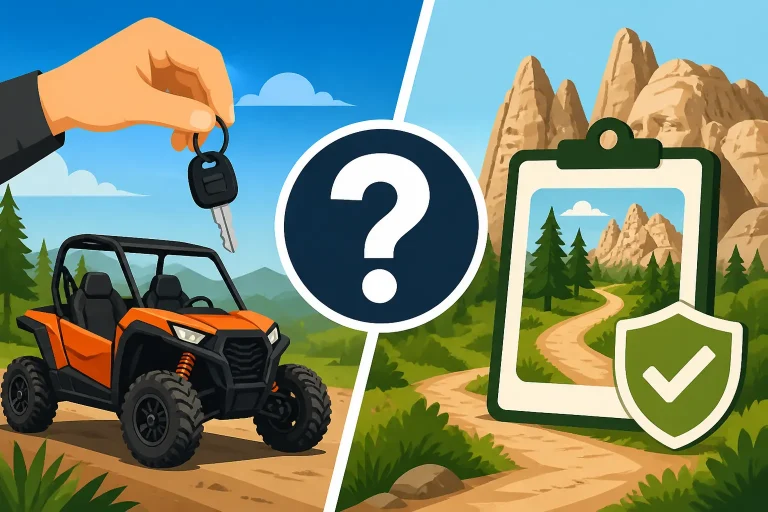
You can arrive in the Black Hills with an out-of-state registration card or a small decal and still find that it does not do what you expected. The key distinction is whether your ATV or UTV is properly plated for road use where it is registered. This guide explains what South Dakota’s reciprocity rule means, where it matters, and what to check before you unload.
What South Dakota Means by Honoring a Plated Machine
Reciprocity is not the same as accepting every out-of-state sticker
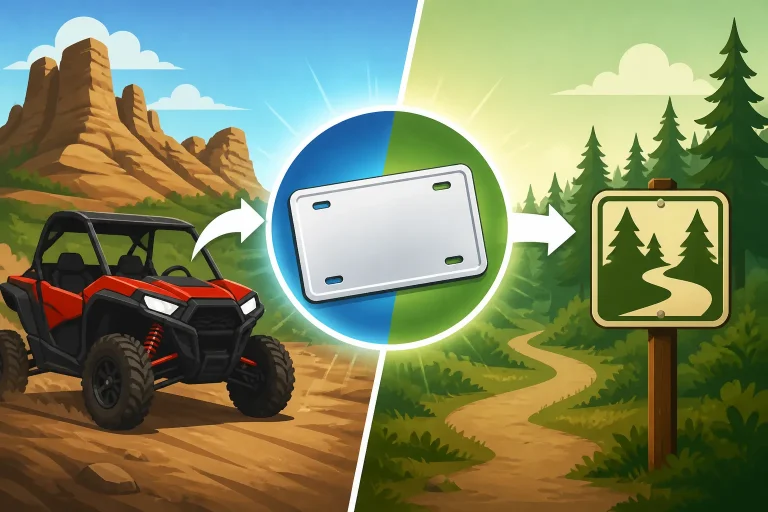
When a state “honors” another state’s vehicle registration, it generally recognizes a machine that has been properly registered under the other state’s rules. For road use, the most meaningful evidence is often a valid license plate and registration—not simply a permit decal, an off-road registration card, or a receipt showing that a fee was paid.
That distinction can catch visitors off guard. An ATV owner may have completed every registration step required at home and reasonably assume that the machine can use roads in South Dakota under the same arrangement. But an out-of-state off-road registration does not automatically give a machine road privileges in South Dakota. A registration that supports road use in the home state is a different thing from an off-road-only registration.
The practical takeaway is not that every machine must be plated in South Dakota before a visit. It is that you should not treat any out-of-state paperwork as equivalent to a plate. South Dakota’s treatment depends on what the document authorizes, what kind of route you intend to ride, and which separate permit or access rules apply there.
A plate is evidence of road registration, not a universal riding pass
A plate can be an important sign that the machine is registered for road use in its home state. That matters when you are using a road or another location where a plate is required. It does not, by itself, grant permission to ride every South Dakota road, trail, forest route, park, or public area.
Think of the plate as one part of a checklist rather than a single pass that covers the whole trip. You may still need to meet South Dakota equipment rules, follow restrictions on where off-highway vehicles can travel, and obtain a trail permit for routes where one is required. Local closures, signs, land-manager rules, and posted access restrictions continue to apply.
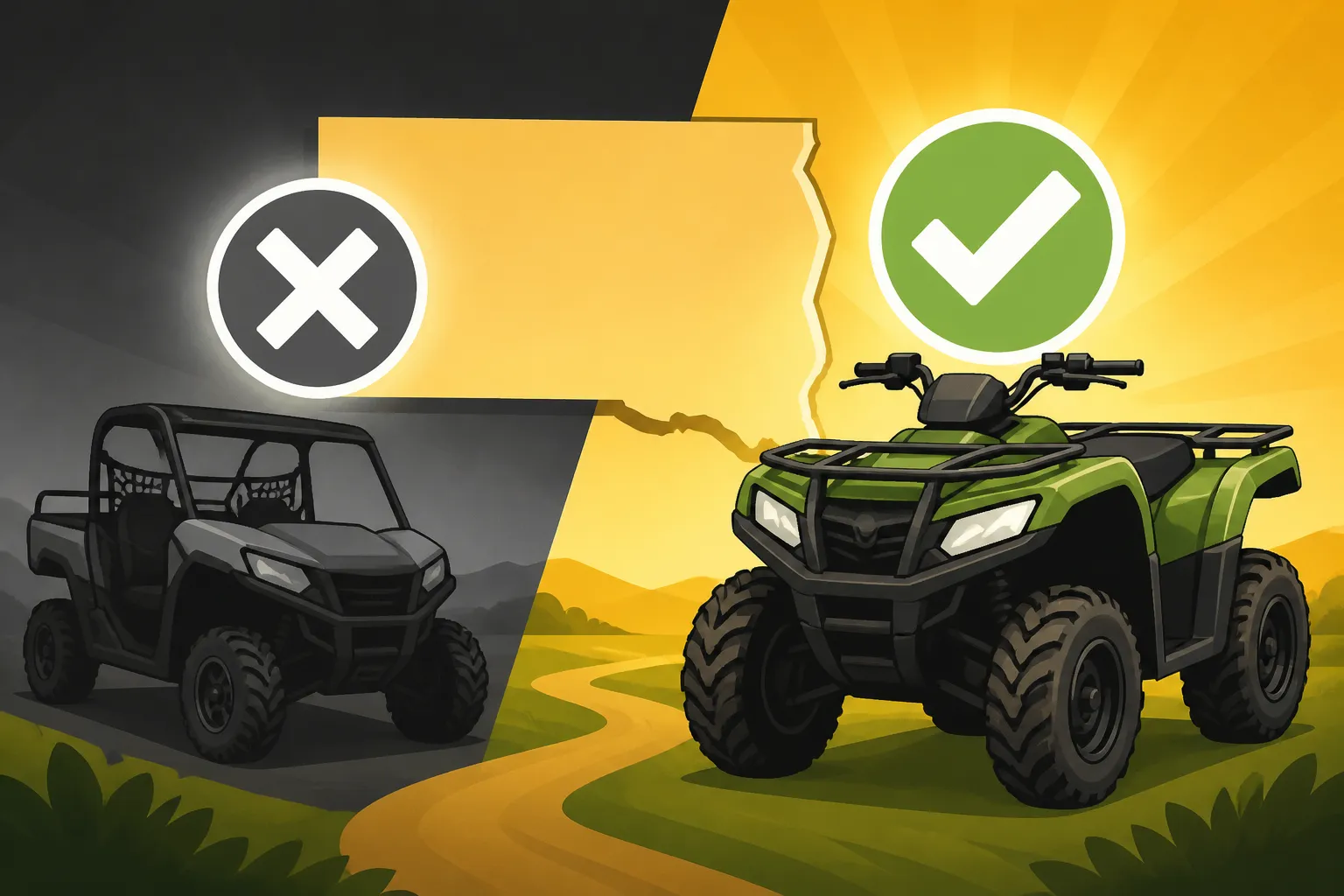
This is why the phrase “South Dakota honors only a plated machine” should be read narrowly. It addresses whether South Dakota recognizes a qualifying out-of-state registration in the relevant context. It does not mean that a plate overrides every local rule or that an unplated machine is necessarily barred from every place where off-road riding is allowed.
If you want a closer look at the registration question itself, Does South Dakota Honor Out-of-State Registration? explains why the type of registration matters. For the road-use side of the issue, Riding South Dakota With an Out-of-State Plate is a useful companion topic.
Why an Off-Road Sticker May Not Be Enough
Different states register off-road machines differently
States do not all organize ATV and UTV paperwork in the same way. One state may issue a registration card and an off-road decal, while another may offer a plate for machines that meet its road-use requirements. A third may have separate programs for off-road trails and public-road operation. A visitor can follow the rules at home and still arrive with documents that do not establish the same privileges in South Dakota.
This is especially easy to misunderstand when the home-state decal looks official. The decal may prove that a machine is registered, permitted, or taxed for a specific purpose. But it may not prove that the machine has been approved for public-road use. The document’s appearance is less important than what the issuing state says it authorizes.
Before traveling, look at the registration description and the rules attached to it. Ask whether the machine is registered for road use or only for off-road use. If the paperwork is vague, contact the issuing agency and ask what privileges the registration grants outside your home state. That answer is more useful than assuming a sticker will be recognized because it is current.
Registration and a trail permit solve different problems
Registration identifies or authorizes a machine under a state’s vehicle program. A trail permit is an access requirement for designated riding areas. They can overlap in practical planning, but they are not interchangeable. A plate may help establish the machine’s road-registration status, while a trail permit may still be needed to use certain motorized trails.
Visitors planning a Black Hills ride often need to separate the trip into route types. A road, a Forest Service motorized trail, a designated riding area, and a privately managed property may each have different requirements. Carrying a plate does not erase those differences. Likewise, purchasing a trail permit does not automatically make an ATV street legal or authorize it to travel on a road.
For a concrete example, imagine a family driving from Wyoming to a trailhead near Spearfish with a plated UTV. The plate may be relevant while the machine is being used on a road where that registration is recognized. Once the family enters a motorized trail system, they still need to check the land manager’s permit, route, and machine requirements. The machine’s legal status does not change just because the scenery does.
A clear explanation of this distinction is available in Why a Plate Does Not Replace a Trail Permit. If your route includes roads as well as trails, Why a Road Needs a Plate or a Permit helps frame the separate questions you need to answer.
| What you have | What it may help establish | What it does not establish by itself |
|---|---|---|
| Valid out-of-state plate and registration | Road-registration status, subject to applicable rules | Permission to ride every road or trail |
| Off-road registration card | Registration or status under a home-state off-road program | Road-use privileges in South Dakota |
| Off-road decal | Compliance with a particular program or access requirement | That the machine is plated for road use |
| South Dakota trail permit | Permission for covered trail access under applicable rules | Street legality or access to closed routes |
| Bill of sale | Ownership or purchase history | Registration, road legality, or trail access |
Where the Plated-Machine Rule Matters Most
Roads and trail access are different parts of a ride
A route that looks like one continuous ride on a map may cross several legal boundaries. You might travel from a town road to a forest road, then onto a designated motorized trail. Each segment can have its own rules, and an out-of-state plate may matter on one segment while a trail permit matters on another.
That is why it helps to plan from the start point to the destination rather than asking only, “Is my machine registered?” Make a list of the roads you expect to use, the public land or trail system you intend to enter, and any private property you will cross. Then verify the rule for each part of the route. A machine can be appropriately plated and still be on a road or trail where it is not allowed.
Visitors around Deadwood, Lead, Hill City, and Spearfish often want to connect riding areas with a short road segment or use a road to reach a trailhead. Do not assume that a route is open to ATVs just because cars use it, that a forest road is open to every machine, or that a nearby trail permit covers the road leading to it. Use current maps and posted signs, and confirm access with the responsible land manager when the route is unclear.
Federal land adds another layer
Some of the region’s riding opportunities are on federal land, including areas managed by the U.S. Forest Service. A state plate does not replace federal land rules. Designated routes, seasonal restrictions, width limits, closures, and permit requirements can apply independently of state registration.
For example, a plated UTV may still be too wide for a particular trail, or a route may be closed for weather, maintenance, fire danger, or another management reason. The plate does not grant an exception to a gate, closure notice, or posted restriction. Similarly, a machine that is not road-registered may still have lawful access to some off-road riding areas if the relevant land rules and permit requirements are satisfied.
Before heading into the Black Hills National Forest, check the route information for the exact area you plan to ride. Do not rely only on a general map, a rental counter’s directions, or a route someone posted online. [South Dakota Rules for Riding Federal Land] provides more context on why federal land requirements need to be considered separately from state vehicle registration.
Private property and designated riding areas follow their own rules
A private ranch, a campground, an organized riding event, and a public trail system do not necessarily share one set of access rules. On private land, permission from the owner or manager matters. On public land, the relevant agency’s route and permit rules matter. A plate does not grant access to property, and a trail permit does not authorize crossing private ground.
That distinction is useful when a route passes near a ranch or follows a two-track that appears to connect two public roads. A visible track is not proof that it is open to public riding. Gates, signs, fence lines, and land boundaries should be treated as meaningful. If access is not clear, stop and find out rather than assuming that a plated machine may continue.
The same caution applies to areas close to popular destinations. A route near Rapid City or Custer may be on land with a different manager from the trail system you started on. Confirm who controls the route, what machines are allowed, and whether a permit is required. For a broader overview of how access rules change with the land, see [South Dakota Rules for a Visiting Rider].
What to Check Before Bringing an Out-of-State ATV or UTV
Read the registration document for what it actually authorizes
Start with the registration card or certificate, not just the plate or decal. Look for language that tells you whether the machine is approved for highway or public-road use, or whether the registration is limited to off-road operation. If the document does not make that clear, ask the issuing agency before traveling.
Also check that the registration is current, that the plate belongs to the machine you are bringing, and that the vehicle identification number matches the paperwork. A mismatch can turn a simple roadside question into a frustrating delay. Keep the original documents accessible, and consider carrying a backup copy separately.
A small document sleeve can help keep registration papers dry and easy to find after a dusty ride. Some riders use a waterproof pouch from an outdoor retailer or Amazon, but the important thing is that the paperwork stays legible and is not left loose in a truck bed or cargo box. Do not place original documents somewhere that becomes inaccessible when the machine is unloaded.
Check the machine’s equipment and intended use
A plate is not a substitute for equipment required for the kind of road use you plan to do. Before you ride, confirm that the machine meets applicable equipment rules and that the road segment allows an ATV or UTV at all. Requirements can depend on the machine, route, and use, so do not assume that a model advertised as “street legal” in one state automatically satisfies every South Dakota condition.
Make a quick pre-trip checklist that includes lighting, mirrors, braking equipment, tires, registration, and any other items required for the route. Then check that the items work, not simply that they are installed. A mirror that has shaken loose on the trailer or a light that fails after a wet ride can create a problem even when the paperwork is in order.
If your plan is strictly off-road, do not spend time treating road equipment as a replacement for trail access requirements. Instead, identify the specific riding area and verify its rules. If the plan includes roads and trails, treat those as separate portions of the trip. That simple distinction helps prevent the common mistake of arriving with the right paperwork for one part of the ride and the wrong paperwork for another.
Confirm requirements with the relevant agencies
Rules can depend on who manages the route. For a state registration or nonresident permit question, contact the appropriate South Dakota motor vehicle or revenue office. For a trail or federal land question, contact the responsible land manager or ranger district. For a county or local road restriction, check with the relevant local authority.
When you call, describe the machine and the paperwork precisely. Instead of asking, “Can I ride my quad there?” say, “My machine has an off-road registration from my home state but no road plate. Does that registration satisfy the requirement for this specific route?” Include the route name, the machine’s type, and whether you intend to travel on roads, trails, or both.
Keep a note of the agency, the date of your call, and the guidance you received. You may also want to save the agency’s written instructions or a screenshot of the official route information on your phone. A weatherproof paper copy can be helpful if cell service is limited. Amazon sells general-purpose document holders, but any secure, readable storage method is fine; organization matters more than the brand.
Permits, Plates, and Reciprocity for Visitors
A nonresident permit may address a different obligation
South Dakota has nonresident permit requirements for certain off-road vehicle use. A visitor should not assume that a home-state registration—even a valid plate—settles every permit question. The permit rule and the plate-recognition question can apply to different kinds of riding or different locations.
The safest approach is to identify what the permit covers and where it applies. Ask whether the requirement is tied to being a nonresident, to operating on a particular type of public land, or to riding in a particular area. Do not infer that an exemption applies simply because your state uses a plate, card, or sticker that looks similar to South Dakota’s.
The details matter to out-of-state visitors coming from places such as Wyoming, Montana, Minnesota, or Iowa. Their paperwork systems may differ, and a rider may have a plate for one machine and an off-road-only registration for another. [South Dakota Nonresident ORV Permit Requirements] is a useful place to start when checking the nonresident side of the question.
A Black Hills trail permit is a separate consideration
The Black Hills are a major draw for ATV and UTV riders, but their trail rules should not be reduced to a registration question. A machine can be plated and still need the applicable trail permit. It can also have a permit and still be restricted from a route because of machine width, a seasonal closure, or a posted restriction.
Plan for the permit before leaving home if you expect to ride designated motorized trails. Confirm whether the permit is required for the specific places you want to visit, how it is issued, where it must be displayed, and how long it remains valid. Those details can matter when a family is traveling a long distance and has only a day or two available to ride.
Visitors planning a short trip can compare their plans with A Seven-Day Permit for a Black Hills Trip. If the visit is longer or includes multiple trips, [South Dakota’s Nonresident Annual Permit] may help explain the annual-permit option. In either case, verify the current requirements before purchasing or relying on a permit.
Do not confuse road reciprocity with trail reciprocity
Road reciprocity asks whether South Dakota recognizes a registration issued by another state for the type of road use in question. Trail access asks whether your machine may use a specific trail and whether a permit, decal, or other condition is required. Those are related travel questions, but they are not one rule.
A useful example is a visitor with a home-state plate who drives a UTV to a Black Hills staging area. The plate may be relevant to the vehicle’s status on permitted roads. The trail permit may govern the machine’s use on designated motorized trails. A seasonal closure or route width rule may still determine whether that particular trail is available to the UTV. Each requirement has to be checked independently.
Another visitor might have a machine with off-road-only registration and a valid trail permit. That permit may address access to the trail system where it applies, but it does not automatically turn the machine into a road-registered vehicle. The rider must still plan a legal way to get from the trailer or staging area to the trail without assuming that the off-road registration provides road privileges.
Common Misunderstandings That Cause Problems
“It is registered at home, so it must be legal here”
This is the most common assumption, and it is understandable. Riders invest time and money in their home-state paperwork, so it feels natural to expect the same document to work everywhere. But registration programs can grant different privileges. A current off-road registration may be perfectly valid at home and still not demonstrate that the machine is plated for road use in South Dakota.
Avoid relying on an informal description such as “registered,” “tagged,” or “legal.” Ask what the registration allows. If it is off-road-only, treat it as off-road-only unless the responsible South Dakota authority confirms otherwise for your particular situation. Bring the actual document so you can describe its wording accurately.
This is especially important if you have recently moved, bought a used machine, or inherited an ATV. The registration status may not transfer automatically with the machine, and an old plate may not prove that the current owner has valid registration. Check the paperwork before planning a road segment.
“The plate means I can ride anywhere”
A plate does not eliminate route restrictions. It does not give permission to enter private property, ride on a closed trail, ignore a posted width limit, or use roads where ATVs are prohibited. It also does not replace a trail permit where one is required.
Consider a rider who sees a forest road crossing near a popular trail. The machine is plated, the road appears open, and other vehicles have passed by. Those observations are not enough to establish that the route is open to that ATV or UTV. Check the current map and signs, and do not ride past a closure or boundary merely because the machine has a plate.
For the same reason, a plate should not be treated as a substitute for route planning. Keep your intended roads and trails on a map, note where you will switch from road use to trail use, and identify the permit or access rule for each segment. Why a Street-Legal Home State Matters can help clarify why a machine’s home-state status is relevant without making it a blanket pass.
“A decal and a plate are basically the same thing”
A decal can be an official document or part of an official program, but it does not necessarily serve the same purpose as a license plate. One decal may show trail access; another may identify off-road registration; a plate may show road registration. The specific program and the rules behind it determine what the item proves.
This distinction becomes especially important when a machine has multiple stickers. A rider may have a home-state registration decal, a trail permit decal, and a plate on another vehicle in the trailer. Keep each item’s purpose straight. If an officer or land manager asks for proof, you want to be able to show the relevant document rather than a collection of unrelated stickers.
If you use a storage pouch or organizer, label the papers clearly and keep the machine’s documents separate from the tow vehicle’s registration and insurance. A simple folder bought locally or through Amazon can help a group traveling with multiple machines avoid mixing up paperwork. The goal is quick access and clear identification, not collecting more accessories.
A Practical Pre-Ride Checklist for Out-of-State Visitors
Before you leave home
First, confirm exactly how your machine is registered. Check whether the paperwork authorizes road use or only off-road use, and make sure the plate and registration belong to that machine. If the document is unclear, ask your home-state agency what the registration permits and then confirm how South Dakota treats it for your planned use.
Next, map the trip in segments. Note which roads you will use to reach the riding area, which motorized trails you hope to ride, and whether any part of the route crosses private land or a separate management area. This is the point to check road restrictions, trail access, permit requirements, width limits, and seasonal closures.
Finally, organize the documents. Bring registration and any required permits, and keep them dry and accessible. If you are carrying several machines, make sure each document is matched to the right VIN. A pouch or folder—whether from a local outdoor shop or Amazon—can keep everything together, but it should not conceal the documents so thoroughly that you cannot present them when asked.
At the trailhead or access point
Before unloading or starting the ride, read signs at the entrance. Signs may identify a closure, a permit requirement, a route designation, or a machine restriction that is not obvious from a general map. If the sign contradicts your plan, do not assume the plate or permit gives you permission to continue.
Check that the permit is displayed or carried as required, and confirm that the machine is allowed on the route you are entering. If a trail has a width limit, use the relevant measurement method rather than estimating by eye. A machine that looks only slightly wider can still be outside the route’s stated limit.
If the route is unclear, stop before riding into it. Contact the responsible office if possible, or choose a route that is clearly open. That pause can feel inconvenient when the group is ready to go, but it is far less frustrating than finding out after the ride that you entered a closed or restricted area.
Keep the questions separate when asking for help
When contacting an agency or land manager, ask one question at a time. For example: “Does this out-of-state registration count as road registration?” is different from “Do I need a nonresident permit on this trail?” and different again from “Is this UTV width allowed on this route?” Clear questions make it easier to get a useful answer.
Write down the route name, the machine type, and the kind of paperwork you hold before calling. If you are asking about a plated machine, say whether the plate is from your home state and whether the vehicle is road-registered there. If you have only an off-road decal, say that plainly rather than calling it a plate.
Save the answer with your trip notes, but do not treat a general answer as permission to ignore a sign or current closure. Conditions can change, and different routes may have different managers. For broader permit questions, What South Dakota Charges Visitors to Ride can help you distinguish visitor obligations from road-registration reciprocity.
Planning a Smooth South Dakota Ride
Build the route around the rules, not just the scenery
The Black Hills offer a mix of roads, trails, towns, and managed recreation areas. It is tempting to choose a loop based on a map’s appearance and then work out the details later. A better approach is to start with the places where you are permitted to ride and connect them only with routes you have verified as open to your machine.
For a weekend based near Deadwood, for instance, check the access rules for the particular trail system and the roads connecting your lodging or staging area to it. If the ride includes Spearfish Canyon, Hill City, or Custer, do not assume the same access rule applies to every segment. Nearby places can be managed differently, and travel between them may involve road rules that do not apply once you reach an off-road route.
Leave room in the plan for a change of route. A closure, weather condition, fire restriction, or machine-width issue can make the preferred trail unavailable. Have a second option that is also legal and suitable for your vehicle. That is more reliable than arriving with one planned route and assuming a plate will solve every access problem.
Carry what you need without overloading the ride
Keep the documents that relate to the machine with the machine or with the driver, according to the applicable requirements. A registration card, permit information, and route map are easier to use when they are organized together. Avoid placing them where dust, moisture, or a spilled drink can make them unreadable.
A phone can be useful for maps and saved agency information, but do not make it the only place you keep essential trip details. Cell coverage can be limited in parts of the Hills, and batteries drain faster when navigation is running. Save maps for offline use where possible and carry a paper backup of key routes or permit information.
If you travel with a group, decide who carries which documents and how the group will handle a route change. Keep each machine’s paperwork identifiable, and do not assume the leader’s permit or plate covers everyone else. Check requirements for each machine separately, particularly when the group includes vehicles from different states or with different registration types.
Treat the plate as one part of a well-prepared trip
The simplest way to remember South Dakota’s reciprocity issue is this: a plate can establish an important part of a machine’s road-registration status, but it does not answer every question about trail access, permits, equipment, or land permissions. An off-road decal or registration card may also be valid for a specific purpose without providing the same road privileges.
Before riding, match the paperwork to the route. Confirm the status of the machine, identify which rules apply to roads and which apply to trails, and check the requirements of the agency or land manager responsible for each area. That small amount of planning can prevent an avoidable disagreement at a trail entrance or roadside stop.
If you are uncertain, explain the exact machine and document rather than relying on broad terms like “registered.” Ask whether the registration is recognized for the specific road or area you intend to use, and separately ask about any permit required for the trail. That is the most dependable way to understand why South Dakota honors a plated machine without assuming the plate does more than it actually does.
Disclaimer
This article is for general informational purposes only and does not constitute professional advice. Laws, prices and regulations vary by location and change over time. Consult a qualified professional for guidance on your specific situation.