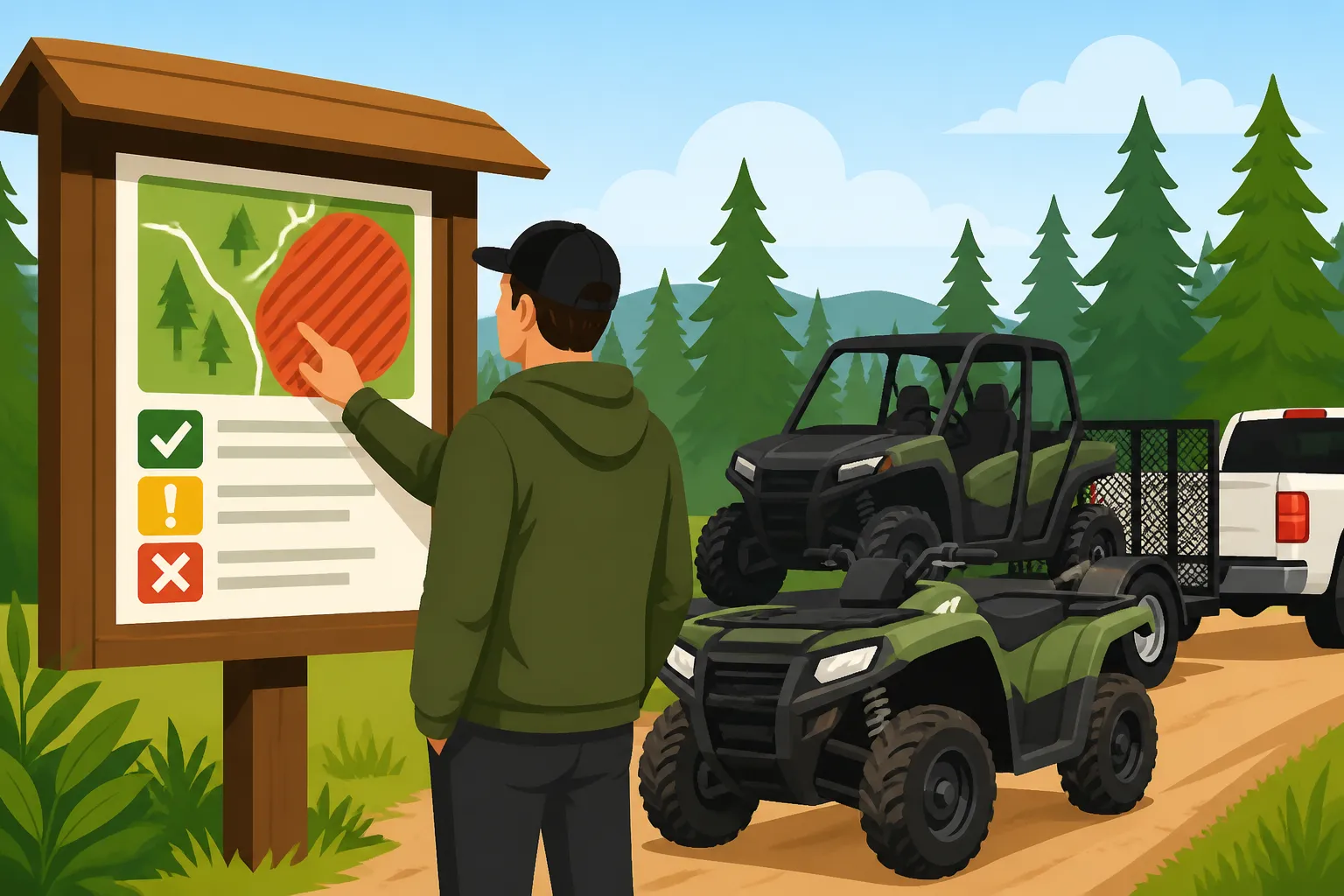
Checking a Forest Notice Before You Load Up
Before loading an ATV or UTV, check more than the weather. A forest road or trail that was open on your last visit may now be closed, restricted, or affected by fire or maintenance. Use the land manager’s current notices to confirm where you can ride, then check which permits apply to your machine and route.
Start with the right forest notice
For rides in the Black Hills, look for current information from the Black Hills National Forest and the ranger district responsible for the area you plan to visit. Search for alerts, closures, and recreation notices—not just a general trail map. Notices can cover temporary road or trail closures, fire danger, storm damage, construction, or restrictions that affect only part of a route.
A search result or old social media post can help you find a notice, but it should not be your final check. Confirm the notice on an official Forest Service page or by contacting the relevant ranger district. If you are already near a staging area, read posted signs and gate information before unloading. A current closure sign on the ground matters even if an online map still appears to show the route as open.
Check both the area and the route. A notice might apply to a particular trail, road segment, trailhead, or recreation area rather than the whole forest. Write down the route number or name and compare it with the notice’s location description. If the notice is unclear, ask the ranger district rather than guessing at the boundary.
Use South Dakota Trail Closures to Check First as a companion when planning around closures. For route details, South Dakota Trail Maps and MVUMs explains why a map showing a route does not necessarily prove that it is open to your machine today.
Check the route, not just the destination
A destination may be open while the route you planned to reach it is not. A closure could affect a connecting road, access point, or section of trail. Before you load up, trace the entire planned ride from the staging area and identify at least one legal alternative if a segment is closed.
A practical check looks like this:
- Choose the specific staging area and route. Note trail or road numbers, nearby landmarks, and the intended turnaround point.
- Search current official notices. Look for the route name or number as well as notices for the broader recreation area.
- Check the map for allowed use. Confirm that the route is open to the type and width of machine you plan to ride. A route’s presence on a map does not automatically mean every vehicle may use it.
- Look for temporary restrictions. Check for closures, seasonal limits, fire-related orders, and other notices that may change access.
- Confirm at the trailhead. Read the gate board and signs before unloading. If signs conflict with what you found online, do not ride past the restriction until you have clarified it.
- Save the information for the trip. Keep the notice, map, and ranger district contact details accessible. Cell service may be limited once you leave town.
Maps and notices answer different questions. A Motor Vehicle Use Map helps show which routes are designated for motorized use and may include vehicle or seasonal restrictions. A current notice can explain a temporary closure or change that is not reflected in a map you saved earlier. Neither one should be treated as a substitute for posted restrictions at the site.
| What you need to confirm | Where to check | Why it matters |
|---|---|---|
| Whether a route is open to motorized use | Current motor vehicle map and official notices | A visible route may be closed or limited to certain uses |
| Whether a closure affects your planned loop | Forest alerts, notices, and route descriptions | A single closed connection can make a planned route unusable |
| Whether seasonal or fire restrictions apply | Current Forest Service notices and local postings | Conditions and restrictions can change during the riding season |
| Whether your machine needs a permit | Applicable South Dakota and forest permit information | A route being open does not mean your paperwork is complete |
| Whether an alternate route is legal | Map, notices, and posted signs | A detour may use a route with different restrictions |
If the route is open but you need to change your plan, do not assume you can ride around a gate or use an unmarked shortcut. Stick to routes designated for your machine and obey closure signs. Riding Past a Forest Closure Sign covers why a closure should be treated as a firm boundary, not a suggestion.
Sort out permits and out-of-state registration
An open route and a valid permit are separate questions. A permit does not authorize riding on a closed route, and an open route does not automatically mean every machine is covered by the permit or registration you already have.
Visitors should check whether their machine’s home-state registration or plate meets South Dakota requirements for the kind of riding planned. Depending on the machine and its status, an out-of-state owner may need a South Dakota nonresident ORV permit. Confirm the current requirements for your situation before travelling; do not rely on a plate from another state as proof that no additional permit applies. Does South Dakota Honor Out-of-State Registration? and South Dakota Rules for a Visiting Rider are useful starting points.
The Black Hills Motorized Trail Permit is another item to check when your route includes motorized trails where that permit is required. It is not the same thing as a state nonresident ORV permit, and one should not be assumed to replace the other. Review How the Black Hills Motorized Trail Permit Works and Why a Plate Does Not Replace a Trail Permit before deciding what to buy.
For each machine, confirm:
- Whether its registration or plate is valid for the planned South Dakota use.
- Whether a South Dakota nonresident ORV permit applies.
- Whether the route requires a Black Hills Motorized Trail Permit.
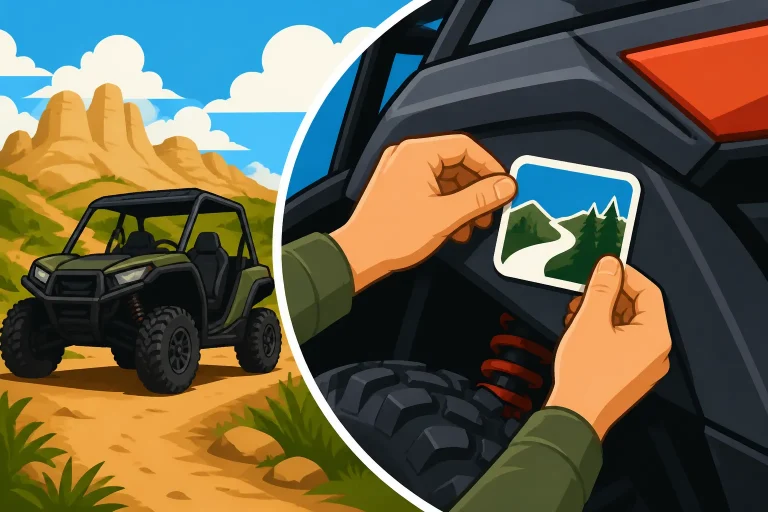
- Whether the permit must be attached to the machine before riding.
- Whether the permit period covers your trip dates.
Do not wait until you are at a remote trailhead to resolve a permit question. Some permits may need to be obtained through a seller or process that is inconvenient once you have left town. Check where permits are sold and how they are issued using Where South Dakota Trail Permits Are Sold. For the state-specific visitor permit, South Dakota Nonresident ORV Permit Requirements can help you identify what to confirm.
A rental machine may already have some required paperwork, but that should be confirmed with the rental provider rather than assumed. Ask which permits and registrations are included, whether the decal is attached, and whether the machine may use the specific roads or trails you intend to ride. A rental agreement alone does not establish that every route is open or permitted.
Make a go-or-no-go decision before unloading
After checking notices, maps, and permits, make a simple decision: ride the planned route, use a verified alternative, or postpone. If a notice’s location or wording leaves you unsure whether it affects your route, get clarification before unloading. A short call to the ranger district can prevent a wasted trip and an avoidable violation.
Weather deserves a separate check. Rain, snow, wind, or fire conditions may affect travel even when a route is not formally closed. Look for current local notices, but also consider whether your vehicle, tires, and group are suited to the conditions. A route that remains legally open can still be a poor choice if it is damaged, muddy, icy, or difficult to turn around on safely.
Keep a small trip record with the route names, map, permit details, and the date you checked official notices. This is especially useful if you are travelling from out of state, where it is harder to return to a staging area or ask someone locally. Recheck notices shortly before departure and again when you arrive, since conditions can change between planning and riding.
A final pre-load checklist:
- The planned route is designated for your machine.
- No current notice closes or restricts the route.
- Any seasonal, fire, or other posted restrictions are understood.
- Required state and forest permits are confirmed for each machine.
- Your map and an alternate route are available offline.
- You will check signs and gate information before riding.
When these checks do not agree, take the more cautious option and ask the land manager. Do not treat an old map, an online comment, or another rider’s route as permission to pass a closure. The safest plan is the one that is both legal and workable under the conditions you find when you arrive.
Disclaimer
This article is for general informational purposes only and does not constitute professional advice. Laws, prices and regulations vary by location and change over time. Consult a qualified professional for guidance on your specific situation.