What a South Dakota UTV Rental Includes
A South Dakota UTV rental can look all-inclusive until you discover that fuel, trail permits, helmets, or damage coverage are handled separately. What comes with the machine depends on the outfitter and booking terms, so the useful question is not just “What’s included?” but “What will I need to arrange or pay for myself?” Here’s what to check before you book.
What a South Dakota UTV rental usually includes
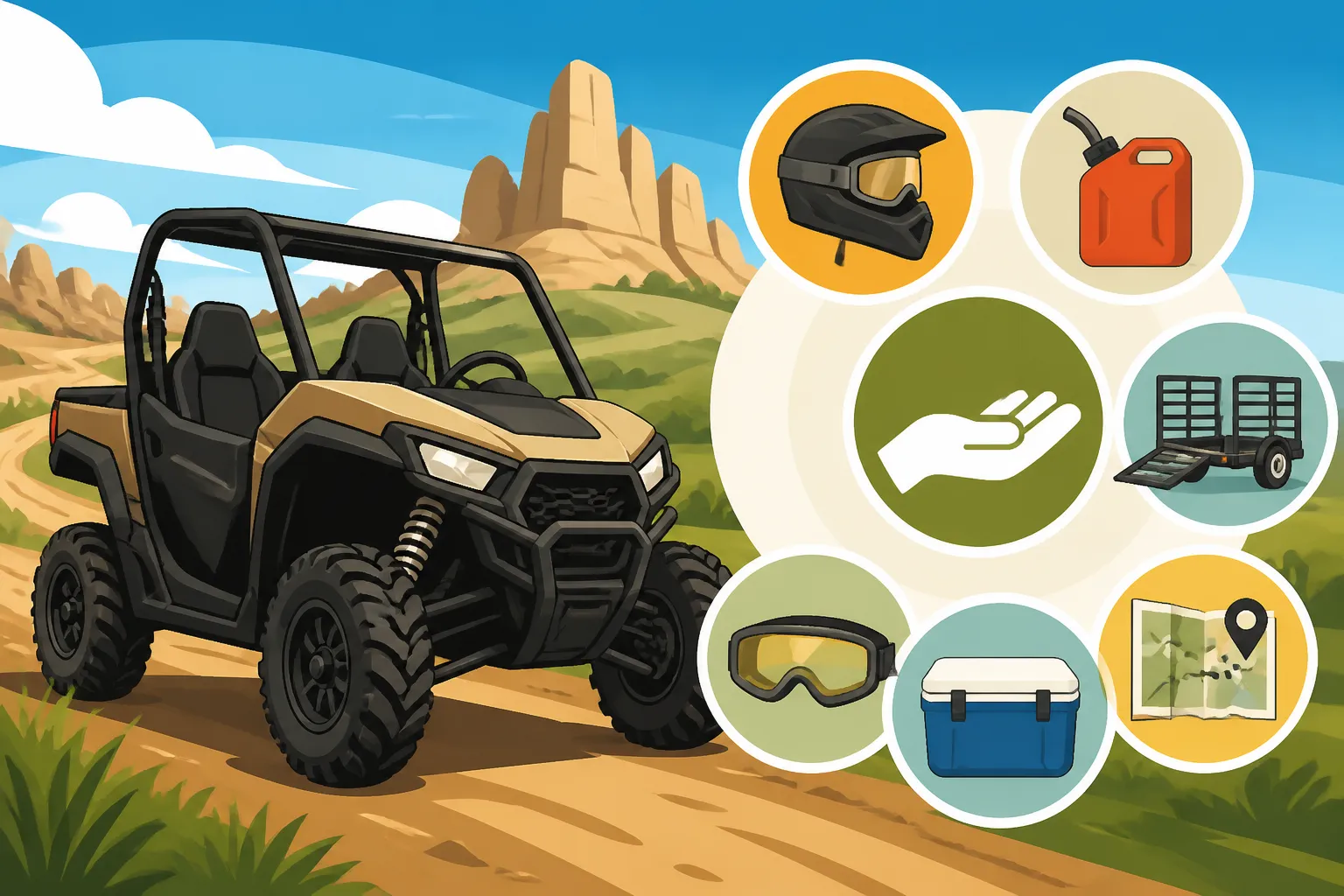
Most rentals include the vehicle for the reserved period and a basic handoff: an explanation of controls, operating rules, and the return process. The details vary. A rental may also come with helmets, a route map, a trail permit, or fuel, but none of those should be assumed without confirmation.
The word “included” can also mean different things. A rental listing might include safety equipment but charge separately for a damage waiver. A package might include a guided ride but not transportation to the starting point. Read the rental agreement and the booking description together, and ask the outfitter about anything that is unclear.
| Item | May be included | What to confirm |
|---|---|---|
| UTV | Usually included for the booked rental period | Seating capacity, age or license rules, mileage limits, and pickup and return times |
| Safety briefing | Common, but the length and format vary | Whether all drivers must attend and whether there is a required practice area |
| Helmets | Sometimes included or available | Sizes, condition, whether passengers receive them, and whether you can bring your own |
| Trail permit | May be included, depending on the machine and rental | Whether it covers the planned riding area and rental dates |
| Route map or GPS | May be supplied | Whether the map is current, downloadable, or available without cell service |
| Fuel | May be provided at pickup, billed separately, or subject to a return policy | Starting level, return level, fuel type, and how unused or missing fuel is handled |
| Damage coverage | Often optional or limited by contract terms | What it covers, exclusions, deductible or hold, and who pays for recovery |
| Delivery or shuttle | Sometimes offered separately | Exact location, timing, and whether it changes the rental period |
| Guided tour | Included only when the booking is for a tour package | Guide time, group size, route, stops, and what happens if conditions change |
A listing that says “gear included” may mean only a helmet, not goggles, gloves, cold-weather clothing, or rain protection. Likewise, “trail access” may refer to a permitted route or staging area rather than permission to ride anywhere in the Black Hills. Ask for a written list of inclusions and exclusions before you pay.
For broader comparisons of rental formats and planning, see Renting an ATV in South Dakota and What a South Dakota UTV Rental Includes is the specific question this article addresses, so use the other rental details in your booking agreement rather than assuming every outfitter follows one standard package.
The machine, seats, and basic operating instruction
The UTV itself is usually the central part of the rental, but “a UTV” does not tell you whether the machine suits your group. Confirm the number of usable seats and whether the booked vehicle is a two-, four-, or six-seat model. Seating capacity matters for comfort as well as safety: passengers need their own seat and restraint, and luggage or bulky gear may take up useful space.
Ask whether the exact machine is guaranteed or whether the outfitter may substitute a similar model. A substitute can have different dimensions, controls, or storage. If you are booking for children, older passengers, or anyone who needs extra help getting in and out, describe that need when you call. Do not rely on photographs alone to judge access or seat space.
What to ask about the vehicle
Before confirming, ask:
- How many people can ride legally and comfortably in the machine?
- Are seat belts provided for every occupant?
- Is there a roof, windshield, doors, or other weather protection?
- Is there a cargo area, and what can it safely hold?
- Does the vehicle have a winch or other recovery equipment?
- Are there restrictions on bringing a child, a pet, or personal equipment?
- Is the rental suitable for the route you plan to ride?
Features such as a roof or windshield can make a ride more comfortable, but they do not make a UTV weatherproof. Dust, wind, cold, and rain can still reach occupants. Ask about the machine’s setup rather than assuming every vehicle in a fleet has identical equipment.
Most outfitters provide some form of orientation before a self-guided rental. It may cover starting and stopping, shifting, seat belts, steering, braking, parking, and what to do if the vehicle becomes stuck or breaks down. Ask whether each person who may drive must attend. If the group includes several drivers, make sure the company knows before pickup rather than trying to add drivers at the counter.
Instruction is not the same as a guided tour. During a self-guided rental, the outfitter may give a briefing and a map, then expect you to follow the permitted route without an employee riding along. A guided tour generally includes a guide who leads the group, but the guide’s role, pace, and route should be confirmed in the booking terms. Compare the two options in Guided ATV Tours in South Dakota and [South Dakota Tours for Beginners] if you are deciding how much support your group needs.
Driver eligibility and passenger arrangements
Rental companies set their own eligibility rules, which may be stricter than the basic rules that apply to riding in a particular place. A company may require a driver to meet a minimum age, hold a valid driver’s license, or satisfy other conditions. Passengers may have different requirements. Check the outfitter’s rules for every member of the group, including young riders, before reserving.
Do not assume that a passenger can become a driver during the ride. Some contracts authorize only the people listed at booking or checkout to operate the vehicle. If a second driver might take a turn, ask how to register them and whether they must attend the briefing or show identification.
If children are riding, ask about child seating, harness fit, supervision, and minimum age rules. A child’s ability to sit securely in the vehicle matters more than whether a listing says the machine has extra seats. For relevant South Dakota riding considerations, see South Dakota Minimum Age to Ride Public Land and [South Dakota Rules for a Passenger on a Trail]. Rental-company rules and land-use rules are separate: meeting one does not automatically satisfy the other.
Helmets, maps, permits, and where you can ride
Gear and access are two of the most easily misunderstood parts of a rental package. A company may provide a helmet and point you toward a trail, but that does not necessarily mean every permit, map, or access permission is included.
Ask whether helmets are included for each occupant, not just each driver. Check what sizes are available and whether the helmets fit securely. If you prefer to bring your own, ask whether it is acceptable and whether the outfitter has any requirements for the equipment. Goggles or other eye protection may be useful on dusty roads, but they are not automatically part of a helmet package. Bring sunglasses or riding goggles only if they work safely with the helmet and the conditions.
A map may be a printed handout, a digital route, or a suggested itinerary. These are not interchangeable. A route map can help you stay oriented, but it does not guarantee that a road or trail is open on the day you ride. Closures, weather, fire conditions, and local restrictions can change access. Ask how the outfitter communicates route changes and whether you can use the map offline.
Ask specifically about the trail permit
Some South Dakota riding areas require a motorized trail permit, while other riding situations have different requirements. A rental listing may include a permit, or the outfitter may tell you that the renter must arrange one. Do not infer that a permit is included because the company is located near a trail system or because the machine is already outfitted for riding.
Ask these questions:
- Does this exact rental include the permit needed for the planned route?
- Does the permit apply to the vehicle, rental dates, and riding area?
- If it is not included, where should the renter obtain it and when?
- Is the permit already attached to the vehicle, or will it be provided at pickup?
- Does the rental cover riding only in a particular area or on a specific route?
A permit requirement is separate from a road-use requirement. A machine may be allowed on a designated trail with the appropriate permit but not be legal for travel on a public road. Similarly, a plate or registration does not necessarily replace a trail permit. Read South Dakota Trail Permits Explained and Do You Need a Permit on a Black Hills Trail? when planning an independent ride, then confirm the rental company’s instructions for its vehicle.
If you will ride on public roads or use a road to reach a trailhead, ask the outfitter exactly where the rental is allowed to go. Do not rely on a general statement such as “street legal” without checking the route and the machine’s equipment. South Dakota rules can depend on the type of road, the vehicle, and the intended use. South Dakota Rules for Riding a Rented Machine is a useful starting point for distinguishing rental terms from riding rules.
A rental company may also limit where its vehicle can go, even if a route might otherwise be open to a privately owned machine. The contract could prohibit certain trails, roads, terrain, or areas outside a defined boundary. Those limits can affect whether your planned loop is realistic. Ask for the allowed riding area in a map or written description, and check what happens if a route closes after you book.
Fuel, pickup, return, and getting to the trail
Fuel arrangements vary enough to affect both your schedule and final bill. Some companies hand over a fueled machine and expect it back at a similar level. Others bill for fuel separately, or specify a different return requirement. Ask before pickup, and make sure the fuel type and refueling plan are clear. A machine that starts with a full tank is not necessarily a rental with fuel included.
For a longer ride, ask about the vehicle’s expected range on the route you intend to use and where refueling is practical. Actual fuel use depends on terrain, load, driving style, and conditions. Avoid assuming that a nearby town or station will be reachable from every trail. Carrying extra fuel may be restricted by the rental agreement or by the area’s rules, so ask before bringing a can.
Confirm the time and location details
“Full day” and “half day” are booking labels, not universal schedules. Check the exact pickup and return times, when the rental clock starts, whether a late return is allowed, and what happens if traffic or a trail delay makes you run behind. Some outfitters use fixed handoff times, and arriving late may reduce riding time without changing the scheduled return.
Confirm whether you pick up the UTV at the outfitter, at a trailhead, or at another meeting point. Delivery and shuttle arrangements, where offered, may be separate from the vehicle rental. Ask whether you need to transport the machine yourself, whether a trailer is supplied, and whether the rental can be taken to your lodging or campground. Never assume that a vehicle can be loaded onto your own trailer without the company’s approval.
For a Black Hills trip, the distance between your lodging, rental counter, and riding area can shape the day. The rental period might include any time needed to reach the trail, depending on the pickup plan and permitted route. Ask whether the vehicle is intended to be trailered to a staging area or driven from the rental location. This is particularly important if the company’s instructions restrict where you can operate it.
The return process deserves as much attention as pickup. Ask where the UTV must be parked, whether it needs to be cleaned, how fuel is checked, and whether an employee must inspect it with you. If the outfitter expects it to be returned at a specified fuel level, ask how that level is measured. Clarify how to report new damage or mechanical trouble and whether you should wait for an employee before leaving.
Equipment and clothing beyond the package
Even when helmets and a map are included, plan to bring clothing that fits the forecast and terrain. Dust, wind, changing temperatures, and sudden rain can make a ride uncomfortable. Closed-toe footwear, layers, gloves, eye protection, and water may be sensible depending on the conditions and the company’s rules. Ask whether bags or personal items can be secured in the vehicle; loose items can be lost or become a distraction.
A rental may not include a first-aid kit, phone mount, charger, or communication device. Do not assume these items are supplied. Ask what emergency equipment is on the UTV and what procedure to follow if your phone has no service. If the company provides a route or emergency contact number, save it before leaving the pickup area. Bring only equipment allowed by the contract and by the land manager.
Deposits, damage coverage, and other possible charges
The rental price is only one part of the financial commitment. The company may require a deposit or card hold, offer optional damage coverage, or charge for certain events under the contract. The structure differs by provider, so check current terms directly rather than relying on a booking summary or another renter’s experience.
A deposit or authorization is not necessarily the same thing as an insurance premium. Ask whether the amount is charged or temporarily held, when it is released, and what could delay its return. Find out who must provide the payment card and whether the person paying must also be the primary driver or renter.
Damage coverage also needs careful reading. It may reduce certain costs under specified conditions, but it might not cover every kind of damage, every driver, or every use. A waiver may have exclusions for prohibited routes, reckless operation, unauthorized drivers, rollover damage, underbody damage, water, or other circumstances. These are examples of issues to check, not a list that applies to every contract.
Before choosing an option, ask:
- What types of damage are covered, and what is excluded?
- Does coverage apply to every approved driver?
- Is there a deductible, maximum responsibility, or other limit?
- Does coverage include towing or recovery from a trail?
- What happens if the vehicle is damaged while parked?
- Does coverage change if the renter leaves the permitted area?
- Is coverage optional, and what does declining it mean under the contract?
Do not treat a waiver as a substitute for reading the agreement. The rental contract may assign responsibility for damage, cleaning, lost keys, late returns, or recovery costs separately from any optional coverage. Ask the outfitter to explain terms you do not understand before signing.
Photograph the machine at pickup, including visible scratches, tires, lights, body panels, and the interior. Point out existing damage and ask that it be recorded on the check-out form. Take a final set of photographs at return and keep a copy of your agreement and any inspection record. This simple documentation can help establish the condition at handoff; it does not override contract terms.
Extra charges may also apply for fuel, cleaning, delivery, a late return, recovery, or damage. The company may bill them after the ride rather than during checkout. Ask which charges could be assessed and how the company determines them. For more detail on this issue, see South Dakota Rental Damage Waiver Cost, South Dakota Rental Fuel Charges, and South Dakota Rental Late Return Fees. Check the provider for current amounts and terms.
Self-guided rentals, guided tours, and booking channels
A self-guided rental and a guided UTV tour can both put you on a machine, but they are different experiences. A self-guided booking usually gives you the vehicle for a set period and relies on you to follow the route, manage your time, and return as instructed. A guided tour generally adds a guide and a planned itinerary. The booking page should make the distinction clear, but confirm it if the description is vague.
With a guide, ask how long the ride lasts, how many vehicles are in the group, whether the route includes stops, and how the guide handles riders who need a slower pace. Find out whether the tour price includes the vehicle, required gear, permit, and any transport to the starting point. “Tour” does not automatically mean every related cost is bundled.
With a self-guided rental, find out how much route support you receive and what happens if you want to take a different path. A map and a verbal briefing may be enough for an experienced group, but less confident riders may prefer an organized ride or guided option. Consider your group’s comfort with navigation, changing conditions, and operating a UTV before choosing.
Booking through a marketplace or through an outfitter can change how you communicate, but it does not remove the need to verify details. A listing through Viator or a Polaris Adventures listing may provide a convenient way to compare options, but the specific activity page and rental provider determine the actual inclusions and conditions. Check who operates the ride, who handles questions, and where changes or cancellations must be addressed. Do not assume that two listings for similar machines have the same gear, route, permit, or coverage.
Before paying, make sure the booking information states:
- The rental or tour duration and exact schedule
- The number and type of vehicles included
- The permitted riding area and route arrangement
- Whether helmets, maps, fuel, and permits are included
- Driver and passenger eligibility
- Deposit, damage coverage, and possible additional charges
- Cancellation, weather, closure, and late-arrival procedures
- The pickup location and contact details for the day of the ride
If a booking page and the rental company give different answers, ask the company to confirm the relevant term in writing. Save the confirmation, contract, and any messages that clarify inclusions. If you book through a third party, check whether changes or cancellation requests go to that platform, the operator, or both.
Choosing the right format for your group
A guided tour may suit a first-time driver, a group unfamiliar with the area, or anyone who does not want to navigate independently. A self-guided rental may offer more flexibility in pace and stops, provided you are comfortable following the route and meeting the return time. Neither option is automatically safer or better; the fit depends on experience, group needs, route conditions, and the level of help included.
Families should verify age rules and seating before choosing. A large group should confirm whether the listed capacity is for one vehicle or the whole booking. Riders who want a scenic stop or a particular destination should ask whether the route allows it rather than assuming the tour follows their preferred itinerary. For destination-based planning, [South Dakota Rentals Near Deadwood], [South Dakota Rentals Near Custer], and [South Dakota Rentals Near Hill City] can help narrow the search, but the operator must still confirm current availability and access.
How to check your booking before you arrive
A little preparation at home can prevent a frustrating counter conversation. Start with the booking confirmation, then compare it with the operator’s rental agreement. Make a list of anything that is not explicitly answered: permit, fuel, helmets, driver eligibility, allowed route, deposit, return procedure, and emergency support.
Use this checklist before travel:
- Confirm the vehicle and seats. Verify the machine type, number of passengers, and whether a specific model is guaranteed.
- Check who may drive. Confirm minimum age, license requirements, approved drivers, and any passenger restrictions.
- Get the route rules. Ask where the machine may go and whether the route is self-guided or led by an employee.
- Resolve the permit question. Get a direct answer about the permit for the planned riding area and dates.
- Clarify what gear is supplied. Check helmet sizes, eye protection, and any gear requirements.
- Agree on fuel and return conditions. Find out the starting level, return level, pickup time, and late-return procedure.
- Read the damage terms. Understand the deposit or card hold, optional coverage, exclusions, and possible recovery costs.
- Save the day-of contact information. Know who to call if you are delayed, the machine has a problem, or a closure affects the route.
If you are unsure whether a specific item is included, ask a direct question that can be answered yes or no: “Is the trail permit for this machine and route included in my booking?” is more useful than “Do you take care of permits?” Likewise, ask “Are helmets provided for every passenger in our group?” rather than assuming “gear” covers everyone.
Check conditions close to the ride date. Trail access and weather can change, and the operator may adjust a route or pickup plan. Ask where to find closure information and whether the company contacts renters about changes. If the forecast looks poor, check the cancellation or rescheduling policy before deciding what to do; do not assume that rain, snow, or a closure automatically guarantees a refund.
At pickup, listen to the briefing and ask questions before leaving. Check the seat belts, tires, lights, and visible condition of the machine. Make sure the permit or other required decal is present if the outfitter says it should be. Confirm the emergency procedure and understand the route boundary. If something promised in the booking is missing, resolve it with the operator before the rental begins.
Frequently Asked Questions
Does a South Dakota UTV rental include a trail permit?
Sometimes, but not always. Ask the rental company whether the permit for your specific machine, dates, and planned riding area is included. Do not assume that a rental booking or a plate alone covers every trail requirement.
Are helmets included with a UTV rental?
Some outfitters provide helmets, while others may offer them separately or have limited sizes. Confirm that there is a properly fitting helmet for every person who needs one, and ask whether goggles or other protective gear are also supplied.
Is fuel included in the rental?
Fuel may be included, billed separately, or subject to a return-level policy. Check the starting fuel level, required return level, fuel type, and any charges that could apply before your ride.
Is a guided tour the same as renting a UTV?
No. A self-guided rental generally provides the vehicle for a booked period, while a guided tour usually includes an employee leading a planned ride. Confirm the route, duration, included gear, and fees for the option you book.
What should I check before signing the rental agreement?
Review approved drivers, route limits, permit instructions, deposit or card hold, damage coverage and exclusions, fuel rules, return time, and possible cleaning or recovery charges. Photograph the machine’s condition at pickup and make sure existing damage is documented.
Disclaimer
This article is for general informational purposes only and does not constitute professional advice. Laws, prices and regulations vary by location and change over time. Consult a qualified professional for guidance on your specific situation.