Renting in Deadwood, South Dakota
Renting an ATV or UTV in Deadwood can be a straightforward way to reach Black Hills riding areas without hauling your own machine. The tricky parts are matching the vehicle to your group, understanding where it can go, and finding out what the booking actually includes. This guide covers the questions to settle before you reserve, pick up the keys, or head for a trail.
How Deadwood rentals work
Deadwood is a convenient base for a Black Hills ride, but a rental’s pickup point, trail access, and return arrangements can differ from one outfitter to another. Some businesses may be in town, while others operate outside Deadwood or arrange transportation to a trailhead. Don’t assume a booking includes a shuttle, a particular trail, or permission to ride from the shop.
Start by treating the rental as a package with several separate pieces: the machine, the pickup location, the route or riding area, required permits, equipment, and the return plan. A listing that says “Black Hills ride” may describe the general location rather than a guided trip or a specific route. Ask what the booking includes before you pay.
If a rental is outside town, check the distance and how you are expected to reach it. Some services may require you to drive to the outfitter; others may offer a shuttle or a machine delivered to a different location. A transfer can save time, but it is not automatic. Confirm whether it is included, whether it has a separate charge, and whether you need to reserve it in advance.
The same caution applies to trail access. A machine parked at a shop is not necessarily staged at a trailhead, and an outfitter’s preferred route may not be open on the day you ride. Ask which public riding area the rental is intended for, whether the route is currently accessible, and how you will get from pickup to the legal starting point.
Rentals can be useful for more than visitors without a trailer. They may also suit travelers who want to try a UTV before buying, riders who are bringing family members who do not own a machine, or a group that would rather avoid towing through unfamiliar roads. If you are comparing rentals with guided outings, Guided ATV Tours in South Dakota can help you think through how much route support you want.
What to settle before reserving
Before selecting a machine, get clear answers to these practical questions:
- Where is pickup, and how long does it take to get there from your lodging?
- Is the machine delivered, or must you transport it yourself?
- Is a shuttle to the riding area included?
- Does the booking include any required trail permit?
- What is the scheduled pickup and return window?
- What happens if the route closes because of weather, fire, or another restriction?
- What equipment comes with the machine, and what should you bring?
- What are the renter’s age, driver’s license, and passenger requirements?
These questions help expose differences between listings that can look similar at first glance. They also give you something concrete to compare if one rental appears more convenient but leaves important logistics to you.
Choosing an ATV or UTV for your group
The right machine depends less on what sounds exciting and more on who will ride, how comfortable they are operating off-road, and what the route allows. An ATV is a single-rider machine in many rental contexts, while a UTV generally has a seat and restraints for a driver and one or more passengers. Models and seating layouts vary, so verify the exact machine rather than relying on a listing photo.
A side-by-side can make sense for couples, families, or groups who want to ride together. It may offer more room for passengers and personal items, but a larger vehicle can be restricted from narrower trails. Do not assume that every trail near Deadwood accommodates every UTV. Check the machine’s actual width against the trails you plan to use and ask the outfitter which routes are suitable. For more on the rental decision, see Renting a Side-by-Side in South Dakota.
An ATV can be appealing to a rider who wants a more direct, hands-on experience and is comfortable steering and balancing the machine. It may also be a better fit if the intended routes have width limits or if the group is riding on separate machines. A beginner who has never operated an ATV should be honest about that when booking. The outfitter can tell you whether its orientation is enough for the route or whether a guided option would be safer and more enjoyable.
| What matters | ATV may suit you if | UTV may suit you if |
|---|---|---|
| Group size | Riders are comfortable operating separate machines | Passengers want to ride together in one vehicle |
| Experience | You are confident with the controls and terrain | You prefer a seated, shared ride with a steering wheel |
| Trail width | You want to consider narrower routes, subject to machine size | You have confirmed the selected trails allow the vehicle’s width |
| Gear and belongings | You can carry only what fits safely on the machine | You need more passenger room or storage, depending on the model |
| Group coordination | Everyone can ride independently and stay together | One driver can carry passengers who do not want to operate a machine |
A UTV’s seat count is not a casual suggestion. Never plan to put more people in the machine than it is designed and equipped to carry. Ask whether child seats or child passengers are allowed under the rental contract, and do not assume that a child who can fit physically is permitted to ride. For rental age and license conditions, see South Dakota Rental Age and License Rules.
Also ask about the vehicle’s width, not just its passenger capacity. A wide machine can limit your route choices even if it is comfortable and easy to drive. If the group has a particular destination in mind, confirm the width restriction before you reserve. A rental shop may suggest another model, but its recommendation should be checked against current trail information.
For a first off-road trip, it is worth considering how your group responds to dust, uneven ground, steep sections, and long stretches without services. A UTV’s passenger seating does not make an unfamiliar route effortless. Passengers still need to follow instructions, keep their hands and feet inside the vehicle, use the restraints, and be prepared for a bumpy ride.
Booking, pickup, and what to confirm
When comparing Deadwood-area rentals, look beyond the headline duration and vehicle photo. Ask whether the stated rental period starts at the time of pickup or when you reach the riding area. A day that includes a long drive to a trailhead may leave less time to ride than you expect. Confirm the clock, the return deadline, and how late returns are handled.
Availability and booking terms can change with the season, local demand, and the operator. Rally Week, weekends, and holiday periods may be especially busy, so reserve early if the dates matter. A booking platform such as Viator can be one way to compare listed options, while an outfitter’s own reservation channel may provide details about its fleet or operating conditions. Check the actual listing and final booking terms rather than assuming that two channels show identical availability or policies.
Some listings are connected with a particular vehicle brand or adventure network. Polaris Adventures may appear as part of a rental or outfitter listing, but that name alone does not tell you the pickup location, route, included gear, or cancellation terms. Confirm those details with the operator responsible for the rental. Brand affiliation does not replace reading the actual booking conditions.
Before you submit a reservation, look for the full price breakdown and identify what is included or charged separately. Do not compare two rentals based only on a displayed starting amount. The final amount can depend on the machine, rental duration, add-ons, taxes, booking method, damage options, and other terms. For a fuller explanation of how rental prices are presented, see South Dakota UTV Rental Prices.
Ask about the machine itself
Request the make or class of vehicle, seating capacity, approximate width, transmission type if relevant, and whether the machine is selected when you reserve or assigned later. A listing may show a representative model rather than guarantee that exact unit. If the trip depends on a specific number of seats or a width limit, get confirmation in writing.
Ask how much operating instruction is provided. A responsible pickup should explain the controls, shifting or drive modes, starting and stopping, parking, seat belts, communication, and what to do if the machine develops a problem. If the explanation is rushed or you do not understand a control, pause and ask again before leaving.
Confirm documents and driver requirements
The named renter may need to present identification, a valid driver’s license, and the payment card used for the booking. Requirements vary by provider and machine, and additional drivers may need to be listed or approved. If someone else in your party expects to drive, confirm that in advance. Do not assume a passenger can take the controls simply because the primary renter is present.
Ask whether there is an age minimum, a higher age requirement for certain machines, or a rule about the number of years a driver must have been licensed. If a younger person will ride as a passenger, confirm both the operator’s policy and whether the vehicle is equipped for that passenger. These details are particularly important for families and groups with teens.
Trail permits, route access, and riding rules
The rental agreement answers what you may do with the machine under the provider’s terms. It does not, by itself, make every road, trail, or open area legal to ride. You still need to use routes that are open to the vehicle and comply with applicable permit and land-use requirements.
In the Black Hills, public motorized trails have permit requirements that can differ from rules for roads or other riding areas. A plate and a trail permit are not automatically interchangeable. Ask the outfitter which permits are required for your intended route, whether the rental includes them, and how to confirm that the required decal is attached to the machine. Why a South Dakota Rental Needs a Trail Permit explains why it is important to sort this out before setting off.
A permit may be associated with a particular machine rather than each rider, but never infer that your group is covered just because one rental has a decal. Check each vehicle. If you rent more than one machine, confirm the permit status for every one. If you are told a permit is included, ask where it is mounted and whether it is valid for the route and dates you plan to ride.
Trail access can also depend on width, seasonal openings, temporary closures, weather, and land-management rules. A route that appears on a map may be closed or unsuitable for a particular machine. Use current information and ask the outfitter to identify a route that fits the vehicle. For a pre-ride check, South Dakota Trail Conditions Before You Ride is a useful starting point, and South Dakota ATV Trails Near Deadwood can help frame the local search.
Stay on the route you are allowed to use
Follow signs, gates, and posted closures. Do not ride around a barrier or assume that an unsigned track is open. A route can cross land with different rules, and a road that seems passable is not necessarily a public motorized route. If the outfitter gives you a map or route instructions, keep them with you and ask how to identify a closure or a turn you should not take.
Private property is another boundary to respect. Do not enter a ranch road, driveway, or open-looking track unless access has been authorized. A rental company’s suggestion to ride in a general area is not permission to cross private land. When in doubt, stop and verify rather than continuing based on guesswork.
Road use is not the same as trail use. A rental machine may not be legal to operate on every public road, and a trail permit does not automatically provide permission for road travel. Ask where you may drive between the pickup point and the riding area, whether any road crossings are necessary, and what rules apply. Do not rely on the machine’s lights or license plate alone to conclude that it is approved for every road.
What to do when conditions change
Black Hills conditions can change during a ride. Rain can make a route slick, storms can reduce visibility, and fire or other closures can affect access. If a trail is closed, turn around. Do not try to find a detour by riding off the designated route.
Before leaving, make sure you know how to contact the rental operator and what to do if you encounter a closure or breakdown. Ask whether the machine has a way to call for help, what information to provide, and whether you should wait in place or move to a safe location. Cell coverage may be unreliable in some areas, so do not make a phone signal your only safety plan.
What your rental may include and what may cost extra
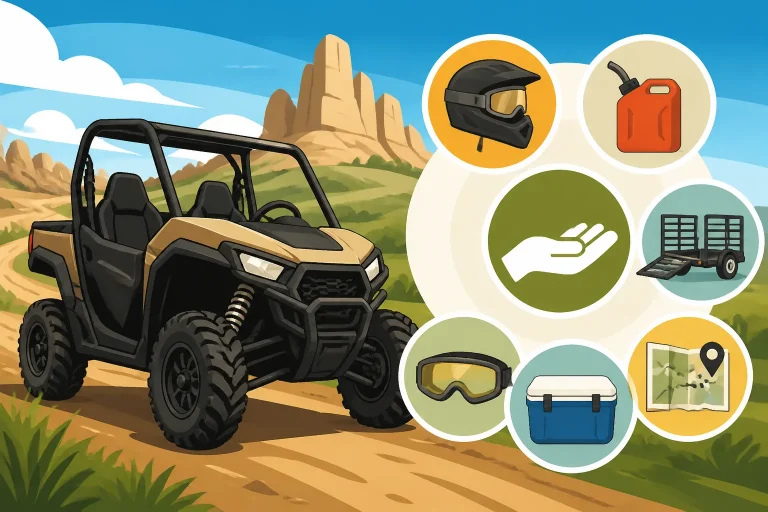
Rental packages vary, so verify every item rather than assuming it is standard. Some providers may supply helmets, maps, or basic instruction; another may include only the machine and require you to bring or arrange other gear. A listing’s photos are not a reliable inventory of what will be handed over.
Ask specifically about:
- Trail permit and decal status
- Helmet availability and sizing
- Eye protection, if supplied
- Printed or digital maps and route guidance
- Fuel level at pickup and the return requirement
- Safety orientation and operating instructions
- A spare tire, tools, or recovery equipment, if any
- Passenger restraints and other safety equipment
- Shuttle service or trailhead delivery
- A contact number for mechanical or route problems
Fuel is a common source of confusion. Find out whether the machine is supplied full, whether you must return it at the same fuel level, and whether the operator charges for refueling. Ask what fuel the machine uses and whether there are convenient fuel stops on the route. Do not plan a long loop based on a fuel range you have not confirmed with the rental company.
Damage terms deserve careful attention. Ask what happens after a puncture, rollover, collision, or mechanical failure, and whether the renter may be charged for recovery or transport. A waiver or damage option may change certain financial responsibilities, but the name of the option does not tell you exactly what it covers. Read exclusions, deductibles or other out-of-pocket obligations, and the process for reporting damage. South Dakota Rental Damage Waiver Cost discusses the questions to ask, while South Dakota Rental Deposits and Card Holds covers another common part of the checkout process.
A damage waiver may not cover every event or every driver. It may have conditions about where the machine is used, who is operating it, whether safety instructions were followed, and how quickly damage is reported. Ask whether damage to tires, undercarriage, or body panels is treated differently from other damage. Get the answer before signing, not after an incident.
Read the cancellation and weather terms
A weather forecast does not always mean a rental will be canceled, and an open booking does not guarantee a route will stay accessible. Ask what the operator does if the trail system closes, if severe weather affects the ride, or if the machine cannot be provided. Find out whether the remedy is a refund, a credit, a rescheduled booking, or another arrangement. The answer can depend on the provider and the reason for the change.
Check the deadline for canceling or changing the reservation, and whether it differs for a group booking or a high-demand date. Review South Dakota Rental Cancellation Policies before you commit if your travel schedule is uncertain. Keep confirmation messages and the terms you agreed to, especially if a reservation was made through a third-party booking service.
Planning your ride from Deadwood
A good rental day is not simply the longest route you can fit into the booking. It is a route that matches the group’s experience, the machine’s limits, the day’s conditions, and the return time. Give yourself room for the pickup briefing, questions, gear adjustments, and a break before you head out.
If it is your first ride in the area, avoid building a plan around several unverified destinations. Ask the rental company for a route recommendation that fits the machine and your experience. Then compare that advice with current maps, posted information, and any closure notices. If you want to ride independently, make sure you can follow the route without relying on one person’s phone or memory.
For a group, agree on a few basic habits before the engines start. Decide who leads and who rides last, keep a pace that allows the group to stay together, and stop somewhere safe if riders become separated. Do not pressure a less experienced driver to match the fastest person. A slower ride with everyone comfortable is better than losing the group or taking a route beyond someone’s ability.
Pack for the terrain and the day
Even when the provider supplies helmets or a map, bring clothing suited to wind, dust, and changing weather. Closed-toe footwear, eye protection, gloves, and layers can make a ride more comfortable. Check what is supplied and whether it fits before departure; poorly fitting protective gear is not something to sort out after you are already on the trail.
Carry water and any personal medication your group may need. Secure loose items so they cannot fall out or interfere with the controls. A phone can be useful for emergency contact or navigation, but protect it from dust and vibration, and do not assume it will work everywhere. Keep any route information available offline if possible.
Before leaving the pickup area, check the machine for visible damage and photograph it from several angles. Make sure the rental representative notes any existing marks on the condition form. Confirm that the machine starts, brakes, steers, and displays no obvious warning that needs attention. Report a concern before riding away rather than hoping it will be overlooked at return.
Choose a realistic day length
Check how much of the reservation is usable riding time. A rental that includes travel to a distant trailhead may leave a shorter window on the trails than a machine already staged near the route. If the operator has a fixed return deadline, plan your turnaround with a buffer. A late return may have consequences under the contract, and a long route can take longer than expected when the group stops for photos or has to reduce speed.
Ask what happens if your party is delayed by a closure, a mechanical problem, or an injury. Save the operator’s number and make sure at least one person in the group knows how to describe your location. Do not continue deeper into a route to “make up time” if the group is behind schedule.
When riding with children or first-time passengers, leave extra time for instructions and breaks. Comfort and attention can decline before a machine’s fuel does. A shorter outing may be the better choice if your group is new to off-road riding or unfamiliar with the terrain.
At pickup and return
The pickup counter is the best time to resolve small uncertainties. Ask the representative to show you the controls rather than relying on a quick verbal overview. Confirm where the required permit decal is placed, how to use the restraints, what warning lights mean, and how the machine should be parked or shut down. If you are unsure about a feature, ask for a demonstration.
Take a few minutes to check the machine’s condition with the representative. Look for existing scrapes, cracks, tire damage, loose parts, or warning indicators. Make sure each issue is documented and take clear photos before leaving. This is useful for both you and the operator; it helps establish the starting condition and gives you a reference at return.
Know the reporting procedure before there is a problem. If the machine starts making an unusual noise or handles differently, stop somewhere safe and contact the outfitter. Continuing to ride may worsen a mechanical issue or create a safety risk. Do not try an unfamiliar repair unless the operator has specifically instructed you to do so.
At return, follow the agreed fuel and cleaning expectations. Ask whether ordinary trail dust is acceptable and how mud or unusually heavy dirt is handled. If the ride produced a puncture, scrape, or other issue, report it promptly and describe what happened. Do not wait for staff to find it later or assume a small problem does not matter.
A clear, calm handover is in everyone’s interest. Return all supplied equipment, tell staff about any route closure or machine issue, and ask for a final receipt or confirmation if needed. If a charge is added, request an explanation and refer to the contract terms rather than trying to settle a misunderstanding in a hurry.
Frequently Asked Questions
Do I need to bring my own ATV or UTV to Deadwood?
No. A rental lets you ride without transporting your own machine, but you need to confirm where pickup takes place and whether transportation to the riding area is included. A rental does not necessarily start at a trailhead.
Does a rental automatically include the trail permit?
Not necessarily. Ask the operator whether each machine has the permit required for your intended route and how you can verify it. Do not assume that a rental fee, plate, or booking confirmation covers every permit requirement.
Can I take a rented UTV on any Black Hills trail?
No. Trail access can depend on vehicle width, current closures, and route rules. Confirm that the particular machine is allowed on the route you plan to use, and follow current signs and closure notices.
Is an ATV or UTV better for beginners?
It depends on the rider and group. A UTV may be practical for passengers who want to ride together, while an ATV requires each rider to operate a machine independently. Ask the outfitter about instruction and route difficulty, and be candid about your experience.
What should I check before paying for a reservation?
Confirm the vehicle, pickup location, schedule, driver and passenger rules, permit status, included gear, fuel policy, deposit or card hold, damage terms, and cancellation policy. These details matter as much as the advertised rental duration.
Disclaimer
This article is for general informational purposes only and does not constitute professional advice. Laws, prices and regulations vary by location and change over time. Consult a qualified professional for guidance on your specific situation.