Renting a Side-by-Side in South Dakota
Renting a side-by-side in South Dakota can make a Black Hills trip easier, but the machine is only part of the plan. You also need to choose between a guided ride and a self-guided rental, understand what the booking includes, and confirm where you’re allowed to ride. This guide helps you compare options and avoid surprises at pickup.
Choose the kind of ride that fits your trip
A side-by-side, often called a UTV, is a small off-road vehicle with a steering wheel, seats beside one another and a protective frame. Rental fleets may have two-, four- or six-seat machines. The best choice depends on your group, the terrain and how much independence you want.
Self-guided rental or guided tour
With a self-guided rental, you drive the machine yourself and follow the provider’s directions, map or approved route. It suits people who want to set their own pace and are comfortable navigating and operating a vehicle on uneven ground. The trade-off is that you’re responsible for staying on permitted routes, following the rental company’s instructions and managing your time.
A guided tour is led by an outfitter or guide. It can be a better fit if you’re new to off-road riding, would rather not navigate, or want someone familiar with the area to set the route and pace. A guided outing may be less flexible than a rental, and the provider decides the route and schedule. Ask whether the tour is private or shared, how many machines are included, and whether the guide rides in a separate vehicle or with your group.
For more help comparing formats, see Guided ATV Tours in South Dakota. A tour can use a side-by-side even when the listing describes the experience broadly as an ATV ride, so check the vehicle type before booking.
Choose seating for the people who will actually ride
A two-seat machine can work for a couple or two riders who are comfortable sharing a small cabin. A four-seat machine gives a family or small group more room, but it is still a compact off-road vehicle. A six-seat machine may suit a larger group, though it can be wider, longer and less nimble than a smaller model.
Count passengers, not just people in your travel party. A person who plans to drive at a different time still needs a seat while riding as a passenger. Do not assume a child can sit on an adult’s lap or ride in cargo space. Ask the rental provider about permitted passenger positions, child seating and any age or size limits before paying.
| Rental choice | Often works well for | Check before you book |
|---|---|---|
| Two-seat side-by-side | A couple or two riders | Whether the passenger seat fits your intended passenger |
| Four-seat side-by-side | A family or a small group | Seat arrangement, child rules and cargo space |
| Six-seat side-by-side | A larger group | Total passenger capacity, vehicle width and route suitability |
| Guided tour | New riders or guests who prefer a planned route | Group size, pace, route, tour length and what is included |
| Self-guided rental | Confident drivers who want more flexibility | Navigation, approved riding area, return time and breakdown support |
The machine with the most seats is not automatically the most comfortable choice. Ask how the seats are arranged and whether passengers have enough room for helmets, layers and small personal items. If a child is coming along, describe the child’s age and size to the provider rather than guessing that a seat will work.
Match the vehicle to the experience
A side-by-side’s size, handling and passenger capacity affect where it can go. Some South Dakota motorized trails have width limits, and not every trail accommodates every machine. A rental company may steer customers toward a particular route or machine based on its own operating area and current access conditions. Confirm the exact vehicle width and what routes the provider authorizes before you commit.
Some providers advertise particular makes or models. Polaris Adventures, for example, may help travelers find participating outfitters offering Polaris vehicles. A brand listing does not, by itself, establish the rental’s route, inclusions or terms. Confirm those details directly with the operator.
Compare rental listings and understand the total cost
A rental listing is a starting point, not a complete description of the day. The headline may focus on the vehicle or ride length, while important details about the pickup location, route, gear and possible additional charges appear elsewhere in the booking information or rental agreement.
Compare like with like
When you compare providers, line up the same details for each option: vehicle capacity, hours, pickup location, riding area, included gear, fuel policy and support if something goes wrong. A lower advertised rate may not mean a lower final bill if the booking excludes items another provider includes.
Use a written list of what you need rather than comparing listings by price alone. If you are looking across local operator websites and booking platforms such as Viator, check whether the listing is operated by the rental company itself or a third-party seller. Confirm who answers questions, handles changes and provides instructions for pickup.
The actual cost can depend on the machine, length of rental, season, group size and provider. Other possible cost components include taxes, a refundable deposit or card hold, optional protection, fuel, cleaning, late return or recovery charges. These are not universal, and a provider’s current terms control. For a breakdown of the factors that commonly matter, see South Dakota UTV Rental Prices.
Ask exactly what is included
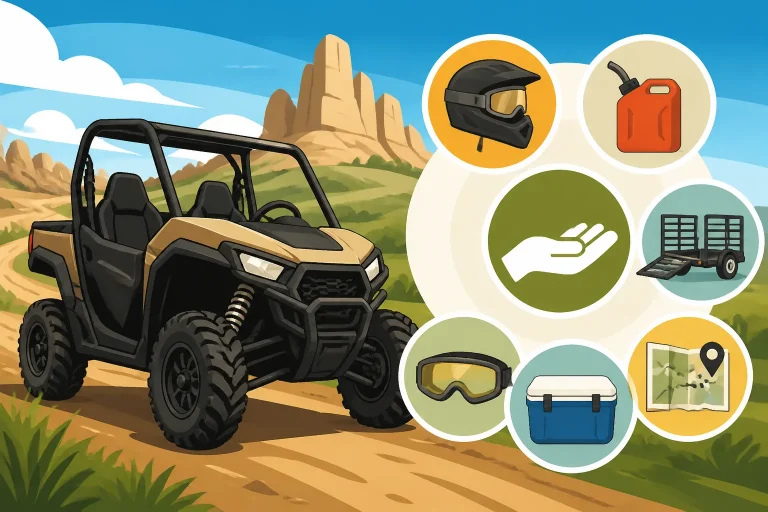
A booking may include the vehicle and basic operating instructions but not every item you expect. Ask whether the reservation includes:
- Helmets, and whether sizes are available for every rider
- Goggles or other eye protection
- A trail map or navigation device
- Fuel at pickup
- A trail permit or other access authorization, if required for the route
- A guide, shuttle or transport to the riding area
- A passenger seat for every person in your party
- Equipment such as a winch, if you believe you need one
- Breakdown or recovery assistance
Some providers bundle gear or access items; others treat them separately. Do not infer that an item is included just because it appears in a photo or is typical of an off-road rental. Get the answer in writing if it affects your budget or ability to ride.
For a closer look at common inclusions, see [What a South Dakota UTV Rental Includes]. If you are deciding whether to bring your own helmet or goggles, ask what the provider supplies and whether outside gear is accepted.
Understand deposits, damage terms and fuel
A deposit or card hold may be used to secure the booking or cover potential charges. A hold is different from a final charge, but it can still reduce the amount of credit available on your card during a trip. Ask when the provider places the hold, what payment methods are accepted and when any unused amount is released.
Read the damage and protection terms before pickup. A waiver or protection option may have exclusions, deductibles, limits or conditions, and it may not cover every type of damage. Clarify who pays if a tire is punctured, the vehicle gets stuck, or the machine is damaged during ordinary use. Ask whether recovery from a remote location is treated separately from mechanical assistance. South Dakota Rental Insurance and Waivers and South Dakota Rental Damage Charges cover questions worth raising before you sign.
Fuel policies differ. A provider might hand over a fueled machine and expect it returned at a similar level, or use another process. Confirm whether fuel is included in the rental cost, where you can refuel, and how the company handles a return with less fuel than required. A long route without convenient fuel access makes this question especially important.
Check driver qualifications and rental paperwork
Rental age rules and legal driving requirements are not necessarily the same thing. A rental provider can set its own minimum age, experience requirements or rules for who may operate the machine. South Dakota laws and access rules may also apply. Check both sets of requirements before booking, particularly if more than one person in your group wants to drive.
Confirm who can drive
Ask the provider for the minimum driver age and whether each driver must show a valid driver’s license. Find out whether a learner’s permit is accepted and whether every person who might take the wheel must be listed on the reservation or rental agreement. A person who is allowed to ride as a passenger may not be allowed to drive.
Do not assume that a license from another state or country is automatically accepted for every rental. Ask what identification the operator requires and whether it must be presented in person. If you are planning for a younger driver, get the provider’s answer directly instead of relying on a booking-site summary. See South Dakota Rental Age and License Rules for the distinction between rental policies and rider requirements.
Read the agreement before the day of the ride
Rental paperwork can set out rules that are easy to overlook when you are focused on the itinerary. Read the agreement before you travel if the provider will send it in advance. Look for:
- Who is authorized to operate the machine
- Where the vehicle may and may not be driven
- Whether passengers may drive at any point
- Return time and late-return terms
- Restrictions on towing, water crossings or riding after dark
- What to do after a breakdown, rollover or collision
- Whether a guide or support vehicle is available
- Damage, cleaning, fuel and recovery terms
- How weather-related cancellations or route closures are handled
Ask for clarification before signing. Do not rely on a verbal assurance that conflicts with the written contract; ask the provider to explain which terms apply.
Give the provider accurate group details
Tell the rental company how many adults and children will ride, who expects to drive, and whether anyone has a mobility or equipment need that affects seating. The provider can tell you whether its available vehicles and safety equipment suit the group. Do not wait until pickup to mention that your group needs an extra seat or child-sized helmet.
If you are reserving for multiple machines, confirm whether all vehicles are booked under one reservation and whether each driver must complete separate paperwork. Ask how the group should stay together on the route and what to do if one vehicle falls behind or has a problem.
Confirm permits, routes and access before you ride
A reservation gives you permission to use the rental vehicle under the provider’s terms. It does not automatically give you permission to ride every road, trail or public land area in South Dakota. Access depends on where you ride, what kind of route it is, which rules apply there and whether the machine meets any relevant requirements.
Ask where the rental is allowed to go
Request the name or description of the riding area and the specific routes the provider allows. Ask whether you may travel on roads as well as trails, and whether the route includes any public land, private land or crossing. A map image in an advertisement is not enough to determine current legal access.
In the Black Hills, for example, motorized routes can have different access rules and width restrictions. A route open to one machine may not be suitable for another. Check current maps, route signs and closures before setting out. South Dakota Trail Maps and MVUMs can help explain why a map and on-the-ground signs both matter, while South Dakota Trail Closures to Check First is useful when conditions or management decisions may affect your plan.
Do not assume a rental company’s suggested route remains open throughout the season. Weather, fire conditions, maintenance or other restrictions can change where travel is permitted. Ask who checks the current route status, and whether the company will provide an alternative if a planned area is closed.
Ask about permits and decals
Some riding areas require a permit or other authorization, while others may not. The rules depend on the specific land and route. Ask the rental provider whether the reservation includes every permit required for its recommended route and whether the permit is attached to the machine before pickup. If the company expects you to obtain one, ask where and how to get it before the ride.
A permit associated with a public riding area does not necessarily authorize travel on every nearby road, private property or other land. Likewise, a machine’s road registration does not necessarily replace a trail permit where a permit is required. The details depend on the route and applicable rules.
For additional background, see South Dakota Rentals That Include the Permit and South Dakota Rules for Riding Federal Land. If you plan to ride outside the rental company’s standard area, get clear approval and verify the separate access requirements yourself.
Keep private land and road use separate from trail access
A route that looks passable is not necessarily open for public use. Do not enter private land or a closed route without permission. Ask whether the rental company’s directions include any private access and whether that permission is arranged by the outfitter. If a route leaves an approved area, stop and check before proceeding.
Road use deserves its own confirmation. Some side-by-sides may be equipped or authorized for particular road use, but that does not mean every rental can travel on public roads. Ask the provider whether the machine can be operated on the roads shown in the directions and what rules apply. Never take a rental onto a highway or road simply because it appears on a navigation app.
Plan pickup, timing and the route
A smooth rental day depends on more than the ride itself. Pickup location, instruction time, route length and return logistics all affect how much time you will actually spend driving.
Confirm pickup details and arrival time
Ask for the exact pickup location, check-in time and parking instructions. Some rentals operate near a town or lodge, while others may have a separate staging location. If the provider offers a shuttle, confirm where it leaves from, when you need to be there and whether your reservation includes it.
Build time for check-in and instruction. You may need to show identification, complete paperwork, review the machine’s controls and inspect the vehicle before leaving. A reservation that appears to cover a full day may include time for these steps, so ask when your riding time begins and when the machine must be back.
For location-specific options, Renting in Deadwood, South Dakota can help you think through how pickup in town differs from a ride staged elsewhere. Do not book transportation or lodging around an assumed return time until the operator confirms its schedule.
Estimate the route realistically
A route’s mileage does not tell the whole story. Gravel, rocks, hills, dust, traffic, stops and the group’s experience can all affect travel time. A short distance on a rough trail may take longer than a much longer drive on an easy road.
Ask the provider how much time riders typically need for the route, where you can stop and whether you must stay within a set boundary. Find out whether the route has reliable navigation points or whether riders need to follow a marked track. Do not add extra destinations to the plan without confirming that the rental agreement and access rules allow them.
Leave a buffer before the return deadline. A late return can create charges and may delay the next customer’s reservation. If you encounter a closure, breakdown or other delay, follow the provider’s instructions and call as soon as you can.
Plan around weather and seasonal conditions
Conditions can change during a ride. Rain may make a route slick or muddy; dry weather can create dust; wind and temperature changes can make exposed areas uncomfortable. In the Black Hills, conditions can also vary between elevations and shaded or open terrain. Check the forecast for the riding area, not only the town where you are staying.
Ask whether the operator cancels, changes routes or offers a rebooking option when weather or a closure affects the trip. Read the cancellation policy before you book, since providers may handle weather-related changes differently. Do not assume that a trail remains open just because the rental office is operating.
Pack clothing that can be adjusted in layers and protect personal items from dust. Bring water and any essentials the rental company permits, but keep belongings secure and avoid carrying more than the vehicle’s storage space can safely handle.
Prepare to drive and ride responsibly
A side-by-side can feel familiar because it has a steering wheel, but it is not a regular car. Its handling, dimensions and center of gravity are different, and the terrain can change quickly. Take the orientation seriously, even if you have driven a similar vehicle before.
Use the pickup inspection as a safety check
Before leaving, walk around the machine with the staff member. Point out existing marks, cracked parts, loose items or damage, and make sure the provider records them. Take photos if the operator permits them and follow its documentation process. Confirm that the fuel level and any accessories match what the agreement says.
Ask the staff member to demonstrate the controls and explain:
- How to start and stop the machine
- How to select drive modes, if applicable
- How to use the parking brake and seat belts
- How to operate headlights and any other installed controls
- Where the emergency equipment is kept
- What to do if the vehicle becomes stuck or stops running
- How to contact the operator from the route
Do not leave until every driver understands the controls. If a warning light appears, a belt will not fasten or a control feels unfamiliar, ask for help before setting out.
Follow the operator’s safety instructions
Wear seat belts and keep arms and legs inside the vehicle. Keep passengers seated in the intended positions and follow the provider’s rules about doors, nets and other protective equipment. Do not exceed the vehicle’s passenger capacity or carry loose cargo where it could shift.
Drive at a pace that allows you to respond to terrain and other users. Slow down for blind turns, dust, loose gravel, wildlife, hikers and approaching vehicles. Leave space between machines so the driver behind can see and has time to react. Avoid sudden steering or braking, especially on uneven ground or slopes.
Never drive impaired. Do not let an unapproved driver take the wheel, even briefly. If you are tired, uncomfortable or uncertain about the route, stop somewhere safe and contact the provider for guidance rather than trying to push on.
Share the area thoughtfully
Trails and roads may be shared with other riders, vehicles, hikers or people working in the area. Follow posted signs and yield as required. Stay on designated routes rather than making a new track around an obstacle or puddle. Riding off-route can damage the land, create hazards and violate access rules.
Be cautious around dust. Keep enough distance to see clearly, and stop in a safe place if visibility becomes poor. Do not stop in a blind corner or where another vehicle cannot see you. If the group gets separated, use the agreed meeting point and communication plan rather than sending one driver off-route to search.
For a family or inexperienced group, agree on a simple pace and stopping plan before pickup. A slower driver should not feel pressured to keep up with a faster one. Ask the outfitter what to do if a passenger feels unwell, a child becomes uncomfortable or the group wants to turn back early.
Know what to do if plans change
Even a well-planned outing can be affected by weather, a closure, a mechanical issue or a change in your group’s needs. Knowing whom to contact and what the rental agreement requires can prevent a small problem from becoming a dangerous one.
If a route is closed or conditions worsen
Follow posted closures and instructions from the operator or land manager. Do not go around a barrier or use an unmarked route as a substitute. Contact the rental company and ask for an approved alternate route or instructions for returning. If you are already on the trail, move to a safe location before using your phone.
A map or booking description may not reflect a new closure. Check current information before starting, and take note of any contact number provided at pickup. If there is no reliable cell coverage, ask the provider in advance what communication plan it recommends.
If the vehicle breaks down or gets stuck
Stop in a safe place and follow the provider’s recovery instructions. Do not attempt a recovery method you have not been shown, and do not put yourself or passengers in a dangerous position to move the machine. Keep passengers away from traffic and unstable ground.
Call the rental company as soon as possible. Tell them your location, the number of people with you and whether anyone is injured. Ask whether the rental includes roadside help or whether recovery is billed separately. The answer should be clear before you leave the pickup area, not something you have to guess at on a remote route.
If someone is injured
Prioritize immediate safety and emergency assistance. Give your location as clearly as possible, using route markers, trail names or other landmarks. Contact emergency services if needed, then notify the rental company when it is safe to do so. Do not move an injured person unless leaving them in place presents a greater danger.
Carry any medication or personal safety items that members of your group need. If anyone has a medical condition that could affect the ride, consider whether the route, duration and access to help are appropriate, and discuss practical concerns with the provider before booking.
At return
Return the vehicle at the stated place and time, following the provider’s instructions for parking, keys and fuel. Report any incident, mechanical issue or damage promptly, even if it seems minor. Ask the staff member to inspect the machine with you, and keep any paperwork or receipt that documents the return.
If your group wants to book again, use the return conversation to note what worked: vehicle size, route difficulty, gear and timing. That information can make your next rental easier to plan.
Frequently Asked Questions
Do I need off-road driving experience to rent a side-by-side?
Not always, but providers set their own requirements and some routes are more challenging than others. Ask whether beginners are accepted, what instruction is provided and whether a guided ride would be a better fit for your group.
Does a South Dakota side-by-side rental include a trail permit?
Sometimes, but do not assume so. Ask whether the specific route requires a permit and whether the provider supplies it or expects you to obtain it. Confirm that the permit or authorization covers the route you plan to ride.
Can children ride in a rented side-by-side?
That depends on the vehicle, the provider’s rules and whether the child can use the intended seat and safety equipment. Give the rental company the child’s age and size before booking, and ask about passenger limits and helmets.
Can I drive the rental on public roads?
Only if the provider authorizes that use and the machine and route meet applicable requirements. A road shown on a map or navigation app is not automatically an approved route for a rental side-by-side. Ask for the allowed route in writing.
Should I choose a guided tour or a self-guided rental?
A guided tour can help if you want a leader to handle navigation and route decisions. A self-guided rental gives more control over your pace but requires you to follow directions and stay within approved routes. Choose based on your experience, comfort and preference.
Disclaimer
This article is for general informational purposes only and does not constitute professional advice. Laws, prices and regulations vary by location and change over time. Consult a qualified professional for guidance on your specific situation.