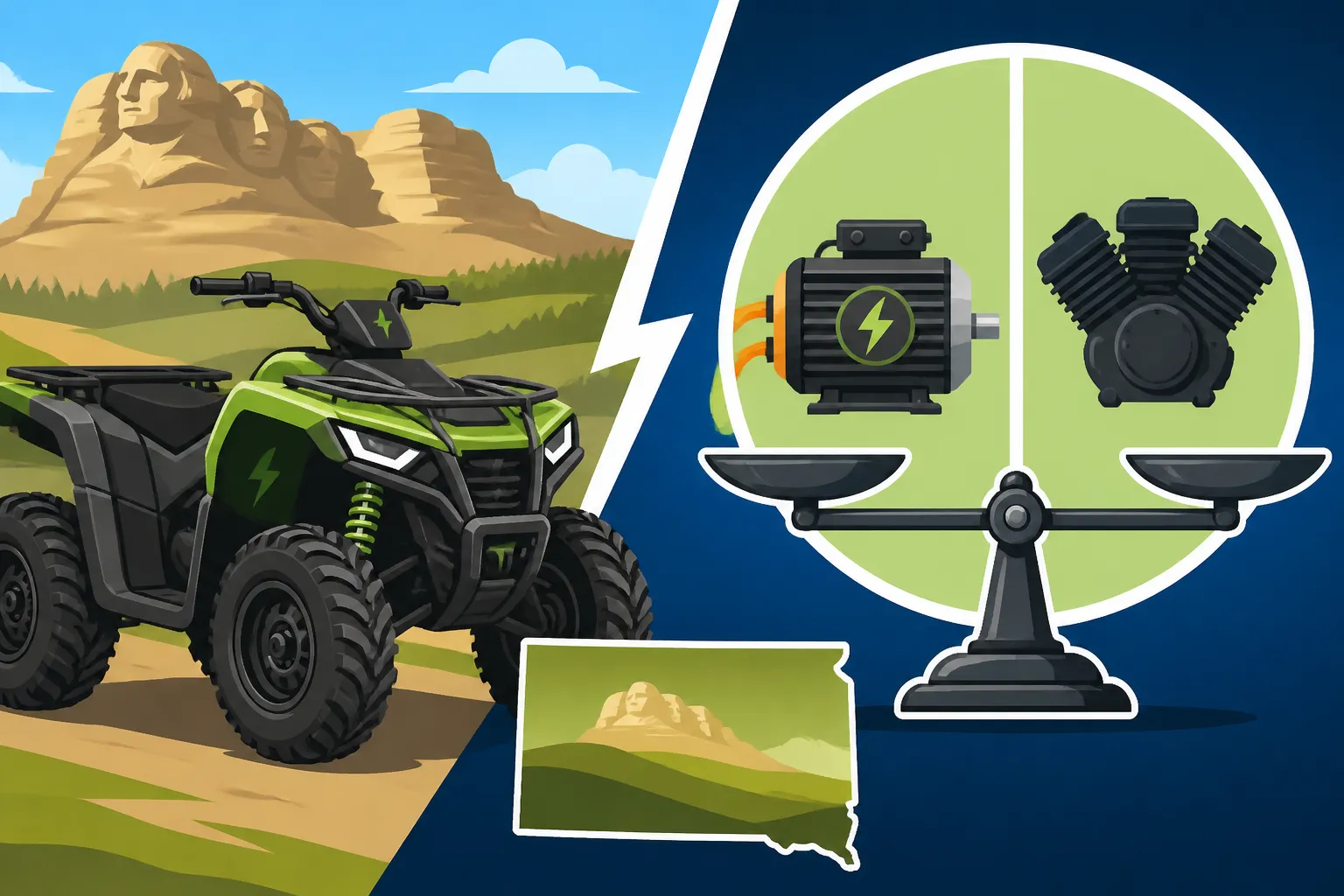
How the Engine Size Rule Applies to Electric ATVs
It's incredibly frustrating when you're keen to hit the scenic gravel roads of South Dakota on your electric ATV or UTV, only to find yourself scratching your head over regulations designed for gasoline engines. The idea of "engine size" for an electric motor can feel like trying to fit a square peg in a round hole, leaving many riders unsure if their eco-friendly machine can ever truly be street legal. This comprehensive guide will clear up the confusion, explaining exactly how South Dakota approaches electric ATVs and UTVs when it comes to road use, from understanding the core rules to the practical steps you'll need to take.
Understanding South Dakota's Baseline for Off-Road Vehicle Street Legality
Before we dive into the specific challenges and solutions for electric machines, it's crucial to understand the foundational rules South Dakota has in place for any off-road vehicle (ORV) to be considered street legal. These rules primarily stem from regulations originally drafted with gasoline-powered engines in mind, which can create a bit of a puzzle for electric vehicle owners.
The "200cc Rule" for Gasoline-Powered Machines
For a conventional, gasoline-powered ATV or UTV to even be eligible for a motorcycle plate in South Dakota, it generally needs to meet a minimum engine displacement of 200 cubic centimeters (cc). This isn't a hard and fast rule for all powered vehicles, but for the class of machines often referred to as ATVs, it's the benchmark. Smaller ATVs, often those intended for youth riders or very light utility work, typically fall below this threshold and cannot be plated for road use. The logic behind this rule often ties into the perceived power, speed, and safety needed to operate alongside other traffic on public roads. Without sufficient power, an ATV could become a hazard by impeding the flow of traffic or struggling to maintain safe speeds.
This 200cc figure is a crucial reference point for county treasurers when they evaluate a machine for titling and plating. It helps them differentiate between recreational vehicles meant strictly for trails or private land and those robust enough to be considered for limited road privileges. For many gasoline ATV owners, this rule means checking their machine's specifications before even dreaming of taking it down a county road. It’s a specific barrier that dictates who gets a plate and who doesn't, setting the stage for the unique challenge faced by electric ATV owners. [South Dakota's 200cc Motorcycle Licensing Rule]
How South Dakota Defines an Off-Road Vehicle
The South Dakota Department of Revenue defines an off-road vehicle (ORV) as a motorized vehicle designed to travel on land and water or land, other than a motor vehicle, which is not otherwise licensed, and which is not a golf cart or an implement of husbandry. This broad definition captures a wide array of machines, including what most of us recognize as ATVs (All-Terrain Vehicles) and UTVs (Utility Task Vehicles), often called side-by-sides. Crucially, this definition doesn't discriminate based on the type of motor, only that it is "motorized."
This is good news for electric ATV and UTV owners because it means their machines are generally recognized as ORVs from the outset. Whether it runs on gas or battery power, if it fits the physical description of a four-wheeled vehicle designed for off-pavement travel, it's considered an ORV in the eyes of the state. This initial inclusion is vital because if electric machines weren't considered ORVs, the subsequent steps to make them street legal would be entirely different or non-existent. Understanding [What South Dakota Counts as an Off-Road Vehicle] is the first step in knowing where your electric machine fits into the regulatory landscape.
Navigating the "Engine Size" Challenge for Electric ATVs
Here's where the rubber meets the road, or rather, where the lack of cubic centimeters on your electric motor creates a unique regulatory hurdle in a system built for combustion.
The Absence of a Direct CC-to-Wattage Conversion
The most significant conundrum for electric ATV and UTV owners in South Dakota is the legislative reliance on cubic centimeters (cc) as the primary measure of an engine's displacement and, by extension, its power and eligibility for plating. Electric motors, by their nature, don't have cubic centimeters. They are rated in watts, kilowatts, or horsepower. Unfortunately, South Dakota's statutes do not provide a direct, legally recognized conversion rate or equivalent threshold between these electrical measurements and the traditional cubic centimeter standard. This legislative gap leaves a significant gray area and can be incredibly frustrating for owners who've invested in powerful electric machines.
Many other states have started to address this by setting horsepower or kilowatt thresholds for electric vehicles, or by classifying them under different categories like "low-speed vehicles" or "electric bicycles" with specific regulations. However, South Dakota hasn't formally adopted such a system for electric ATVs intended for road use. This means you won't find a line in the law that says, "15 horsepower equals 200cc" or "a 10kW electric motor is equivalent." This ambiguity puts the onus on the interpretation of existing laws and, frequently, on the discretion of the officials you encounter at the county level. It’s this lack of explicit guidance that causes so much confusion and makes the process feel uncertain for electric ATV enthusiasts.
South Dakota's Practical Approach to Electric Machine Eligibility
Given the absence of a direct legislative conversion, South Dakota tends to take a pragmatic, "spirit of the law" approach when evaluating electric ATVs and UTVs for street legality. Instead of getting bogged down in the missing cubic centimeter measurement, the state often looks at the overall characteristics, performance, and intended use of the electric machine. If an electric ATV or UTV looks and performs like a gasoline-powered machine that would otherwise meet the 200cc threshold, it is generally treated as eligible for titling and plating.
This means officials at the county treasurer's office, who are ultimately responsible for issuing titles and plates, will assess your electric ORV based on its design, size, and power output, often comparing it visually and functionally to gasoline counterparts. For example, a full-sized electric UTV from a major manufacturer, designed for rugged off-road performance with significant torque and speed capabilities, is far more likely to be considered eligible than a small, low-power electric utility cart. The key is whether it can safely operate at speeds comparable to other vehicles on a public road and whether its build quality suggests it's a legitimate, robust off-road vehicle, not merely a modified golf cart. This practical interpretation helps bridge the legislative gap, but it also means that the more your electric machine resembles and performs like a traditional, powerful ATV, the better your chances are of getting it plated. [Why a County Treasurer Handles South Dakota Titles]
Equipping and Titling Your Electric ATV for South Dakota Roads
Once your electric ATV is deemed eligible for street-legal status, the journey isn't over. You'll still need to ensure it's properly equipped for safety and then navigate the standard titling and plate application process.
Mandatory Equipment for Any Street-Legal ATV
This is where all ATVs, regardless of whether they run on gas or electricity, fall under the same umbrella. To be legally operated on South Dakota public roads, your electric ATV must be equipped with several critical safety features. It's not enough for it to simply be powerful; it must be visible, audible, and controllable in a way that aligns with road safety standards. This list includes:
- Headlights: Functional headlights are required for visibility, especially during dawn, dusk, or adverse weather conditions. They must emit a white light visible from a certain distance.
- Brake Lights: A working red brake light is essential, activating when the brakes are applied to signal to traffic behind you.
- Horn: A horn capable of emitting a sound audible from at least 200 feet away is mandatory. Many electric ATVs, especially those purely designed for off-road, may not come with one, so this is a common aftermarket addition. [South Dakota Horn Requirement]
- Rearview Mirror: At least one rearview mirror, providing a clear view of the highway to the rear for at least 200 feet, is required. Again, off-road specific electric models might lack this. [South Dakota Mirror Requirement]
- Turn Signals: Functional turn signals, indicating your intent to turn, are crucial for safe road operation.
Many electric ATV owners find that while their machine is powerful, it often lacks the specific street-legal equipment required right off the showroom floor. This is where aftermarket solutions become invaluable. Companies like SuperATV offer a vast selection of universal rearview mirrors, robust LED lighting kits, and comprehensive turn signal packages that can transform an off-road electric vehicle into a road-ready machine, adhering to South Dakota's stringent requirements. Before hitting the road, make sure your electric ATV has all the necessary safety equipment. Whether you're looking for durable mirrors or robust lighting solutions, checking out what SuperATV offers can give you a good starting point for compliance. [South Dakota Equipment List for Road Use] [South Dakota Lighting Requirements for ATVs]
| Equipment Item | Requirement for Road Use | Common for Electric ATVs? | Notes |
|---|---|---|---|
| Headlights | Must emit white light, visible from specified distance | Often built-in | Ensure they are functional and properly aimed. |
| Brake Lights | Must emit red light, activate when brakes applied | Often built-in | Crucial for signaling stops to other motorists. |
| Horn | Audible from at least 200 feet away | Usually aftermarket | Many off-road electric ATVs do not come with a horn; an aftermarket addition is typically required. |
| Rearview Mirror | At least one, providing clear view of highway 200 feet to the rear | Usually aftermarket | Essential for situational awareness on public roads; often an easily installed accessory. |
| Turn Signals | Front and rear, amber or red, clearly indicating turns | Usually aftermarket | Integrated kits are available from companies like SuperATV to add this critical safety feature for road use. |
| Plate Light | Illuminates license plate for visibility at night | Often aftermarket | Some aftermarket lighting kits will include this. |
The Titling and Plate Application Process for Electric ORVs
Once your electric ATV is equipped to meet South Dakota's road-ready standards and has been determined eligible, the actual titling and plating process mirrors that of any other eligible off-road vehicle. This means a trip to your local county treasurer's office is in order. This isn't a complex process, but it does require specific documentation and the payment of various fees.
You will need to provide proof of ownership, which typically includes the manufacturer's certificate of origin (MCO) if the machine is new, or a properly assigned title and a bill of sale if you purchased it used. The bill of sale should clearly state the purchase price, as this is critical for calculating the excise tax. You'll fill out a title and registration application form, which the treasurer's office can provide. During this process, you will pay the necessary fees, which include the title fee, plate fee (which can vary by the machine's age and weight), and South Dakota's 4 percent excise tax on the purchase price. There's also a technology fee and small contributions to solid waste and highway patrol funds. [Titling an ATV in South Dakota] [South Dakota ATV Title Paperwork] [South Dakota's 4 Percent Excise Tax] [South Dakota ATV Plate Cost]
Navigating the paperwork at the county treasurer's office is one thing, but making sure your electric ATV is physically compliant with state law for road use is another. Beyond the necessary mirrors and lighting, ensure any accessory you add, perhaps even a windshield or heavy-duty bumper for protection, meets safety standards. SuperATV, for example, is known for producing accessories that prioritize both functionality and safety, giving you peace of mind as you prepare your electric ride for the open road. Once all fees are paid and documentation is submitted, your county treasurer's office will process your application. You will receive a temporary tag, and your official title and plate will be mailed to you, typically within a few weeks. [South Dakota ATV Title Processing Time] [South Dakota Motorcycle Plate for an ATV]
Disclaimer
This article is for general informational purposes only and does not constitute professional advice. Laws, prices and regulations vary by location and change over time. Consult a qualified professional for guidance on your specific situation.