Why No South Dakota County May Bar a Crossing
Navigating the rules for riding ATVs and UTVs in South Dakota can feel like trying to solve a puzzle with missing pieces, especially when it comes to where you can and can't operate your machine on public roads. Many riders worry that a local county might suddenly shut down a vital crossing, leaving them stranded from trails or unable to access their own property. This guide is here to clear up that confusion, explaining precisely why, under South Dakota law, no county has the authority to ban you from crossing a highway or public road.
Understanding South Dakota's Ditch Riding Framework
It's easy to get confused by the patchwork of local rules when you're out riding your ATV or UTV. One county might seem totally open, while the next has signs everywhere telling you to stay out of the ditch. This variability can make riders feel like they're walking on eggshells, constantly worried about inadvertently breaking a local ordinance. The key to understanding this landscape is recognizing that South Dakota law establishes a baseline, and then allows for certain local modifications, but these modifications have clear limits.
The General Rule: Ditch Riding is Permitted Until Banned
Let's start with the fundamental principle in South Dakota: riding in the bottom of a highway ditch or on the back-slope alongside a public road is generally considered permissible for ATVs and UTVs. This isn't just some unspoken tradition; it's rooted in state statutes designed to provide reasonable access for off-road vehicles. For many rural residents and recreational riders, this general allowance is crucial, enabling them to move between properties, access fields, or simply connect to different riding areas without always needing to trailer their machine.
Imagine you're at your hunting cabin, and the nearest public land access is just a mile down the road. If ditch riding wasn't generally allowed, that short trip would become a complicated logistical nightmare, potentially requiring you to load your machine onto a trailer just to move it a brief distance. This is why the state legislature, in its wisdom, set up this default allowance, recognizing the practical needs of residents and visitors alike. It's about maintaining a balance between public safety and the utility of these vehicles for work and recreation.
Of course, this general permission comes with an unspoken expectation of responsible riding. It means staying within the ditch right-of-way, respecting private property boundaries adjacent to the ditch, and always being aware of other traffic, pedestrians, or farm equipment. While the law grants you the ability to ride in these areas, it doesn't absolve you of the responsibility to do so safely and courteously. [Riding the Bottom of a Highway Ditch] explains more about the specifics of this practice.
How Counties "Opt Out" of Ditch Riding
Now, here's where some of the local variation comes into play. While the state broadly allows ditch riding, it also provides a mechanism for individual counties to opt out of this general rule within their jurisdiction. This means a county commission, after due consideration and a public process, can decide to prohibit ATV and UTV use in the highway ditches within their county boundaries. This decision is usually driven by specific local concerns, such as high traffic volumes on certain roads, safety worries from residents, or instances of property damage.
When a county decides to ban ditch riding, they're not just making an announcement and hoping everyone hears it. The law requires them to take a very specific step: they must post [Regulatory Signs a South Dakota County Must Post] at every major entrance point to the county where such a ban is in effect. These signs are critical because they serve as official notification to riders that the rules have changed from the statewide default. Without these signs, a rider could reasonably assume that ditch riding is still permitted.
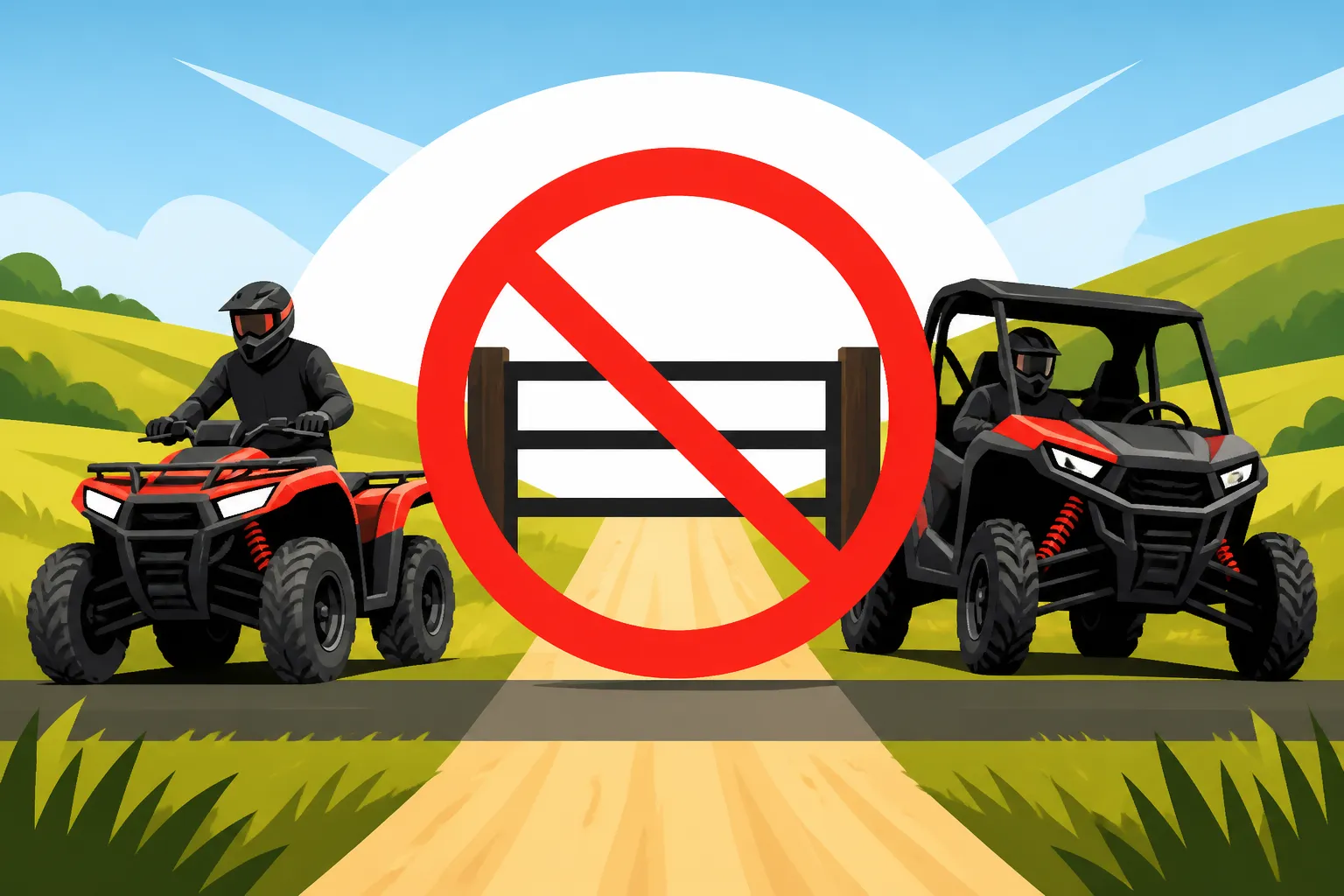
It's important to understand the scope of this "opt-out." A county ban on ditch riding prohibits the act of traveling along the ditch or right-of-way. It means you can't use the ditch as a linear path for your journey. However, and this is a crucial distinction, this county-level authority to opt out does not extend to preventing highway crossings. A county can tell you not to ride down the ditch, but they cannot tell you that you can't cross over it to get to the other side of a road or connect with a trail. [How a South Dakota County Opts Out of Ditch Riding] dives deeper into this process.
The Difference Between Ditch Riding and Crossing
This is the crux of the matter and where a lot of confusion lies. When we talk about "ditch riding," we're generally referring to operating your ATV or UTV in the ditch along the length of a public road. Think of it as using the shoulder or an unpaved margin parallel to the traveled lanes. It's about moving from point A to point B along the road's right-of-way, but not on the paved surface itself. This is the activity that counties have the power to regulate and, if they choose, ban within their borders.
"Crossing," on the other hand, is a completely different action in the eyes of South Dakota law. A crossing involves moving your machine from one side of a road to the other, or from private property, a trailhead, or a field across the road to another destination. It's a perpendicular movement, often short in duration, designed to bridge a gap created by a roadway. For instance, if your ranch is bisected by a county highway, you need to cross that highway to access different parts of your land. Similarly, if a fantastic trail system begins on the opposite side of a paved road, you'll need to cross to get there.
The law treats these two actions differently because their impact and necessity are distinct. Ditch riding, while useful, is a continuous movement that could potentially pose more sustained safety concerns or create nuisance if not properly managed. Crossing, by its nature, is a brief, targeted maneuver that is often essential for connectivity and property access. The state legislature recognized this fundamental difference, ensuring that the necessary function of crossing is preserved, even if local jurisdictions decide to restrict the more continuous activity of ditch riding. This legal distinction is what empowers you to traverse roads even in counties with strict ditch riding rules.
The Unwavering Right to Cross Highways and Roads
It's a common scenario: you're planning a fantastic Black Hills ride, using your SuperATV-equipped machine to tackle the varied terrain. You've studied your maps, identified your routes, and know exactly where you want to go. But then you see a county line sign and wonder, "What if this county has banned all ATV use on roads? Will I be stuck?" This fear, while understandable, often stems from a misunderstanding of a critical protection embedded in South Dakota law. When it comes to crossing, your rights are much more secure than you might think.
The Legal Foundation for Unrestricted Crossings
South Dakota statutes are quite clear on this point: while counties may have the authority to regulate or prohibit ATVs and UTVs from traveling in the highway ditch or on the right-of-way, they expressly do not have the authority to prevent these vehicles from crossing a highway or public road. This isn't an oversight; it's a deliberate and vital provision designed to maintain connectivity and accessibility across the state. The legislature recognized that without the ability to cross roads, many properties would become isolated, and extensive trail networks would be fragmented and unusable.
Think about the sheer practicality of this. South Dakota's landscape, particularly in areas like the Black Hills National Forest, is crisscrossed by countless county roads and state highways. Many popular motorized trails either cross these roads or are located on opposite sides of them. If a county could simply erect a sign saying "No ATV crossings allowed," it would effectively create impassable barriers for riders. This would undermine the very purpose of having an off-road vehicle for recreation or even agricultural use. For example, a rancher might need to move their UTV between pastures separated by a paved road. The right to cross ensures that their livelihood isn't suddenly halted by a local ordinance.
This legal foundation means that your ability to traverse a road is protected at the state level. It's a guarantee that ensures you can connect trail sections, get from one side of your property to another, or reach a gas station without fear of being illegally blocked by local regulations. It provides a consistent framework for all riders, regardless of which county they happen to be passing through.
Why County Bans Cannot Apply to Crossings
The reason counties cannot ban crossings lies in the principle of state preemption. In legal terms, when a state law addresses a specific issue and sets a statewide standard, local governments generally cannot pass ordinances that contradict or are more restrictive than the state law, unless the state explicitly grants them that power. In the case of ATV and UTV crossings, South Dakota law has carved out this specific activity as protected, preventing counties from legislating against it. [Why No County Can Close a Highway Crossing] elaborates on the specifics of this legal barrier for counties.
This means that even if you're riding through a county that has completely banned ditch riding within its borders, you still retain the legal right to cross any public road or highway. An enforcement officer in that county might issue a citation if they observe you riding along a ditch where it's prohibited, but they cannot legally ticket you simply for making a safe, compliant crossing. It's a critical distinction that many riders, and even some local officials, might not fully grasp. The intention is to prevent local jurisdictions from creating "no-go" zones that impede legitimate and necessary movements of off-road vehicles.
Consider a scenario where you've spent the day riding trails and you need to get back to your campsite, which is on the other side of a county highway. Even if that particular stretch of highway is within a county that has opted out of ditch riding, you are still legally permitted to stop, ensure it's safe, and cross the pavement to continue your journey. This preemption by state law ensures that your adventure isn't arbitrarily cut short by a local rule that oversteps its bounds.
Safe Crossing Practices
While the law protects your right to cross, it doesn't give you a free pass to do so recklessly. Safety is paramount, and there are universal best practices that every rider should follow when crossing a highway or public road. The goal is to minimize your time on the paved surface and ensure you're visible and predictable to other motorists.
First and foremost, always come to a complete stop before entering the roadway. Treat it like a stop sign. Look both ways, several times, for oncoming traffic. Remember that ATVs and UTVs are often smaller and less visible than cars, especially in certain lighting conditions or around blind curves. If you have a SuperATV horn kit installed, a quick, polite beep can help alert others, though it's never a substitute for visual confirmation. Yield to all traffic on the roadway. You do not have the right-of-way.
When the path is clear, cross the road at as close to a 90-degree angle as safely possible. This minimizes the distance you travel on the paved surface and makes your trajectory clear to any approaching vehicles. Avoid long, angled crossings that keep you on the road for extended periods. Accelerate smoothly and decisively across the road, but maintain control. If your machine is equipped with turn signals, use them to indicate your intention to cross, even if you're only on the road for a few seconds.
Ensure your machine is properly equipped for maximum visibility. This means having working headlights and taillights, even during daylight hours if conditions warrant. For machines plated for road use, [South Dakota Equipment List for Road Use] outlines specific requirements like mirrors and horns. Even if your machine isn't plated, good visibility is just common sense. The less time you spend exposed to traffic, and the more visible you are during that time, the safer your crossing will be.
Navigating Local Regulations and State Preemption
Riding an ATV or UTV in South Dakota involves understanding a blend of state statutes and potential county-level ordinances. While the state provides a foundational framework, individual counties can enact their own rules regarding certain aspects of off-road vehicle use, particularly concerning ditch riding. This can create a challenging environment for riders who want to stay compliant, but it's crucial to remember that state law always holds the ultimate authority, especially when it comes to fundamental rights like crossing a highway.
Identifying a County's Ditch Riding Status
One of the biggest questions riders have is, "How do I know if ditch riding is banned in this particular county?" South Dakota law provides a clear answer: a county that has chosen to opt out of the statewide allowance for ditch riding must post regulatory signs. These aren't subtle billboards or small notices; they are official signs placed at the main entry points to the county. If you don't see these signs when you enter a county, the general assumption is that ditch riding is permitted there, in accordance with state law. However, even if you don't see a sign, always exercise good judgment and prioritize safety.
Beyond looking for physical signs, proactive riders can also do a little homework. Many county websites, especially those in popular riding areas, might have information regarding their local ordinances. You could also contact the county sheriff's office or the county commission directly to inquire about their specific rules concerning ATVs and UTVs in highway ditches. While the legal burden is on the county to post signs for a ban, being informed never hurts. For more detail on this, check out [Regulatory Signs a South Dakota County Must Post].
It's important to differentiate between general public land use rules and county-specific ditch riding ordinances. For example, the Black Hills National Forest has its own set of rules for trails and forest roads, which are separate from county ditch riding regulations. A county might ban ditch riding on a state highway passing through it, but that doesn't mean you can't access an authorized forest trail immediately off that highway.
When Local Rules Conflict with State Law
The concept of state preemption is incredibly important for ATV and UTV riders in South Dakota. Simply put, if a state law covers a topic, a local government (like a county) cannot create a rule that is stricter, weaker, or contradicts the state law, unless the state law explicitly allows for such local variation. In the context of highway crossings for off-road vehicles, state law is very clear: counties cannot prohibit them. This means any local ordinance attempting to ban crossings is invalid and unenforceable.
While such direct conflicts are rare, misunderstandings can happen. Imagine a situation where a new county deputy, perhaps unfamiliar with the nuances of ATV law, tries to issue a citation for crossing a road in a county where ditch riding is banned. In such a scenario, it can be helpful to politely and respectfully inform the officer that state law specifically protects the right to cross. Having a basic understanding of the relevant statutes can empower you to advocate for yourself. However, it's generally advisable to comply with an officer's directive at the moment and address the issue through legal channels later, rather than creating a confrontation roadside.
This preemption principle is a safeguard for riders, ensuring that crucial rights, like connecting trail systems or accessing private property, cannot be arbitrarily removed by local authorities. It brings consistency to key aspects of ATV and UTV use, so you don't have to worry about a fundamental right disappearing the moment you cross an invisible county line. This helps foster a more unified approach to off-road vehicle recreation across the state.
Exceptions and Nuances: What Still Applies
It's vital to understand that while your right to cross a highway is protected, this protection doesn't magically exempt you from all other state laws governing ATV and UTV operation. The right to cross is about the act of traversing the road; it doesn't waive requirements for vehicle equipment, rider age, or operating conduct.
For example, if you are riding a plated ATV or UTV and using it to travel on roads (even just briefly for a crossing), your machine still needs to meet the [South Dakota Street Legal ATV Requirements]. This means having proper headlights, taillights, brake lights, a horn, and mirrors. Many riders upgrade their machines with accessories from companies like SuperATV to ensure they meet these requirements and enhance safety. If your machine isn't street legal in terms of equipment, even a quick crossing could lead to a citation for equipment violations.
Furthermore, state laws regarding rider age and safety still apply. For instance, [South Dakota Helmet Law for ATV Riders] dictates when helmets are required, particularly for younger riders. [Why South Dakota Exempts Adults From Helmets] clarifies the age at which helmets are no longer mandated, but even then, safety gear is always a smart choice. Additionally, operating an ATV or UTV under the influence of alcohol or drugs is strictly prohibited, and [South Dakota DUI Rules for ATV Riders] apply equally to off-road vehicles as they do to cars. The right to cross simply means you can traverse the road; it doesn't grant permission to operate unsafely or illegally in other respects.
Practical Implications for Riders and Landowners
The legal clarity surrounding ATV and UTV road crossings in South Dakota has significant real-world implications, impacting everyone from recreational riders exploring the Black Hills to farmers tending their fields. Understanding these practical aspects can enhance your riding experience, help you avoid legal troubles, and contribute to a more harmonious co-existence with other road users and landowners.
Connecting Trails and Accessing Private Property
For many ATV and UTV enthusiasts, the ability to cross roads is what makes South Dakota such an appealing destination. Imagine a vast network of forest roads and trails, but they are all cut off from each other by paved highways. Without the right to cross, these trail systems would be isolated pockets, significantly limiting the scope and enjoyment of multi-day rides. The legal protection for crossings ensures that riders can link these various segments, creating epic loops and long-distance adventures. Whether you're planning a week-long journey through the Black Hills or just a day trip connecting state-managed lands, this right is invaluable.
Beyond recreation, this also holds immense importance for landowners, especially those with agricultural operations. Many farms and ranches in South Dakota are bisected by public roads. A farmer might need to move a UTV from one field to another, or transport equipment, without having to load it onto a trailer every time. The ability to safely and legally cross a road with their off-road vehicle is essential for their daily operations and livelihood. It underscores the state's recognition of ATVs and UTVs as legitimate utility vehicles, not just recreational toys.
This connectivity also impacts local economies. Outfitters who rent ATVs and UTVs rely on their customers being able to access and connect to various trailheads. Rental companies, particularly those near popular riding areas like Deadwood or Custer, know that the freedom to traverse roads for short distances is crucial for providing a seamless experience.
Impact on Non-Resident Riders
South Dakota is a huge draw for out-of-state riders, particularly during events like the Sturgis Rally or for those seeking the unique beauty of the Black Hills. Non-residents often come with their machines from states with different, and sometimes more restrictive, ATV laws. The consistent statewide rule protecting the right to cross roads is a huge benefit for these visitors. It means they don't have to navigate a maze of potentially conflicting local ordinances just to move from one trail to another.
However, non-resident riders still need to be aware of other specific South Dakota requirements. For example, if you're riding federal lands, you'll need a [South Dakota's Nonresident ORV Permit] in addition to knowing the crossing rules. While the right to cross is universal, other administrative requirements might still apply. The state's goal is to welcome visitors while ensuring that all riders operate responsibly and contribute to the maintenance of the riding infrastructure.
This clear, consistent approach to crossings reduces ambiguity and encourages tourism. Visitors can plan their trips with confidence, knowing that a critical aspect of their riding experience won't be arbitrarily restricted by local authorities. It's an incentive for riders to choose South Dakota as their destination, knowing they can fully explore the landscape.
Ensuring Compliance and Avoiding Fines
Knowing your rights under the law is the first step, but ensuring compliance involves more than just understanding where you can and cannot go. It also means operating your machine safely and being aware of the potential consequences of non-compliance. While you have the right to cross, you don't have the right to cross unsafely or with a machine that doesn't meet necessary standards.
One of the easiest ways to get into trouble, even with a protected crossing, is to neglect basic equipment or safety. If your ATV or UTV is not properly equipped for road use (even for a brief crossing) and you are stopped by law enforcement, you could still face citations for things like missing mirrors, a non-functional horn, or inadequate lighting. Aftermarket accessories from companies like SuperATV can often enhance visibility and compliance, but they must be correctly installed and maintained. For example, bright LED lights improve your visibility to other drivers, making your crossing much safer.
Furthermore, any operation of an ATV or UTV that is deemed reckless, careless, or endangers public safety will still be subject to enforcement. The right to cross is not an invitation to speed, perform stunts, or ignore traffic laws while on the pavement. Always yield to traffic, use appropriate hand signals or turn signals, and cross decisively. Violations like these, or riding in a ditch where a county has opted out, can result in [South Dakota Fines for Illegal ATV Road Use]. Being a responsible rider means respecting both the written law and the unwritten rules of safe operation.
Remember, the goal is to enjoy your ride while staying safe and within legal boundaries. By understanding the distinction between ditch riding and crossing, and by always prioritizing safety and proper equipment, you can confidently navigate South Dakota's diverse terrain without unnecessary worry.
Here's a quick comparison of ditch riding versus crossing rules:
| Feature | Ditch Riding (Along the Ditch) | Highway Crossing (Across the Road) |
|---|---|---|
| Default State | Generally Permitted Statewide | Generally Permitted Statewide |
| County Authority | Counties may prohibit if they "opt out" and post signs | Counties may NOT prohibit; state law preempts local bans |
| Purpose | Traveling along the right-of-way | Moving from one side of a road to the other, or to/from property |
| Legal Basis | SD Codified Law 32-20-13 (with county opt-out provision) | SD Codified Law 32-20-13 (specifically protecting crossings) |
| Signs Required for Ban | Yes, regulatory signs must be posted at county entry points | No county can post signs banning crossings |
| Key Action | Continuous movement parallel to the roadway | Brief, perpendicular movement across the roadway |
| Safety Considerations | Be aware of road traffic, private property, ditch obstructions | Yield to all traffic, cross at 90 degrees, maximize visibility |
| Equipment | General ATV/UTV safety gear, appropriate tires | Road-legal equipment if plated, excellent visibility, horn recommended |
Disclaimer
This article is for general informational purposes only and does not constitute professional advice. Laws, prices and regulations vary by location and change over time. Consult a qualified professional for guidance on your specific situation.