Fog in a Black Hills Draw
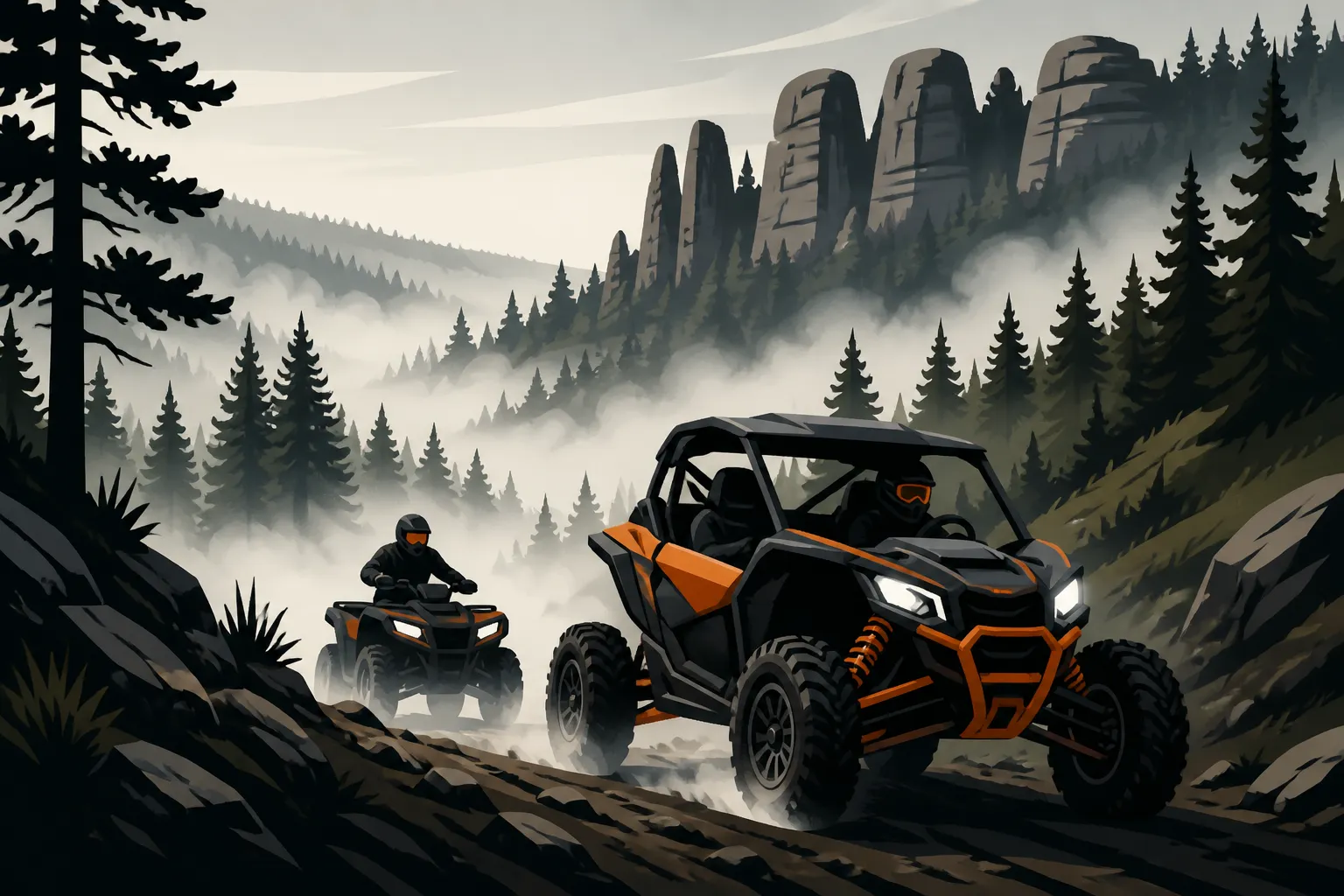
You're out enjoying the stunning Black Hills on your ATV or UTV, cruising along a familiar forest road or gravel section line, when suddenly, you drop into a draw, and a thick, soupy fog rolls in, swallowing the landscape and making it impossible to see beyond a few feet. That sudden loss of visibility can turn an enjoyable ride into a genuinely harrowing experience. This guide is here to help you understand why fog forms in these tricky Black Hills draws, the specific dangers it presents to off-road riders, and most importantly, how to prepare yourself and your machine to safely navigate or even avoid these low-visibility conditions when exploring South Dakota's beautiful terrain.
The Phenomenon of Fog in Black Hills Draws
The Black Hills, with their unique geological formations, dense forests, and winding valleys, are particularly prone to localized fog. It's not just a blanket of gray that rolls in; often, it's specific pockets, particularly in the lower elevations and secluded draws, that catch riders completely off guard. Understanding why these conditions occur is the first step in being prepared.
How Draws and Topography Create Fog Pockets
Draws, ravines, and valleys in the Black Hills act like natural bowls, collecting and holding cooler, denser air. When warm, moist air from higher elevations or recent rain moves across these cooler pockets, it cools rapidly to its dew point. This process causes the water vapor to condense into tiny liquid droplets, forming fog. It's a classic example of a temperature inversion at a micro-level. Imagine riding along a ridge where the air is clear and crisp, and then descending into a deep gulch where a stream runs, shaded by towering pines. The temperature can drop several degrees, and suddenly, you're enveloped in a milky whiteout. The dense tree cover further traps this moist, cool air, preventing it from dissipating quickly, making these spots particularly notorious for sudden, thick fog banks.
Seasonal and Weather Factors Increasing Fog Risk
While fog can occur at any time, certain seasons and weather patterns significantly increase the likelihood of encountering it in the Black Hills. [South Dakota Riding in Spring] often brings warmer days followed by cooler nights, creating ideal conditions for fog, especially after a spring rain when moisture is abundant. The same can be said for [South Dakota Riding in Autumn], when changing temperatures and falling leaves contribute to a moist, cooling environment in the draws. Even in summer, a warm, humid day followed by a cold front or a sudden evening chill can trigger dense fog in low-lying areas. After a significant rainfall, the evaporation from the saturated ground and vegetation can quickly feed these fog pockets. So, if you're planning a morning or evening ride, or if there's been recent precipitation, always factor in the increased potential for fog, particularly if your route takes you through many deep draws or near bodies of water.
Navigating the Hazards of Riding in Fog
Riding an ATV or UTV in thick fog is profoundly different from riding in clear conditions. The very nature of off-road riding, with its varying terrains and potential for unexpected obstacles, becomes exponentially more dangerous when visibility is severely compromised. It's not just about seeing the path ahead; it's about reacting to everything around you.
Reduced Visibility and Reaction Time
The most obvious and immediate danger of fog is the drastic reduction in visibility. What was once a clear trail stretching hundreds of feet ahead can shrink to just a few yards, or even less in dense fog. This makes judging distances, assessing terrain changes, and even determining your own speed incredibly difficult. A sharp turn you'd normally navigate with ease can appear suddenly, leaving you little time to react. Similarly, obstacles like fallen branches, rocks, or deep ruts become invisible until you're right on top of them. Your reaction time, which is crucial for safe off-road riding, is severely hampered, increasing the risk of collisions or loss of control. It's a bit like trying to drive blindfolded, with only glimpses of the world appearing sporadically.
Traction Loss and Unpredictable Surfaces
Fog doesn't just obscure your vision; it saturates the environment with moisture, making surfaces wet and slippery. Gravel roads, which normally provide good traction, can become slick and greasy. Dirt trails can turn into muddy tracks, and wet leaves become treacherous ice-like patches. When you can't see these changes in surface conditions, you're at a much higher risk of losing traction, especially when braking or turning. A subtle incline or a patch of wet clay that would be easily spotted on a clear day can lead to an unexpected slide or spin out in heavy fog. This unpredictable nature of the terrain, combined with reduced visibility, demands extreme caution and a significant reduction in speed to maintain control.
Encountering Wildlife and Other Riders Unexpectedly
The Black Hills are teeming with wildlife, from deer and elk to wild turkeys and smaller critters. In clear conditions, you typically have time to spot these animals and react appropriately. However, in dense fog, they can appear out of nowhere, often just feet in front of your machine. An elk stepping onto the trail from dense timber, or a deer darting across your path, becomes a high-risk encounter when you have only a second or two to react. Similarly, other riders—whether they're on another ATV, a motorcycle, or even a bicycle—can suddenly materialize from the whiteout. Hikers, joggers, or even parked vehicles near a trailhead can also become unexpected hazards. [Meeting Traffic on a One-Lane Ranch Bridge] is already a tight squeeze, but in fog, it becomes a true gamble. This dramatically increases the chance of a collision, underscoring the need for extreme vigilance and a readiness to stop at a moment's notice.
Essential Strategies for Safe Fog Riding
When the Black Hills weather throws a curveball like dense fog, it’s not just about knowing the dangers; it’s about having a game plan. Being prepared with the right mindset, equipment, and decision-making skills can make all the difference between a scary moment and a safe ride home.
Adjusting Your Speed and Following Distance
The single most critical adjustment you can make in foggy conditions is to drastically reduce your speed. Your speed should always be dictated by your ability to see and react to what's ahead. If you can only see 10 feet in front of you, you need to be able to stop within those 10 feet. This often means crawling along at a pace that feels painfully slow compared to your usual cruising speed. Don't feel pressured to keep up with others in your group if you're not comfortable. Furthermore, if you're riding with companions, increase your following distance significantly. The typical "one machine length for every 10 mph" rule goes out the window in fog. You want enough space to react to their braking or swerving, plus any unforeseen obstacle they might encounter. Remember, their taillights might be the only warning you get, and fog can make even those appear blurry and close.
Enhancing Machine Visibility with Lighting and Markings
Your machine's lights become your best friends in the fog. Turn on all available lights: headlights, taillights, and any auxiliary lighting you have installed. For serious low-visibility conditions, consider aftermarket fog lights or LED light bars. Companies like SuperATV offer a range of robust lighting solutions designed for off-road use, which can provide a wider, lower beam that cuts through fog better than standard headlights. While standard headlights aim higher and can reflect off the fog droplets, causing glare, dedicated fog lights are designed to illuminate the ground directly in front of and below the fog. Additionally, using reflective tape on your machine, especially on the front, rear, and sides, can significantly increase your passive visibility to other riders or vehicles, helping you stand out in the grayish haze.
Personal Gear for Rider Safety
Your personal gear plays a crucial role too. While [South Dakota Helmet Law for ATV Riders] primarily addresses head protection, choosing the right visor or goggles for your helmet in foggy conditions is paramount. Avoid dark or tinted visors at all costs. Instead, opt for a clear or yellow-tinted visor or goggles. Yellow tints can help increase contrast in low light and fog, making it slightly easier to discern shapes and changes in terrain. If you only have a dark visor, you'll need to ride with it open, but then you risk eye irritation from the damp air and potential debris. Wearing bright, highly visible clothing, especially fluorescent colors or gear with reflective elements, will also help you stand out to others. Some riders even attach a small, battery-powered headlamp to their helmet, which can provide an extra point of light that's often above the thickest part of the fog. [South Dakota Eye Protection Rules for Riders] typically require eye protection; in fog, the type of protection becomes critical.
When to Pull Over and Wait It Out
Sometimes, despite all preparations, the fog can simply be too thick and the conditions too dangerous to continue. Knowing when to call it quits and wait for the fog to lift is a sign of a responsible rider. If you find yourself struggling to maintain control, constantly fearing an unseen obstacle, or experiencing severe disorientation, it’s time to find a safe place to pull over. Look for a spot well off the main trail or road, ideally on higher ground or a wider shoulder, where you won't be an unexpected obstacle for others. Turn on your hazard lights or flashers to make yourself as visible as possible. Waiting it out might mean enjoying a hot thermos of coffee, checking your map, or simply taking a breather. Fog can lift surprisingly quickly, especially as the sun gets higher or winds pick up. A few minutes or an hour of waiting is a small price to pay for your safety.
| Visibility Condition | Rider Action | Machine Lights | Personal Gear | When to Stop |
|---|---|---|---|---|
| Light Fog | Reduce speed slightly, increase following | Headlights, taillights on | Clear/yellow visor, bright clothing | If conditions worsen quickly |
| Moderate Fog | Slow significantly, ride with extreme caution | All lights, auxiliary if available | Reflective gear, clear/yellow visor | If disoriented or anxious |
| Dense Fog | Crawl slowly, be ready to stop at any moment | All lights, fog lights if installed | Max reflective gear, clear visor | Immediately if visibility is less than 10 ft |
| Whiteout | DO NOT PROCEED. Find a safe pull-off point | Hazard lights, all lights on | All safety gear | ASAP, wait for conditions to improve |
South Dakota Regulations for Low Visibility Riding
While common sense and personal safety are paramount when riding in fog, it's also important to be aware of how South Dakota's regulations apply to your machine, especially if you're utilizing public roads or rights-of-way. Being prepared for low visibility means understanding what's expected of you, legally, when you're out there.
Lighting Requirements for Road-Legal ATVs
If your ATV or UTV is plated and designated as street-legal in South Dakota—a possibility for machines over a certain engine size, like those meeting the [South Dakota's 200cc Motorcycle Licensing Rule]—then it must adhere to specific lighting requirements that are particularly relevant in foggy conditions. This means functional headlights, taillights, and brake lights are not just a good idea for safety, but a legal mandate. [Equipment a South Dakota Road Machine Needs] includes these items, and they must be in good working order. A burned-out bulb in clear weather is a minor inconvenience, but in thick fog, it could be a critical safety failure, potentially leading to a citation or, worse, an accident. Even if your machine isn't fully road-legal, if you find yourself on a public road or sharing space with other vehicles in reduced visibility, having all your lights blazing is a non-negotiable step for your own protection and the safety of others.
Ditch Riding and Fog Considerations
South Dakota has specific rules regarding [South Dakota Ditch Riding Rules Explained], allowing ATVs and UTVs to operate in highway ditches under certain conditions, even if the machine isn't street-legal. However, riding in a ditch during foggy conditions introduces a unique set of dangers. The ditch bottom itself can be a magnet for cooler, moist air, making fog even thicker there than on the adjacent roadway. This severely limits your ability to see unexpected obstacles like culverts, fence posts, or uneven terrain. Furthermore, while ditch riding, you still need to be aware of traffic on the main road, especially when crossing entrances or intersections. In fog, vehicles on the highway may have a harder time seeing you emerging from the misty ditch, increasing the risk of a collision. It's imperative to proceed with extreme caution, reduce your speed to a crawl, and ensure your machine's lights are on, even if the legal requirement for a ditch-only ride is less stringent than for a plated machine on the pavement.
The Importance of a Plated Machine in Reduced Visibility
While South Dakota does not mandate an ATV safety course, having a plated machine offers an inherent advantage in foggy conditions when you're on public roads. A plated ATV or UTV is inherently designed and equipped with standard safety features like headlights, taillights, brake lights, and often mirrors, which all contribute to better visibility for both the rider and surrounding traffic. These machines, by virtue of their street-legal status, are expected to be seen and recognized as vehicles on the road. For example, if you're riding a gravel road that turns foggy, a plated machine's lights and reflectors make it far more conspicuous to an oncoming pickup truck than an unplated machine might be. While a [South Dakota Nonresident ORV Permit] allows out-of-state riders certain privileges, it's the full compliance with plating and safety equipment standards that truly enhances safety in those unpredictable Black Hills fog banks. Think of it as an extra layer of signaling that says, "I'm here, and I'm a vehicle, so please proceed with caution." This can be particularly important when utilizing sections of road that may also allow [South Dakota Rules for Riding a Highway Shoulder].
Disclaimer
This article is for general informational purposes only and does not constitute professional advice. Laws, prices and regulations vary by location and change over time. Consult a qualified professional for guidance on your specific situation.