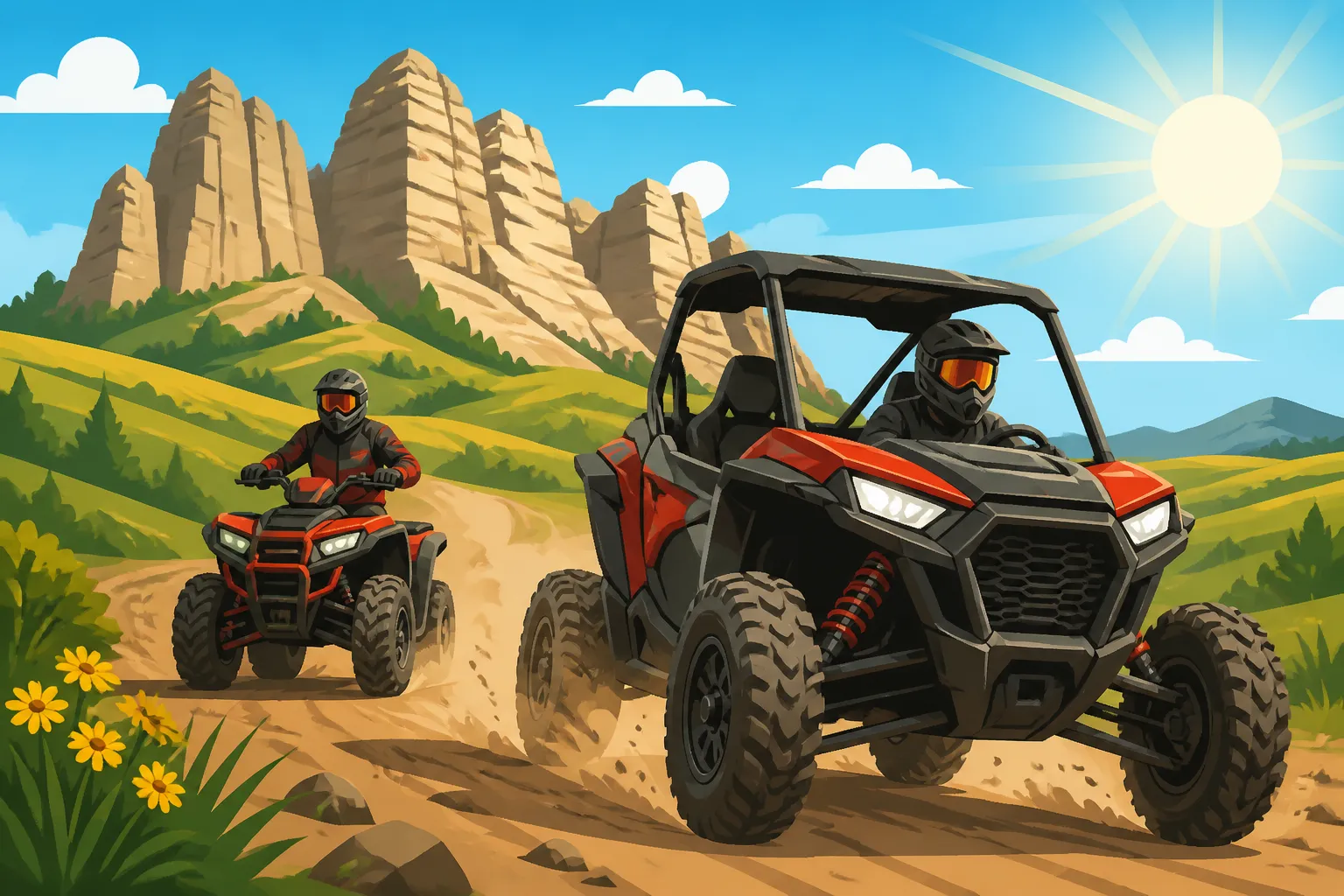
South Dakota Riding in Summer
Summer riding in South Dakota can mean dusty forest roads, sudden Black Hills thunderstorms, crowded trailheads and route closures that are easy to miss until you arrive. A little planning helps you avoid wasted miles and ride more comfortably. This guide explains how to check access, choose a suitable route, prepare for summer conditions and respect other trail users.
Plan around seasonal access and trail conditions
Check which routes are actually open
Summer is a popular time to ride South Dakota’s Black Hills, but “summer” does not mean every motorized route is open. Trails and roads can have different seasonal access dates, and a route that appears on an older map may now be closed or subject to a seasonal restriction. Before loading your ATV or UTV, check the current forest travel information and look for notices about construction, fire, weather damage and temporary closures.
Start with the latest official motor vehicle use map for the area you plan to ride. These maps show which routes are open to motorized use and may identify restrictions that a general navigation map does not show. A mapping app such as onX Offroad can help you explore and follow a route, but treat it as a planning aid, not permission to ride. Compare it with the official map and any posted signs at the trailhead. For a practical starting point, review [South Dakota Trail Maps and MVUMs] and [South Dakota Trail Closures to Check First].
A route can also become difficult or unsuitable without being formally closed. A recent storm may leave ruts, washouts, loose rock or muddy sections, while a dry stretch can make dust and visibility problems worse. Check [South Dakota Trail Conditions Before You Ride] close to your departure, then be willing to change plans if the report, weather or trailhead signage calls for it.
Understand permits before the ride
Do not assume that a license plate, an out-of-state registration or a rental agreement automatically covers every place you intend to ride. Requirements depend on where you are riding and what kind of machine you have. A public road, a designated motorized trail and a managed riding area may each have different rules. Confirm what applies to your specific destination before setting out.
South Dakota’s Black Hills motorized trails have permit requirements. The details can depend on the type of route and machine, so read [South Dakota's Motorized Trail Permit] and confirm how the permit must be displayed. A permit is not a substitute for route access: you still need to stay on routes open to your vehicle, follow posted restrictions and avoid closed areas.
Visitors should make this check part of trip planning rather than a last-minute stop at the trailhead. If you are riding federal land, review [South Dakota Rules for Riding Federal Land] as well as the forest’s current maps and notices. For seasonal context, [South Dakota's May to December Trail Season] explains why the calendar matters, but always verify the current opening and closing information for the route you have in mind.
Choose a route that fits your machine and group
Match trail width and difficulty to your vehicle
A route that works for a narrow ATV may not suit a wider side-by-side. Before choosing a trail, check any width limits and measure your machine from the outside edge of one tire to the outside edge of the other if the rules call for it. Do not rely on the vehicle’s advertised width alone; tires, accessories and modifications can change the practical measurement.
Difficulty is more than the name or color assigned to a trail. Consider the surface, slope, turns, rock ledges, exposure and how much room there is to pass or turn around. A route that feels manageable for an experienced rider on a dry day may be a poor choice for a novice, a loaded machine or a group with children. If the route includes a long climb or rough sections, make sure everyone in the group is comfortable with those demands before you commit.
It also helps to think about your day as a whole. A short route on a map can take longer than expected when the surface is rough, you stop for views, or traffic slows progress. Build in time for breaks and a safe return, rather than planning a ride that only works if everything goes perfectly.
Select an area with practical staging and support
Start with the places and amenities that matter to your group. A good ride plan considers where you will park and unload, whether there is room for a trailer, how far you are from fuel and what you will do if someone needs to stop early. Check whether facilities are available before counting on them; services can be limited once you leave town.
For riders staying near the Black Hills’ main communities, explore options in advance through [South Dakota ATV Trails Near Rapid City]. That does not mean the closest route is automatically the best one. Compare the drive to the trailhead, expected ride length, route limits and current conditions. If your group is new to the area, prioritize a straightforward itinerary with clear navigation and an easy way to return to the staging area.
Planning tools can help you keep track of alternatives. onX Offroad, for example, may be useful for reviewing a route and saving a plan for offline reference where the app supports it. Still, download or carry the official information you need, know how to identify the trail you are on, and avoid following a digital line into a signed closure. A phone battery, cellular signal or map layer should never be your only navigation plan.
| Planning question | What to check | Why it matters |
|---|---|---|
| Is the route open? | Current official map, closure notices and signs | Prevents riding into a restricted or closed area |
| Does it fit my machine? | Width limits, surface and trail difficulty | Helps avoid an unsafe or prohibited route |
| Is the permit sorted? | Requirements for the specific area and machine | Reduces uncertainty at the trailhead |
| Can we finish comfortably? | Ride time, fuel, daylight and group experience | Leaves room for stops and unexpected delays |
| What if plans change? | Alternate routes, return options and local notices | Makes it easier to respond to weather or closures |
Prepare for heat, storms and changing surfaces
Manage heat and hydration
A sunny day in the Black Hills can feel pleasant at the trailhead and much hotter once you have been riding for several hours. Protective gear, exertion and limited shade can make heat harder to notice, particularly when the ride is dusty or noisy. Start with water on board, take regular breaks and make sure each rider has a way to drink without relying on a single shared bottle.
Plan your route around your group’s pace and comfort. Children, new riders and anyone unaccustomed to hot-weather activity may need more frequent stops. Watch for unusual fatigue, dizziness, nausea, headache or confusion, and stop riding if someone seems unwell. Move to a cooler place, rest and seek appropriate help if symptoms are serious or do not improve. Do not treat a planned mileage target as more important than a rider’s condition.
Pack for practical comfort as well as safety: sun protection, suitable clothing, snacks and enough water for delays. A small issue such as a flat tire or a route detour can extend a ride, so carry supplies for more than the ideal schedule. Tell someone who is not riding where you expect to go and when you plan to return, especially if your route takes you away from busy trailheads.
Expect fast weather shifts and fire-related changes
Summer weather in western South Dakota can change quickly. A clear morning does not guarantee a clear afternoon, and thunderstorms can bring lightning, heavy rain and reduced visibility. Check the forecast before leaving and keep an eye on the sky while riding. If storms approach, do not press on merely to reach a viewpoint or finish a loop. Choose a safer place to stop or return by a route you know is open.
Rain changes the character of a trail. Loose gravel may become slippery, exposed rock can be slick, and water can hide damage or a soft edge. After a heavy shower, slow down, increase following distance and avoid entering water where you cannot judge its depth or the surface underneath. If conditions exceed your group’s experience, turn around rather than trying to prove that the route is passable.
Dry weather brings its own concerns. Dust can limit visibility between machines, while hot, dry conditions may lead to fire restrictions or closures. Leave extra space between riders, avoid driving through dust clouds without a clear view and check for notices before you set out. [South Dakota Riding in Summer] is a useful companion topic for thinking through seasonal conditions, and [South Dakota Trail Conditions Before You Ride] is worth checking again when the forecast changes.
Ride safely and share the trail
Keep the group together without crowding
A group can spread out quickly when riders have different experience levels or machines with different capabilities. Agree on a simple plan before leaving: who leads, who brings up the rear, where you will stop and what everyone should do if the group gets separated. Choose regrouping points that are easy to recognize, such as a signed junction or a trailhead, rather than assuming everyone will stop at the same scenic pullout.
Give the rider ahead enough room to see and react. Dust, loose gravel and blind corners make close following uncomfortable and risky. If visibility drops, slow down and let the dust settle before continuing. Avoid sudden stops in places where another vehicle may not see you, and do not block the trail while checking a map or adjusting gear.
Carry basic supplies appropriate to your machine and the route, such as a tire repair kit, tools, first-aid items, a charged phone and a backup way to navigate. Check that your machine is in good condition before the trip, including tires, brakes, lights and fuel. A roadside repair on an exposed slope or narrow trail can become more complicated if the group has not planned where to pull over safely.
Be considerate of hikers, cyclists, horses and other riders
A popular summer route may bring together motorized users, hikers, cyclists, horseback riders and local traffic. Slow down when approaching others, give them space and follow any posted right-of-way rules. Dust and engine noise can make a machine feel intimidating to someone on foot or horseback, so ease off the throttle, avoid startling animals and wait for a safe opportunity to pass.
Stay on the route. Cutting corners around a puddle or riding around a barrier can widen a trail, damage vegetation and create new tracks that other riders may mistakenly treat as open. If a section is blocked or seems impassable, do not invent a detour across a meadow or private land. Turn back or use a route that is clearly open and permitted.
Etiquette also includes how you arrive and leave. Park in designated spaces, keep trailers from blocking access and pack out trash. Be especially mindful near busy communities and visitor areas during summer. [South Dakota Trail Etiquette With Tourists] offers more context on sharing popular riding areas respectfully.
Build a flexible summer itinerary
Make a realistic day plan
A good itinerary includes more than a destination. Note your starting point, intended route, expected ride time, fuel needs, planned breaks and a sensible turnaround time. Include a backup route that is open to your machine, and make sure your group knows how to return if the lead rider has to stop. For a day ride, avoid treating every planned mile as non-negotiable.
Check fuel availability before you leave town. Do not assume a station will be open or convenient just because one appears near the route on a map. Some rides require more fuel than expected because of slow terrain, repeated climbs, detours or extra stops. If you are uncertain, ask locally about fuel options and carry only what is safe and appropriate for your vehicle and the riding rules.
When you are camping, think about how the trail plan fits with the campsite. Confirm the campground’s access and parking arrangements, and avoid leaving a trailer where it blocks other visitors. [Camping Near South Dakota Trails] can help you plan the overnight side of a riding trip. If you are mapping a multi-day outing, keep each day’s route manageable rather than stacking long rides back to back without time for weather or equipment issues.
Keep a clear decision point for changing plans
Before you leave, agree on conditions that mean the group will shorten or cancel the ride. Those might include a closure notice, lightning, poor visibility, a machine problem, heat affecting a rider or a route that proves more difficult than expected. Having that conversation in advance makes it easier to make a calm decision when people are tired and eager to continue.
Use official sources for closures and land-use rules, and treat posted signs as meaningful even if a digital map shows a route. onX Offroad can be helpful for reviewing a planned line and seeing your position, but it should complement—not replace—official information and judgment on the ground. If a sign, map and app appear to conflict, do not assume the least restrictive interpretation is correct; pause and clarify access before proceeding.
Finally, leave enough daylight to get back without rushing. Summer days are long, but mechanical problems, dust, traffic and unexpected stops can stretch a ride. A plan that ends with time to spare is more comfortable than one that depends on riding quickly as the light fades. For related trip planning, see [South Dakota Trails With Fuel Nearby] and [South Dakota Riding in August].
Disclaimer
This article is for general informational purposes only and does not constitute professional advice. Laws, prices and regulations vary by location and change over time. Consult a qualified professional for guidance on your specific situation.