Snow Depth on a High Hills Road
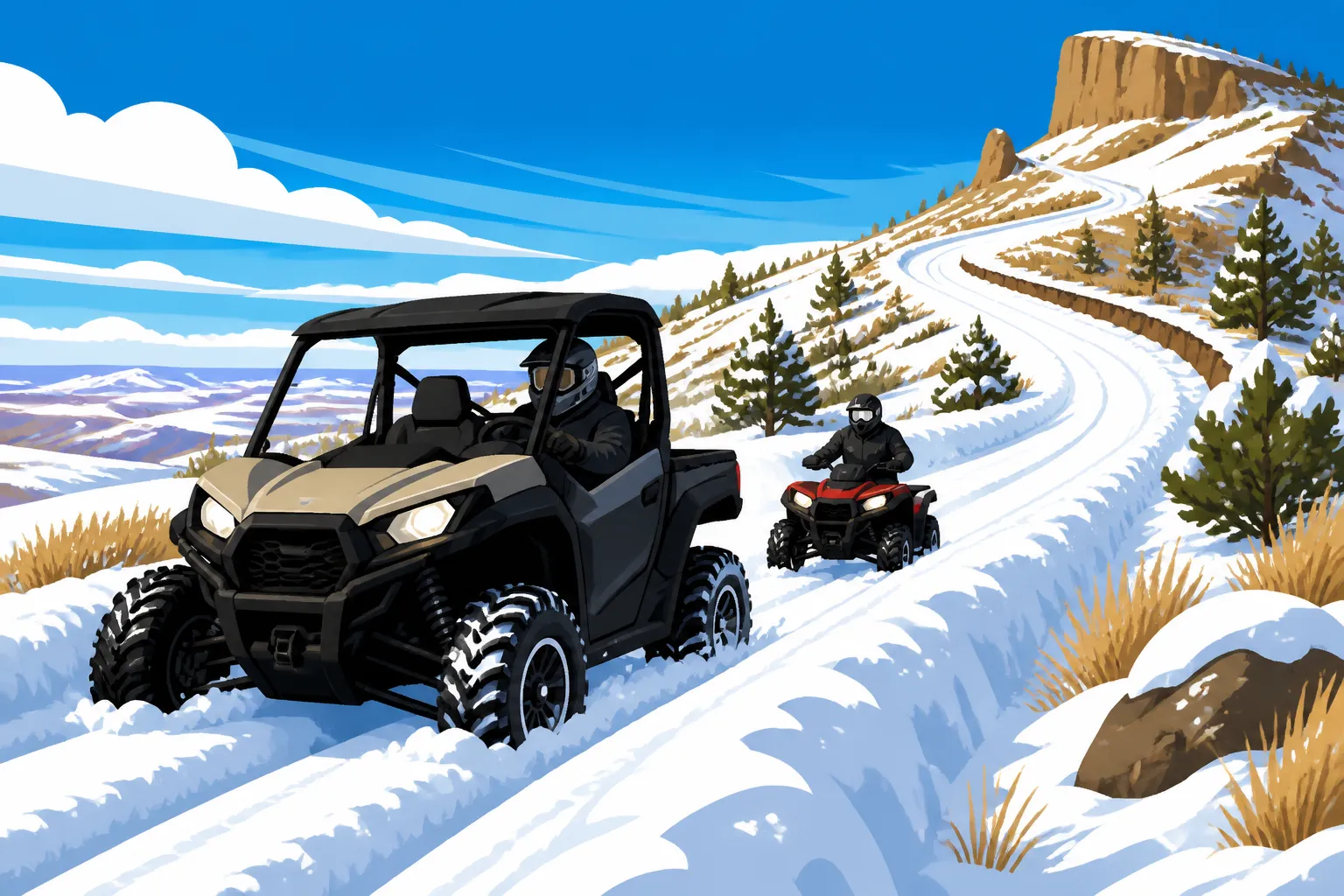
A high Black Hills road can look passable from a sunny pullout and still hide deep, drifted snow around the next bend. For ATV and UTV riders, elevation is only part of the picture: wind, shade, recent weather, road exposure, and seasonal closures all matter. This guide explains how to judge snow conditions, plan a safer ride, and know when to turn around.
Why snow depth changes so quickly on high Hills roads
Elevation matters, but it does not tell the whole story
Higher roads in the Black Hills generally hold snow longer than lower, more exposed routes, but there is no dependable rule that converts elevation into an exact snow depth. A road near Lead or around the higher forested country may have a very different surface from a road at a lower elevation near Rapid City, even after the same weather system.
Conditions can also change over a short distance. One stretch may have thin, compacted snow where vehicles have traveled, while a nearby section has soft drifts that cover the road’s edge. A rider who sees bare gravel at a trailhead should not assume the rest of the route is clear.
The hills’ mix of ridges, draws, and forest cover makes local variation especially important. Wind can sweep snow off an exposed section and pile it into a drift farther along. A sheltered road may keep a continuous layer of snow, while a sunny, south-facing stretch melts sooner. In other words, a single depth estimate rarely describes an entire route.
Shade and slope can keep a road icy after nearby snow melts
North-facing slopes and shaded forest roads often stay cold longer than open, sunny areas. Snow may melt during the day and refreeze overnight, leaving a hard, slick surface even where the surrounding ground looks mostly clear. That thin-looking layer can be more difficult to manage than deeper, soft snow because tires may lose grip on the packed or icy surface.
A road through a shaded draw can also feel very different from an exposed ridge road nearby. For instance, you might ride over damp gravel in the sun, then reach a shadowed bend where ice remains beneath a dusting of snow. Bridges, culverts, and low spots deserve extra caution because their surfaces can be slick when the approaches appear manageable.
Before a winter ride, consider the route’s aspect, tree cover, and exposure—not just its elevation. A paper or digital map can help you understand the general terrain, but it cannot tell you whether a particular turn is iced over today. Route notes from other riders may help with context, but conditions can change after fresh snow or strong wind.
Wind can turn a manageable route into a drift problem
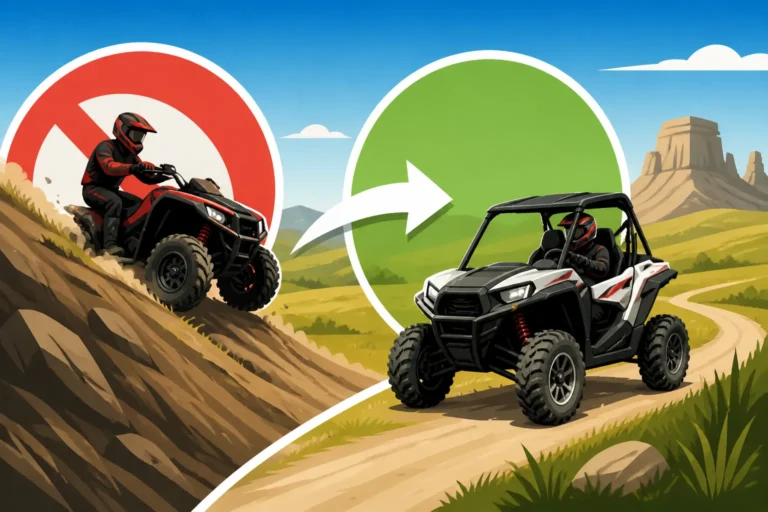
Drifting is one of the main reasons a road’s average snow depth can be misleading. Snow may be shallow over most of the route yet piled across a low spot, cut, or bend. A UTV can have more clearance than an ATV, but greater vehicle size does not make every drift safe to cross. Snow can conceal rocks, ruts, branches, or the road edge, and a machine can become stuck before the rider realizes how deep the drift is.
Be especially wary where the road runs along an open ridge, crosses a clearing, or enters a cut between slopes. Those places can collect windblown snow unevenly. A drift that looks smooth from the approach may have a steep face or a soft pocket underneath.
If you cannot see the road surface or the route beyond a drift, stop before entering it. Do not treat another vehicle’s tracks as proof that the crossing is safe. The tracks may be from a different machine, may be several days old, or may lead into a section that has changed since they were made.
How to check conditions before taking an ATV or UTV out
Check the route, not just the forecast
A general forecast describes conditions across an area; it does not show the snow depth on a specific road. Before leaving, check recent weather, any relevant land-manager notices, and the status of the route you intend to use. Pay attention to new snow, wind, warm afternoons followed by freezing nights, and any posted seasonal or temporary closures.
Start with a specific route plan rather than a broad goal such as “ride the high roads.” Identify the roads or trails you hope to use, where you can turn around, and how you would return if a passable-looking section becomes blocked. A route that has several practical exit points is easier to manage than one that leaves you committed to a long, remote return.
Motorized access can depend on more than snow conditions. A road or trail may be closed for seasonal, resource-protection, or safety reasons even when it appears physically rideable. Check South Dakota Trail Closures to Check First and Reading a Black Hills Travel Map before heading out, and do not assume that a route shown on a map is open to motorized travel.
Use maps as planning tools, not live snow reports
An offline map can be useful when cell service is limited, especially in the Black Hills. Apps such as onX Offroad can help riders review mapped routes and maintain access to trip information when reception drops. The map still does not confirm current snow depth or prove that a road is open, so use it alongside current land-manager notices and on-the-ground judgment.
Before leaving a service area, download or save the information you will need. Check that you can identify your route, the roads that intersect it, and a sensible retreat option. If you are using onX Offroad, review the mapped route in advance and make sure the area displayed matches your intended riding area. A digital route line can support planning, but it should not override a closure sign or an uncertain road surface.
Carry a second navigation option as well, such as a paper map of the area. Batteries can drain faster in cold weather, and a phone can become difficult to use with gloves. If you rely on a phone, keep it warm and protected, and avoid waiting until you have lost reception to figure out how to navigate.
Ask focused questions when seeking local information
If you contact a local office, outfitter, or knowledgeable rider, ask about a particular road or trail segment rather than asking whether “the Hills” are rideable. Useful questions include whether the route has recent drifting, whether the surface is icy, whether access is open, and where riders have needed to turn around.
Be careful with reports that only say “it was fine.” Ask when the person traveled the route, what kind of machine they used, and whether they reached the same section you plan to ride. A narrow ATV and a wider UTV may handle different conditions, and a report from before a storm may no longer be useful.
Keep checking for changes close to departure. A sunny morning does not guarantee a good afternoon ride, and overnight refreezing can change a route’s traction. For a broader seasonal overview, South Dakota Trails Open in Winter and When an Early Snow Closes a Black Hills Trail can help frame the questions to ask before you go.
Reading snow conditions on the road
Use a cautious stop-and-assess routine
When you reach snow, stop somewhere with a clear view and enough room to turn around. Do not pause in a blind corner or on a steep, slippery grade. Look at the road surface ahead, the edges of the track, the slope beside the route, and any signs of water, ice, or drifting.
A practical check is to compare what you can see with what your machine can safely manage. If the snow hides the road edge, conceals the route’s shape, or looks deep enough to contact the underside of the machine, do not enter just to see what happens. If you cannot tell whether a white patch is packed snow, ice, or a drift, treat that uncertainty as a reason to stop.
Avoid using speed to carry a machine through an unknown section. Momentum may help in some conditions, but it can also make a loss of control more serious. Keep enough distance between machines that each rider can stop without being pressured by the person behind them. If one machine becomes stuck, the rest of the group should remain in a safe position rather than crowding the same narrow spot.
Know when to turn around
Turning around is a sound decision, not a failed ride. Consider retreating if you encounter a deep drift, an icy slope, poor visibility, a route edge you cannot identify, or repeated sections that require risky momentum. The same applies if your machine begins to struggle, steering becomes unpredictable, or the group has no clear recovery plan.
Conditions can worsen as you travel. A route that was manageable going uphill may be more difficult on the way back, especially if the surface has become polished by traffic or refrozen in the shade. Before continuing beyond a junction, ask yourself whether you could safely reverse course if the next section is worse.
Do not ride around a closure barrier, sign, or snow blockage to reach an open-looking road beyond it. A closure may apply to the route itself, and an apparent shortcut may put you in an unauthorized or unsafe area. Trusting a Route Marked Open on a Forest Map is not a substitute for following current signs and notices.
Prepare for a slow ride or an unexpected stop
Cold-weather preparation matters even on a short outing. Bring warm layers, gloves, water, food, a charged phone, and a way to contact your riding group. Tell someone where you plan to go and when you expect to return. If the weather changes or a machine gets stuck, the group may spend much longer outside than planned.
Pack recovery gear suitable for your machine and know how to use it before you need it. A winch or tow strap is not a guarantee of recovery, especially if the machine is positioned on a slope or near an unstable road edge. Keep riders clear of tensioned recovery equipment, and avoid attempting a pull that could drag a person or machine into danger.
A snow ride also calls for conservative timing. Short daylight, cold temperatures, and slow travel can make a modest route take longer than expected. Set a turnaround time and stick to it, even if you have not reached the destination you had in mind.
| Road or snow condition | What it may mean | Cautious response |
|---|---|---|
| Thin snow over visible gravel | The surface may still be slick, particularly in shade | Reduce speed and check traction before continuing |
| Packed snow with a glossy surface | Ice may be present beneath or on top of the snow | Avoid abrupt steering, braking, or acceleration |
| A drift hiding the road edge | The road width and obstacles may be unclear | Stop before the drift and turn around if you cannot assess it |
| Fresh snow with no visible tracks | Depth and underlying road features are uncertain | Do not assume the route is passable |
| Snow-covered shaded bend | Ice may remain where nearby sunny sections have melted | Approach slowly and leave room to stop |
| Closure sign or blocked access | Motorized access may be prohibited | Do not bypass the closure |
Planning a winter ride around access and machine limits
Separate road access from trail access
A road that appears passable is not automatically open for riding, and a route open to vehicles may have different rules from a designated motorized trail. Check the applicable access information for the place you plan to ride. If you are heading into a motorized trail system, confirm both the route status and permit requirements. [South Dakota Rules for Riding Federal Land] and South Dakota’s Motorized Trail Permit are useful starting points for understanding the distinction.
Trail conditions and access rules can vary across the region. A route near a staging area may be treated differently from a forest road farther into the hills. Do not assume that a permit, plate, or open road sign grants access to every trail, and do not assume that snow itself means an otherwise closed route is available.
If your trip includes public land, check the responsible land manager’s notices for the exact area. Keep an eye out for closure signs at junctions and trailheads, and follow any route restrictions posted along the way. South Dakota Trail Conditions Before You Ride is a helpful companion when planning around changing access and surface conditions.
Match the route to your machine and group
A UTV may offer more seating and cargo capacity, while an ATV may fit narrower routes more easily, but neither machine is automatically suited to deep snow or ice. Tire condition, ground clearance, load, drivetrain, and rider experience all affect how a machine responds. A heavily loaded UTV may behave differently from the same model carrying only a driver, while an ATV can become difficult to control if a rider is tired or cold.
Plan for the least experienced rider and the machine least capable of handling the expected conditions. If the group includes different vehicle types, do not assume that the most capable machine sets a safe pace for everyone. Leave room for stops, and agree in advance that any rider can call for a turnaround without argument.
Width can matter when choosing a route, too. A narrow road that looks appealing on a map may have drifted snow along its edges, leaving less room to maneuver. For a refresher on measuring and interpreting route limits, see Measuring Outside Tire to Outside Tire and South Dakota Trails for a Wide Machine.
Make the decision before the ride becomes an emergency
A good winter plan includes a clear “no-go” point. That might be a road segment where drifts are common, a route that becomes shaded and icy, or a junction beyond which there is no convenient way back. Decide what conditions will make your group turn around before you are tired, cold, or invested in reaching a destination.
Use onX Offroad or another suitable navigation tool to review the route and possible exits before leaving, then check signs and conditions as you ride. If the planned road is blocked, choose an approved alternative only after confirming it is open and appropriate for your machine. A shorter ride on a known, accessible route is usually a better choice than pushing deeper into uncertain snow.
The most useful snow-depth estimate is often the one you make at the road itself, with enough room to stop and reconsider. Elevation, shade, wind, and recent weather can help you anticipate trouble, but none can guarantee what is around the next bend. In the high Hills, a cautious turnaround can protect your group, your machine, and the chance to ride another day.
Disclaimer
This article is for general informational purposes only and does not constitute professional advice. Laws, prices and regulations vary by location and change over time. Consult a qualified professional for guidance on your specific situation.