Sharing the Black Hills With Deer Hunters
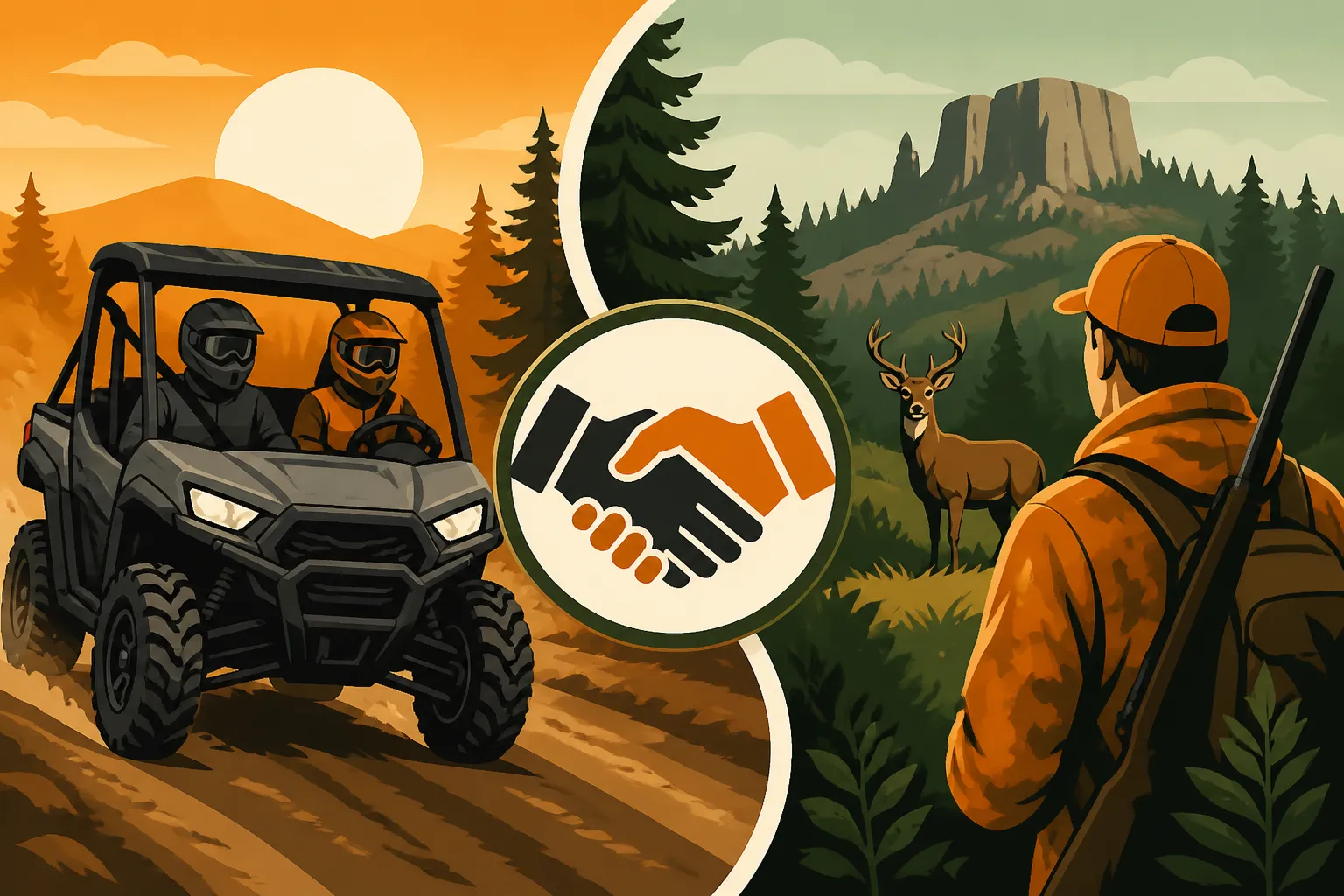
A fall ride in the Black Hills can put you on the same forest roads and trail networks used by deer hunters. That overlap can mean more parked trucks, slower traffic, and people moving quietly off the route. This guide explains how to plan an ATV or UTV ride around hunting activity, improve your visibility, and avoid confusing shared access with permission to ride anywhere.
Why fall riding and deer hunting overlap
Hunters and riders may use the same access points
The Black Hills’ network of roads and trails draws visitors for different reasons. Riders may be following a mapped route between forest roads, while hunters use roads and trailheads to reach an area on foot. A truck or trailer parked near a trail entrance may belong to someone hunting nearby, even if you do not see them.
That overlap can feel surprising when a route has been quiet all summer. In autumn, a trailhead that usually has a few vehicles may be crowded with pickups, trailers, and hunting gear. Give yourself extra room to park, avoid blocking gates or turnarounds, and don’t assume a vehicle has been abandoned just because its occupants are out of sight.
Hunters may also be moving slowly, watching the terrain, or waiting quietly near a route. A machine coming around a blind corner can startle someone who is focused on spotting game. Keep your speed moderate, watch well ahead, and be prepared to stop when visibility is limited by trees, bends, dust, or a rise in the road.
Hunting access is not the same as riding access
A forest road, trail, or two-track may be open to one type of use and restricted to another. A hunter’s ability to walk into an area does not mean an ATV or UTV may leave the designated route to reach it. Likewise, a route shown on an old screenshot or third-party map may have a seasonal closure, a vehicle-width restriction, or a different designation than you expect.
Before heading out, confirm that each part of your planned route is open to your machine and intended use. Forest travel maps and official notices help clarify where motorized travel is allowed. For background on checking mapped routes, see South Dakota Trail Maps and MVUMs and [South Dakota Rules for Riding Federal Land].
Treat the rules as route-specific, not as a general permission to ride through the forest. If you reach a closed gate, a closure sign, or a marked boundary, turn around rather than searching for a way around it. The same applies when a route is muddy, blocked, or appears to continue as an unmarked path. Guidance on staying on approved routes is covered in [South Dakota Rules for Riding Off a Route].
Hunting dates and access conditions can vary
Deer seasons, weapon types, and hunting units do not all follow one universal schedule. Activity can differ from one part of the Black Hills to another and from one week to the next. A familiar trail may be busy during a particular season even when a nearby area feels quiet.
Check hunting information and land-manager notices for the specific place and date you plan to ride. Don’t rely on a friend’s recollection of last year’s conditions or assume that a road will be empty because it was empty on your previous visit. For a riding-focused overview of seasonal access, consult South Dakota Rules for Riding in Hunting Season and South Dakota Trail Closures to Check.
| What you notice | What it may mean | A considerate response |
|---|---|---|
| Pickups or trailers at a pullout | People may be hunting or accessing the area on foot | Park without blocking the road, gate, or turnaround |
| A person near the route | They may be tracking, watching, or moving between locations | Slow down, give them space, and pass only when safe |
| A closure sign or gate | Motorized access may be restricted | Turn around and use a confirmed open route |
| Poor visibility around a bend | Someone or an animal may be beyond your sightline | Reduce speed and be ready to stop |
| A route shown differently across maps | The route status or designation may be unclear | Check current land-manager information before proceeding |
Plan a ride that leaves room for other users
Check the route before loading your machine
A few minutes of route checking can prevent a frustrating drive to a closed trailhead. Review the land manager’s current maps and notices, and confirm that your machine’s width and type are permitted on the routes you want to use. Conditions can change because of maintenance, weather, fire danger, or seasonal restrictions.
Apps such as onX Offroad can help you review a route and keep track of your planned ride, but a digital map should not be treated as final authority on whether a road is open. Compare what you see with current official information, especially when the route crosses different jurisdictions or approaches a restricted area. A line on a screen is not permission to ride it.
If you use onX Offroad to prepare a route, zoom in on the actual roads and trail connections rather than relying only on the overall loop. Check where you can safely turn around, where you might encounter a gate, and how you will return if part of the route is closed. It is easier to adjust at home than to discover a dead end with a group, a trailer, and limited daylight.
Before leaving, tell someone where you expect to ride and when you plan to return. Cell service can be inconsistent in parts of the Hills, so download or save the information you need before entering areas with weak reception. Carry a paper map or another offline navigation option as a backup.
Choose a route and time that suit the conditions
If you have flexibility, choose a route with good visibility, multiple safe places to pull over, and clear legal access. Avoid planning an ambitious loop that depends on a narrow, unfamiliar connector late in the day. A shorter route can be the better choice when hunting activity, weather, or trail conditions are uncertain.
Starting earlier may help you avoid some midday congestion, but it does not guarantee that a route will be free of hunters. People may be in the field at different times, and activity varies by location. The more useful approach is to ride as if someone could be nearby at any hour: maintain a controlled pace, keep to the marked route, and pay attention at trailheads and crossings.
If the area feels crowded or you repeatedly encounter people on foot, consider turning around and choosing another confirmed open route. That is not giving up on the day; it is adapting to shared use. South Dakota Trail Etiquette With Tourists also offers useful reminders about sharing busy routes respectfully.
Make the group easy to manage
Before setting off, agree on a few simple group rules. Decide who leads and who rides last, establish how the group will handle a stop, and remind everyone to leave space between machines. When riders bunch together, dust and noise can make it harder to notice a person approaching from a side road or pullout.
Set a pace that allows the lead rider to stop safely without surprising the rest of the group. If the person at the front sees a hunter, hiker, or vehicle, they should slow down early and signal the riders behind them. Avoid sudden acceleration near people on foot, and do not rev engines or repeatedly circle a trailhead while waiting for the group.
For mixed-experience groups, explain the plan before the ride rather than trying to sort it out on a narrow road. Make sure everyone knows to stay on the designated route and to wait in a safe pullout if the group gets separated. A small amount of coordination reduces the chance of a rider taking an unapproved shortcut to catch up.
Improve visibility without disrupting others
Wear high-visibility clothing
In fall, dark jackets and earth-toned riding gear can blend into trees, brush, and shaded road edges. Wearing a bright outer layer—particularly blaze orange—can help other people notice you sooner. It is a practical visibility choice for riders sharing an area with hunters, even when rider clothing rules differ from hunting requirements.
Wear color that can be seen from more than one direction. A bright vest or jacket is more useful than a small patch hidden beneath a backpack. If you are riding a UTV, consider how visible passengers will be when seated, and make sure gear does not interfere with seat belts, controls, or safe movement.
Visibility works best when combined with predictable riding. Wear bright clothing, keep your machine’s lights in working order, and avoid cutting across brush or appearing suddenly from an unofficial path. For more on using high-visibility clothing on a ride, see Blaze Orange on a Hills Ride.
Use lights and ride with sightlines in mind
Use appropriate lights when conditions call for them, and make sure lenses are clean enough to be seen through dust and road grime. Lights can help others notice a machine, but they do not make it safe to travel quickly around blind corners. Slow down before a bend, crest, junction, or narrow section where someone could be standing or walking.
Dust can reduce visibility for riders behind you and for people approaching from another direction. Leave enough space between machines to let dust settle, and avoid accelerating hard near a parked vehicle or trailhead. If visibility becomes poor, pull over in a safe place rather than continuing at a pace that depends on guessing what lies ahead.
Pay special attention near intersections and shared access points. Someone on foot may step toward the road while looking away from you, or a hunter may be moving equipment across the route. Stop if needed, make your presence clear without startling them, and wait for a safe moment to pass.
Keep the machine’s noise and movement considerate
ATVs and UTVs are not quiet, and a machine can disrupt a hunter’s patience even when the rider is following every rule. That does not mean you should ride off-route or attempt to sneak through the forest. It means keeping your machine in good repair, avoiding unnecessary revving, and riding steadily rather than repeatedly accelerating and stopping near people.
Do not follow someone on foot to ask where they are hunting, and don’t approach a parked vehicle to inspect its contents. If you need to pass someone, give them room and a moment to move clear. If the road is too narrow for a comfortable pass, wait in a safe location rather than forcing the issue.
A courteous greeting can help when you are stopped near another user, but keep it brief and nonintrusive. Hunters may prefer not to discuss their plans or location. Respect that privacy, and continue on the designated route when it is safe.
What to do when you encounter hunters
Slow down, create space, and communicate calmly
When you see a person near the route, ease off the throttle early and stop if the space is tight. Avoid a sudden approach that could startle them. If the person appears to be handling equipment, moving across the road, or watching the surrounding area, wait until they are clearly out of your path.
If you need to pass, do so slowly and with enough room to avoid forcing the person toward a ditch, brush, or unstable shoulder. Don’t assume they have seen you simply because your machine is visible. A calm pause is usually better than trying to squeeze past.
If someone asks you to stop or points out a closure, remain polite and check the situation. A person’s presence alone does not establish that a public route is closed, but signs, gates, and official notices matter. If you cannot tell whether a route is open, turn back until you can confirm its status rather than escalating a disagreement on the trail.
Avoid firearms, game, and private property
Never approach a person who is carrying or handling a firearm. Give them a wide berth and do not stop close enough to create confusion about your direction or intentions. If a firearm is visible, keep your machine controlled, avoid sudden movements, and continue only when you can do so safely and without entering a restricted area.
If you encounter harvested game or hunting equipment, leave it alone. Do not move, touch, photograph at close range, or ride around it through vegetation. An apparent shortcut can damage habitat, trespass onto private property, or put you in a place where the land manager has not authorized motorized travel.
A map app can help you understand your planned route, but boundaries and access rules still need careful confirmation. onX Offroad may be useful as one planning layer; compare it with official maps and posted signs rather than treating a boundary line on a screen as the only information you need. For the broader access principles, see South Dakota Landowner Permission Rules.
Be prepared to change the plan
Sometimes the most sensible choice is to leave a busy area. If several access points are crowded, visibility is poor, or the group is uncomfortable, head back to a known open route or call the ride early. Do not let the pressure to finish a loop lead to speeding, riding around a closure, or taking an unverified track.
If weather turns, dust becomes heavy, or daylight is fading, shorten the ride. Carry enough fuel and supplies to handle a slower return, and keep your group together. A route that looked straightforward on the map can take longer when you stop for traffic, wait for other users, or turn around at a restriction.
Before the next trip, note which areas were busy and which routes were clearly marked, but recheck their status before riding again. Conditions and access can change. A saved route is a planning aid, not a guarantee that the same passage will be open or suitable the next time you visit.
Disclaimer
This article is for general informational purposes only and does not constitute professional advice. Laws, prices and regulations vary by location and change over time. Consult a qualified professional for guidance on your specific situation.