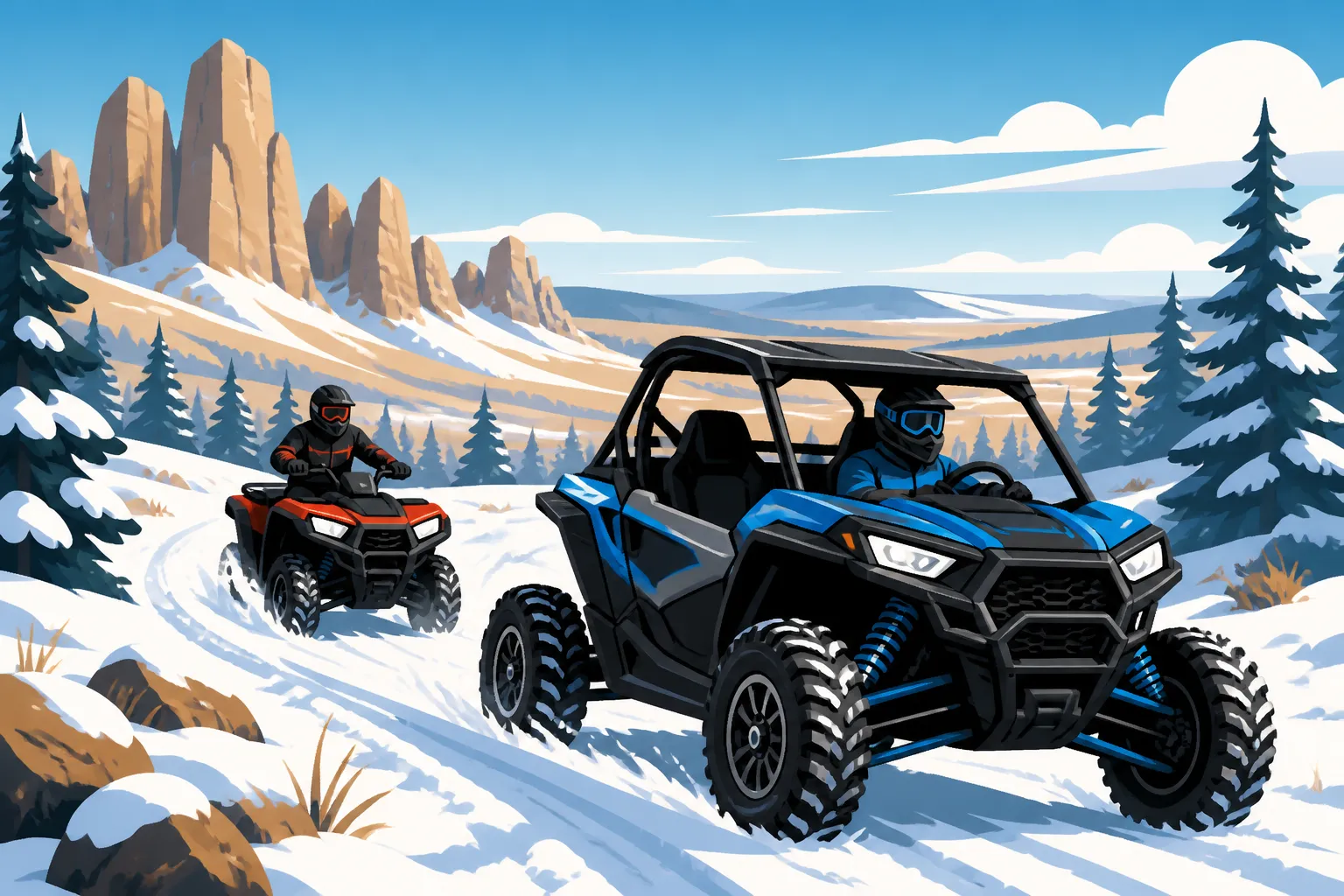
South Dakota Trails Open in Winter
Winter plans can fall apart when a trailhead is snowed in, a seasonal closure has started, or a route that looks open on an app is no longer legal to ride. In South Dakota, many well-known Black Hills motorized trails have seasonal operating dates, so winter riding takes extra checking. This guide explains how to find routes that may still be available and what to verify before unloading your ATV or UTV.
Are South Dakota ATV trails open in winter
Why many Black Hills trails close for the season
The Black Hills are South Dakota’s best-known destination for motorized trail riding, but the main ATV and UTV trail season is not year-round. Many designated motorized trails have seasonal dates, with some commonly closing in mid-December and others opening later in spring. A trail that was legal and busy in October may therefore be closed by the time you plan a January ride.
Those dates are not a blanket guarantee that every trail opens or closes on the same day. Conditions, management decisions, and specific route rules can differ. Before traveling from Rapid City, Spearfish, Lead, Sturgis, or Custer, check the current information for the exact trail or road you have in mind. The seasonal patterns described in [Trails Open May 15 to December 15](Trails Open May 15 to December 15) and [Trails Open August 15 to December 15](Trails Open August 15 to December 15) are useful reminders that an area can have more than one opening schedule.
Snow can make a closure harder to spot, not less important. A packed track, tire marks, or an unlocked-looking gate does not mean motorized travel is permitted. Closures can protect trails from damage, address winter conditions, or reflect rules for a particular route. Treat signs and official notices as controlling, even when a map or another rider suggests the road is passable.
A motorized trail and a forest road are not the same thing
Riders often use “trail” to mean any route where an ATV or UTV can travel. Land managers may distinguish between designated motorized trails, forest roads, other roads, and areas where motorized travel is prohibited. A route that remains open to regular highway vehicles through winter is not automatically open to off-highway vehicles.
This difference matters in the Black Hills National Forest, where route access can depend on the current motor vehicle use map and seasonal restrictions. A road may be open to a vehicle class or purpose that does not include your machine. Similarly, a route shown on an older map might have changed status. Check the map and the associated rules rather than relying on the color or line style alone.
If you are trying to salvage a trip after discovering a trail closure, [Where to Ride When a Black Hills Trail Shuts](Where to Ride When a Black Hills Trail Shuts) can help you think through alternatives. The key is to find a route that is explicitly open to your type of machine during the dates of your visit—not merely a nearby road that looks drivable.
How to find a route that is actually open
Start with the land manager’s current information
First, identify who manages the land. A route in the Black Hills National Forest, a South Dakota Game, Fish and Parks riding area, a county road, and private ranch land may all have different rules. Check the current map, posted notices, or office responsible for that specific place. For Forest Service ground, use the relevant motor vehicle use map and check for current closures or alerts before setting out.
The map is part of the answer, but it is not always the whole answer. A seasonal order or temporary closure can affect access after a map is published. That is why it is worth checking [South Dakota Trail Maps and MVUMs](South Dakota Trail Maps and MVUMs) alongside [South Dakota Trail Closures to Check](South Dakota Trail Closures to Check). If you are unsure which district manages your planned route, contact the appropriate office and describe the trailhead or road by name.
Mapping apps can make it easier to plan a route and keep track of where you are. For example, you can use onX Offroad to review a planned route, then compare it with the official land-manager map and any current closure notice. Do not treat an app’s route line as permission to ride: mapping information may not reflect a newly posted restriction, a seasonal change, or the precise vehicle rules for a segment.
Check the route from end to end
A route can cross more than one kind of land or connect segments with different rules. Before you go, confirm the status of the entire trip, including the approach road, the staging area, and the return route. A legal first section does not make the next section legal, and a winter road closure can leave you with no practical way to complete a loop.
Use this checklist:
- Identify the land manager for each section of your planned route.
- Confirm that the route is open on your travel dates.
- Check that the rules allow your specific vehicle type and width.
- Look for seasonal restrictions, temporary closures, and posted gates.
- Confirm where you can park or unload without blocking access.
- Save an alternate route that is also confirmed open.
Using onX Offroad alongside official maps can help you spot route connections and plan an alternate, but make the official information your final check. If you cannot establish that a segment is open to your machine, leave it out of the plan rather than deciding at the trail entrance.
| Route or area type | What to verify before riding in winter | Common planning mistake |
|---|---|---|
| Designated motorized trail | Seasonal dates, current closure notices, vehicle-width rules | Assuming a trail open in autumn stays open all winter |
| Forest road | Whether motorized access is allowed for your vehicle and purpose | Treating every drivable road as an ATV route |
| Public riding area | Winter operating status, staging access, posted site rules | Assuming the area follows the same dates as nearby trails |
| County or local road | Local vehicle rules, road conditions, and any restrictions | Confusing permission to use a road with permission to ride adjoining land |
| Private property | The owner’s permission and the boundaries of the allowed area | Treating a visible track as an invitation to ride |
Winter alternatives when a trail is closed
Look for a designated winter activity, not an ATV workaround
When a motorized ATV or UTV trail closes, a nearby winter recreation route may be intended for snowmobiles or another use. That does not mean an ATV can use it. Separate seasons, vehicle categories, and trail designations exist for a reason. If you want to ride a snowmobile, check the rules for that activity; if you want to take an ATV or UTV, confirm access specifically for that machine.
It is also worth separating “the area is open” from “my vehicle can ride here.” A recreation site may remain accessible to visitors while its off-highway vehicle routes are closed. Snow-covered ground can make boundaries and signs difficult to see, so do not use the absence of visible markers as a substitute for checking the rules.
The same caution applies when exploring routes around towns such as Deadwood, Spearfish, and Hill City. A scenic forest road or a track leading toward an overlook may be tempting, especially after fresh snow, but winter access still depends on the road’s designation and current restrictions. Plan only on routes you can verify.
Private land can be an option, but permission must be clear
If public trails are closed, riding on private property may be possible with the landowner’s permission. Ask directly and be specific: which machine you plan to use, what dates you want to ride, where you may travel, and whether you can bring other riders. A general invitation to visit a property should not be assumed to include permission for off-road riding.
This is especially important in rural areas, where a two-track may cross private land, a grazing lease, or a working ranch. Stay within the agreed boundaries, leave gates as instructed, and avoid riding when conditions could damage the ground or interfere with livestock operations. If permission is limited to a particular field or road, do not extend the route because a connecting track appears convenient.
For public land, the trail permit is another separate consideration. A valid permit does not override a seasonal closure or expand the areas where riding is allowed. Review [South Dakota's Motorized Trail Permit](South Dakota's Motorized Trail Permit) and [South Dakota Rules for Riding in Winter](South Dakota Rules for Riding in Winter) for the permit and riding-rule questions that can apply to a trip.
Preparing for a South Dakota winter ride
Plan for snow, cold, and limited help
Even a short winter ride can become demanding when wind, low temperatures, deep snow, or poor visibility slows progress. Conditions can change between a town and a higher-elevation trailhead. Before leaving, check the forecast for the actual riding area, tell someone where you are going, and set a return time. Do not assume that a route will be easy to navigate just because you have ridden it in summer.
Carry clothing that stays warm when you stop, water, food, a charged phone, and basic recovery and repair supplies suited to your machine. Keep a paper map or an offline navigation option available in case you lose signal. onX Offroad can be one tool for saving a route for reference, but it should not be your only navigation plan. Snow can also hide rocks, ruts, drainage dips, and trail edges that are obvious in warmer months.
Think carefully about whether the machine and group are suitable for the conditions. A narrow trail, steep grade, or icy slope can become a poor choice for a large UTV or an inexperienced rider. If the route is difficult to confirm, the weather is deteriorating, or the surface is unsafe, postponing the ride is a sensible decision—not a wasted trip.
Recheck access on the day you go
A route that was open when you planned the trip can become inaccessible after snowfall, a closure notice, or a road condition change. Check again before loading the machine and, if possible, before leaving the last town with reliable service. Make sure the staging area is accessible and that your trailer can be parked without blocking gates or maintenance access.
Keep your permit and vehicle requirements in mind, too. A permit may be required on designated motorized routes, but it does not make a closed trail legal. Review the details in [South Dakota Trail Permits Explained](South Dakota Trail Permits Explained), and confirm the rule for the particular area you plan to visit. The practical question is always two-part: is the route open today, and is it open to this vehicle?
Finally, plan for a change of scenery if the answer is no. Have a confirmed alternate activity or route rather than improvising onto an unverified road. onX Offroad may help you organize your options, but use official maps and land-manager notices to verify access. In winter, the most reliable ride is the one you have confirmed before you arrive at the gate.
Disclaimer
This article is for general informational purposes only and does not constitute professional advice. Laws, prices and regulations vary by location and change over time. Consult a qualified professional for guidance on your specific situation.