Why South Dakota Charges Everyone the Same
If you ride a South Dakota ATV or UTV, it can feel odd to pay the same trail-permit fee as someone visiting from out of state—especially if you already pay local taxes. The reason is that the Black Hills motorized trail permit is tied to the machine’s use of designated trails, not the rider’s home address. This guide explains what that means, where the permit applies, and how it differs from plates and other permits.
What “everyone pays the same” means
The fee is based on the permit, not your home address
For the Black Hills motorized trail permit, residency does not create a separate resident discount. A South Dakota resident and an out-of-state visitor seeking the same type of permit pay under the same fee structure. The important details are which permit you need and where you plan to ride—not whether your driver’s license shows a South Dakota address.
That can feel unfair if you live in the state and already contribute through taxes. It helps to think of the permit as access to a particular riding opportunity rather than as another general tax bill. The fee is connected to using designated motorized trails, which have maintenance, management, and visitor-use needs whether the rider lives nearby or has driven in from another state.
The rule also makes planning more straightforward. You do not need to figure out a different permit category just because your home is in Wyoming, Minnesota, Iowa, or elsewhere. You still need to confirm that you have the correct permit for the machine and the place you intend to ride, but residency alone does not change the permit price.
A uniform fee is not the same as a universal permit
“Everyone pays the same” does not mean every rider can buy one permit and ride anywhere in South Dakota. A trail permit has a defined purpose and area of use. A permit for designated motorized trails is not automatically permission to ride on private land, travel on every forest road, or use a road that requires a plate.
This distinction matters because visitors sometimes arrive with an out-of-state registration and assume it covers every kind of riding. A plate may be relevant to road use, while a trail permit applies to designated motorized trails. They answer different questions, and one should not be treated as a substitute for the other unless the specific rules say so.
If you are trying to sort out the broader permit system, start with South Dakota Trail Permits Explained. It is especially useful when your trip includes a mix of forest roads and designated trails, because the correct requirement can change as your route changes.
The permit follows the machine’s use
A trail permit is generally associated with the machine being operated, not with a person buying unlimited access for every ATV in a household. That is why a family with two machines should not assume that one decal covers both. Before setting out, make sure each machine that needs a permit has one.
This machine-based approach also explains why the same permit rule can apply to a local rider and a visitor. The trail surface, signs, drainage, and management needs do not change depending on whether the machine came from Rapid City or crossed the state line on a trailer.
For practical planning, keep the permit question attached to each machine in your group. If you are bringing a second ATV, borrowing a friend’s side-by-side, or switching vehicles during a trip, check whether that machine has the required decal. A rider’s permit purchase does not necessarily transfer across machines.
Why residency does not create a discount
The permit is tied to trail use rather than local tax status
A resident discount may seem intuitive: local residents support public services through taxes and may ride the trails more often. But a trail-use permit is not necessarily designed as a reward for tax residency. Its function is to establish permission for a defined kind of riding and help support the trail system.
That distinction does not mean taxes are irrelevant to public lands or that residents receive no benefits from living in South Dakota. It simply means that the permit price is not calculated as a rebate on a person’s taxes. The same permit category carries the same charge regardless of where the rider lives.
Imagine two riders arriving at a trailhead outside the Black Hills. One lives in South Dakota and the other has driven from North Dakota. If both are riding the same type of machine on the same designated trail, the use being regulated is essentially the same. The state’s uniform fee structure avoids having to price that activity differently based on each rider’s residence.
One price is simpler to administer
A resident discount would require a clear way to define and verify residency. Staff or sellers might need to distinguish among full-time residents, temporary residents, seasonal property owners, college students, military families, and people using a mailing address that does not match where they live. Each category can create paperwork and questions at the point of sale.
A uniform price reduces those decisions. The person buying the permit focuses on the permit type and the machine, instead of proving eligibility for a particular rate. That can make a purchase easier for both a local rider and a visitor who is buying shortly before a trip.
Simplicity is not the only consideration in public fee policy, and it does not guarantee that every rider will agree with the result. But it does explain why a system may set one rate for a permit category rather than create multiple prices based on where the buyer sleeps or pays taxes.
A visitor does not automatically pay an extra trail-permit fee
It is important not to confuse the Black Hills trail permit with other South Dakota requirements. Some state motor-vehicle rules or fees may apply differently to nonresidents, and title or tax costs can vary with a transaction. Those are separate issues from the uniform fee for a designated trail permit.
For example, the title process for a machine is not the same as getting a trail decal. If you are buying or bringing a machine into South Dakota, What an Out-of-State Owner Pays to Title in South Dakota can help you keep the title question separate from the riding-access question. Similarly, a nonresident ORV permit is a different topic from the Black Hills motorized trail permit.
The safest approach is to identify the exact thing you are paying for. Ask whether the charge is for a title, vehicle plate, nonresident ORV permit, trail permit, or another access requirement. Similar-sounding terms can lead to unnecessary confusion, especially when a trip includes both public roads and motorized trails.
How permit duration affects what you pay
Choose a permit that fits the trip
A short visit and a full season of riding do not necessarily call for the same permit duration. A visitor planning one weekend in the Black Hills may want a short-term option, while a frequent rider may find an annual option more convenient. The uniform-pricing principle means the permit category is not discounted just because the buyer lives nearby, but duration can still affect which permit makes sense.
Start by counting the days you expect to ride, not just the days you will be in South Dakota. A trip might include a day spent driving, a weather day, or time in Deadwood, Spearfish, or Rapid City when the machine stays parked. Paying for a longer permit than you need may not be worthwhile, while choosing an option that expires before a planned ride can create a frustrating last-minute problem.
The permit descriptions and current fee schedule should guide the choice. Do not rely on an old decal, a friend’s recollection, or a price mentioned in a trip post. Permit terms and charges can change, so check the official information before you buy and leave enough time to get the decal if it is mailed.
Annual and short-term permits serve different riders
An annual permit can be practical for someone who rides repeatedly during the season, owns a cabin in the area, or makes several trips to the Black Hills. It avoids having to arrange another permit for each visit, provided it remains valid for the dates and riding locations involved.
A short-term permit can be more suitable for someone visiting once. If you are driving from out of state for a single trip, consider the number of planned riding days and the permit’s stated validity period. Do not assume that “seven days” means seven separate riding days you choose at any point; read how the period starts and when it ends.
The calendar can matter too. Some permits may be valid through a stated date rather than for a rolling year from purchase. The details are worth checking before you compare options. A Permit Valid Through December 31 explains why an annual permit’s expiration date can matter when you buy late in the riding season.
| Your riding plan | What to compare | Common planning mistake |
|---|---|---|
| One short visit | Short-term permit validity and start date | Assuming the permit covers a different future trip |
| Several visits in one season | Total riding days and annual permit dates | Comparing only the number of days on the first trip |
| A late-season purchase | Expiration date and remaining riding window | Assuming the permit lasts a full year from purchase |
| A group with several machines | Permit requirement for each machine | Buying one permit and expecting it to cover the whole group |
Buy early enough for the decal to arrive
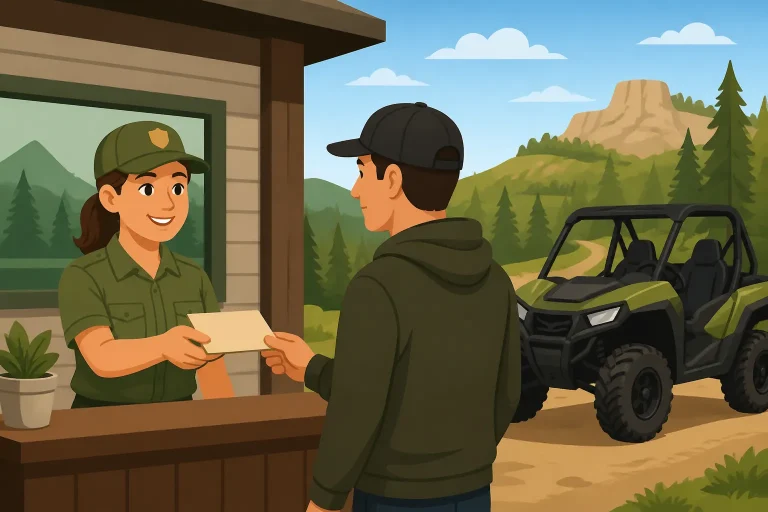
A permit may need to be displayed as a decal rather than kept only as a receipt. If the decal is sent by mail, ordering shortly before a trip can leave little room for delays. A confirmation email or payment record may not meet the display requirement, so check what must be attached to the machine before you ride.
Plan around the actual delivery process rather than the date you place the order. If your trip is approaching, check authorized in-person purchase options and whether they provide the permit you need. Do not assume every store, visitor center, or ranger office sells every permit type.
For decal placement details, see Why a South Dakota Trail Permit Is a Stick-On Decal. A clean, visible placement can save time at a trailhead or during a compliance check. It also makes it easier for your riding group to confirm that every machine is ready before unloading.
How plates and permits work together
A plate is not a substitute for a trail permit
A machine with a valid plate may be permitted to travel on certain roads, depending on the applicable rules. That does not automatically make it lawful to ride on a designated motorized trail without the required trail permit. A plate identifies and authorizes a vehicle for a different kind of use than a trail decal.
This is one of the most common sources of frustration for visitors. They may have paid for registration at home, insured the machine, and brought all the paperwork, only to discover that a separate trail permit is still required. The issue is not that the home-state plate is meaningless; it is that it does not necessarily cover trail access.
A useful rule of thumb is to ask two separate questions: “Is this machine allowed on this road?” and “Does this machine have the permit required for this trail?” The answers may both be yes, one may be yes and the other no, or the route may not be open to that type of vehicle at all.
Road rules and trail rules apply to different places
A forest road and a designated motorized trail may be close together on a map, but they are not interchangeable. Each can have separate rules for vehicle access, width, seasonal opening, equipment, and permits. A route that is legal for a plated machine may not be open to an unplated ATV, while a trail may require its own decal even when the machine has a plate.
That is why a route plan should identify the type of route, not simply the name of the forest or recreation area. Check maps and signs for the specific road or trail. Conditions, closures, and vehicle restrictions can affect access even if you bought the right permit.
For a clearer explanation of how a plate fits into the system, read Why South Dakota Honors Only a Plated Machine. Then compare it with Why a Plate Does Not Replace a Trail Permit before planning a ride that combines roads and trails. Reading both helps keep road authorization separate from trail access.
Out-of-state registration and South Dakota trail access are separate questions
A visitor’s home-state registration may be relevant when riding on a road, but it does not automatically answer whether the machine qualifies for every South Dakota riding area. The rules can depend on the location, the machine’s status, and the route being used.
Before leaving home, check whether the machine is considered street legal under the rules that apply to the roads on your itinerary. Then check the trail-permit requirement for designated motorized trails. Do not assume that registration in one state guarantees identical treatment on every route in another state.
This matters for machines that are used mainly off-road, including some side-by-sides and youth models. If you are not sure whether your paperwork counts as a plate or registration for road use, ask the relevant motor-vehicle authority. If the question is whether your machine needs a trail decal, check the permit instructions for the specific riding area.
Where the uniform permit rule applies
Designated motorized trails are the key setting
The Black Hills motorized trail system is the central setting for the trail-permit question. The permit requirement is connected to riding the designated motorized trails, so the trail map and on-the-ground signs matter. A general statement that you are “riding in the Black Hills” is not enough to establish what you need.
Before a ride, identify the route and confirm it is open to your machine. Trail width restrictions, seasonal dates, and temporary closures can all affect where you may go. A permit does not override a closure sign or grant permission to leave the designated route.
If you are new to the area, use the official trail information and maps to plan around your machine’s width and the trail’s opening dates. South Dakota Trail Maps and MVUMs is a useful related topic when you are trying to distinguish an open route from one that is closed or restricted.
Not every public or private riding area uses the same permit
A permit requirement for one trail system should not be generalized to every place where ATVs and UTVs are used. A private ranch, a state-managed riding area, a federal forest trail, and a public road may each have different access rules. Permission to ride in one place does not transfer to another.
On private land, the landowner’s permission is central. A trail permit does not grant a right to cross private property or ride across a grazing lease. On public land, the managing agency’s route rules and posted restrictions still apply. The rider needs to follow the requirements for the land and route in question.
This is particularly important when a route appears to connect two public areas. A map line or familiar two-track does not prove that the entire route is open to motorized use. Check property boundaries and signs, and get permission when the route crosses private ground. A permit is access to a defined activity under defined rules—not a general pass to roam.
Permits do not erase safety and equipment requirements
Even when a machine has the correct permit, riders still need to follow applicable operating rules. Those may involve age, supervision, helmets, protective eyewear, equipment, route restrictions, or other requirements. The permit confirms one part of the compliance picture; it does not replace the rest.
For instance, a trail permit does not make an otherwise closed trail open, allow a machine onto a route it cannot legally use, or make unsafe riding acceptable. A group can have every decal correctly placed and still need to turn around because of a closure or a route restriction.
If you are visiting with children or new riders, check the age and supervision rules separately. Likewise, confirm required safety equipment for each rider and machine. Taking a few minutes to do this at home is much easier than discovering a missing requirement at a trailhead.
Reciprocity and common visitor questions
What reciprocity does and does not mean
Reciprocity usually refers to one jurisdiction recognizing a credential issued by another. For ATV and UTV riders, the word may come up when discussing plates, registrations, or permits from a home state. Recognition of one credential does not automatically mean every local access requirement disappears.
A home-state plate may be recognized for certain road use, while a South Dakota trail permit may still be required on a designated trail. Those rules can coexist without contradicting each other because they govern different activities. One concerns vehicle status or road operation; the other concerns access to a particular trail system.
When someone says, “My state registration is valid here,” ask what they mean by “here.” Are they talking about a public road, a forest road, a motorized trail, or a specific recreation area? The location and route—not just the state line—determine which rule to check.
A nonresident ORV permit is not the same as a trail decal
The phrase “nonresident permit” can sound like the exact opposite of a uniform trail-permit fee, but these terms refer to different requirements. A nonresident ORV permit and a Black Hills motorized trail permit should not be treated as interchangeable. The purpose, authority, and location of use may differ.
If you are bringing a machine from another state, work through the questions in order. First, determine whether you need a permit or registration for the roads you plan to use. Next, determine whether the designated trails require a separate decal. Finally, confirm whether your machine meets the trail’s width and equipment rules.
This sequence prevents a common mistake: buying one credential, assuming it covers every situation, and then learning that another requirement applies. For more on how the nonresident permit works, see [South Dakota Nonresident ORV Permit Requirements]. Keep that information separate from the Black Hills trail-permit fee question.
Ask about the exact route when the rules are unclear
A vague question such as “Can I ride my ATV in South Dakota?” is hard to answer accurately because the state has different kinds of roads, trails, public lands, and private property. A better question names the machine, the route, and the land manager. For example: “Can this plated side-by-side use this forest road, and do I need a decal on the designated trail connected to it?”
Before calling or visiting an office, gather your machine’s basic details, including whether it is plated, its width, and where you intend to ride. If you are traveling with a group, note whether the machines are alike or whether some are youth models or unplated off-road machines. Specific details help the person answering direct you to the correct rule.
At the trailhead, posted information deserves attention even if you researched beforehand. Closures can change, and local signs may identify restrictions that do not appear in a general trip description. If the sign and your plan conflict, follow the posted closure and seek clarification before continuing.
A practical checklist before you ride
Confirm the permit and validity dates
Start with the permit itself. Confirm the permit category, the area where it applies, and the dates it covers. If you purchased online or through a retailer, check whether the decal must be attached before riding and whether a receipt alone is insufficient.
Then match the permit to each machine. A permit for one ATV should not be assumed to cover a second ATV or a side-by-side. If you are swapping machines or bringing a spare, verify the requirement for that vehicle before unloading.
Finally, look at the expiration date rather than relying on the purchase date. Some permits may have a defined seasonal or calendar expiration. If you are planning a late-season ride or returning after a long gap, confirm that the decal remains valid for the planned date.
Match the machine to the route
Check whether the machine is allowed on the intended trail or road. Width restrictions can rule out a wide UTV even when the rider has the correct permit. Seasonal openings and closures can also change which routes are available.
Use a current map and pay attention to route markings. A trail number, road number, or nearby landmark is more useful than a general destination name. If your loop crosses between roads and trails, mark the transitions so you know when different rules may apply.
Do not assume that a visible track is open to motorized travel. Some routes are non-motorized, some are closed for resource protection, and some may be private. A permit does not authorize travel off designated routes or around a closure.
Keep proof and make a backup plan
Keep purchase confirmation and any relevant vehicle paperwork accessible, but do not confuse proof of purchase with the required display decal. If the machine has a plate, carry the documentation required for that use as well. Keeping the records together can make a roadside or trailhead question easier to resolve.
Plan for practical problems. A decal can peel, a machine can be changed at the last minute, and weather can alter a route. Know where you can ask for help and have a legal alternative route in mind if a trail is closed or your machine does not meet a restriction.
For groups, do a quick check before departure: each machine has its required permit, each rider understands where the route is open, and no one is relying on another person’s decal. That small pause can prevent an avoidable turn-back after everyone has already hauled equipment to the trailhead.
Why South Dakota Charges Everyone the Same
A uniform trail-permit fee can feel counterintuitive to residents who already support public services through taxes, but the permit is structured around access to designated motorized trails rather than the rider’s address. Visitors and residents using the same permit category are treated alike, while duration and location still determine what each rider needs.
The practical takeaway is to separate the trail permit from plates, registration, nonresident ORV requirements, and landowner permission. Confirm the route, machine, validity dates, and decal requirements before you ride. That approach is more reliable than assuming one credential covers every road and trail in the state.
Disclaimer
This article is for general informational purposes only and does not constitute professional advice. Laws, prices and regulations vary by location and change over time. Consult a qualified professional for guidance on your specific situation.