Mud After a Hills Thunderstorm
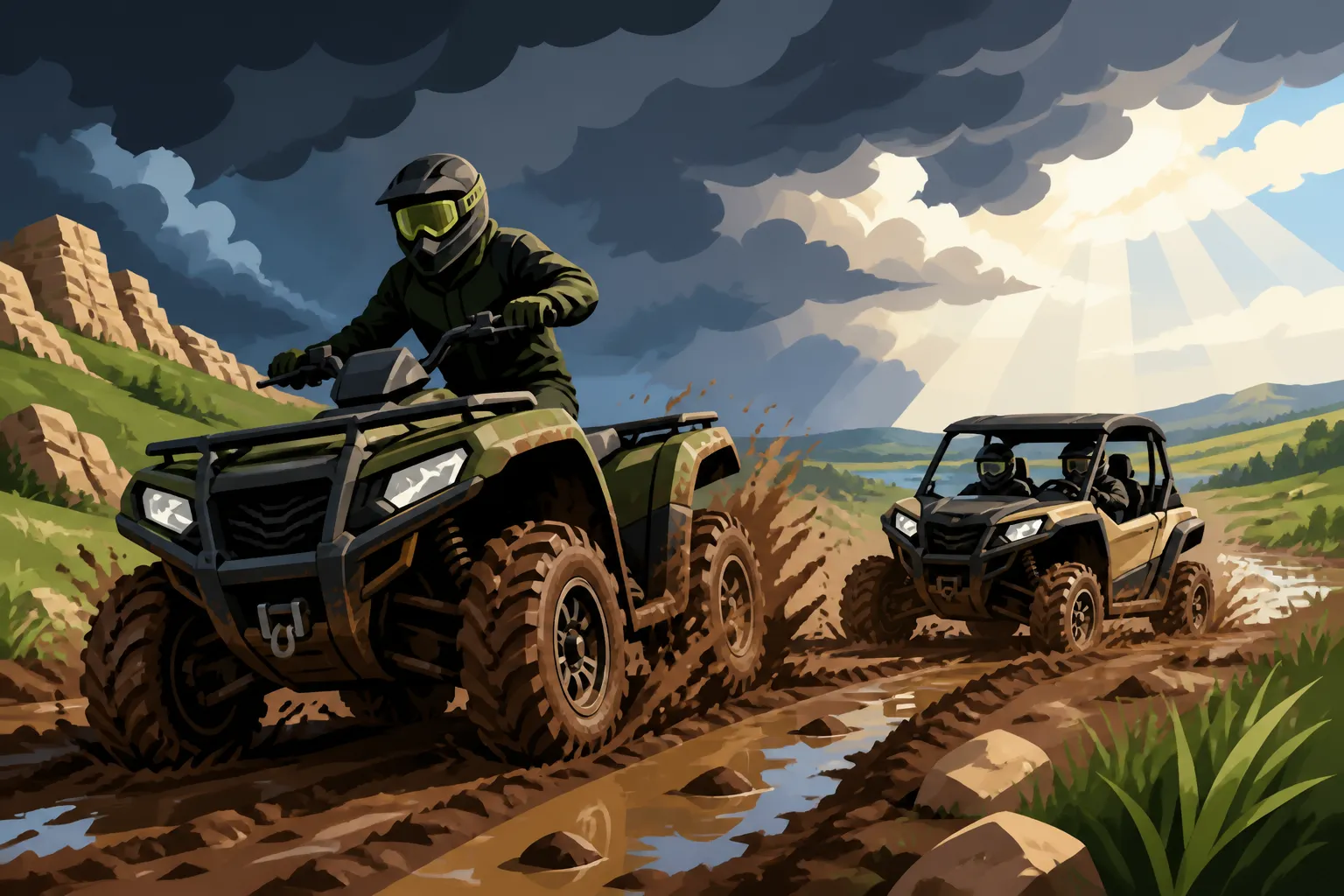
A thunderstorm can turn a dry Black Hills route into slick clay, standing water, and deep ruts before you have time to rethink the ride. The tricky part is knowing when mud is manageable and when continuing could damage the trail, your machine, or your day. This guide explains how to assess conditions, ride cautiously, and choose a safer plan.
Why Black Hills trails change so quickly after rain
Mud is more than a traction problem
Rain affects different surfaces in different ways. A gravel road may remain passable while a shaded, soil-covered trail becomes slick. Clay can cling to tires and reduce steering control; loose gravel over wet ground can shift beneath the machine; and water may conceal rocks, ruts, or a washed-out edge. A route that looked straightforward on the way out may feel very different on the return.
In the Black Hills, forest cover, slopes, and changing elevations can create patchy conditions. One section may be damp beneath ponderosa pines while an exposed stretch nearby is already drying. A storm can also leave debris or create runoff channels, especially where water follows the route downhill. Don’t assume that a trail is consistently wet—or consistently safe—just because one part looks fine.
Mud can also make a rut deeper and more damaging with every pass. Spinning tires dig into soft ground, and repeated traffic can widen a route or chew up its surface. If you find yourself fighting for traction, stop before the machine is stuck or the trail is being torn apart. For more context on surface changes, see [Ponderosa Forest and Loose Gravel] and [Rock Ledges on a Hills Trail].
Why timing and location matter
A short shower and a thunderstorm that drops substantial rain are not the same riding conditions. The ground may already be saturated after earlier rain, or runoff from higher terrain may reach a lower route after the storm has passed. A blue patch of sky doesn’t necessarily mean a trail is drying quickly.
Pay attention to what you can see and feel: water flowing across the route, fresh channels, muddy tire grooves, or a surface that gives way under light pressure are all reasons to slow down and reassess. Conditions can differ between Rapid City, Hill City, Lead, Deadwood, and higher forest roads. A report from one area is useful, but it can’t guarantee the condition of a route several miles away.
Before leaving, check route information and forest notices rather than relying on yesterday’s plan. [South Dakota Trail Conditions Before You Ride] and [South Dakota Trail Closures to Check First] are useful starting points. If you use a mapping tool such as onX Offroad to plan your route, treat it as a navigation aid—not confirmation that a muddy trail is open or passable. Verify access and closures through the appropriate land manager before riding.
How to assess a muddy route before committing
Make a deliberate stop instead of testing the mud at speed
When a route first turns muddy, stop somewhere firm and safe, out of the way of other riders. Look ahead for water crossing the trail, deep tire tracks, slippery slopes, exposed roots, or a narrow section with no room to turn around. If you can’t see where the route goes, don’t ride into it just to find out.
A quick walk of a short, questionable section may reveal more than a throttle blip. Check whether the ground is firm enough to support your boots, whether water is moving, and whether there is a safe place to turn around. Avoid walking into fast-moving water or onto a steep, unstable bank. If the area looks unsafe on foot, it’s not a place to test with an ATV or UTV.
A useful rule of thumb is to consider the whole situation, not just whether the tires can get through. A machine might climb a slick patch but leave you facing a steeper, muddier stretch with no safe exit. If you’re uncertain about traction, visibility, or turning room, the conservative decision is to back out while you still have a clear route to firm ground.
| What you notice | Why it matters | Safer response |
|---|---|---|
| Water flowing across the route | Runoff can hide loose ground, rocks, and changes in depth | Stop well back and do not enter water you cannot assess |
| Deep, fresh ruts | The surface may be soft and easy to damage or get stuck in | Turn around if you can do so safely |
| Tires spinning with little forward movement | You may be losing control and digging into the trail | Ease off, avoid repeated throttle, and reassess |
| A steep muddy descent or climb | Slippery ground can make braking and steering unpredictable | Avoid committing unless the route is clearly safe and permitted |
| A closure sign or blocked route | The route may be closed for safety or resource protection | Do not go around the closure |
| Poor visibility in rain or fog | You may not see other riders, obstacles, or route edges | Wait in a safe location or return by a known route |
Choose a turnaround point before you need one
Before riding into an unfamiliar area, identify places where you could safely stop or turn around. That matters on narrow forest routes, where backing down a slick grade can be harder than it sounds. Don’t wait until you are stuck to decide how you’ll get out.
Use a map to understand where your route connects to other roads, but don’t assume every visible line is open to motorized use. A mapping app such as onX Offroad can help you keep track of your planned route and position, especially if cell service is limited. Check that your map is available offline before leaving coverage, and confirm current access information with the land manager. For broader navigation tips, read [Reading a Black Hills Travel Map].
If rain arrives while you’re out, shorten the ride rather than trying to preserve the original plan. Turn back on a route you know is open and passable. Avoid improvising a detour around mud, a closure, or a washout: the alternate line may be unauthorized, private, or more hazardous than the original route. [South Dakota Rules for Riding Off a Route] explains why staying on permitted routes matters.
Safer riding choices when the ground is wet
Adjust your pace and control inputs
Wet conditions call for smooth, deliberate riding. Keep your speed low enough to respond to changing traction, leave extra space between machines, and avoid abrupt braking or sharp steering on slick ground. If a tire starts to slide, sudden inputs can make the slide harder to manage. Keep your attention on the surface ahead, not only on the machine directly in front of you.
On a muddy incline, don’t charge forward simply because you’re worried about stopping. A fast approach can leave you with too little time to react to a rut, hidden rock, or slippery turn. If the slope looks beyond your ability or the machine’s capability, turn around before attempting it. The same goes for a descent where you cannot see a safe stopping area below.
Keep passengers and other riders in the group in mind. A UTV with passengers may respond differently from a lighter ATV, and a group can become separated when visibility drops or one machine has to stop. Agree on a simple plan before the ride: where to regroup, how to signal a stop, and who will turn back first if conditions deteriorate. Don’t pressure another rider to continue through a section they consider unsafe.
Protect the route and your machine
If a machine is stuck, avoid repeated wheelspin. Spinning tires can dig a deeper hole, throw mud, and damage the trail surface. Stop and make a careful recovery plan, using appropriate equipment and help from your group. Don’t attach a winch or tow line to trees or other objects unless the setup is safe and permitted, and keep people clear of tensioned lines.
Mud can hide hazards and work its way into components. After the ride, inspect tires, brakes, lights, and the underside of the machine. Remove packed mud carefully, especially where it could interfere with moving parts or cooling. If you crossed standing water, pay attention to unusual noises or changes in braking and get the machine checked if something seems wrong.
If the route is soft enough that passing leaves deep ruts, consider the ride over—even if you believe your machine can get through. A machine’s ability to travel through mud does not mean the trail can withstand repeated traffic. For wet-weather perspective, [Riding the Hills After a Wet Spring] covers why recently soaked ground deserves extra caution.
What to do when a storm changes your plan
Use a simple decision process
When the weather turns or the trail conditions worsen, make the decision in a calm order. First, stop somewhere safe. Then check the route ahead, the way back, and any nearby signs or barriers. Consider whether you can return on a known, open route without entering a flooded, closed, or badly rutted section.
If the way ahead is uncertain, don’t keep moving just to stay on schedule. Contact your group, share your location if you have a reliable way to do so, and choose the safest route back. If you’re unsure whether a road or trail is closed, check with the responsible forest office or land manager before continuing. A map can support that decision, but it doesn’t replace posted restrictions or current access guidance.
A mapping app such as onX Offroad can be useful for checking your position against a planned route, but don’t let a line on a screen persuade you to cross a closure or take an unsafe detour. Save the route and relevant map area before the ride, and carry a backup way to navigate. If you’re planning around changing weather, [Where to Ride When a Black Hills Trail Shuts] can help you think through alternatives without treating every nearby road as an authorized substitute.
Prepare for the possibility of turning back
Before heading out, tell someone where you plan to ride and when you expect to return. Bring suitable clothing for a sudden change in weather, water, basic recovery supplies, and a way to contact help where possible. Keep enough fuel in reserve to return by a shorter route if conditions force you to abandon part of the plan.
If a thunderstorm catches you away from your vehicle, prioritize shelter and personal safety over finishing the route. Avoid exposed ridges and other places that put you at risk during lightning. Don’t attempt a flooded crossing, and don’t stand in a route where other riders may approach without seeing you. Once the immediate weather passes, reassess the ground rather than assuming the danger has passed with the storm.
The best outcome after a wet-weather ride is often an uneventful turnaround. A missed loop is frustrating, especially after driving to the Black Hills and unloading your machine, but it’s better than getting stranded, hurting someone, or leaving a damaged trail behind. Use the conditions you can actually observe, respect closures, and be willing to change the plan.
Disclaimer
This article is for general informational purposes only and does not constitute professional advice. Laws, prices and regulations vary by location and change over time. Consult a qualified professional for guidance on your specific situation.