Overnight Parking Near a Hills Trail
Finding a legal place to leave a truck and trailer overnight near a Black Hills riding area can be harder than choosing the trail itself. A busy staging lot may not allow overnight parking, while camping rules can differ by land manager and site. This guide explains how to check your options, protect your gear, and avoid arriving after dark without a workable plan.
Know what kind of overnight stay you need
The first step is separating overnight parking from overnight camping. A sign or rule that permits one does not automatically permit the other. If you are towing an ATV or UTV, you may need a place for the truck and trailer, a place to camp, and somewhere your machine can remain securely parked.
Parking is not the same as camping
A trailhead or staging area may be intended for day-use access. Even if a vehicle can be parked there during riding hours, that does not necessarily mean it can stay overnight. A tent, sleeping in a vehicle, a campfire, or occupying a parking space for an extended period can fall under different rules from ordinary parking.
Look for posted signs at the entrance and around the lot. Check for restrictions on overnight use, camping, trailers, fires, and length of stay. If the rules are unclear, ask the land manager or site operator before relying on that location. It is much easier to change plans at home than to discover at dusk that your planned parking area is not available.
This distinction matters around the Black Hills, where riding routes and access points can be near a mix of public land, private property, developed campgrounds, and communities. A Forest Service road or a nearby trail does not mean every pullout or parking area along it is open for overnight use.
Decide what you need to leave overnight
Make a quick list before searching. Are you leaving only a tow vehicle and trailer while you camp elsewhere? Do you need a campsite large enough to park both? Are you hoping to leave your ATV or UTV on the trailer while you sleep? Will you be returning to the same trailhead the next morning?
These details affect which places are practical. A small campsite may fit a tent and one vehicle but not a long trailer. A campground may offer an appropriate space but be a longer drive from your intended trail. A day-use staging lot may be convenient but unsuitable for an overnight stay unless its rules specifically allow it.
If your plans involve several trailheads or a long loop, map the parking and overnight stops together rather than treating them as separate decisions. Resources such as Camping Near a South Dakota Trailhead and Where to Camp Near a Hills Trailhead can help you think through the relationship between a campsite and your riding access.
Check rules before choosing a parking spot
The Black Hills are not managed as one single recreation area. Rules can change with the land manager, the specific site, seasonal conditions, and posted restrictions. Confirming the location and its rules is more reliable than assuming that a familiar-looking pullout or trailhead works like another one.
Identify who manages the land
Start by pinning the exact place where you want to park. Then identify whether it is on National Forest land, state-managed land, a town or county property, private property, or a developed campground. Each may have a different process for answering questions about overnight parking and camping.
A trail map helps you understand access, but it does not by itself confirm that an adjacent lot is open overnight. Check the relevant land manager’s information and pay attention to signs at the site. If a location is near Deadwood, Spearfish, Hill City, Custer, or Rapid City, do not assume that town rules apply to a trailhead outside town—or that public-land rules apply to a private lot nearby.
Mapping tools can help with route planning. For instance, onX Offroad can help you locate roads and riding areas, but treat a map as a planning aid, not permission to park or camp. Verify the specific lot and its posted rules before you arrive.
Confirm seasonal access and restrictions
A place that works during one part of the year may be closed or restricted during another. Weather, road conditions, fire restrictions, maintenance, and temporary closures can affect access. A gate, closure sign, or current notice should take priority over an old saved route or a map that still displays a road.
Before departure, review South Dakota Trail Closures to Check First and South Dakota Trail Conditions Before You Ride. For Forest Service routes, consult the appropriate travel information and motor vehicle use map as part of your planning. South Dakota Trail Maps and MVUMs explains why these maps matter when you are choosing where to ride and how to reach it.
Use onX Offroad or another navigation tool to save your intended route and backup locations, then compare those plans with land-manager information. Offline access can be useful where cell service is limited, but it cannot tell you that a newly posted sign has changed the rules. Check notices close to your trip and again when you reach the site.
Ask a specific question
If you contact a ranger district, campground, or property operator, ask about the exact place and your exact setup. “Can I park overnight?” may be too broad if you have a truck, a trailer, and a UTV. Instead, ask whether overnight parking is allowed at that location, whether trailers are permitted, whether camping is allowed, and whether any seasonal restrictions apply.
Also ask about arrival and departure logistics. Some campgrounds may have check-in procedures or designated parking areas. A staging lot may have limited space or restrictions that matter if you arrive late. If you are relying on a private business, get permission directly rather than treating an open-looking lot as public parking.
Compare practical overnight options
There is no single best arrangement for every Black Hills trip. A developed campground can offer a clear place to stay but may be farther from your route. A permitted public-land campsite may put you closer to riding, but you must verify the applicable rules and access. A town lodging base can be convenient for services, though it may not provide room to leave a trailer.
| Option | What it can work well for | What to confirm |
|---|---|---|
| Developed campground | A planned overnight stay with a designated site | Trailer dimensions, vehicle limits, reservation or check-in rules, and whether your machine may be parked there |
| Designated public-land campsite | Riders seeking a base near public land | Whether camping is allowed at that exact site, access conditions, fire restrictions, and stay limits |
| Approved trailhead or staging-area parking | Day riding when overnight parking is expressly allowed | Overnight permission, trailer parking, time limits, and any posted closures |
| Town lodging with suitable parking | Riders who want nearby services and a secure place to stay | Whether the property permits trailers and whether parking must be arranged in advance |
| Private property by permission | A tailored option when an owner agrees | Written or clearly documented permission, parking location, access hours, and any conditions |
Developed campgrounds
A developed campground can be a straightforward choice when you want a defined place to sleep and park. Before booking or arriving, explain that you are towing a trailer and ask whether the assigned site can accommodate the full combination of vehicle and trailer. A space that appears adequate for a car may be awkward for a long truck-and-trailer setup.
Confirm whether you can leave your ATV or UTV on the trailer overnight and whether the campground has rules about vehicle movement, generators, fires, or quiet hours. Do not assume that a campground near a trail has direct access to that trail or that riding from the campsite is permitted. You may still need to trailer to a legal staging area.
Public-land camping and trailhead lots
Some riders prefer to camp near their route, but public-land camping rules are location-specific. Do not treat every forest road shoulder, clearing, or parking area as a campsite. Look for a site that is explicitly designated or otherwise confirmed as suitable for your intended use, and follow posted limits and seasonal restrictions.
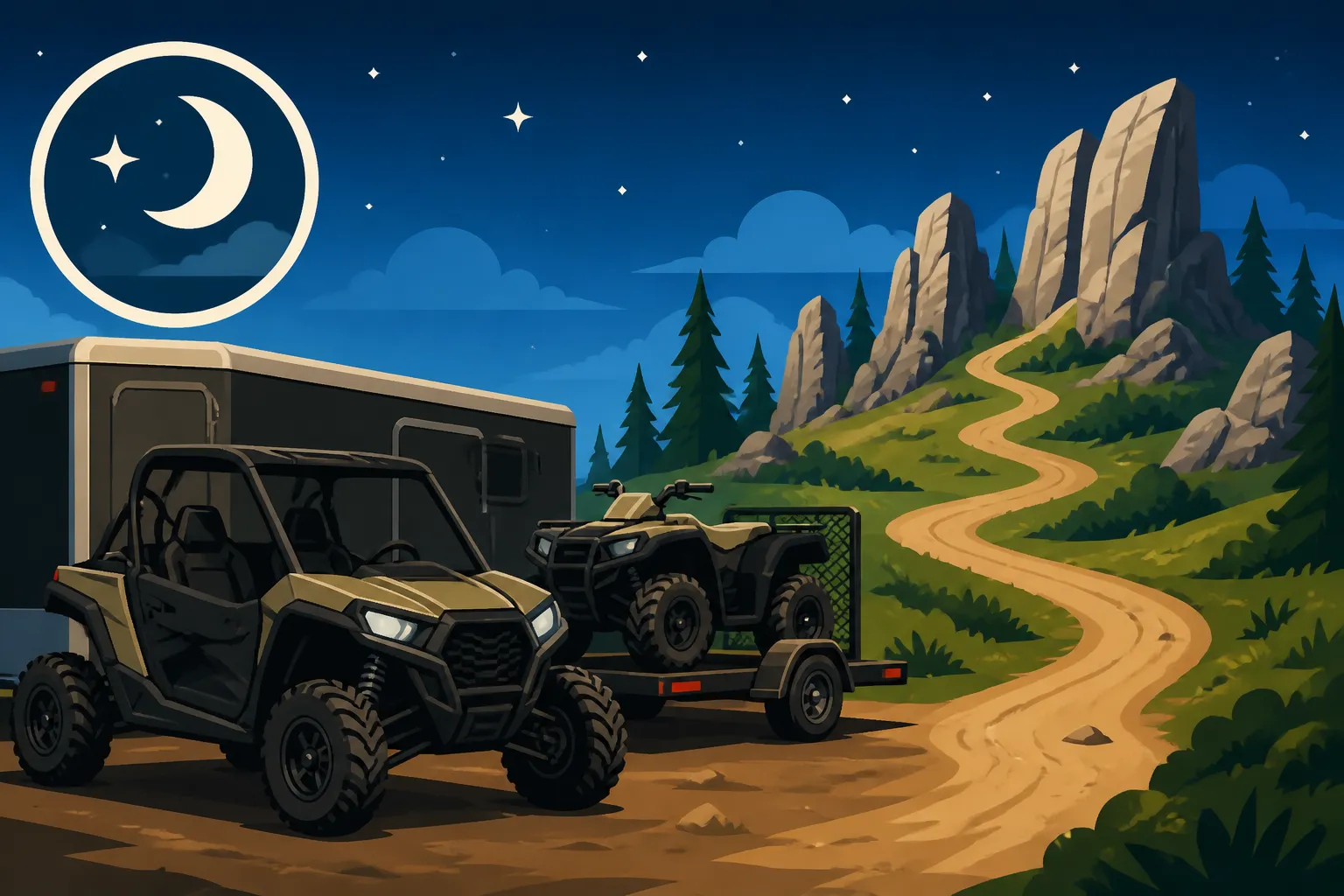
A staging lot is even more important to verify. It may be designed for unloading and day use rather than overnight storage. Before choosing it, confirm whether overnight parking is allowed, whether trailers can remain, and whether the lot is open during your planned dates. Parking a Trailer at a Hills Trailhead covers the practical considerations of bringing a trailer to a riding access point.
Lodging near a riding area
Staying in a town such as Deadwood, Spearfish, Hill City, or Custer can make meals, fuel, and other services easier to reach. The tradeoff is that you may need to drive or trailer to the trail system each day. Lodging properties vary, so call ahead about trailer parking rather than assuming a standard parking lot will have room.
Ask whether the trailer can remain attached to the tow vehicle, whether there is a designated overflow area, and whether the machine can stay loaded overnight. If you are traveling during a busy event or a popular riding period, confirm parking before you commit to the room. A convenient bed does not solve the problem if there is nowhere appropriate to put the trailer.
Make a safer plan for your truck, trailer, and machine
Even when overnight parking is permitted, the site may be remote, busy, exposed to weather, or beyond reliable cell coverage. Plan for the practical risks of leaving valuable equipment unattended, and make your return route easy to follow.
Choose a site that fits your full setup
Measure your truck and trailer together, including any hitch or rear-mounted equipment that affects the overall length. Check whether you can turn around without blocking a road or another parking space. If the lot is small or crowded, arriving late can make a suitable space difficult to find.
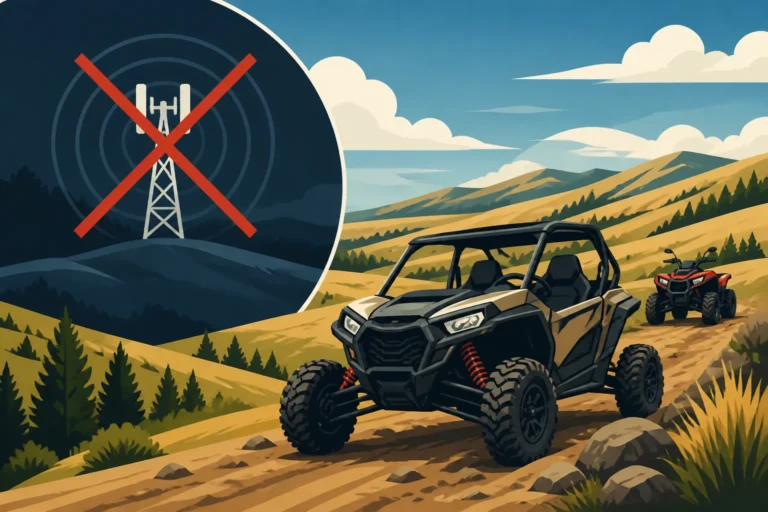
Have a backup option that is genuinely usable, not just a second pin on a map. Confirm its rules and consider how far it is from your route. Save directions to both options offline, and tell someone where you expect to park and camp. In parts of the Hills, cell reception can be inconsistent, so do not rely on making a quick call once you are already far from town.
When using onX Offroad or a similar app, save the route and important locations before leaving service. Mark the legal parking location separately from the trail itself. A route line crossing near a lot does not establish that the lot is open overnight or suitable for a trailer.
Secure equipment without creating new problems
Remove keys and valuables from the machine, lock the trailer when appropriate, and avoid leaving loose gear visible. A coupler lock, wheel lock, or other suitable security measure can make casual tampering more difficult, but no device guarantees that equipment will be safe. Keep registration and title documents secure rather than leaving originals in an unattended vehicle.
Park so the trailer does not obstruct traffic, access gates, maintenance equipment, or other visitors. Do not use trees, signs, or barriers as tie-off points, and do not spread out into extra spaces unless the site rules allow it. Keep your campsite and parking area tidy, and pack out waste rather than leaving it for the next visitor.
If the lot feels unsuitable when you arrive—because it is full, muddy, poorly accessible, or posted with restrictions—do not force the plan. Move to your verified backup or contact the relevant operator. A short adjustment is better than leaving a trailer in a prohibited or difficult-to-reach place overnight.
Build in a fallback for closures and weather
The Black Hills can bring changing road and trail conditions. Heavy rain, snow, fire danger, maintenance, or a closure may alter where you can ride or park. Check official notices before leaving and again at the entrance to the area. If a gate is closed or a sign prohibits access, do not drive around it to reach a preferred parking spot.
Keep enough fuel and daylight margin to reach your alternate location. If your first choice is full, you do not want to be forced into a long, unfamiliar drive after dark with a trailer. Save the phone number or contact details for your campground or lodging, and confirm any arrival instructions before you lose service.
A good overnight plan is not only about finding a place to sleep. It connects legal parking, permitted camping, trailer access, trail conditions, and a backup route. The more of those details you confirm in advance, the less likely you are to spend the evening searching for a place that can safely accommodate your whole setup.
Disclaimer
This article is for general informational purposes only and does not constitute professional advice. Laws, prices and regulations vary by location and change over time. Consult a qualified professional for guidance on your specific situation.