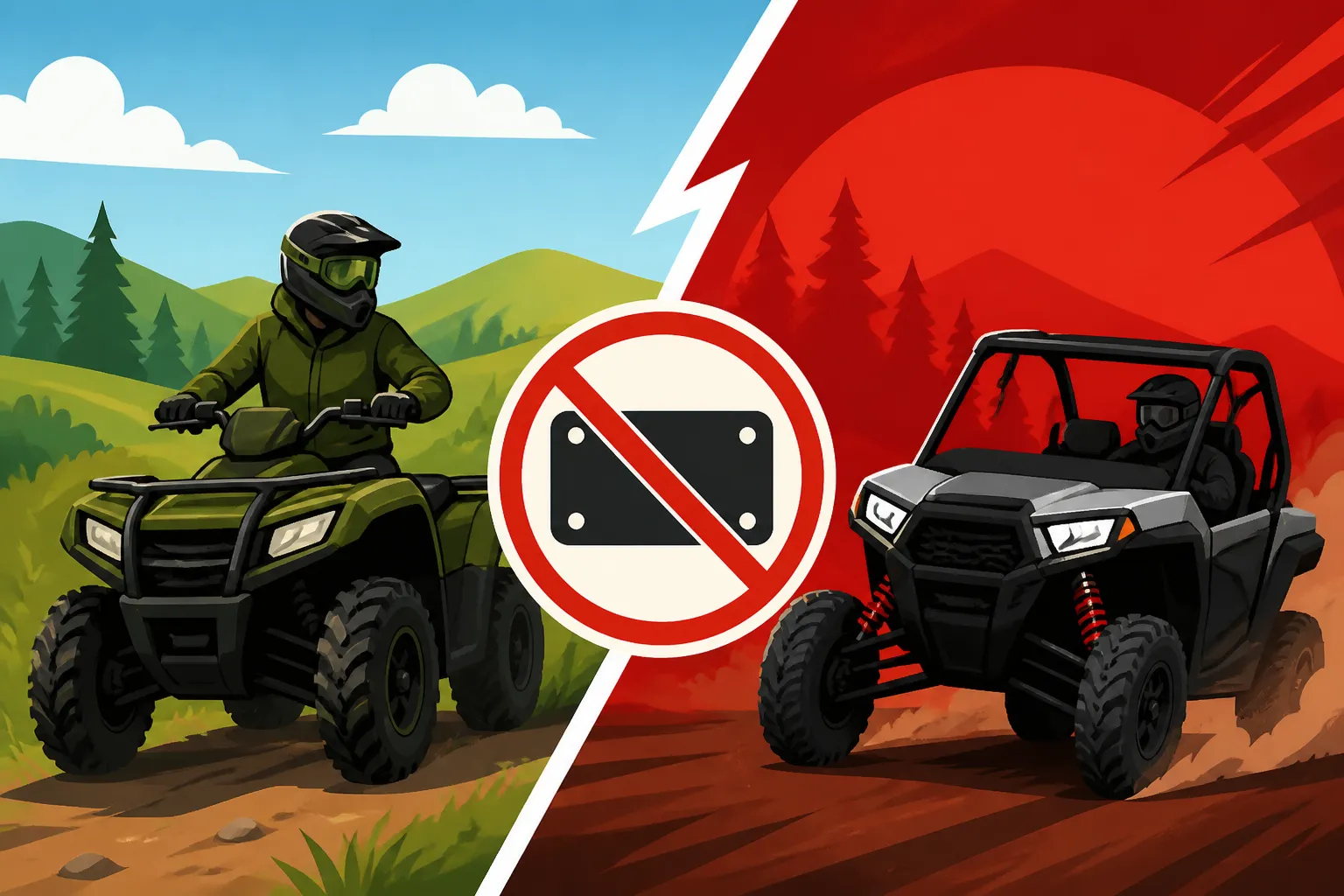
Riding a GFP Area Without a Plate
A missing ATV plate does not automatically keep you out of every South Dakota riding area. On certain designated Game, Fish and Parks OHV areas, a plate may not be required to ride within the area. The important catch is that this is a limited exception: it does not make an unplated machine legal on public roads or every trail.
Can you ride a GFP area without an ATV plate
Why a designated riding area can be different
A plate is generally associated with operating a machine on roads where road-use requirements apply. A designated off-highway vehicle area is different: riding takes place within a defined recreation area, rather than as ordinary travel on public streets. That distinction is why a rider may be able to use an unplated ATV or UTV inside a qualifying GFP riding area.
The word “designated” matters. A parcel being owned or managed by the South Dakota Game, Fish and Parks Department does not automatically make every track, field, or access road a place where you can ride without a plate. The location needs to allow that kind of motorized riding, and the machine must stay within the area’s permitted boundaries.
A useful way to think about it is that the area’s rules govern access within the riding site, while separate rules govern travel to get there. An unplated machine on a trailer can be unloaded at an authorized riding area and used there if the site allows it. Riding it along a public road to reach the gate is a different matter.
Plate, permit and park license are not the same thing
The lack of a plate does not mean that every other requirement disappears. Riders often use “registration” as a catch-all word, but a plate, a trail permit, a site access requirement and a park entrance license can serve different purposes. Whether one or more applies depends on where you are riding and what the site rules say.
For example, a South Dakota motorized trail permit associated with designated Black Hills National Forest routes is not automatically the same thing as permission to ride at a GFP OHV area. Likewise, a park entrance license is not a substitute for permission to operate on a route that does not allow motorized vehicles. Check the rules for the specific area rather than assuming one decal or payment covers every kind of riding.
| Item | What it generally relates to | What to check before riding |
|---|---|---|
| ATV or UTV plate | Road use and vehicle requirements | Whether you will travel on a public road or leave the designated area |
| Trail permit | Use of certain designated trail systems | Whether the permit applies to the specific land and route |
| Site access requirement | Entry or use of a particular recreation area | Posted instructions and current site rules |
| Park entrance license | Access to applicable state park facilities or areas | Whether the riding location requires one |
| Area boundary | Where riding is allowed | Maps, signs, gates and closed-route notices |
If you are unsure what category applies, start with the exact riding location and its posted instructions. The distinction is also useful when reading [Why No Plate Is Needed Inside a GFP Area] and [Why No Park License Is Needed Inside One]. Those are separate questions from whether the area permits your machine and route.
Confirm that the location is actually a designated OHV area
Before unloading, confirm the name and boundaries of the place you intend to ride. GFP manages a range of lands and recreation facilities, and motorized access can differ from one place to another. A nearby gravel road, access lane, campground road or parcel boundary should not be treated as part of an OHV area just because it leads toward one.
Use the site’s current information and signs at the entrance. A mapping app such as onX Offroad can help you orient yourself and compare your planned route with mapped riding areas, but it should not replace official signs or site rules. If a map layer is unclear, or the route appears to cross a road or a different land unit, stop and confirm before riding farther.
This is especially important if you arrive after a long drive and see other machines moving around. Someone else’s route does not prove that every connecting track is open, or that their machine has the same registration status as yours. When boundaries are uncertain, staying on a clearly marked route is the safer choice.
What to check before riding an unplated machine
Verify the route and the riding area
First, identify the specific GFP area by name. Then confirm that ATV or UTV use is allowed there and that the route you plan to ride is open to your machine. Look for entrance boards, trail markers, gates, temporary closure notices and any posted vehicle restrictions. A route can be closed even when the surrounding area remains open for other uses.
It helps to plan the ride before unloading. Mark the entrance, the route, any turnaround points and the way back to the trailer. If you use onX Offroad to view mapped routes, treat it as a planning aid: check the map against official information and what you see on the ground. Do not assume that a colored line on a map guarantees access or that every visible two-track is an authorized route.
Pay attention to adjoining roads. An unplated machine may be allowed within the designated riding area but still be prohibited from using a public road or an unapproved connector. If a route appears to leave the recreation area, do not follow it unless the applicable road and land rules clearly allow that travel.
Read the posted requirements for your machine
A site can have rules beyond plate status. Check for restrictions that apply to vehicle type, width, sound, hours, rider conduct or the route itself. If your group includes a wider side-by-side, a youth rider or a passenger, confirm that the site rules and the machine’s setup are appropriate before starting.
Do not rely on a general statement such as “ATVs are allowed.” That may not answer whether a particular UTV, modified machine or combination of rider and passenger is permitted. The relevant details are often in posted notices or the area’s official information. If you cannot find an answer, contact the managing office before making the trip rather than trying to resolve it at the entrance.
Keep any required documents or proof of compliance accessible. If the area has a site-specific access requirement, follow its instructions even if your machine has no plate. For broader context on separate permit systems, see [South Dakota's Motorized Trail Permit] and [Why a Plate Does Not Replace a Trail Permit].
Plan how the machine gets there and back
An unplated ATV or UTV should be transported to the riding area when road use is not permitted. Make sure the trailer, tie-downs and loading setup are ready before you leave home. It is easy to focus on the riding plan and overlook the practical issue of getting an unplated machine from the staging point to the permitted area without using a road illegally.
Think through the entire route, not just the final trail. If the parking or unloading area is outside the designated riding boundary, check whether there is an authorized connection. A short stretch of pavement can still be a public road; being close to the entrance does not make it part of the OHV area.
If your plan includes more than one location, check each one independently. Permission to ride at one GFP area does not carry over to another nearby parcel, forest route or public road. Articles such as [Riding a GFP Area Without a Park License] and [Where the Black Hills Permit Stops Being Required] can help clarify why access rules vary by land type.
What the no-plate exception does not allow
It does not authorize road riding
The most common mistake is treating “no plate needed inside the area” as “no plate needed anywhere on the trip.” Those are not equivalent. A designated off-highway riding area is a bounded place; public roads and road shoulders are governed by their own requirements.
Do not ride an unplated machine from a motel, campground, private cabin or nearby town to the entrance unless the route is legally open to that machine and you meet the applicable requirements. The same caution applies when crossing a road or using a road to connect two riding areas. Check the specific road rules before crossing or traveling along it. [South Dakota Rules for Crossing a Highway] explains why a crossing is not the same as general road use.
Likewise, a plate on the machine does not necessarily give you permission to ride anywhere. A plated ATV or UTV still needs to follow access restrictions, route closures and land-management rules. The machine’s road status and the land’s permission are separate questions.
It does not open closed trails or private land
A designated OHV area may contain boundaries, closed routes or places where motorized access is not allowed. A gate, closure sign or barrier should be treated as meaningful, not as an invitation to find a way around it. Riding outside an authorized route can damage habitat, create conflicts with other visitors and put future access at risk.
Private property is another separate issue. A trail that appears to continue across a fence line or ranch road does not automatically grant permission to cross. Ask the landowner when needed, and do not assume that public access to one section of land creates access to an adjacent section. [South Dakota Landowner Permission Rules] offers further guidance on that distinction.
Keep an eye on temporary notices, too. Seasonal closures, maintenance, fire conditions or other site-specific concerns can change where riding is allowed. A route shown as open in an older map may not reflect a closure notice posted at the entrance. If the signs and a digital map disagree, follow the official on-site restriction and confirm with the managing office.
It does not replace responsible riding practices
A plate question can feel like the main hurdle, particularly when you have already loaded the machine and driven to the area. But safe riding still depends on the basics: stay on authorized routes, keep a suitable speed for visibility and terrain, give other users room, and avoid riding through sensitive or damaged ground.
Before the ride, check that the machine is in safe working condition. Confirm tires, brakes, steering, lights where relevant, fuel and communication plans. Carry water and basic recovery supplies appropriate to the route. If your group becomes separated, agree on a meeting point and a simple plan before anyone heads down a different trail.
For location planning, onX Offroad can help you review mapped routes and orient yourself, while official site information and posted notices determine what access is actually allowed. That combination is more useful than relying on memory or following another group. You can also review [South Dakota Rules for Riding Federal Land] when your plans include land outside the GFP riding area.
A practical pre-ride checklist
Before loading the trailer
Use this quick sequence before heading out with an unplated ATV or UTV:
- Identify the exact GFP OHV area, not just a nearby town or general recreation site.
- Confirm that the area allows the type of machine you plan to ride.
- Review official access information and any current closures or restrictions.
- Check whether the site has a permit, entry payment or other access requirement.
- Confirm that your route stays inside the authorized riding boundary.
- Plan how the machine will get from the trailer to the riding area without unauthorized road use.
- Bring the equipment, supplies and contact information appropriate for the ride.
This checklist is deliberately more careful than simply asking whether the machine needs a plate. That is because the correct answer can change with the route, the land boundary and the site’s specific requirements.
At the entrance and on the trail
When you arrive, read the entrance board before unloading. Look for changes that may not have appeared in your planning materials, including temporary closures, route restrictions or instructions about where to park. If the entrance information conflicts with what you expected, pause and confirm the rules rather than guessing.
Once riding, follow marked routes and turn around when you reach a boundary or closure. Keep the site information handy, and avoid treating an unmarked spur as an approved route. A map can make navigation easier, but the rider remains responsible for paying attention to signs and conditions on the ground.
If you are still uncertain about plate status, permits or where a particular route leads, contact the managing office before riding. The safe interpretation is narrow: a designated GFP OHV area may allow riding without a plate within its authorized boundaries, but that permission does not automatically extend to roads, other public lands or neighboring property. For related guidance, see [South Dakota Rules for Riding a State Trail] and [South Dakota Rules for Riding Private Property].
Disclaimer
This article is for general informational purposes only and does not constitute professional advice. Laws, prices and regulations vary by location and change over time. Consult a qualified professional for guidance on your specific situation.