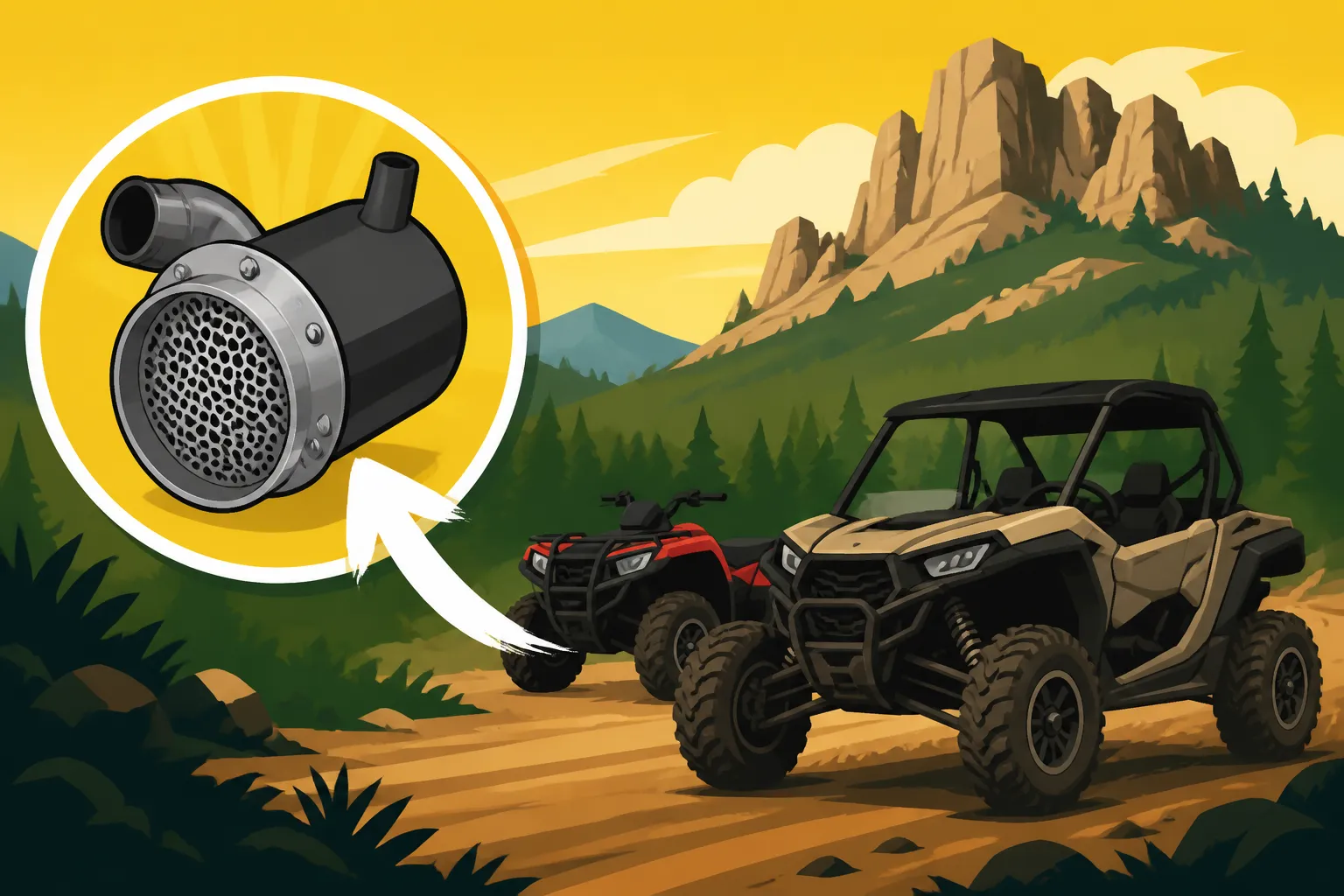
Which Spark Arrester Black Hills Trails Require
A spark arrester is easy to overlook when you are packing an ATV or UTV for the Black Hills, especially if the machine has a stock muffler. On Black Hills National Forest motorized routes, the key is having a working, properly installed arrester that meets Forest Service requirements. Here’s how to check your machine, understand where the rule applies, and avoid confusing equipment compliance with a trail permit.
Where the spark arrester rule applies
On Black Hills National Forest lands, a motorized vehicle with an internal-combustion engine must have an approved spark arrester in effective working order and properly attached. That requirement applies to machines using National Forest System motorized routes, including designated trails and roads where motorized travel is allowed.
The practical takeaway is that a muffler alone does not establish compliance. A spark arrester is designed to keep hot carbon particles from escaping the exhaust and starting a fire. It may be built into the muffler assembly, but the two terms do not mean the same thing. A quiet exhaust is not automatically a compliant exhaust, and a loud exhaust is not necessarily missing an arrester. Sound rules and spark-arrester rules are separate.
The Black Hills riding network includes different land managers and riding areas. A rule that applies on National Forest land should not automatically be assumed to cover every state, local, or privately managed area. Before riding, identify who manages the route and check that manager’s current requirements. The Black Hills National Forest in South Dakota provides context on the forest riding area, while South Dakota Rules for Riding Federal Land explains why federal land rules need to be considered separately from state requirements.
| Question | Practical answer |
|---|---|
| Is a spark arrester required on Black Hills National Forest motorized routes? | Yes, an internal-combustion machine must have a properly installed, effective arrester that meets the applicable Forest Service standard. |
| Does a stock muffler prove the machine complies? | No. Check the machine’s documentation or exhaust assembly details for the arrester. |
| Does a trail permit replace the equipment requirement? | No. A permit and compliant equipment are separate requirements. |
| Do the same rules necessarily apply on every nearby riding area? | No. Confirm the rules with the land manager for the specific location. |
| What if the arrester is damaged, missing, or uncertain? | Do not assume the machine is compliant; repair or verify it before riding. |
A South Dakota motorized trail permit is not an equipment certification. It authorizes riding where the permit is required, subject to route access and other rules. It does not make an unapproved or damaged exhaust system acceptable. For background on the permit side, see South Dakota Trail Permits Explained and How the Black Hills Motorized Trail Permit Works.
That distinction matters when planning a trip. A machine can have the correct decal and still fail an equipment check, just as a compliant spark arrester does not grant access to a closed route. Route access, permits, and machine condition are separate parts of being ready to ride.
How to check whether your ATV or UTV has one
Start with the owner’s manual and the manufacturer’s parts information for your exact make, model, and year. Look for wording such as “spark arrester,” “spark arrestor,” or a reference to an exhaust screen or arrestor assembly. Some machines have an arrester integrated into the muffler, while others may use a removable component. A generic description of the exhaust as “stock” is not enough to confirm what is installed now.
If the manual is not clear, check the parts diagram or contact a dealer or qualified repair shop. Give them the machine’s exact model information and ask whether the exhaust assembly includes a Forest Service-qualified spark arrester, whether the correct part is installed, and how to inspect it. Do not rely only on a seller’s short description or a visual guess.
Look for the device, not just a quiet exhaust
An arrester can be hidden inside an exhaust outlet or muffler assembly. It may not look like a separate accessory from outside the machine. Conversely, an exhaust screen or aftermarket tip should not be assumed to meet the requirement simply because it appears to block debris.
A manufacturer’s documentation is usually a better starting point than appearance. If you have an aftermarket exhaust, check its paperwork and the manufacturer’s specifications for the specific model and part number. If the documentation does not establish that the arrester meets the relevant standard, get confirmation from the manufacturer or a knowledgeable service professional before taking the machine onto National Forest routes.
Listings on Amazon or other marketplaces can be useful for locating a replacement part, but a product title alone is not proof of approval, fit, or compliance. Verify the exact part number against your machine and confirm the arrester’s status through reliable manufacturer documentation. Avoid buying a part based only on a broad claim such as “fits most ATVs.”
Inspect condition and installation
A compliant part can still be a problem if it is missing, loose, damaged, or installed incorrectly. Before a ride, check the exhaust assembly for signs that a screen or insert has been removed. Look for loose fasteners, cracks, obvious gaps, or other damage. Follow the manufacturer’s instructions for inspection and cleaning; do not modify the arrester or enlarge openings as a shortcut.
Some arresters need periodic cleaning because carbon can build up. Follow the machine or component maker’s maintenance directions, and let exhaust components cool before handling them. If cleaning requires removal, reinstall the part exactly as instructed and make sure it is secured. Do not ride with the arrester removed while waiting to clean or replace it.
A few common assumptions can lead riders astray:
- “It has a muffler, so it has a spark arrester.” A muffler reduces exhaust noise; it does not by itself confirm that an arrester is present.
- “It came from the factory, so it must still be compliant.” A previous owner may have changed the exhaust or removed an insert.
- “The machine sounds quiet.” Sound level does not verify the arrester’s construction or condition.
- “There is a screen in the outlet.” A screen’s appearance does not establish that it meets the applicable standard.
- “The permit decal covers the requirement.” It does not; equipment compliance and permits are independent.
If you cannot confirm the part, treat that as a maintenance question to resolve before the trip rather than a detail to sort out at the trailhead. South Dakota Spark Arrester Rules offers related context, but the land manager’s requirements for the specific route remain the deciding factor.
Before you ride: a practical compliance check
Use a short pre-trip process rather than relying on memory. This is especially helpful when taking a borrowed, newly purchased, or rental machine into the Black Hills.
- Identify the route and land manager. Check whether the planned road or trail is on Black Hills National Forest land or another managed area. Verify that motorized travel is allowed on that route.
- Confirm the machine’s equipment. Use the owner’s manual, parts information, or manufacturer support to determine whether the machine has the required arrester.
- Check the installed part. Look for signs of removal, damage, looseness, or incorrect installation. Follow the manufacturer’s maintenance procedure.
- Keep supporting information available. If the machine has an aftermarket exhaust or an unusual configuration, retain the product details or confirmation that identifies the installed part. This does not replace the equipment itself, but it can help resolve uncertainty.
- Review other trip requirements separately. Check permits, route closures, width limits, and any other rules for the area. South Dakota Trail Conditions Before You Ride is useful when checking for changing access conditions, and South Dakota Rules for Riding Off a Route covers why staying on designated routes matters.
For a rental, ask the outfitter directly whether the machine is equipped with a compliant spark arrester for the routes you plan to use. Do not assume that every rental includes the same equipment or that a rental permit answers the question. If you are arranging a guided ride, ask the operator what routes are planned and whether the machines are prepared for those routes.
The same caution applies to a borrowed machine. Get confirmation from the owner about the exhaust configuration, then inspect it yourself. If the owner cannot say whether the arrester is installed, a quick visual check may not be enough; use the model documentation or ask a service professional.
If the machine fails the check
Do not ride a machine on a route that requires an arrester if its arrester is missing, damaged, or unverified. Have the correct part installed or repaired, then confirm it is secured and maintained as the manufacturer specifies. Replacing an exhaust component with a generic part that looks similar may not solve the problem.
If you are already near a trail and discover the issue, do not remove the part, improvise a screen, or assume that a nearby road is exempt. Check the land manager’s rules for that road and arrange a compliant machine or repair before continuing. A route’s appearance does not tell you which rules apply.
It is also worth checking for closures and fire-related notices before loading the machine. Equipment compliance does not override a temporary closure, and conditions can change the access available on a planned route. The safest plan is to verify both the machine and the route before leaving, then follow posted signs and current land-manager instructions while riding.
A properly installed, working spark arrester is a small but important part of Black Hills ride preparation. Confirm the actual exhaust equipment rather than judging by sound, and keep the arrester rule separate from permits and route access. When the machine’s configuration is uncertain, verify it before the trip rather than taking a chance on the trail.
Disclaimer
This article is for general informational purposes only and does not constitute professional advice. Laws, prices and regulations vary by location and change over time. Consult a qualified professional for guidance on your specific situation.