Why South Dakota Mandates No Safety Course
South Dakota does not make an ATV safety course a universal ticket to ride, which can leave new riders unsure whether a course is optional, whether a permit replaces it, or whether an out-of-state credential counts. The practical answer is to separate training from legal permission: a course may help you ride more safely, but it does not replace the rules for your machine, route, land, or permit.
What “No Safety Course Mandated” Means
South Dakota does not generally require every ATV or UTV rider to complete a state safety course before riding. That is the central point, but it is narrower than it may sound. It does not mean every rider can ride anywhere, that all vehicles are treated the same, or that other rules disappear.
A safety course is training. A title, registration, plate, permit, insurance document, or land-use authorization serves a different purpose. Each answers a different question:
- Training: Have you learned basic controls, safe riding practices, and how to respond to common hazards?
- Vehicle status: Is the machine titled or registered when required, and does it meet the rules for the place you intend to ride?
- Access: Is this route or property open to your machine?
- Permit: Does this particular riding area require a permit or decal?
- Rider conduct: Are you following applicable age, helmet, equipment, speed, and operating rules?
Completing a course does not automatically satisfy the other requirements. A training certificate is not a substitute for a trail permit, and a permit is not proof that you have learned to operate a machine.
It also helps to avoid reading too much into the absence of a statewide course mandate. It does not mean South Dakota has concluded that training is unnecessary. A course can be valuable, particularly for a first-time rider, a young operator, or someone moving from a small ATV to a heavier side-by-side. It simply is not a universal state prerequisite for every rider in every riding situation.
The distinction matters most when riders are planning a trip. Someone may arrive with an out-of-state registration, a safety-course card, and a machine ready to ride, then discover that a specific area still requires a separate permit. Another rider may have the right permit but be unfamiliar with the machine’s handling. Both can be true at once.
| Question | What a safety course does | What it does not do |
|---|---|---|
| Can I legally ride this machine here? | May help you understand rules and safer operation | Does not authorize access to a road, trail, or property |
| Do I need a permit? | Can explain why permits matter | Does not replace a required permit or decal |
| Does my home-state registration count? | May cover general riding topics | Does not settle South Dakota registration or reciprocity questions |
| Am I prepared to ride? | Builds knowledge and practice habits | Cannot guarantee readiness for every machine or terrain |
| Does a rental company require training? | May satisfy a provider’s training request if accepted | Does not override the rental company’s own conditions |
For the legal side, begin with Does South Dakota Require an ATV Safety Course? and [South Dakota ATV Safety Course Requirements]. For the practical side, treat training as a way to reduce risk even when it is not a statewide legal requirement.
Why the State’s Rule Is Not the Whole Story
A rider asking “Does South Dakota require a safety course?” may actually be asking several different questions: whether state law requires a certificate, whether a public land manager requires one, whether a rental company will hand over a machine without one, or whether a child needs instruction before riding.
Those questions can have different answers. A state-level rule is only one layer. Riding may also be subject to local restrictions, land-manager rules, event conditions, private-property permission, or a business’s rental contract. A specific requirement can apply to one situation without becoming a statewide course mandate.
That is why it is better not to rely on a broad statement such as “No course is required in South Dakota” as the only preparation for a ride. Instead, check the rules that apply to the actual place and activity.
Public trails and managed land
Public riding areas may have their own access conditions. A land manager can designate which routes are open, restrict vehicle types or widths, close areas temporarily, and require a permit. Those conditions are separate from whether the state requires a safety course.
For a Black Hills ride, for example, a rider needs to understand the motorized route system and applicable permit rules. A course does not grant permission to use a closed route, ride off an authorized trail, or enter an area where motorized vehicles are prohibited. Review South Dakota Rules for Riding Federal Land and South Dakota Trail Maps and MVUMs before assuming a route shown on a general map is open to your machine.
Conditions can also change. Weather, fire danger, maintenance, resource protection, or other management concerns can lead to closures. A rider who completed a course and bought the right permit still needs to check current notices and signs. A route that was open on an earlier visit may not be open on the day of the ride.
Private land and organized rides
On private land, the landowner’s permission is a separate issue. A course does not grant access, and the fact that a gate is open or a two-track is visible does not establish permission to ride there. If an area is leased, managed, or shared, make sure the person granting access has authority to do so. See [South Dakota Rules for Riding Private Property] and [South Dakota Landowner Permission Requirements].
Organized rides can bring additional conditions. An event organizer, guide, club, or land manager may set rules about equipment, age, supervision, waivers, or rider experience. If you are joining a group, ask what the organizer requires before traveling. A general state rule does not prevent an event from setting reasonable participation conditions.
Rental businesses
A rental provider may require a demonstration, briefing, minimum level of experience, or a particular person to sign the agreement. These requirements are not the same as a state-mandated safety course. They are part of the provider’s process for handing over its equipment and controlling the risks of a rental.
Ask what the rental includes and what the company expects from each driver. Confirm whether the person operating the machine must meet a stated age or licensing condition, whether passengers are allowed, and whether the provider gives route instructions. For a broader planning checklist, see [Renting an ATV in South Dakota] and South Dakota Rental Age and License Rules.
If a company says it requires a course or training document, ask which course it accepts and whether the requirement applies to every driver or only the person signing the agreement. Do not assume that a certificate accepted by one provider will satisfy another provider’s policy.
Safety Course, Permit, Plate, and Registration Are Different
The most common planning mistake is treating every document as if it proves the same thing. It does not. A safety card is about training; a permit is about access or use; registration and plates identify the machine under applicable rules. Which documents you need depends on your machine, where you ride, and whether you are a resident or visitor.
South Dakota’s rules may also distinguish between road use, designated motorized trails, an open riding area, private ground, and machines that are not classified the same way. Do not assume that a document valid for one purpose covers another.
A permit is not a safety certificate
A South Dakota trail permit can be required for a particular riding area even though the state does not impose a universal safety-course requirement. The permit gives no guarantee that the rider is skilled, and a safety course does not serve as the permit.
For a Black Hills trip, learn which permit applies to your route and machine, how it must be displayed, and when it is valid. Start with South Dakota Trail Permits Explained and How the Black Hills Motorized Trail Permit Works. If you are visiting from another state, also check [South Dakota Rules for a Visiting Rider].
The same principle applies to an off-road vehicle permit for a nonresident. It is not a course card, a title, or permission to ignore the land manager’s route rules. Nonresident requirements depend on the vehicle and the type of use. Read South Dakota’s Nonresident ORV Permit before relying on a home-state document.
A plate does not replace every trail requirement
A machine’s plate or registration may matter for certain road-use situations, but that does not automatically make every trail or recreation area open to it. A road-legal machine still has to obey route restrictions, and public motorized trails may have separate permit rules.
Likewise, a home-state plate does not automatically answer every question about riding in South Dakota. Reciprocity is not a blanket promise that every out-of-state registration will be treated as sufficient for every location or use. A useful starting point is Does South Dakota Honor Out-of-State Registration?. Then confirm the rules for the specific area you plan to ride.
A rider can be fully compliant in one setting and not in another. For example, a plated machine may be appropriately equipped for an allowed road segment but still need a trail permit before entering a designated motorized trail system. Conversely, an off-road permit does not turn an ATV into a road-legal vehicle.
Titles and registration answer ownership and vehicle questions
A title generally documents ownership, while registration and plates relate to the vehicle’s legal status and use under the applicable system. They are not certificates of rider training. If you are buying a machine or bringing one into the state, check the paperwork separately from your riding-area plan.
Use Titling an ATV in South Dakota if you need to sort out ownership paperwork, and What South Dakota Counts as an Off-Road Vehicle if you are unsure how the machine may be classified. A machine’s appearance or marketing label is not always enough to tell you which rules apply.
The short version is: do not ask one document to do the job of another. Check training, vehicle paperwork, permits, land access, and operating rules as separate items.
Who Should Consider Taking a Course Anyway
Not being required to take a course is not the same as being ready to ride. Training is especially helpful when a rider is new to the controls, unfamiliar with the terrain, or responsible for passengers or younger riders.
A useful course does more than explain where the throttle and brakes are. It can help riders think about terrain, visibility, speed, protective gear, stopping distance, group spacing, and how to avoid making a small mistake worse. The most useful training includes hands-on practice on the kind of machine the rider will actually use.
First-time riders
A first ride on a quad or side-by-side can feel simple in a flat yard and very different on a rocky climb, loose gravel, a steep descent, or a narrow forest road. New riders should practice in a controlled area before heading into traffic, a busy trail system, or unfamiliar terrain.
Start with basic tasks: mounting and dismounting, starting and stopping smoothly, turning at low speed, braking without panic, reversing, and identifying the machine’s controls. Then practice on gradual changes in slope and surface. A short, deliberate practice session is more useful than learning while trying to keep up with an experienced group.
Do not assume that experience on a motorcycle, snowmobile, tractor, or personal watercraft transfers perfectly. Some habits carry over, but each vehicle responds differently. A side-by-side has a different width, center of gravity, turning behavior, and rollover risk than a small ATV. A familiar rider may still need time to understand the machine.
Young riders and supervising adults
A course can give a young rider a structured introduction, but it does not replace adult supervision or the rules that apply to age and operating conditions. The adult should understand the route, set a pace the child can manage, and make sure the machine is appropriate for the rider’s size and ability.
Before riding, talk through the plan in plain language: where the group is going, what to do if separated, when to stop, how to signal a problem, and why the rider must stay on the route. Make sure the child can reach and use the controls properly rather than assuming that a machine is suitable because it is marketed for youth.
South Dakota’s age-related riding rules can depend on the setting. Review South Dakota Minimum Age to Ride Public Land and South Dakota Supervision Rules for Young Riders rather than relying on an old family habit or another state’s rule. Helmet and eye-protection requirements are separate questions; training does not waive them.
Experienced riders moving to a new machine
A rider who has spent years on a small ATV may still need an adjustment period on a powerful, heavier, or wider machine. Added weight and width affect braking, cornering, obstacle clearance, and recovery options. Passengers also change how a machine handles.
Before a group ride, practice at a pace that allows the operator to learn the machine. Check the owner’s manual, understand the drive modes and braking system, and find out where the winch, gear selector, and emergency controls are located. If a rental provider offers an orientation, take it seriously even if you have ridden similar machines before.
For riders unsure whether their machine can fit a route, review South Dakota Trail Width Limits and How South Dakota Measures Trail Width. Skill does not compensate for a vehicle that is too wide for the route.
Riders who have not ridden recently
Skills fade. A rider returning after years away may be surprised by changes in machine size, control layout, or trail conditions. Start again with a refresher rather than treating past experience as a guarantee.
A formal course is one way to refresh knowledge. Another is a thorough practice session with an experienced instructor or rider, provided that the practice stays within legal access and does not substitute confidence for instruction. If you are unsure, choose the slower, more conservative option.
How Visitors Should Think About Reciprocity
A safety course earned in another state may be useful evidence of training, but it does not decide whether your vehicle or permit is accepted in South Dakota. Reciprocity concerns recognition of things such as registration or permits; training is a separate subject unless a specific provider or land manager says otherwise.
If you are traveling to South Dakota, work through the questions in order rather than starting with the course card:
- Identify the machine. Is it an ATV, UTV, dirt bike, or another type of off-road vehicle? How is it titled or registered at home?
- Choose the riding area. A forest route, designated trail, open riding area, private ranch, and public road can have different rules.
- Check the machine’s legal status. Confirm whether your home-state registration or plate is recognized for the type of use you intend.
- Check permit requirements. Find out whether you need a South Dakota permit or a permit specific to the riding area.
- Check the route and conditions. Confirm that your machine’s size and type are allowed, and that the route is open.
- Check rider and equipment rules. Review applicable age, helmet, eye-protection, lighting, and other requirements.
- Ask about extra conditions. For rentals, guided rides, or organized events, confirm the provider’s own requirements.
The order is useful because a course cannot solve a vehicle-registration problem, and a plate cannot solve an access problem. Each question has to be checked on its own.
Visitors should be especially careful about assuming that a registration sticker from home is enough for all South Dakota riding. The answer may depend on whether the machine is being used on a road, a designated trail, or land with its own permit system. See Riding South Dakota With an Out-of-State Plate and [South Dakota Nonresident ORV Permit Requirements].
For the Black Hills, do not assume that an out-of-state plate replaces the trail permit. Check the specific permit rule and the route’s status before leaving your lodging or staging area. If a permit is required, a course certificate does not replace it. If you hold a permit, that still does not make a closed trail open.
If your trip crosses more than one land-management area, check each area separately. A route can pass from one jurisdiction or type of property into another, and the applicable rules may change along the way. Use current official maps and notices, then look for signs at the route entrance. A map helps with planning, but it does not override a closure sign or an on-the-ground restriction.
A Practical Preparation Plan Without a Course Mandate
Whether you take a formal course or not, prepare as if the ride itself is the final test of your decisions. That means matching the machine and route to the least experienced rider, checking equipment before departure, and having a plan for ordinary problems such as a breakdown, bad weather, or a separated group.
Before choosing a route
Pick a route that fits the riders and machines you have, not the route that sounds most impressive. Consider width restrictions, surface, elevation changes, exposure, likely traffic, weather, and how far the group is from help. A wide UTV may be excluded from a route that works well for a narrow ATV. A beginner may be uncomfortable on a route that an experienced rider considers easy.
Check current land-manager information shortly before the ride. Confirm openings, closures, permit requirements, and any restrictions that could affect your plan. Do not rely only on a saved map, an old online post, or a route someone remembers from a previous season.
Set a clear turnaround point. A group that is running behind, low on fuel, or dealing with a mechanical problem should be willing to shorten the ride rather than push into a more difficult section late in the day.
Before starting the machine
A short pre-ride inspection can catch problems before they become a roadside recovery. Check tires, visible damage, brakes, steering, lights where relevant, fuel or battery charge, and any loose cargo. On a rental, photograph existing damage and report anything that could be misunderstood later.
Make sure every operator knows the controls and basic emergency procedures. Identify how to stop the machine, shift it, engage four-wheel drive if equipped, and use the parking brake. If a winch is present, learn its safe operating procedure before needing it under pressure.
For personal protective equipment, prioritize correct fit and suitability for the ride. A helmet that moves around, blocks vision, or is uncomfortable may not be worn properly. Eye protection should work with the helmet and remain clear enough to use in dust. Gloves, sturdy footwear, and layers appropriate to the weather can make a long day more manageable.
If you shop for protective gear through Amazon, treat a product listing as a starting point rather than proof that an item fits or meets your needs. Check the manufacturer’s specifications, sizing guidance, and return conditions, and try the equipment before the ride when possible. For helmets in particular, fit matters more than choosing by appearance or a single customer review.
A basic tool kit, tire-repair supplies appropriate to the machine, water, a first-aid kit, and a charged communication device are also sensible preparations. Amazon can be useful for comparing small accessories such as storage pouches or compact first-aid supplies, but verify that the items are suitable for off-road use and that you know how to use them. Do not buy emergency equipment and leave it unopened in a garage.
During the ride
Use a pace that leaves room to react. Keep enough space to see the rider ahead and avoid dust, and do not follow so closely that a sudden stop becomes a collision. On unfamiliar terrain, slow down before a blind corner, crest, steep descent, or narrow section rather than after entering it.
Stay on the authorized route. Riding around a barrier or making a short cut can damage land, create conflicts with other users, and expose the group to citations or more serious consequences. Respect signs, gates, closures, and private-property boundaries.
Agree on group procedures before setting out. Decide who leads, who sweeps, where the group waits at junctions, and what riders should do if they lose sight of one another. A simple plan helps prevent a small gap from turning into a search. For longer rides, make sure the group knows the route and the expected return time.
Leave room to change the plan. If a rider is uncomfortable, visibility drops, weather shifts, or the trail becomes more difficult than expected, stop and reassess. Pressuring a less experienced rider to continue is not a substitute for training.
If something goes wrong
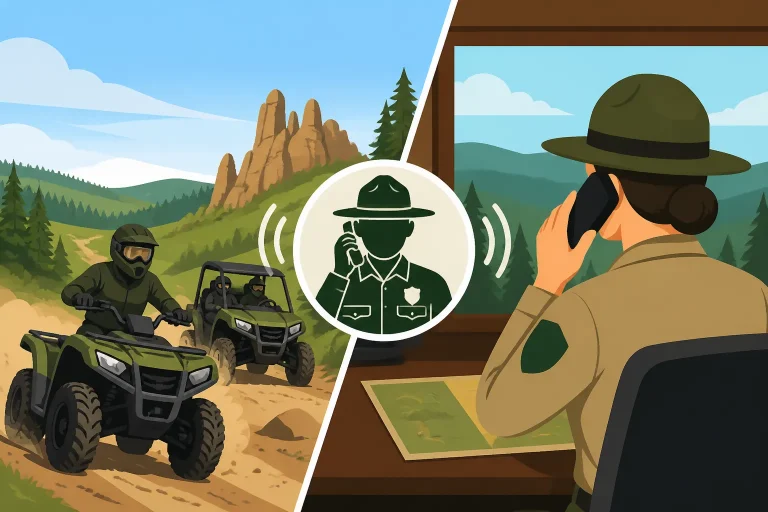
A course may teach useful response habits, but every group should also plan for common problems. If a machine breaks down, move it out of the way only if it is safe to do so. Keep the group together, use a phone or other communication device if available, and share your location and route information with someone who can help.
For an injury, prioritize immediate safety and get appropriate assistance. Do not move a seriously injured person unless staying in place creates a greater danger. Be ready to describe the location, access route, and nature of the problem.
If conditions make the return route unsafe, do not treat finishing the planned loop as more important than getting back safely. A shorter return, a wait for improved conditions, or a call for assistance may be the sensible choice. This is one of the reasons to carry water, basic supplies, and a realistic plan rather than relying on the assumption that every ride will go as expected.
Common Misunderstandings to Avoid
Several mistaken assumptions come up because “course,” “permit,” and “registration” are often discussed together. Keeping the categories separate prevents avoidable surprises.
“No course is required, so no preparation is needed.”
The legal minimum is not a measure of skill. Riders still need to learn the controls, understand the terrain, and use appropriate protective equipment. A course may be optional under the statewide rule and still be a smart choice for a particular rider.
“A course card lets me ride on public land.”
A training card does not grant land access. You still need to identify where motorized riding is allowed, follow route restrictions, and obtain required permits. Start with Where to Ride an ATV in South Dakota and confirm the rules for the exact area.
“My out-of-state registration covers every South Dakota trail.”
Do not assume that. Registration and reciprocity questions depend on the machine and use, while designated trail systems may have additional permit requirements. Check Does South Dakota Honor Out-of-State Registration? and the permit rules for the destination.
“A permit means my machine is road legal.”
A trail permit does not make an off-road vehicle street legal. Road use has its own requirements, and a plate does not give permission to ride on every road or trail. If road use is part of your plan, review South Dakota Street Legal ATV Requirements.
“The rental company’s briefing is the same as a course.”
A rental briefing may explain how to use a particular machine and where the renter may go. It may be helpful, but it is not necessarily a formal safety course or a substitute for experience. Ask exactly what the briefing covers and follow the rental agreement.
“Someone else in the group has the paperwork, so we are covered.”
Permits and other requirements can apply to each machine or operator, not simply to the group as a whole. Confirm what each machine needs, who may operate it, and where it may be used. See One Permit Per Machine, Not Per Rider for a related permit distinction.
“The trail was open last time.”
Access can change. Check current notices and pay attention to signs at the trailhead. A course, permit, or prior visit does not override a current closure.
The safest way to read South Dakota’s no-course rule is as a narrow answer to one question: the state does not make a universal safety course the gateway to riding every ATV or UTV. It is not a promise that every machine, route, rider, or activity is automatically approved. For a legal trip, verify permits, reciprocity, vehicle status, and land access. For a safer trip, make training and practice part of your plan even when the law does not require a certificate.
Disclaimer
This article is for general informational purposes only and does not constitute professional advice. Laws, prices and regulations vary by location and change over time. Consult a qualified professional for guidance on your specific situation.