Where South Dakota Permit Money Goes
South Dakota’s off-highway vehicle permit helps support the riding system, but it can be hard to tell what the fee actually pays for. The money does not buy access to every road or trail, and a decal does not mean every route is open. Here’s how to think about the permit revenue, what it may support, what it does not cover, and how to check the rules before you ride.
Start with what the permit pays for
South Dakota’s motorized trail permit is part of a system for managing off-highway vehicle use. Its purpose is connected to riding on designated public routes and areas where the permit is required—not to providing unrestricted access across public land.
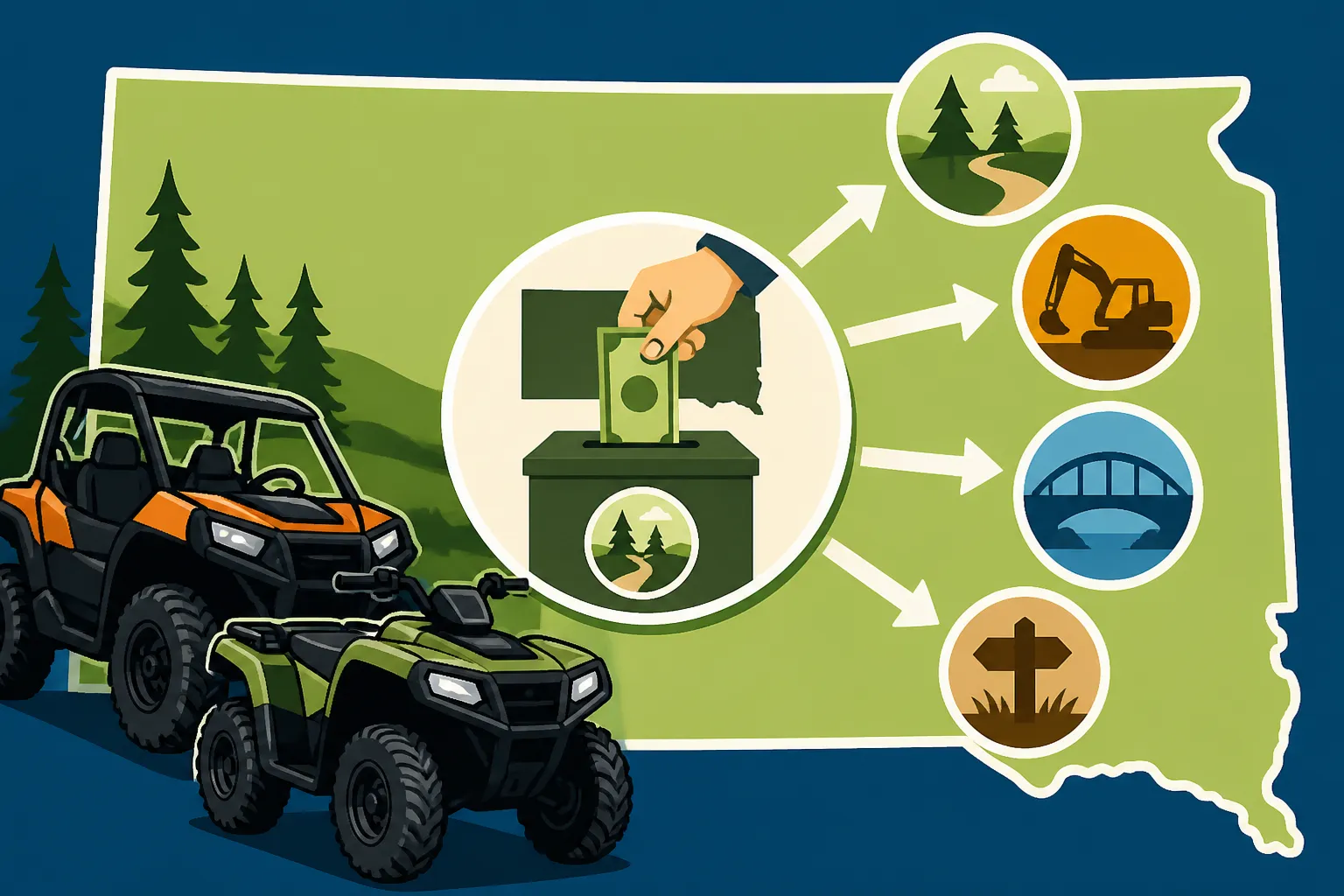
Permit revenue is intended to support the permit program and its trail-related work. That can include practical needs such as maintaining eligible routes, providing signs or information, and managing the system riders use. But a permit fee is not a personal contribution to one named trail, and buying a decal does not mean the fee goes directly to the road or trail you ride that day.
The distinction matters because several different systems can overlap on a single trip:
- A state-issued permit may be required for motorized trail use in a particular area.
- A federal land manager may decide which routes are open and maintain routes under its responsibility.
- A separate registration or plate may apply to road use.
- A state park, campground, or other recreation site may have its own access rules or charges.
Those are related pieces of a ride, but they are not interchangeable. A plate does not automatically replace a trail permit, and a trail permit does not make an otherwise closed route legal. For a broader explanation of the permit system, see South Dakota Trail Permits Explained. If you are deciding whether a plate or a permit applies to a particular road, Do You Need a Permit on a Black Hills Road? is a useful companion.
The safest way to describe where permit money goes is to separate the purpose of the program from the exact accounting for a particular year. The purpose is trail-system support. The exact split among administration, maintenance, signs, facilities, or other eligible costs is an accounting question. Unless you have a current official budget or financial report in front of you, do not assume a particular percentage or dollar amount goes to any one item.
That may feel less satisfying than a neat pie chart. It is also more honest. A broad program purpose can be clear while detailed spending figures change from year to year, or appear in records that do not match the way riders casually describe the permit.
Where the money can make a difference
A trail system costs more to operate than the visible track under a machine’s tires. The trail itself is only one part of the job. Managers also have to keep routes understandable, deal with damage, communicate closures, and balance motorized use with other public-land needs.
Route upkeep and repairs
Rain, snow, heavy use, and ordinary erosion can change a route. Water may cut ruts across a slope, gravel may wash away, or a section may become unsafe or unsuitable for its intended use. Maintenance can involve drainage work, surface repair, clearing debris, or addressing other damage.
Not every route is maintained in the same way or on the same schedule. A remote route may receive a different level of attention from a busy staging area. Some work may be handled by the agency responsible for the land, while other work may be supported through a permit or recreation program. That is one reason it is difficult to say that a particular rider’s fee “paid for” a particular repair.
The sensible expectation is that permit revenue supports the system in which permitted riding takes place—not that every mile gets the same treatment or that every rough patch will be repaired quickly.
Signs, maps, and route information
A route system only works if riders can understand where they are allowed to go. Signs may identify a route, indicate a closure, explain a restriction, or help riders distinguish an authorized route from a tempting but closed track. Maps and other route information can play a similar role.
This is not merely a convenience. Clear information helps prevent accidental travel off an open route, which can damage land and create conflicts with other users. It also helps riders plan within the limits of the route network, including width restrictions and seasonal closures.
A decal alone cannot provide that information. Before a ride, check the current map and notices for the area you plan to visit. The general guide South Dakota Trail Maps and MVUMs explains why riders should treat route maps and closure information as part of trip planning, not as optional extras.
Staging and access facilities
Some riding areas need places for riders to unload, park, check maps, or organize their machines before setting out. Those facilities may require maintenance or improvements, and they can affect how safely and efficiently people use a route network.
A permit program may be connected to this kind of trail-system support, but riders should not assume that every parking lot, restroom, campground, or recreation site is paid for by the permit. Facilities can have different owners, funding sources, and operating rules. A campground reservation or park entrance charge, for example, is not automatically covered by an ORV permit.
Program administration
Collecting fees, issuing permits, providing information, and coordinating the rules all take administrative work. Administration may not be the part of the system riders notice most, but it is part of making a permit program function.
A fair question is how much of the program’s resources go to administration compared with on-the-ground work. The answer should come from official accounting, not a guess based on what a decal costs or how many riders are seen at a trailhead. If the published information groups costs into broad categories, those categories may not reveal every staff task or shared expense behind the program.
Other support that needs confirmation
Riders sometimes hear that permit fees pay for enforcement, safety programs, conservation, or a specific trail project. Those may be worthwhile activities, but they should not be treated as funded by the permit unless official program information confirms the connection.
A practical test is to ask: Does the current program description or financial report identify this as an eligible expense or funded activity? If not, describe it as a possible related cost rather than a confirmed destination for the money.
What your permit does not buy
A permit is permission to participate under the rules that apply to the permit program. It is not a general pass to ride anywhere in South Dakota, and it does not override land-manager decisions.
| A permit may support or authorize | It does not automatically provide |
|---|---|
| Use of routes or areas where the permit is required, subject to current rules | Access to every public road, trail, or parcel |
| Participation in the designated motorized trail system | Permission to ride a closed route or travel off-route |
| A way to help fund the permit and trail program | A guarantee that a specific trail will be repaired or remain open |
| Compliance with a permit requirement in the area where it applies | A road plate, vehicle registration, or permission for all road use |
| A valid decal for the applicable period and machine | Campground access, park entry, or other separately managed recreation privileges |
It does not guarantee that a route is open
Routes can close for weather, fire danger, maintenance, resource protection, or other management needs. A permit does not cancel a closure. Nor does it let a rider cross a boundary or continue past a sign simply because the route was open on an earlier visit.
Check current notices before loading your machine, and check again at the trailhead. A route shown as open on an older map may have changed. South Dakota Trail Closures to Check First covers the importance of checking for current conditions rather than relying only on a map you have kept in the truck.
It does not replace every other permission
Land ownership and management matter. A public-land permit does not grant access across private property, and it does not replace a separate permit or entry requirement when one applies. A rider planning to use a state park, a campground, a private road, or another managed area should check that destination’s own rules.
The same is true for roads. A route that is open to motorized use under a trail program is not necessarily a public road on which a vehicle may be driven without meeting road-use requirements. Conversely, a plated machine may still need a trail permit on a route where the permit is required. For the distinction, see Why a Plate Does Not Replace a Trail Permit.
It does not reserve a route for you
Permit purchase does not reserve trail space, provide priority over other users, or guarantee that a staging area will have room. Popular areas can be busy. A permit supports a system of use; it is not a reservation for a particular day or trail.
It is not a substitute for checking the decal rules
The permit decal needs to be the valid one issued through the appropriate process and displayed according to current instructions. A decorative sticker, a home-printed image, or a decal bought from an unrelated seller should not be assumed to meet the requirement. Read Why There Is No Print-at-Home South Dakota Permit and Mounting a Trail Permit Decal on a Wheel Panel before attaching the decal.
Online searches can blur the difference between official permits and look-alike stickers. An Amazon listing for a generic ORV decal is not proof that the item is a valid South Dakota permit. Amazon may be useful for unrelated riding supplies, such as a map case, but the permit itself should come from an authorized source.
Why riders may not see a direct payoff
A common frustration is paying for a permit and then encountering a muddy section, a rough trail, a missing sign, or a closed route. The reaction is understandable: if riders pay into a program, they want to see a clear return.
There are several reasons the connection may not be obvious.
Costs and visible work do not line up neatly
A permit fee is part of a program, not a promise that the same amount will be spent immediately on the route a rider uses. Work may be planned across a network, scheduled for a particular season, or delayed until conditions allow. A maintenance project can also require coordination, equipment, labor, or approvals that are not visible to someone passing through.
Even when a repair is completed, the benefit may be subtle. Better drainage, clearer route markings, or a safer surface may prevent a problem rather than produce a dramatic new feature.
Different agencies can have different responsibilities
A rider may travel through an area that looks like one continuous landscape but is managed under more than one authority. The state permit program, a federal land manager, a county road department, and a private landowner do not necessarily share the same budget or duties.
That can create a gap between what riders expect and what the permit pays for. For example, a rider may assume that a state-issued permit funds every road-related service in the area. In reality, the route’s owner and the program responsible for the permit may not be the same. The correct answer depends on the land and route involved.
The fee is not an individual trail donation
A permit is usually tied to eligibility and use of a system, rather than a choice to fund one trail. Riders do not normally get to select a maintenance project at checkout. If a particular route is important to you, the useful question is not only whether permit revenue supports trails generally, but also which agency manages that route and how its work is funded.
Some costs are shared
A program may rely on shared staff, equipment, facilities, or administrative services. A report may categorize those costs broadly rather than assign every expense to one trail or one permit sale. This is common in public programs, but it can make the accounting difficult for a rider to interpret without a clear explanation of the categories.
If an agency publishes a total for permit collections and a separate total for trail work, do not automatically assume the difference was diverted. Timing, carryover, shared expenses, and the report’s accounting method can all affect how totals appear. Ask what the figures cover and what period they represent before drawing a conclusion.
How to check where the money actually went
If you want more than a general explanation, look for current official information about the program’s revenue and expenditures. The key is to compare records that cover the same time period and the same program.
Look for the right kind of document
A general permit webpage may explain the purpose of the permit but not show detailed spending. A budget, annual report, program summary, or financial statement may provide more detail. The titles and availability of those records can vary, so focus on the information rather than expecting a particular document name.
Useful details include:
- Total permit revenue collected during the reporting period
- Whether that figure is gross revenue or net of processing costs
- How the program defines eligible expenses
- Spending on route maintenance or improvements
- Spending on signs, maps, or rider information
- Administrative or collection costs
- Funds carried forward for later work
- Any transfers or shared costs involving another program or agency
Do not compare a calendar-year collection total with a fiscal-year spending total without checking the periods. A mismatch can make it look as though money is missing or over-spent when the two numbers simply cover different dates.
Ask precise questions
If the available explanation is too broad, a specific question is more likely to get a useful answer than “Where does the money go?” For example:
- Which office or program receives the permit revenue?
- What time period does the published revenue figure cover?
- Which expenses are charged to the permit program?
- Does the program report administration separately from trail work?
- Are funds carried forward when a project is delayed?
- Which agency is responsible for the route I plan to ride?
- Is a named maintenance project funded by permit revenue, another source, or a combination?
This approach helps distinguish program-wide accounting from the budget for one trail. It also avoids assuming that an agency has a single pot of money for every riding-related expense.
Be careful with informal claims
A social media post or a rider’s recollection may identify a real concern, but it is not the same as an accounting record. Claims such as “all the money goes to signs” or “none of the fee reaches the trails” should be checked against current official information before being repeated.
Likewise, a single project does not prove how the entire program spends its revenue. A visible repair may have multiple funding sources. A lack of visible construction does not prove that the program has done no useful work.
If the records are difficult to read, ask for clarification about the categories rather than treating the first total you find as a complete answer. The aim is to understand the flow of money, not to force a simple split where the underlying accounting does not support one.
Budgeting a ride without confusing the costs
Understanding permit revenue is useful, but it does not tell you the full cost of riding. Before heading out, keep the permit separate from other trip expenses and requirements.
A simple planning checklist:
- Confirm whether your machine needs the permit. Requirements can depend on the area, route, machine, and how you intend to use it. Start with Why a Road Needs a Plate or a Permit.
- Check whether a plate or registration also applies. The answer may differ between riding a trail and using a road.
- Confirm the permit’s validity period and display instructions. Do not rely on an old decal or a copied image.
- Check the route’s status. Look for closures, seasonal limits, and width restrictions before you travel.
- Separate other charges. Park entry, camping, lodging, fuel, and rental costs may be outside the permit program.
- Use an authorized seller. A marketplace purchase receipt is not necessarily proof of a valid permit. An Amazon search result or order confirmation should not be treated as permit documentation.
- Keep evidence of your purchase. Save a receipt or confirmation from the authorized seller, while following the program’s actual decal-display rules.
If you are comparing trip costs, don’t count the permit as a blanket access fee and then assume every additional charge is a duplicate. Some charges may support separate services or apply under a different authority. On the other hand, do not pay twice for the same item based only on unclear sales wording: ask the seller or managing agency what is included.
For visitors planning a short trip, A Seven-Day Permit for a Black Hills Trip explains the short-duration option, while South Dakota’s Nonresident Annual Permit addresses the annual option. Check the current official terms before purchasing, because permit options and requirements can change.
There is also a difference between a permit’s official purpose and the other items you buy for a ride. A map pouch, tie-downs, gloves, or a cleaning kit may help you prepare, but those purchases do not support the trail program simply because you use them on a permitted ride. Amazon can be one place to find basic gear, but it is a separate retail purchase—not a permit contribution.
A useful way to judge the program
You do not need to assume that every dollar is spent perfectly to recognize why a permit program exists. You also do not need to accept vague claims without asking for clearer accounting. A balanced view is to check three things: what the program is meant to support, how the revenue is reported, and whether the route you plan to ride is managed by the program or by another authority.
For riders, the most practical expectations are these:
- Permit revenue is connected to operating and supporting the permitted trail system.
- A permit does not earmark money for one route or guarantee a particular repair.
- Trail conditions, closures, and access decisions remain subject to the responsible land manager.
- Other costs—such as registration, road-use requirements, park entry, camping, or rentals—may be separate.
- The best source for exact spending figures is current official program accounting, not an assumption based on the decal price.
If a listing on Amazon promises a “South Dakota trail permit” but does not direct you through an authorized permit seller, treat it cautiously. A valid permit is part of an official system, and a generic sticker or marketplace receipt cannot establish that it was issued correctly. For the same reason, do not substitute a purchased accessory decal for the official one or alter the issued decal in a way that conflicts with its instructions.
The clearest explanation of permit spending should make it possible for riders to trace the money at a program level, understand what counts as an eligible cost, and see how those costs relate to the riding system. If those details are not easy to find, ask for them. That is a reasonable part of public accountability—and it is more useful than guessing where the fee went based on one good or bad trail experience.
Disclaimer
This article is for general informational purposes only and does not constitute professional advice. Laws, prices and regulations vary by location and change over time. Consult a qualified professional for guidance on your specific situation.