Why a Road Needs a Plate or a Permit
An ATV or UTV can be allowed on a particular road without being street-legal everywhere in South Dakota. The confusion comes from treating a road, a designated motorized trail and a state highway as the same thing. They are not. Knowing which route you are entering—and whether your machine has a valid plate or needs a permit—helps you avoid riding where you are not authorized.
What “road” means for an ATV or UTV
A road is not automatically open to every kind of motor vehicle. Before deciding whether you need a plate or permit, identify the route and the rules that apply there. A public highway, a Forest Service road, a designated motorized trail and a private ranch road can all have different access requirements.
This distinction matters especially in the Black Hills, where a ride may include both motorized roads and designated motorized trails. A road can be open to vehicles while a nearby trail has a separate permit requirement. A permit that authorizes access in one setting does not make every other road or trail legal to ride.
A road’s status also does not make an ATV or UTV street-legal. A machine may be allowed on a specific route under that route’s rules but still be prohibited from ordinary public streets or highways. For the separate question of public-road operation, see Are ATVs Street Legal in South Dakota? and South Dakota Street Legal ATV Requirements.
The practical question is not simply, “Is this road open?” Check both:
- Is the route open to the type of machine you have?
- What registration, plate or permit does that route require?
A road sign, official motorized-use map or land manager’s current notice can help establish where you are allowed to ride. Do not assume a route is open because it appears on a general road map, because another vehicle is using it or because it connects to a permitted trail.
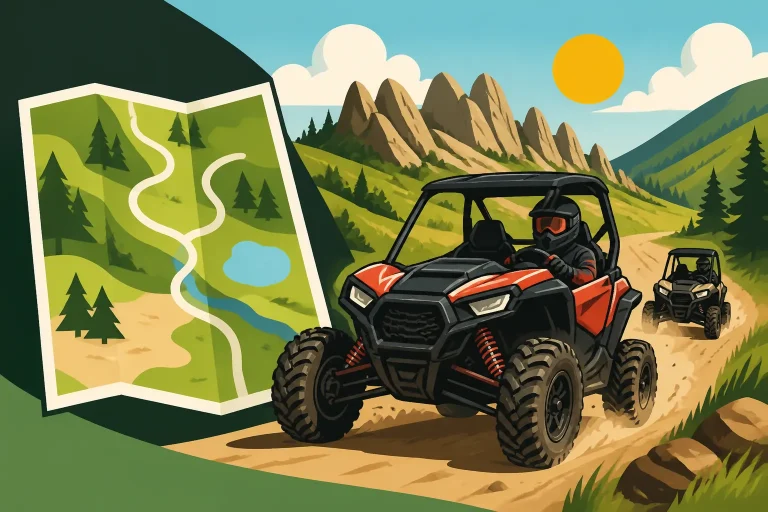
For Black Hills National Forest riding, use the current motorized travel map and obey posted closures. A road shown as open to motor vehicles is not a blanket invitation to ride off the road, enter a closed spur or continue onto a trail without meeting that trail’s requirements. South Dakota Trail Maps and MVUMs explains why the official motorized-use map is more useful than a general navigation map.
Why a road may require a plate or permit
A plate and a permit serve different functions, but on a road each can help show that the machine is authorized to use the route under the applicable rules. A valid plate generally reflects that the vehicle has been registered for road use under its home jurisdiction. A permit is an alternative authorization for a machine that does not have qualifying road-use registration.
This is why riders often hear that a road needs “a plate or a permit.” It does not mean that every ATV or UTV needs both items to use every road. Nor does it mean that a permit turns an otherwise closed road into an open one. The route must be open first; then the rider must meet its vehicle and access requirements.
A useful way to think about the distinction is:
| Where you ride | What to check | What a plate or permit does |
|---|---|---|
| A road open to motor vehicles | Route status, machine eligibility and current access rules | A qualifying plate or applicable permit may satisfy the road-use authorization requirement |
| A designated motorized trail | Trail designation, closures and permit rules | The required trail permit applies even if the machine has a plate |
| A state highway or ordinary street | State road-use law, equipment and licensing rules | A permit alone does not make an ATV or UTV street-legal |
| Private land or a ranch road | Owner permission and any route-specific restrictions | A plate or permit does not replace the landowner’s permission |
The plate must be meaningful for the kind of road use at issue. A title proves ownership; it is not a road-use plate. A bill of sale is not a substitute for registration. A registration document that does not authorize the machine for road use may not qualify as a road plate either.
For an out-of-state visitor, the key question is whether the home-state plate and registration make the machine legal for road use there. South Dakota does not treat every paper or decal as equivalent to a road-use plate. Review Out-of-State Plates on South Dakota Roads and Why a Street-Legal Home State Matters before relying on an out-of-state registration.
If the machine does not have qualifying road-use registration, a South Dakota permit may be the route-specific alternative where the rules allow it. The permit does not replace the need to follow posted route restrictions, carry any required documents or comply with safety and operating rules. Details on the permit system are covered in South Dakota Trail Permits Explained.
A road permit is not a trail permit
The biggest mistake is assuming that a plate or road permit covers the whole ride. A road and a designated motorized trail are separate route types, and the permit rules can change as you move from one to the other.
On a qualifying road, a valid plate may be accepted instead of a South Dakota permit for that road-use purpose. A machine without a qualifying plate may need the applicable permit to use the road. But once you enter a designated motorized trail, the trail permit requirement applies separately. Having a plate does not automatically waive it.
That difference is easy to miss on a loop ride. The route may start on a forest road, branch onto a trail and later return to a road. A rider who checked only the road rule can reach the trail entrance without the required decal. The road segment and trail segment need to be treated as separate parts of the trip.
Keep these points in mind:
- A plate can satisfy a road-use condition where the applicable rules recognize it.
- A South Dakota permit can provide an alternative for a qualifying road when the machine lacks a qualifying plate.
- A designated motorized trail has its own permit requirement.
- Neither a plate nor a permit authorizes travel on a closed route or off an authorized route.
- A permit does not provide general street-legal status.
The trail permit is tied to the machine and its authorized use, not simply to the person riding. Check the permit’s current terms, where it must be displayed and which routes it covers. One Permit Per Machine, Not Per Rider covers the machine-based aspect, while Why a Plate Does Not Replace a Trail Permit explains why registration should not be treated as a substitute on a designated trail.
This distinction also matters when riding a rented machine. Ask the rental provider whether the machine has the required permit for the trails you plan to use. Do not assume that a rental’s plate, paperwork or included equipment means the trail permit is covered. A rental operator can explain what is already in place, but the rider still needs to follow the route rules. See Does a Rental Include the Trail Permit? before setting out.
What visiting riders should confirm
Visitors often have a plate from another state and reasonably want to know whether it will be accepted. The answer depends on what that plate authorizes. The important distinction is between a machine that is legally plated for road use in its home state and one that has only ownership paperwork, an off-road registration or a permit that does not authorize road use.
Before relying on an out-of-state plate, check:
- The machine’s home-state status. Confirm that its registration and plate authorize the kind of road use you intend to undertake. Do not assume that a title or off-road-only registration is enough.
- The specific route. Confirm that the road is open to your machine. A valid plate does not override a closure, width restriction or other posted limit.
- The route beyond the road. If the ride continues onto a designated trail, find out whether the South Dakota trail permit is required. A plate that works for the road does not necessarily cover the trail.
- Any land-manager conditions. Route maps, signs and current closure notices can add restrictions that are not obvious from the road itself.
- The permit display requirement. If a permit is needed, check how and where it must be displayed. Keep any associated paperwork available as directed.
An out-of-state plate is not a universal pass for South Dakota riding. It is relevant to the road-use question only when it represents valid road-use registration and the route’s rules recognize it. Some riders may still need a South Dakota permit for other parts of their trip. For a fuller explanation, see Does South Dakota Honor Out-of-State Registration? and Riding South Dakota With an Out-of-State Plate.
The same caution applies to nonresident permits. A visitor permit is for the uses described by its terms; it is not a substitute for every form of registration, and it does not create permission to ride on a route that is closed or restricted. Confirm the correct permit before travel through South Dakota’s Nonresident ORV Permit and What a South Dakota Nonresident Permit Requires.
If you are unsure whether a machine’s home-state plate qualifies, resolve that question before unloading at a trailhead or riding onto a forest road. It is much easier to check the registration status and route rules in advance than to discover at a junction that your paperwork does not cover the next segment.
A practical check before leaving the staging area
A simple pre-ride check can prevent the most common plate-and-permit mistakes. It should cover the machine, the route and the transition points between roads and trails.
Identify every route type on your planned ride
Use an official motorized-use map rather than relying only on a phone’s ordinary road layer. Mark where the route uses a road and where it enters a designated trail. Look for seasonal access information, temporary closures and restrictions that apply to your machine’s size or type.
If the map or signage is unclear, pause and confirm with the relevant land manager. A trail entrance can be easy to overlook when it branches from a road, so note junctions before riding rather than trying to sort out the rules after reaching them.
Match the machine’s documents to the route
Check that the plate and registration are current and appropriate for road use. If you are using a permit instead, confirm that it is the right permit for the route and that it is displayed as required. A permit purchase receipt may not be the same thing as the required decal or displayed authorization.
Do not treat these documents as interchangeable:
- A title establishes ownership.
- A bill of sale documents a transaction.
- A registration card describes registration status.
- A plate is visible identification associated with qualifying registration.
- A route permit grants only the access described by its terms.
If you are unsure what paperwork is relevant, Showing a Plate and a Decal is a useful companion to the route check.
Recheck at every road-to-trail transition
The permit rule may change at a junction. Before leaving a road and entering a trail, confirm that the trail is open and that the machine has the required permit. Do the same when returning to a road: make sure that the road is open and that your plate or permit meets its conditions.
Do not follow another rider’s example as proof that your own machine is covered. The other vehicle may have a different registration status, may be using a different route or may simply be riding without the required authorization.
Keep the authorization visible and the rules in view
A plate or decal needs to be displayed in the manner required for the relevant authorization. Keep the documents you may need accessible, but do not assume that carrying a permit in a pocket is enough if the rules require a decal on the machine.
Before you ride, check for new notices and closures. Weather, fire danger, maintenance or other conditions can change route access. A route that was open when you planned the trip may not remain open on the day you arrive.
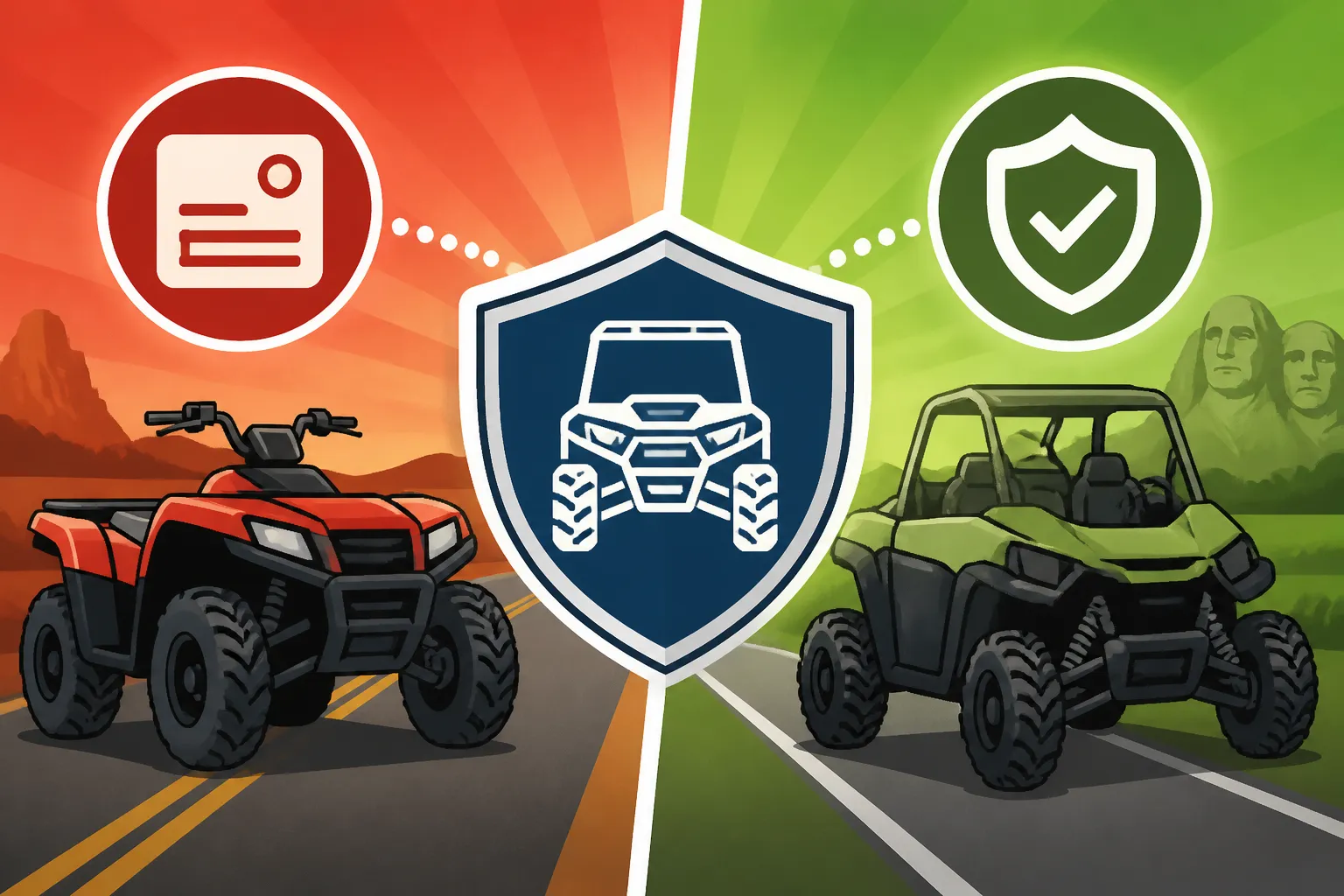
The central rule is straightforward: a road may accept a qualifying plate or an applicable permit, while a designated trail can require its own permit regardless of the plate. Check the route first, then check the machine’s authorization. That sequence is more reliable than starting with the assumption that one document covers the entire ride.
Frequently Asked Questions
Does an ATV need a plate or permit for every road in South Dakota?
No single answer applies to every road. The route’s status and the rules for that road matter. A qualifying plate or applicable permit may be needed on an authorized motorized road, but neither one makes a closed route open or an ATV street-legal everywhere.
If my ATV has an out-of-state plate, do I still need a South Dakota permit?
It depends on the route and what the plate authorizes. A valid home-state plate may meet a road-use condition when recognized, but a designated motorized trail can still require a South Dakota trail permit. Confirm both your registration status and the route requirements.
Does a plate replace the permit on a designated motorized trail?
Do not assume that it does. The trail permit requirement is separate from the road-use rule, and a plate that is accepted on a road may not satisfy the trail requirement.
Does buying a permit make my ATV street-legal?
No. A route permit provides only the authorization described by its terms. It does not by itself meet the separate requirements for operating an ATV or UTV on ordinary streets or highways.
Disclaimer
This article is for general informational purposes only and does not constitute professional advice. Laws, prices and regulations vary by location and change over time. Consult a qualified professional for guidance on your specific situation.