Does South Dakota Require an ATV Safety Course?
South Dakota does not generally require an ATV safety course before you ride or obtain a trail permit. That does not mean every ride is permit-free or that age, road-use and land-access rules disappear. The key is to separate training from permission to ride, then check the requirements for your machine and destination.
Does South Dakota require an ATV safety course?
For ordinary ATV and UTV riding, South Dakota does not generally make a state-approved safety course a prerequisite to riding or buying a trail permit. A course can still be useful, especially for a new rider, but completing one does not take the place of a permit, registration or other requirements that apply to a particular route.
That distinction matters because several different rules can affect the same ride:
- Training teaches safe operation. It is generally optional under statewide rules for recreational ATV and UTV riding.
- Permits authorize use in particular places or under particular conditions.
- Registration, plates or other vehicle credentials can affect road use and whether an out-of-state machine qualifies for an exception.
- Age, supervision and protective-equipment rules may apply even when no course is required.
- Land-manager or business rules can add conditions for a trail system, event, rental or guided ride.
A course certificate does not make an unpermitted machine legal on a trail, and a permit is not proof that the operator has received training. Treat each requirement as its own question.
This is also why riders should avoid relying on a general claim such as “South Dakota has no course requirement” to plan every kind of outing. A rental company, organized event, private riding facility or other land manager may set its own rules. Those conditions are separate from a statewide course mandate, so check directly with the business or land manager if you are booking a ride or attending an event.
For a broader overview of course-related rules, see [South Dakota ATV Safety Course Requirements]. If you are traveling with a young rider, also check the separate rules covered in South Dakota Minimum Age to Ride Public Land and South Dakota Supervision Rules for Young Riders. A course may help a young person build skills, but it does not override an age limit or supervision requirement.
| Question | General answer | What to check before riding |
|---|---|---|
| Is a state ATV safety course generally required to ride? | No general statewide course prerequisite for ordinary recreational riding | Any rules for the specific area, event or business |
| Does a course replace a trail permit? | No | Permit rules for your destination and machine |
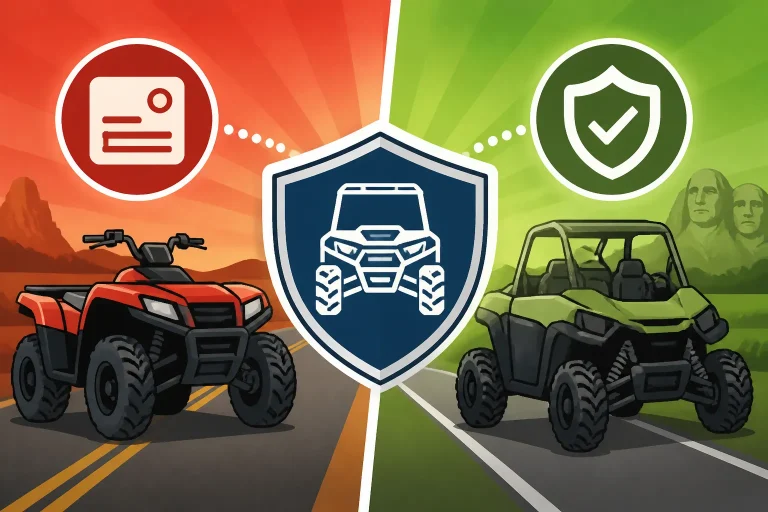
| Does a course make an unplated ATV road-legal? | No | Road-use, plate and equipment requirements |
| Can a rental company require training or instruction? | It may set its own conditions | Rental contract and pickup instructions |
| Does out-of-state registration settle every permit question? | Not necessarily | Machine status, destination and nonresident rules |
Permits and out-of-state machines are separate from training
Visitors sometimes assume that a safety card from home will satisfy South Dakota requirements, or that out-of-state registration automatically grants access to every trail. Neither assumption is safe. A course certificate is about training; reciprocity and permits are about whether a particular machine may be operated in a particular place.
Before traveling, identify where you intend to ride. Public roads, designated motorized trails, other public land, private property and an organized ride can have different access conditions. The requirement may depend on the machine’s status, not only on the rider’s home state.
Check whether a nonresident permit applies
If you are bringing an unplated ATV or UTV from another state, check whether South Dakota requires a nonresident ORV permit for the kind of riding you plan to do. Do not assume that a home-state title, registration, permit or safety-course card automatically satisfies South Dakota’s rules. The details can depend on the vehicle and the land or route involved.
Start with South Dakota Nonresident ORV Permit Requirements. For a machine that has out-of-state plates, Does South Dakota Honor Out-of-State Registration? can help frame the separate reciprocity question. If you are bringing a machine with a plate issued elsewhere, see Riding South Dakota With an Out-of-State Plate as well.
The practical takeaway is to confirm your machine’s status before leaving home. A plated, road-legal machine may be treated differently from an unplated off-road vehicle, but that does not necessarily eliminate all trail-specific requirements. If you cannot tell which category your machine falls into, ask the relevant state office or land manager and describe the machine and planned use clearly.
Check trail-specific permits, too
Some riding areas have their own permit requirements. In the Black Hills, for example, a motorized trail permit is a separate issue from whether the rider has completed a safety course. Read How the Black Hills Motorized Trail Permit Works before setting out, and keep in mind that a plate does not necessarily replace a trail permit. Why a Plate Does Not Replace a Trail Permit explains why road credentials and trail access should not be treated as interchangeable.
A simple pre-trip check can prevent the most common mix-up:
- Name the exact area or route where you plan to ride.
- Confirm whether that place allows your type of machine.
- Check whether it requires a permit or decal.
- Confirm whether a plate, home-state registration or nonresident permit affects the requirement.
- Check any separate conditions for passengers, young riders, events or rentals.
- Save the relevant permit information and confirm where the decal or other proof must be displayed.
If your trip includes more than one type of riding area, repeat the check for each one. Permission to use one trail system does not automatically carry over to a road, another public area or private land.
Age, road use and land access still matter
The absence of a general course mandate does not mean that a rider of any age can operate any machine anywhere. Age and supervision rules are separate from training, and road-use rules are separate from trail permits. A safety course may prepare a rider to make better decisions, but it cannot waive a legal requirement.
For younger riders, confirm the rules that apply to the particular location and activity. Do not rely only on a course provider’s age recommendation or a general statement about ATV riding. The rules for public land may differ from those for private property, and road use can add another layer. The links on South Dakota Minimum Age to Ride Public Land and South Dakota Supervision Rules for Young Riders are useful starting points.
Road riding also calls for a separate check. A trail permit does not itself authorize ordinary travel on public roads, and taking a safety course does not convert an off-road machine into a road-legal vehicle. If your route includes a road or ditch, review the applicable rules for the machine, route and rider before using it. For riding on federal land, see South Dakota Rules for Riding Federal Land and confirm that the route is open to your vehicle.
Private land is not a blanket exception to every concern, either. Permission from the landowner is essential, and a business, event organizer or property owner may impose conditions for access. Ask before riding rather than assuming that a course certificate or a public-land permit grants permission on private ground.
When a course is worth taking anyway
Even when a course is not legally required, training can be a sensible choice. ATVs and UTVs have different handling characteristics from cars, and a rider may encounter loose gravel, steep grades, changing surfaces, limited sight lines and other traffic. A course can help a new operator understand basic controls, speed management, turning, braking and how to respond when conditions change.
Training is particularly valuable when:
- The operator is new to ATVs or UTVs.
- A rider is moving to a larger or heavier machine.
- The trip will include unfamiliar trails, hills or loose surfaces.
- A family is deciding how to introduce a young rider to off-road driving.
- Several people will share a machine or take turns operating it.
- The group will travel in an area where help may be some distance away.
A course is not a substitute for reading the machine’s manual, checking its condition or matching the vehicle to the rider. Operators should understand the controls before setting out, wear appropriate protective gear, keep passengers within the machine’s design limits and ride at a pace that allows them to stop safely. A group should also agree on a route and a plan for what to do if someone becomes separated or a machine breaks down.
If you are renting, ask the outfitter what instruction is included and whether it has conditions beyond state rules. Rental businesses can set their own operating, age or training requirements. The rental agreement may also explain what areas are allowed, whether a permit is included and what the operator must do at pickup. South Dakota Rules for a Rented Machine is a useful companion when comparing a rental ride with bringing your own vehicle.
A careful checklist is more useful than relying on a course card alone. Before departure, verify the area’s access rules, the permits for your machine, any age or supervision conditions, and whether the route is open. Then use training to make the ride safer—not as a substitute for permission to ride.
Disclaimer
This article is for general informational purposes only and does not constitute professional advice. Laws, prices and regulations vary by location and change over time. Consult a qualified professional for guidance on your specific situation.