When a Plate Stands In for a Trail Permit
A South Dakota plate can save an out-of-state rider from needing one permit in some places, but it does not open every road or trail. The confusing part is that a state license plate and a Black Hills motorized trail permit serve different purposes. Here’s how to tell which one you need before unloading your ATV or UTV.
What a plate does and does not replace
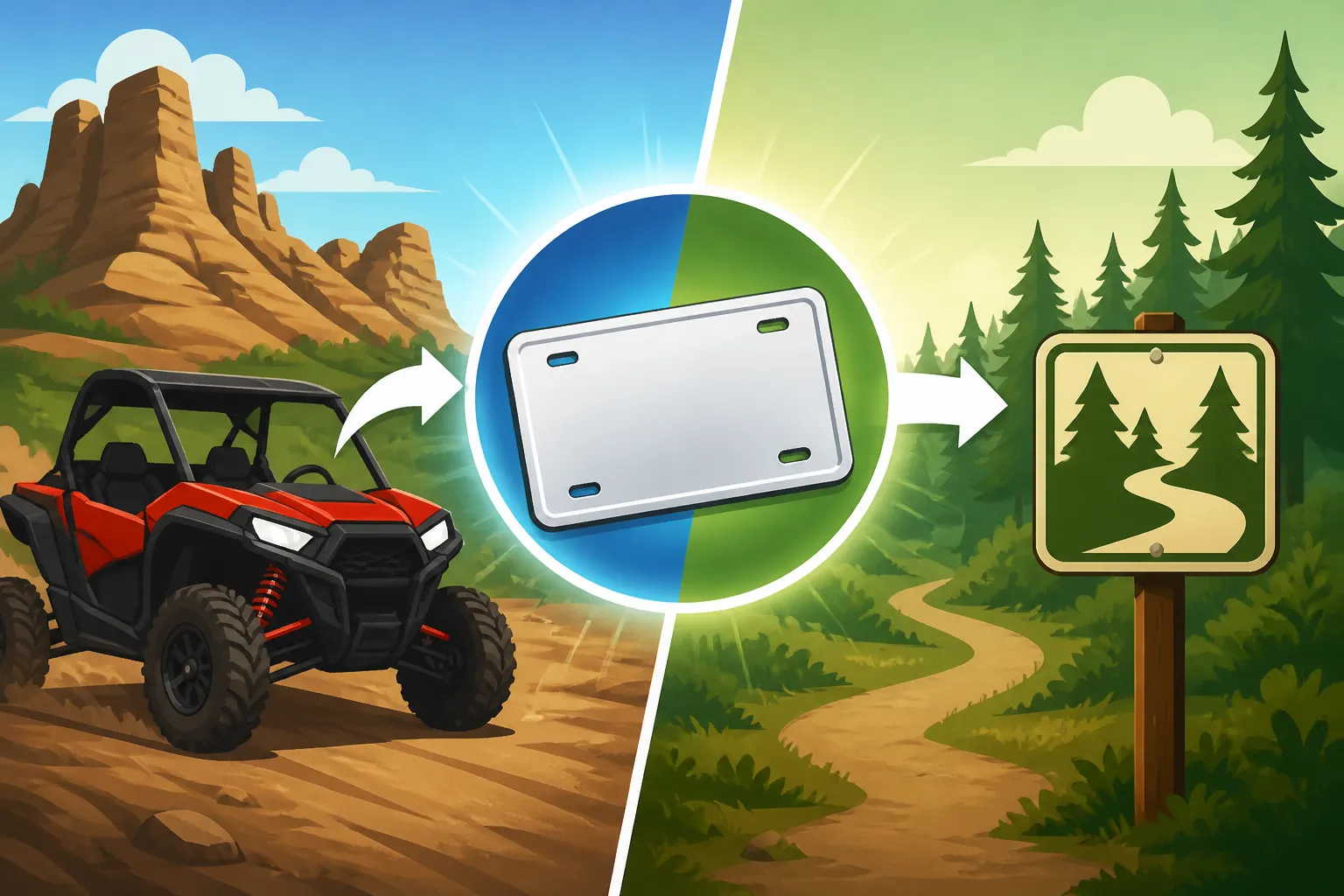
A valid state license plate can stand in for a Black Hills Forest permit on certain roads, but it does not replace the permit when you ride a designated motorized trail. According to the Forest Service, vehicles with a valid state license plate do not need a Black Hills Motorized Trail Permit unless they are traveling on a designated motorized trail. A permit is required for motor vehicles on motorized-use trails in the Black Hills National Forest.
That distinction is easy to miss because the Black Hills has both roads and trails open to motorized travel. The Forest Service’s Motor Vehicle Use Map, or MVUM, is the official map for determining which roads, trails, and areas are open to public motorized travel. A route that looks rideable, or that appears on a general recreation map, is not necessarily an authorized motorized route.
| Where you ride | What a valid state plate means | What to check |
|---|---|---|
| A Forest Service road open to all vehicles | According to the Forest Service, a valid state plate generally means you do not need a Black Hills Motorized Trail Permit on that road | Confirm the road is marked Open to All Vehicles on the MVUM |
| A designated motorized trail in the Black Hills National Forest | A plate does not replace the trail permit; according to the Forest Service, a permit is required on motorized-use trails | Get the Forest permit and check the route’s designation |
| A Forest Service road open to all vehicles, traveled by an unlicensed OHV | According to the Forest Service, an unlicensed OHV needs a valid Black Hills Motorized Trail Permit | Confirm the road is open to all vehicles and the permit is valid |
| A designated OHV area managed by South Dakota Game, Fish, and Parks | According to South Dakota Game, Fish, and Parks, vehicles inside designated OHV areas do not require a vehicle license or park entrance license | Stay within the area’s designated riding boundaries |
| A South Dakota park or campground outside a designated OHV area | According to South Dakota Game, Fish, and Parks, an off-road vehicle operated in a park or campground needs a South Dakota license and a park entrance license, and the operator must have a valid driver’s license | Check the park’s access rules before riding |
The practical rule is to identify the type of route first. A plated vehicle may be able to use an eligible Forest Service road without a trail permit, but the same vehicle still needs the permit on a designated motorized trail. For background on the state permit system, see South Dakota’s Motorized Trail Permit and Why a Plate Does Not Replace a Trail Permit.
A plate is not the same as a title
A title, a plate, and a trail permit are different documents or permissions. The South Dakota Department of Revenue says off-road vehicles must be titled even though they may not be registered and licensed for highway use. Having a title does not by itself mean the machine is street legal or that it can use a Forest Service trail without a permit.
For a machine from another state, the South Dakota Department of Revenue says an out-of-state OHV must have a hard license plate issued by its home state’s DMV to be street legal. The agency also sets minimum engine classifications for street legality: 200 cc for a four-wheeled OHV and 120 cc for a two-wheeled OHV. Electric four-wheeled OHVs are permitted to meet the street-legal engine classification requirements.
Those street-use rules do not turn a plate into a Black Hills trail permit. A plate can matter on Forest Service roads, but the Forest Service’s designated motorized trails have their own permit requirement. For the details behind out-of-state plates and reciprocity, see Does South Dakota Honor Out-of-State Registration? and Riding South Dakota With an Out-of-State Plate.
South Dakota’s nonresident permit and the Forest permit are separate
Visitors can encounter two different permit systems: South Dakota’s nonresident off-road vehicle permit and the Black Hills National Forest Motorized Trail Permit. Do not assume that buying one automatically covers the other. According to the South Dakota Department of Revenue, a nonresident off-road vehicle permit is valid for one year. Separately, the Forest Service requires a permit for motor vehicles using motorized trails in the Black Hills National Forest.
The state nonresident permit is not available to everyone. The South Dakota Department of Revenue says South Dakota residents cannot purchase the nonresident off-road decal. Applicants must provide a copy of their driver’s license and proof of their Social Security Number. If an authorized agent signs the title and registration application, the Department of Revenue requires a Power of Attorney document.
The South Dakota Department of Revenue lists the nonresident permit cost as $50 as of November 2026. The agency says decals mailed to applicants have an additional $2.50 mailing fee. Online applicants should submit the application at least two weeks before their planned trip, so mailing and processing do not become a last-minute problem. For the application requirements and distinction between permit types, see What a South Dakota Nonresident Permit Requires.
A permit decal also needs to be displayed correctly. According to the South Dakota Department of Revenue, the decal must be placed on the rear of the off-road vehicle in an easily visible location, and the expiration sticker must be placed on the decal for the permit to be valid. A permit that has been purchased but is not properly displayed may not satisfy the display requirement.
The Forest permit is specific to the Black Hills National Forest motorized trail system. The Forest Service says permit sales support maintenance of that system. Permits are sold at Black Hills National Forest offices, local vendors, online, and the visitor center. If you plan to buy one near your riding area, check the current seller information before setting out; the Forest Service identifies local vendors, but availability and opening hours can change.
The two permits answer different questions. The South Dakota nonresident permit concerns the state’s off-road vehicle permit process for eligible nonresidents. The Forest Service permit covers use of designated motorized trails in the Black Hills National Forest. A plated vehicle may not need the Forest permit on an eligible road, but it does need the Forest permit to use a designated motorized trail. A state permit should not be treated as a substitute for that trail permit.
Check the route before you ride
The surest way to avoid an unnecessary stop or an accidental permit violation is to verify each planned segment against the official map. The Forest Service says the MVUM is the official map for roads, trails, and areas open to public motorized travel on the National Forest. It is available free from local Forest Service offices, local vendors, and online.
Use the map to answer two separate questions:
- Is the route open to the kind of vehicle you are riding?
- Is it a road open to all vehicles, or a designated motorized trail that requires a permit?
That second question matters even when your machine has a valid plate. The plate exception described by the Forest Service applies unless the vehicle is driving on a designated motorized trail. For planning help, see South Dakota Trail Maps and MVUMs and Where to Buy a Black Hills Trail Permit.
Do not use a nearby trailhead as proof that every route from it is open. The Forest Service says Antelope Springs Trailhead is used mainly for motorized vehicles and day-use motorized trail users, and a permit is required to use the motorized trails there. But the trailhead’s general purpose does not replace checking the map for the specific route. The Forest Service also says potable water is not available at the Antelope Springs Trailhead site, so plan supplies before arriving.
There are other places where permit rules differ from the Black Hills National Forest system. South Dakota Game, Fish, and Parks says vehicles inside designated OHV areas do not require a vehicle license or park entrance license. The agency identifies the Oahe Downstream Off-highway Area as having nearly 400 acres of terrain, with riding restricted to designated areas only. At Revheim Bay, the agency describes a 1.1-mile track. These designated areas are not a reason to assume the same rules apply on nearby public roads, campgrounds, or Forest Service trails.
The reverse is also true: a state plate does not mean you can ride anywhere beyond a road. The Forest Service map governs which Forest Service routes are open, and restrictions can apply even when a machine is properly plated and its permits are in order. For instance, the Black Hills National Forest prohibits motor vehicles on the ’76 Trail. Always follow posted closures and route designations rather than relying only on a plate or decal.
For visitors crossing between South Dakota and Wyoming, check the permit rules for the side of the forest where you plan to ride. The Forest Service says trail users must display a Wyoming State ORV Permit on their vehicles because the Forest partners with the Wyoming State Trails Program. It also says a Black Hills National Forest Trail Permit is not required for OHVs using trails in Wyoming. Those rules do not remove the need to verify the route or the applicable state requirements.
A simple pre-trip check
Before loading the machine, work through the relevant checks for your vehicle and route:
- Confirm whether your machine is plated. A South Dakota title alone does not show that an off-road vehicle is registered and licensed for highway use. If you are relying on an out-of-state plate, verify that it is a hard plate issued by your home state’s DMV and that the machine qualifies for street use under South Dakota’s requirements.
- Mark the roads and trails you intend to ride. Use the Forest Service MVUM to confirm each route’s designation. Do not treat a road and a motorized trail as interchangeable for permit purposes.
- Get the Forest permit if your route includes a designated motorized trail. According to the Forest Service, a valid state plate does not eliminate the permit requirement on those trails.
- Check whether you need the state nonresident permit. The South Dakota Department of Revenue sets separate application and display requirements for eligible nonresidents. South Dakota residents cannot buy that nonresident decal.
- Display each required decal correctly. Follow the placement instructions for the relevant permit. The South Dakota Department of Revenue requires the state decal at the rear of the vehicle in an easily visible location, with the expiration sticker on the decal.
- Check area-specific restrictions. A designated OHV area, a park or campground, and a Forest Service trail can each have different access rules. Make sure the machine, operator, and permits fit the place you are entering.
This approach avoids the most common misunderstanding: a plate can be enough for some Forest Service roads, but it is not a universal riding permit. The route designation, the land manager, and the kind of permit involved all matter. If your ride includes both roads and designated trails, plan for the rules to change as you move from one route type to another.
Sources
- South Dakota Department of Revenue — Off-Road Vehicles | South Dakota Department of Revenue (checked November 3, 2026)
- South Dakota Game, Fish, and Parks — ATVs & Off-Highway Vehicles | South Dakota Game, Fish, and Parks (checked November 3, 2026)
Disclaimer
This article is for general informational purposes only and does not constitute professional advice. Laws, prices and regulations vary by location and change over time. Consult a qualified professional for guidance on your specific situation.