Why a Plate Does Not Replace a Trail Permit
A hard plate can make an ATV or UTV street legal, but it does not automatically authorize every kind of off-road riding in South Dakota. The key is where you plan to ride: a public road, an open Forest Service road, or a designated motorized trail may each have different requirements. Here’s how to tell which permit applies before you unload.
A plate and a trail permit cover different things
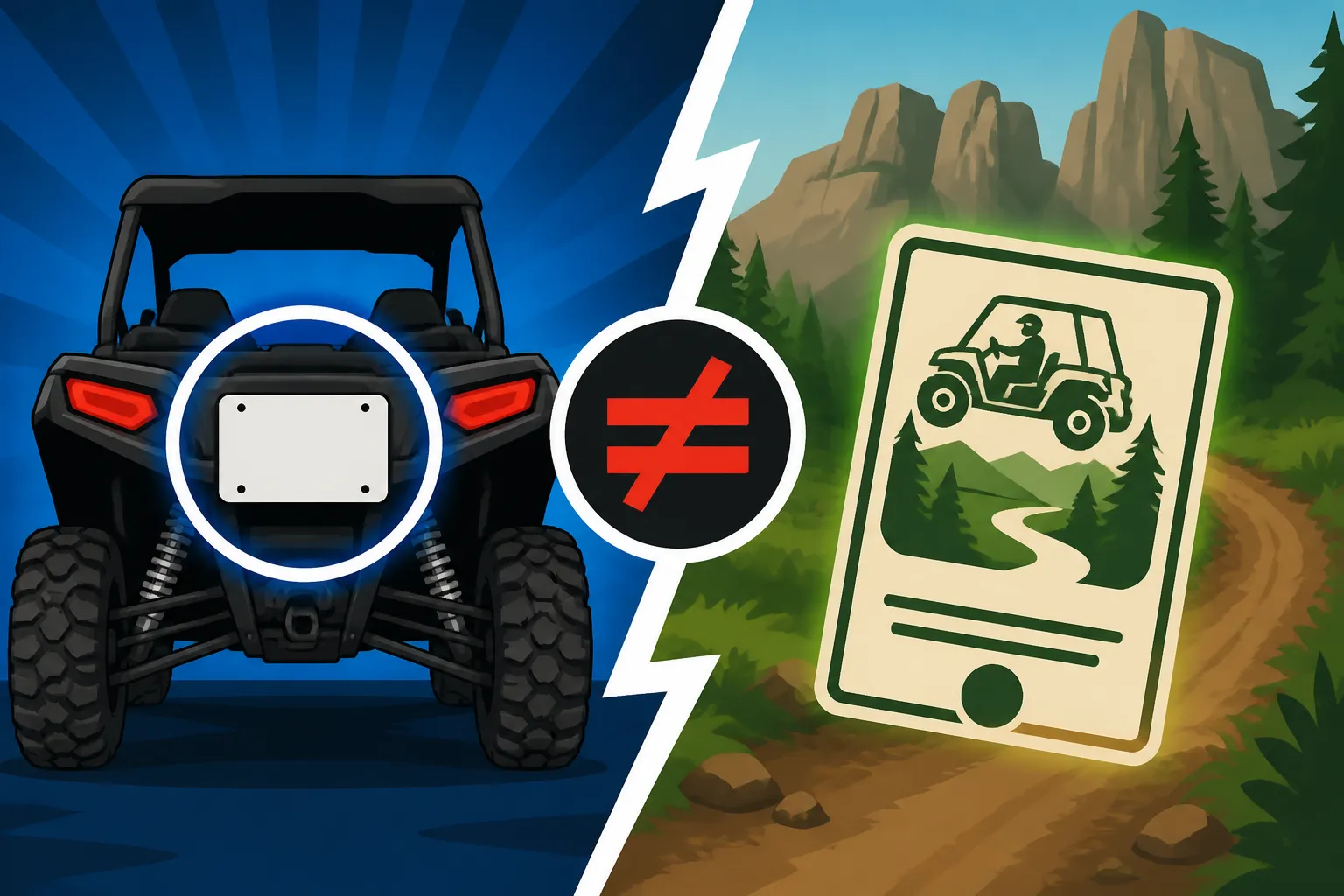
Think of a license plate as proof that a vehicle meets the relevant requirements for road use. A trail permit, by contrast, grants access to particular motorized routes or areas. They are not interchangeable documents, and having one does not always remove the need for the other.
The Forest Service draws an important distinction in the Black Hills National Forest: a vehicle with a valid state license plate generally does not need a Motorized Trail Permit on forest roads, but it does need one when traveling on a designated motorized trail. The Forest Service also requires a permit for any motor vehicle using motorized trails in the Black Hills National Forest in South Dakota. So a plated vehicle may be able to use an eligible road without the trail permit, but the plate alone does not authorize riding a designated trail.
An unlicensed OHV has a different requirement. According to the Forest Service, unlicensed OHVs on forest roads designated Open to All Vehicles need a valid Black Hills Motorized Trail Permit. That does not mean the permit makes every road or trail available: the route still has to be open to that vehicle and type of use.
| Where you plan to ride | What the facts say about the requirement |
|---|---|
| Designated motorized trail in the Black Hills National Forest | The Forest Service requires a Motorized Trail Permit, including for vehicles with a valid state plate. |
| Forest road marked Open to All Vehicles | According to the Forest Service, an unlicensed OHV needs a valid Black Hills Motorized Trail Permit; a valid state plate means a permit is not required unless the vehicle is on a designated motorized trail. |
| Street use in South Dakota | According to the South Dakota Department of Revenue, an out-of-state OHV needs a hard license plate issued by its home state’s DMV to be street legal. |
| Oahe Downstream OHV Area | According to South Dakota Game, Fish, and Parks, vehicles inside designated OHV areas do not require a vehicle license or park entrance license, and riding is restricted to designated areas. |
The practical takeaway is to check both the vehicle rules and the route rules. A plate may matter for street use or for travel on certain forest roads, while the motorized trail permit applies to designated trails. For a closer look at the distinction between a state plate and out-of-state registration, see Does South Dakota Honor Out-of-State Registration? and Out-of-State Plates on South Dakota Roads.
Which permit you may need in South Dakota
Visitors can encounter more than one permit requirement, and the permits serve different purposes. A South Dakota nonresident off-road vehicle permit is not the same thing as a Black Hills Motorized Trail Permit. According to the South Dakota Department of Revenue, using U.S. Forest Service trails requires a separate permit in addition to the state permit.
The state nonresident permit applies to nonresidents and is valid for one year, according to the South Dakota Department of Revenue. The department lists its cost as $50 as of November 2026. Applicants who have the decal mailed to them are subject to an additional $2.50 mailing fee, according to the department. South Dakota residents cannot purchase the nonresident off-road decal.
The Black Hills Motorized Trail Permit is tied to use of motorized trails in the National Forest. According to the Forest Service, permit sales support maintenance of the Forest’s motorized trail system. The Forest Service says permits are available from Black Hills National Forest offices, local vendors, online, or the visitor center. The state permit and the Forest Service permit should therefore be treated as separate checks, rather than alternatives.
If you are applying for the nonresident state permit online, allow time for the decal to arrive. The South Dakota Department of Revenue advises submitting an online application at least two weeks before a planned trip. Applicants must provide a copy of their driver’s license and proof of their Social Security Number, according to the department. The department also says the decal must be placed on the rear of the off-road vehicle in an easily visible location, and the expiration sticker must be attached for the permit to be valid.
For the Black Hills permit, check the current purchasing options and where the decal must be displayed before setting out. The Forest Service lists a range of purchase locations, including Forest Service offices, vendors, online sales, and the visitor center. Where South Dakota Trail Permits Are Sold can help you think through the purchase-location question, while South Dakota’s Nonresident ORV Permit covers the separate state decal.
A quick pre-trip comparison can prevent a common mistake:
- You have a plate and plan to ride a designated Black Hills motorized trail: the Forest Service still requires the Motorized Trail Permit.
- You have a plate and plan to use a forest road: verify that the road is open to your vehicle and use; the Forest Service says a valid state plate generally removes the permit requirement on forest roads unless you ride a designated motorized trail.
- Your OHV is unlicensed and you plan to use an Open to All Vehicles forest road: the Forest Service requires a valid Black Hills Motorized Trail Permit.
- You are a nonresident riding in South Dakota: check whether the state nonresident permit applies to your trip, and separately check for any federal-land permit requirement.
- You plan to visit a specific OHV area: follow that area’s designated-use rules instead of assuming a plate or permit opens routes beyond its boundaries.
For route planning, the Forest Service identifies the Motor Vehicle Use Map as the official map for roads, trails, and areas available for public motorized travel on National Forest land. The map is available free from local Forest Service offices, local vendors, and online, according to the Forest Service. Use it to check whether your intended route is a road or a designated motorized trail; that distinction can determine whether the trail permit is required. More on federal-land access is covered in South Dakota Rules for Riding Federal Land and South Dakota Trail Maps and MVUMs.
Plates, engine classifications, and where they apply
A plate only helps with street legality if the vehicle meets the applicable requirements. For out-of-state OHVs, the South Dakota Department of Revenue says the machine must have a hard license plate issued by its home state’s DMV to be street legal. A registration document, permit decal, or other proof of ownership is not the hard plate described by the department.
Engine classification also matters. According to the South Dakota Department of Revenue, four-wheeled OHVs must have a minimum engine classification of 200 cc to be street legal, while two-wheeled OHVs must have a minimum engine classification of 120 cc. The department says electric four-wheeled OHVs are permitted to meet the street-legal engine classification requirements.
Those street-use rules do not turn a plated vehicle into an all-access trail vehicle. The plate is relevant to road legality; it does not override a trail closure, route designation, or separate permit requirement. Before riding, check the exact route on the official Motor Vehicle Use Map and confirm that the vehicle type is allowed there. For additional route and land-use context, see Do You Need a Permit on a Black Hills Trail?.
There are also public OHV areas where the rules differ from ordinary park or campground use. South Dakota Game, Fish, and Parks says vehicles inside designated OHV areas do not require a vehicle license or a park entrance license. The same agency says riding at the Oahe Downstream Off-highway Area is restricted to designated areas only. That exception is about operation inside the designated OHV area; it should not be read as permission to ride an unapproved route on the way there.
By contrast, South Dakota Game, Fish, and Parks says off-road vehicles operated in parks or campgrounds must have a South Dakota license and a park entrance license, and operators must hold a valid driver’s license. Check whether your planned riding is inside a designated OHV area or elsewhere in a park or campground. The location changes which requirements apply.
South Dakota Game, Fish, and Parks describes the Oahe Downstream Off-highway Area as having nearly 400 acres of terrain, with riding limited to designated areas. The agency also lists a 1.1-mile track at the Revheim Bay Off-highway Vehicle Area. These are examples of named OHV locations, not a substitute for checking access rules for the roads and trails you use to reach them. See South Dakota’s Oahe Downstream Riding Area for more area-specific context.
A simple check before you unload
Use this sequence to avoid assuming that a plate covers a permit or that one permit covers every destination.
- Identify the route, not just the general destination. Determine whether you will ride on a street, a Forest Service road, a designated motorized trail, or within a designated OHV area. The Forest Service’s Motor Vehicle Use Map is the official map for motorized routes on National Forest land.
- Confirm that the machine meets the relevant vehicle requirements. For out-of-state street use, the South Dakota Department of Revenue requires a hard home-state DMV plate and gives separate engine classification thresholds for four-wheeled and two-wheeled OHVs. A trail decal does not establish street legality.
- Check for the permit tied to that route. According to the Forest Service, a valid state plate does not replace the Motorized Trail Permit on a designated motorized trail in the Black Hills National Forest. An unlicensed OHV also needs a valid permit on forest roads designated Open to All Vehicles.
- Check whether a state nonresident permit is also required. The South Dakota Department of Revenue says the state nonresident off-road permit is separate from the permit required for U.S. Forest Service trails. South Dakota residents cannot buy the nonresident decal.
- Make sure the permit is properly issued and displayed. For the state nonresident decal, the South Dakota Department of Revenue requires an easily visible location on the rear of the vehicle and an expiration sticker attached to the decal. Check the applicable display instructions for any separate trail permit.
- Recheck closures and designated-use limits before riding. A permit does not make a closed route open, and it does not expand access beyond the designated roads, trails, or OHV areas.
A useful rule of thumb is: a plate answers a road-use question, while a motorized trail permit answers an access question for designated trails. In the Black Hills, you may need both, even if your vehicle is already plated. Confirm the route and its requirements before departure, especially if your plans include both forest roads and motorized trails.
Sources
- South Dakota Department of Revenue — Off-Road Vehicles | South Dakota Department of Revenue (checked November 3, 2026)
- South Dakota Game, Fish, and Parks — ATVs & Off-Highway Vehicles | South Dakota Game, Fish, and Parks (checked November 3, 2026)
Disclaimer
This article is for general informational purposes only and does not constitute professional advice. Laws, prices and regulations vary by location and change over time. Consult a qualified professional for guidance on your specific situation.