Riding a National Forest in South Dakota
Riding a National Forest in South Dakota can mean very different things depending on whether you’re using an open road or a designated motorized trail. The right permit, your machine’s registration and the route’s current status all matter. Here’s how to sort out those requirements before you unload, especially if your ATV or UTV is registered in another state.
Know which permit applies to the route
The first question is not simply whether your ATV or UTV has a plate. It is where you plan to ride. On the Black Hills National Forest, roads and designated motorized trails can have different requirements. A plate or permit that works for one type of route may not cover the other.
For a motorized trail, expect to need the applicable South Dakota trail permit even if your machine is registered or plated elsewhere. For a National Forest road, the rules may depend on whether your machine is legally permitted for road use and whether that specific road is open to it. A trail permit does not make a closed road legal, and a plate does not make a closed trail legal.
| Where you plan to ride | What to check before you go |
|---|---|
| Designated motorized trail | Whether the trail is open to your machine and whether you have the required South Dakota trail permit |
| Forest road | Whether the route is open to motorized traffic and whether your machine meets the applicable road-use requirements |
| Road connecting to a trail | Requirements for both parts of the route; road authorization does not replace a trail permit |
| Private land or a grazing lease | Whether you have permission from the landowner or leaseholder |
| A closed route or an area off the designated system | Do not ride there unless an official rule specifically allows it |
The practical rule is to treat trail authorization and road authorization as separate checks. South Dakota’s motorized trail permit is associated with riding designated trails in the Black Hills; it is not a general pass for every road or piece of public land. The permit also doesn’t grant permission to leave an authorized route. For a broader overview of federal-land responsibilities, see South Dakota Rules for Riding Federal Land.
If you’re unsure how the trail permit works, start with How the Black Hills Motorized Trail Permit Works. Pay particular attention to which machine the permit applies to, how it must be displayed and when it expires. A permit for one machine should not be assumed to cover another machine in your group.
How reciprocity works for an out-of-state ATV or UTV
An out-of-state plate can help establish that a machine is registered for road use in its home state. It does not automatically replace South Dakota’s trail permit on a designated motorized trail. In other words, reciprocity is not blanket permission to ride every route in the forest.
For roads, check whether South Dakota recognizes the machine’s home-state registration for the kind of road you plan to use. The machine must also be allowed on that particular route under the applicable signs, maps and rules. A plate from another state does not override a seasonal closure, a width restriction, or a sign prohibiting motorized travel.
For trails, plan on the separate permit requirement, including when the machine already carries a license plate. This distinction is easy to miss because the same ride may use both roads and trails. A plated UTV might travel a road that is open to it, then need a trail permit when it turns onto a designated motorized trail. Why a Plate Does Not Replace a Trail Permit explains that difference. To check the broader question of home-state registration, see Does South Dakota Honor Out-of-State Registration?.
A useful way to think about reciprocity is:
- Your home-state registration may help determine whether the machine can use certain roads.
- South Dakota’s permit rules determine whether it can use designated trails.
- Forest route designations determine where motorized riding is allowed.
- Local signs, closures and restrictions can still limit access, even when you have the correct paperwork.
Permit rules can also depend on whether you are a South Dakota resident or a visitor. Check the current official requirements for your situation before traveling, rather than assuming a registration card or permit from home will carry over. If you are visiting, South Dakota Nonresident Annual Permit is a useful starting point for understanding the nonresident permit question. Confirm current options, validity dates and display instructions with the official permit provider.
Carry the registration and permit information with you in a form you can access during the ride. A photo or digital copy can be useful as a backup, but don’t assume it replaces an original document or a properly displayed decal if the rules call for one. Follow the permit’s instructions.
Check maps, closures and machine limits before unloading
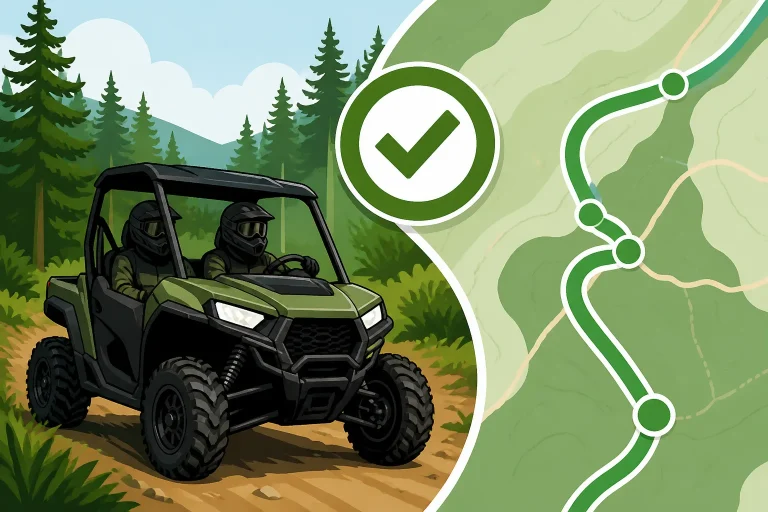
Having the right permit does not tell you which routes are open. National Forest travel maps and Motor Vehicle Use Maps, often called MVUMs, show designated motorized routes and can include limits such as vehicle type, season or width. Use the current official map for route decisions. A general road map, a trail app or an older paper map can be helpful for orientation, but it may not show the latest restrictions.
Start with South Dakota Trail Maps and MVUMs and compare the route you want to ride with current official information. Then check for temporary closures or changed conditions using South Dakota Trail Closures to Check First. A route shown as open on an old map may be closed due to weather, fire, maintenance or another restriction. If signs at the trailhead conflict with a map or app, stop and resolve the discrepancy before continuing.
Machine width matters too. A trail open to narrower machines may not allow a wider side-by-side. Measure the machine as directed by the route rules, and don’t rely on the model name or a rough estimate. A trail permit does not make an oversized machine eligible for a restricted route.
Before setting out, use this process:
- Choose a route type. Decide whether the ride uses a designated trail, a Forest Service road, or both.
- Check the official route map. Confirm that each planned segment is open to motorized travel and suitable for your machine.
- Check current notices. Look for seasonal limits, temporary closures, fire restrictions and other posted changes.
- Confirm your paperwork. Verify whether your registration covers road use and whether the required trail permit is valid for each machine.
- Read signs at the access point. Treat posted restrictions as part of the route plan, not as optional guidance.
- Stay on the authorized route. Don’t cut a corner, bypass a gate or leave the route to find a viewpoint.
A route plan should include a realistic turnaround option. Forest roads and trails can change character quickly, and a detour that looks convenient on a phone may lead to a closed route or private ground. Download or carry useful route information before entering areas with limited cell service. A paper map can be a sensible backup, but make sure it is current and use official maps to confirm motorized access.
Avoid the mistakes that cause permit and access problems
The most common mistake is treating a plate, a trail permit and a route map as interchangeable. They solve different problems. A plate or registration relates to the machine’s legal status for road use; a trail permit addresses access to designated trails; and the official map and signs tell you where you may ride. None gives permission to ignore the others.
Another mistake is assuming that any unpaved road in a National Forest is open to ATVs or UTVs. A visible track is not proof of legal motorized access. Some routes may be closed, restricted to certain vehicles, or open only during particular periods. Follow the designated system and check route rules before entering.
It is also risky to assume a rental, borrowed machine or newly purchased ATV already has everything needed. Ask the owner, rental provider or seller what registration and permits are in place, then verify the details yourself. If the machine will be used on both roads and trails, ask specifically about both. A rental permit or decal may apply only to the machine provided and may not cover a second vehicle in your party.
Keep these points in mind:
- One permit may not cover a group. Check the official instructions for whether a permit is required for each machine.
- A decal has to follow its display rules. Make sure it is attached where required and can be read or inspected.
- A permit does not authorize off-route travel. Stay on routes designated for your machine.
- A permit does not grant private-land access. Get permission before crossing private property or a grazing lease.
- A road connection does not erase trail rules. Carry the permit if your ride includes designated trails.
- A previously open route may have changed status. Recheck official notices close to the ride.
If a planned route crosses between road and trail segments, mark those transitions before leaving. That small bit of preparation prevents the common surprise of reaching a trail entrance without the required permit. It also helps you avoid treating a road-use registration as permission to continue onto a trail.
When in doubt, contact the relevant official office or permit provider with the exact route, machine type and registration state. Ask whether the route is open to that vehicle and what permit is required for each portion of the ride. That is more reliable than guessing from a decal, a friend’s experience or an app’s route line.
Disclaimer
This article is for general informational purposes only and does not constitute professional advice. Laws, prices and regulations vary by location and change over time. Consult a qualified professional for guidance on your specific situation.