Why Golf Carts Are Excluded in South Dakota
It can be incredibly confusing when you see all sorts of vehicles zipping around South Dakota, from traditional cars to roaring ATVs, and then there are those quieter golf carts. Many folks wonder if they can simply add a few lights to their golf cart and treat it like an off-road vehicle (ORV) that’s street legal, or perhaps even an actual car. The truth is, South Dakota has very specific definitions and regulations, and golf carts, despite their utility and growing popularity, are generally excluded from the state’s classification of off-road vehicles. This guide will meticulously break down why golf carts are treated differently, what that means for their use, and how they contrast with the rules governing ATVs and UTVs in the Mount Rushmore State.
Understanding South Dakota's Definition of an Off-Road Vehicle (ORV)
When we talk about off-road vehicles in South Dakota, the state has a pretty clear picture in mind. This isn't just about what looks off-road capable; it's about specific design, purpose, and capability as outlined in the law. Getting this foundational understanding correct is crucial to grasping why a golf cart, which might sometimes venture off a paved path, doesn't make the cut.
The Core Characteristics of an ORV
South Dakota defines an off-road vehicle (ORV) quite precisely. Generally, an ORV is a motorized vehicle designed to travel on unimproved natural terrain, or in the absence of roads. Think rugged suspensions, knobby tires, powerful engines, and a chassis built to handle bumps, climbs, and varied landscapes. This includes things like all-terrain vehicles (ATVs), often called quads, and utility task vehicles (UTVs), sometimes known as side-by-sides. These machines are engineered for performance and durability in environments far from your typical golf course. They're typically designed for recreation, agriculture, or utility work in places where a standard car or even a light truck might struggle. The focus is on capability and robust construction for demanding conditions, not necessarily for speed or comfort on paved roads. For a deeper dive, check out [What South Dakota Counts as an Off-Road Vehicle].
Consider the typical ATV or UTV you might see tackling trails in the Black Hills. These machines are often equipped with features like four-wheel drive, independent suspension, high ground clearance, and roll-over protection systems (ROPS) or roll cages. Their engines are designed to deliver torque and power to navigate tough terrain, from rocky climbs to muddy trails. Accessories, perhaps from a brand like SuperATV, are often geared towards enhancing off-road performance, protection, or utility, rather than simply making the vehicle street-ready. These are not slight modifications; they are inherent design principles that set them apart from vehicles intended for gentler uses.
Where Golf Carts Diverge from the ORV Definition
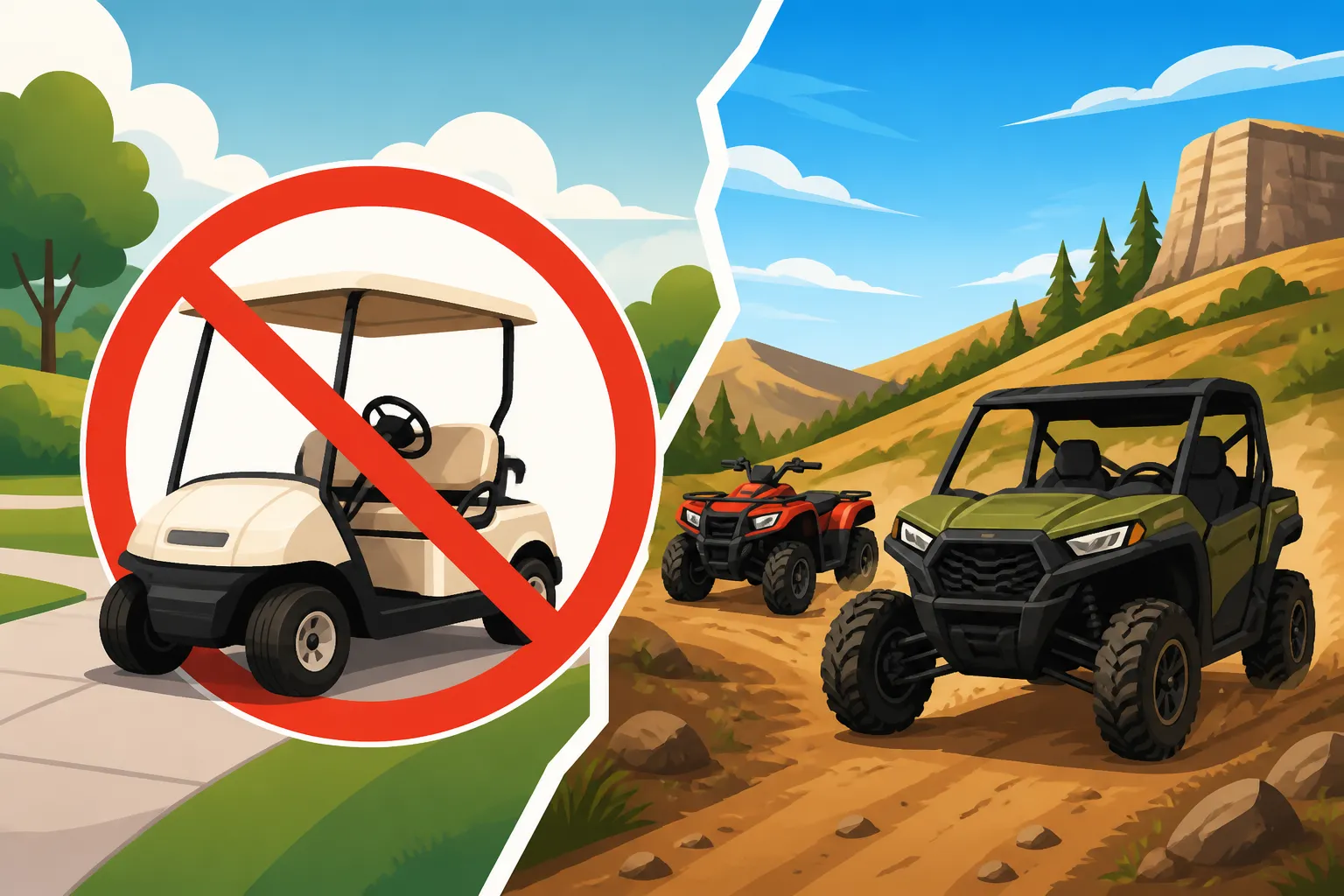
Now, let's look at the golf cart. While a golf cart is motorized and can certainly go off a paved cart path onto the grass, its fundamental design ethos is vastly different from an ORV. Golf carts are purpose-built for low-speed travel on golf courses, typically carrying a few passengers and golf clubs. Their suspensions are designed for smooth, relatively flat surfaces, not rugged trails. Their tires are usually turf-friendly, meant to minimize damage to greens and fairways, not to provide aggressive traction on dirt or rocks. Their engines, whether electric or small gasoline, prioritize quiet operation and fuel efficiency over raw power and torque.
The structural integrity of a golf cart, while sufficient for its intended use, simply isn't engineered to withstand the stresses of true off-road environments. They lack the robust chassis, heavy-duty suspension, high ground clearance, and often the roll-over protection that defines an ORV. In essence, the state of South Dakota recognizes that while a golf cart can move off a paved surface, its design and intended use do not align with the definition of a vehicle primarily built for unimproved natural terrain. This distinction is crucial because it influences everything from where you can drive it to whether it even qualifies for a title or registration as an ORV.
Golf Carts as Low-Speed Vehicles (LSVs) or Special Purpose Vehicles
Since golf carts aren't classified as ORVs, where do they fit into South Dakota's vehicle landscape? The state has other categories, and golf carts often fall under "Low-Speed Vehicle" (LSV) definitions or are simply recognized as a specific type of special purpose vehicle with very limited operational allowances. This distinction is vital, as it governs how and where you can legally operate them.
Distinguishing LSVs from ORVs in South Dakota
South Dakota differentiates between a low-speed vehicle (LSV) and an off-road vehicle. An LSV is typically defined as a four-wheeled vehicle with a top speed greater than 20 miles per hour but not greater than 25 miles per hour. These vehicles are usually street legal on roads with speed limits of 35 mph or less, provided they meet certain safety equipment requirements, which are more akin to those for automobiles than for ORVs. Think headlights, tail lights, turn signals, seat belts, mirrors, and a vehicle identification number (VIN). Some larger, modified golf carts might attempt to meet these LSV standards, but it requires significant upgrades beyond their factory configuration.
Conversely, an ORV, as discussed, is designed for off-road use. While an ORV can, with the proper licensing and equipment, be made [Are ATVs Street Legal in South Dakota?] and operate on certain public roads, its primary identity and design intent remain off-road. The process for making an ATV street legal often involves adding specific components like mirrors, turn signals, and a horn, perhaps sourced from a specialty retailer like SuperATV, to meet the criteria for a motorcycle plate. A golf cart, even if modified to reach 25 mph, is fundamentally different in its chassis, power train, and overall safety design from an ORV that achieves street legality. The rules for [South Dakota Low-Speed Vehicle Rules] further clarify these differences.
What Makes a Golf Cart a "Golf Cart" to the State
In South Dakota, a golf cart is generally understood as a motor vehicle that is designed and manufactured for operation on a golf course for sporting purposes. This description inherently limits its scope of permissible use. They are not built to meet federal motor vehicle safety standards (FMVSS) for passenger cars, nor are they typically equipped for the rigors of public roads or trails. This specific, narrow definition is why they are often excluded from categories like ORVs or even standard automobiles.
Because of this narrow definition, golf carts don't typically qualify for traditional vehicle titles or registrations in the same way ATVs or cars do. They are not issued "motorcycle plates" like street-legal ATVs. Instead, their use is heavily restricted to private property or specific, localized circumstances. This designation protects public safety by ensuring that vehicles operating on public thoroughfares or off-road trails meet the appropriate construction and safety standards for those environments. If you’re considering [Titling an ATV in South Dakota], you’ll quickly see the forms and requirements are geared towards robust vehicles, not golf carts.
Navigating Road Use Rules for Golf Carts vs. ATVs
This is where the rubber truly meets the road—or, more accurately, where the turf tires meet the pavement, or where the knobby tires meet the gravel. The legal ability to use public roads, shoulders, and rights-of-way is vastly different for golf carts compared to properly registered and plated ATVs and UTVs in South Dakota. Many people assume some level of interchangeability, but this is a common misconception that can lead to fines and safety hazards.
Permitted Road Use for Plated ATVs and UTVs
For ATVs and UTVs in South Dakota, gaining permission for road use means meeting specific criteria to be licensed as a motorcycle. This process involves ensuring the machine has all the necessary safety equipment: at least one headlight, at least one taillight, a brake light, a horn, a rearview mirror, and tires that are approved for highway use. Once these modifications are made and verified, the ATV or UTV can be titled and registered with a motorcycle plate. With a valid motorcycle plate, these machines gain significant access to public roads, subject to certain restrictions like speed limits and avoiding interstates. For detailed requirements, refer to [South Dakota ATV Plate Requirements] or [South Dakota Motorcycle Plate for an ATV].
A properly plated ATV or UTV can then navigate gravel roads, section lines, and even some town streets, provided the local municipality hasn't specifically opted out or has speed restrictions in place. Riders must adhere to standard traffic laws, just like any other motor vehicle operator, including having a valid driver's license. This transformation from an off-road-only machine to a road-legal one significantly expands its utility, allowing owners to ride from their campsite to a trailhead, or even commute short distances. Many owners utilize aftermarket parts from companies like SuperATV to ensure their machine meets these road-legal specifications, from mirrors to turn signal kits.
Limited Road Use for Golf Carts
Golf carts, on the other hand, face severe restrictions when it comes to public road use. Because they are not classified as ORVs and typically do not meet the standards for LSVs without significant modification, their presence on public roads is largely prohibited. There are a few, very specific exceptions, primarily related to crossing roads or operating on designated private property. For example, some municipalities might have ordinances allowing golf carts on specific, low-speed residential streets within their jurisdiction, but this is entirely at the local government's discretion and not a blanket state rule.
Generally, you cannot simply drive a golf cart down a county road or through a town street in South Dakota. Any such use would likely be considered illegal operation of an unregistered and unsafe vehicle on public roadways, leading to potential citations, fines, and even impoundment. They are designed for golf courses, private communities, and large private properties where traffic is controlled and speeds are low. The idea of converting a golf cart into a "street legal" vehicle comparable to a plated ATV is generally not feasible or recognized under South Dakota law without essentially rebuilding it to LSV standards, which is a costly and often impractical endeavor. For more on what is permissible, consult [South Dakota Rules for Riding a Town Street].
| Feature | South Dakota ORV (ATV/UTV) | South Dakota Golf Cart |
|---|---|---|
| Primary Design | Off-road terrain, utility, recreation | Golf courses, low-speed private use |
| Engine/Power | High torque, robust for diverse terrain | Low power, quiet, for paved/turf |
| Suspension | Rugged, long-travel, for uneven surfaces | Basic, short-travel, for smooth surfaces |
| Road Legal Status | Can be plated as a motorcycle (with mods) | Generally not road-legal, unless LSV-certified |
| Titling/Reg. | Required as an ORV (or motorcycle) | Typically no state title/registration |
| Safety Features | ROPS/roll cage, seatbelts (UTV), sturdy frame | Basic seating, minimal crash protection |
| Typical Speed | Varies widely, higher speeds possible off-road | Max 15-25 mph (factory) |
| Aftermarket | Extensive for performance, utility, street-legal mods (e.g., SuperATV) | Limited, mostly aesthetic or basic utility |
Implications for Owners: Why the Distinction Matters
Understanding the difference between golf carts and ORVs isn't just an academic exercise; it has real, tangible consequences for owners in terms of legality, expenses, and safety. Misinterpreting these distinctions can lead to significant headaches, from legal troubles to unforeseen costs, and even compromise safety.
Titling, Registration, and Permitting Differences
The most immediate practical difference for owners lies in the requirements for titling, registration, and permits. If you own an ATV or UTV in South Dakota, you are generally required to title it. This means going through the county treasurer's office, providing proof of ownership, and paying applicable fees and taxes, such as [South Dakota ATV Title and Sales Tax]. Once titled, if you intend to use it on public roads, you’ll then register it and obtain a motorcycle license plate. This is a clear, established process for integrating these machines into the broader transportation framework. You might also need a [South Dakota Nonresident ORV Permit] if you're visiting and riding off-road.
For golf carts, this entire process largely doesn't apply. Because they aren't considered ORVs or standard motor vehicles by the state, there's no state-level titling or registration requirement. This might sound convenient initially, but it's precisely why their legal use is so restricted. Without a title or registration, they lack the legal standing to operate on most public roads. While some private communities or golf course facilities might have their own internal registration systems, these do not grant access to public thoroughfares. This absence of formal state recognition underscores their limited legal operational scope.
Equipment and Safety Requirements
Another major point of divergence is in equipment and safety. ATVs and UTVs, especially when made street-legal, must meet a comprehensive list of equipment requirements designed to enhance safety for road use. This includes functional headlights, taillights, brake lights, turn signals, a horn, and mirrors. Many owners rely on reputable aftermarket providers like SuperATV to supply these critical components, ensuring they are durable and compliant. Furthermore, UTVs often come standard with seatbelts and roll-over protection, which are paramount for occupant safety in the event of an accident, particularly on trails or roads.
Golf carts, in their typical factory configuration, lack most of these essential safety features for public road use. While they have basic headlights and taillights for visibility on a golf course, they usually don't have brake lights that are distinct from taillights, turn signals, or even robust rearview mirrors. Their structure offers minimal protection in a collision with a larger vehicle, and seatbelts, if present, are often basic lap belts. These inherent design limitations are a primary reason South Dakota excludes them from ORV classification and heavily restricts their road access. The state prioritizes public safety, and a golf cart simply doesn't measure up to the safety standards required for general road-going vehicles or even properly equipped ORVs. [Equipment a South Dakota Road Machine Needs] provides a detailed list for ORVs that golf carts simply don't match.
Common Misconceptions and Practical Advice
The world of ATVs, UTVs, and golf carts can be full of folklore and assumptions. Clearing up these common misconceptions is paramount for any owner to avoid legal trouble, stay safe, and truly enjoy their machine within the bounds of South Dakota law.
The "Street Legal" Myth for Golf Carts
One of the biggest misconceptions circulating among golf cart owners is that they can somehow easily make their golf cart "street legal." The idea often involves adding a few basic accessories like a horn, some lights, and perhaps a mirror, and then assuming it can legally share the road with cars and trucks. In South Dakota, this is largely a myth. As established, golf carts are not recognized as ORVs, nor do they typically meet the requirements for Low-Speed Vehicles (LSVs) without significant and often cost-prohibitive modifications. Even if a golf cart is modified to achieve the 20-25 mph speed range and fitted with LSV-required safety gear, it's still operating under a different set of rules than a plated ATV.
The term "street legal" when applied to a golf cart needs to be viewed with extreme skepticism. For ATVs and UTVs, "street legal" means meeting state requirements to be plated as a motorcycle, which is a specific, well-defined process. For golf carts, if any "street legal" status exists, it's usually limited to very specific local ordinances on low-speed roads within a particular community or resort, not a statewide blanket permission. Attempting to drive an unmodified or minimally modified golf cart on public roads outside of these extremely rare, defined exceptions will almost certainly lead to legal repercussions. If you're pondering the details of [South Dakota Street Legal ATV Requirements], you’ll find a distinct process not applicable to golf carts.
Ensuring Compliance: What Owners Should Know
For owners of golf carts, the most crucial piece of advice is to understand and respect the limitations of your vehicle. Golf carts are best used on private property, golf courses, or within private communities that explicitly permit their operation. If you reside in a community with specific golf cart allowances, familiarize yourself thoroughly with those local rules. Do not assume that because a golf cart is permitted in one town, it is permitted in another, or on rural county roads. When transporting your golf cart, always use a trailer, just as you would with an ORV when traveling to a distant trail.
For ATV and UTV owners, the path to compliance for road use is clearer but requires diligence. If you wish to ride your ORV on public roads, ensure it is properly titled, registered, and equipped to meet South Dakota's requirements for a motorcycle plate. This might mean investing in aftermarket parts from trusted suppliers like SuperATV to add turn signals, mirrors, or other necessary components. Always carry your driver's license, registration, and proof of insurance when operating any vehicle on public roads. Understanding these rules ensures not only your legal compliance but also your safety and the safety of others sharing the roads. Familiarize yourself with [South Dakota Rules for Riding Private Land] for when your machine is not road legal or you are on private property.
Disclaimer
This article is for general informational purposes only and does not constitute professional advice. Laws, prices and regulations vary by location and change over time. Consult a qualified professional for guidance on your specific situation.