Buying the $50 Visitor Permit
Visiting South Dakota with an ATV or UTV can involve more than one permit, especially if your plans include Black Hills National Forest trails. The main challenge is knowing which permit applies to your machine and where you intend to ride. Here’s how to apply for the state nonresident permit, what paperwork to prepare, and when you’ll need a separate Forest Service permit.
What the $50 visitor permit covers
South Dakota’s nonresident off-road vehicle permit is for qualifying visitors operating an off-road vehicle in the state. According to the South Dakota Department of Revenue, the permit is valid for one year. The South Dakota Department of Revenue lists its cost as $50 as of November 2026; applicants who have a decal mailed to them pay an additional $2.50 mailing fee.
That state permit is not the same as a Black Hills National Forest Motorized Trail Permit. If you plan to use motorized trails in the Black Hills National Forest, you may need that separate permit as well. The Forest Service says a permit is required for motor vehicles on motorized use trails there. For an overview of the state permit, see South Dakota Nonresident ORV Permit. For the separate forest permit, see Black Hills Motorized Trail Permit Cost.
| Permit or status | When it matters | What to check |
|---|---|---|
| South Dakota nonresident ORV permit | When a nonresident operates an off-road vehicle in South Dakota | Application requirements, permit validity, and decal delivery |
| Black Hills Motorized Trail Permit | When using motorized trails in the Black Hills National Forest | Whether your route requires the permit and where to buy it |
| Home-state plate | When you want to use an out-of-state OHV on public roads | Whether your machine is properly plated and street legal under the applicable rules |
| South Dakota title | For ownership documentation, separate from permission to use a trail or road | Whether your machine needs a title and what paperwork applies |
The distinction is important: a permit authorizes certain use; it does not automatically make an OHV street legal or give access to every route. Likewise, being able to ride a road with a plate does not necessarily mean you can ride a designated motorized trail without its required permit. The state’s requirements and Forest Service requirements can overlap, so check both against your planned route.
South Dakota residents cannot purchase the nonresident decal, according to the South Dakota Department of Revenue. If you live out of state, confirm that the nonresident permit fits your situation before applying. The rules for an out-of-state plate are a separate question; Does South Dakota Honor Out-of-State Registration? explains why a visitor should check the machine’s home-state status rather than assume the state permit replaces a plate.
Prepare the application before your trip
The South Dakota Department of Revenue requires nonresident permit applicants to provide a copy of their driver’s license and proof of their Social Security Number. Gather those documents before beginning the application so you can check that the information is complete and legible.
According to the South Dakota Department of Revenue, online permit applications should be submitted at least two weeks before the planned trip. That lead time matters if you’re relying on a decal mailed to you. The Department also says mailed decals have an additional mailing fee. If you’re close to departure, check the current application instructions and available purchase options with the official source rather than assuming the decal will arrive in time.
A practical application sequence is:
- Confirm that you’re applying for the right permit. The state nonresident ORV permit and the Black Hills Motorized Trail Permit are different permits. Decide where you plan to ride before choosing what to buy.
- Gather the required identification. The South Dakota Department of Revenue requires a copy of your driver’s license and proof of your Social Security Number for the annual nonresident permit.
- Submit the state application early if applying online. The South Dakota Department of Revenue advises submitting it at least two weeks before your planned trip.
- Check how you’ll receive the decal. If it will be mailed, account for the additional mailing fee listed by the Department.
- Arrange any separate Forest Service permit. The Forest Service allows Motorized Trail Permits to be purchased through Forest Service offices, local vendors, online, or the visitor center. Check the Forest Service’s current options and requirements for your route.
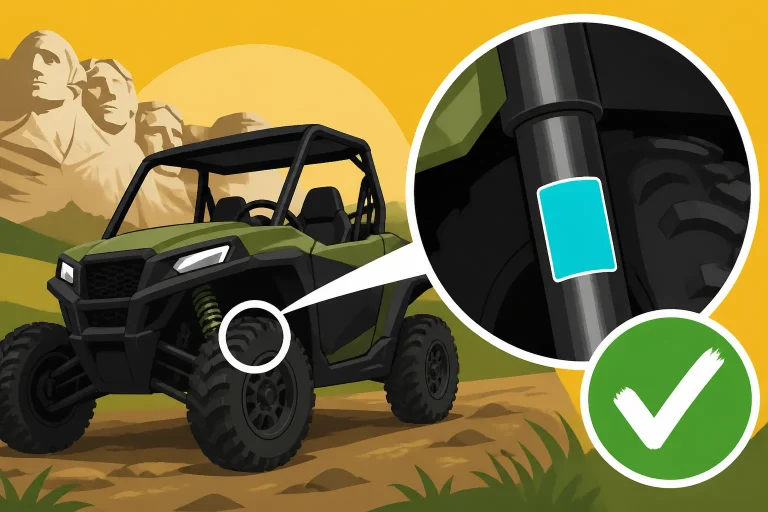
- Install the decals as instructed. The South Dakota Department of Revenue says the state decal must be placed on the rear of the off-road vehicle in an easily visible location. The expiration sticker must be placed on the decal for the permit to be valid.
If someone else signs the title and registration application as your authorized agent, the South Dakota Department of Revenue requires a Power of Attorney document. That requirement concerns the title and registration application; it is not a substitute for the identification documents required for the nonresident permit. For more on the application documents, see What a South Dakota Nonresident Permit Requires.
It also helps to keep your permit documents and purchase confirmations available during the trip. Check that the decal is attached correctly before riding, and make sure the expiration sticker is in place. These details are easy to overlook when a permit arrives shortly before departure.
Check whether your route needs another permit
A South Dakota nonresident permit does not cover every kind of riding. For a Black Hills trip, check the Forest Service rules for the roads, trails, and areas on your itinerary. The Forest Service says a Motorized Vehicle Use Trail Permit is required for motor vehicles traveling on motorized use trails in the Black Hills National Forest in South Dakota. The Motor Vehicle Use Map is the official map for identifying roads, trails, and areas open to public motorized travel on the National Forest.
The Forest Service also distinguishes between forest roads and designated motorized trails. Unlicensed OHVs using forest roads designated as Open to All Vehicles need a valid Black Hills Motorized Trail Permit. Vehicles with a valid state license plate do not need that permit unless they are driving on a designated motorized trail. In other words, having a state plate may affect whether you need a Forest Service permit on an open forest road, but it does not remove the permit requirement for a designated motorized trail. See Why a Plate Does Not Replace a Trail Permit for more on that distinction.
The Forest Service says the permit can be purchased at Black Hills National Forest offices, local vendors, online, or the visitor center. Vendor locations include the Black Hills Visitor Information Center in Rapid City, Big D Oil in Sturgis, and Black Hills UTV Outfitters in Lead. Before traveling to a particular seller, confirm that it currently offers permits and check its hours. For more options, see Where to Buy a Black Hills Trail Permit.
The Black Hills National Forest offers extensive motorized routes, but a large trail network is not a sign that every road or trail is open to your machine. The Forest Service says the Motor Vehicle Use Map is available free from local Forest Service offices, local vendors, and online. Use it to plan a legal route, then check for any closures or current notices before setting out. Forest Service permit sales support maintenance of the Forest’s motorized trail system.
Other riding areas have their own boundaries and requirements. The South Dakota Game, Fish, and Parks says the Oahe Downstream Off-highway Area has nearly 400 acres of terrain, but riding is restricted to designated areas only. The agency says vehicles inside designated OHV areas do not require a vehicle license or park entrance license. That exception applies to the designated OHV area; it should not be treated as a general exemption for operating an off-road vehicle elsewhere in a park or campground. Check What South Dakota Charges Visitors to Ride if your plans include more than the Black Hills.
Avoid assuming a permit makes an OHV street legal
A nonresident ORV permit and a Forest Service trail permit do not, by themselves, make an ATV or UTV legal to ride on public roads. The South Dakota Department of Revenue says out-of-state OHVs must have a hard license plate issued by their home state’s DMV to be street legal in South Dakota. The Department also sets engine-classification thresholds for street-legal OHVs: four-wheeled machines must meet a minimum of 200 cc, and two-wheeled machines must meet a minimum of 120 cc. Electric four-wheeled OHVs are permitted to meet the street-legal engine classification requirements.
Those road-use rules are separate from the process for buying a visitor permit. Before planning a route that uses a public road, confirm that your machine’s home-state plate and its equipment meet the requirements that apply. If your machine is not street legal, do not treat a trail permit or state nonresident decal as permission to ride on the road. What South Dakota Charges Visitors to Ride can help you sort out the different permissions involved.
Ownership paperwork is another separate issue. The South Dakota Department of Revenue says off-road vehicles must be titled even though they may not be registered and licensed for highway use. A title establishes ownership; it is not a riding permit, a Forest Service permit, or a street-legal plate. For details on the state’s requirements, see Do You Need a Title for an ATV in South Dakota?.
A few common planning mistakes are worth avoiding:
- Buying only the state permit for a Black Hills motorized trail ride. Check whether the Forest Service permit is also required for the route.
- Assuming a home-state plate covers designated trails. The Forest Service says plated vehicles still need a permit on designated motorized trails.
- Applying online at the last minute. The South Dakota Department of Revenue recommends applying at least two weeks before the trip.
- Leaving the expiration sticker off the state decal. The South Dakota Department of Revenue says the sticker must be placed on the decal for the permit to be valid.
- Treating a permit as a road-use authorization. Confirm that the OHV has the required home-state plate and meets the applicable street-legal rules before riding roads.
A little route planning before you leave can prevent a wasted purchase or an avoidable detour. Match each part of your trip to the rules for that location: the state permit for nonresident operation, the Forest Service permit where required, and the relevant plate and road-use requirements if your route includes public roads.
Sources
- South Dakota Department of Revenue — Off-Road Vehicles | South Dakota Department of Revenue (checked November 3, 2026)
- South Dakota Game, Fish, and Parks — ATVs & Off-Highway Vehicles | South Dakota Game, Fish, and Parks (checked November 3, 2026)
Disclaimer
This article is for general informational purposes only and does not constitute professional advice. Laws, prices and regulations vary by location and change over time. Consult a qualified professional for guidance on your specific situation.