What a Minnesota Rider With No Plate Must Buy
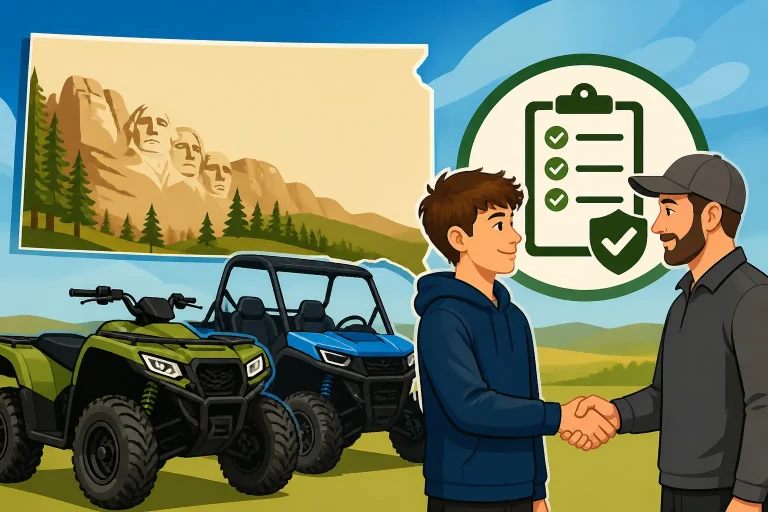
A Minnesota rider bringing an ATV or UTV to South Dakota without a plate needs to sort out permits before unloading. The key distinction is between the state’s nonresident off-road vehicle permit and a separate permit for certain Black Hills National Forest roads and trails. Neither permit makes an unplated machine street legal, and each riding area has its own access rules.
The short answer: buy the state nonresident ORV permit
According to the South Dakota Department of Revenue, a nonresident who wants to ride an off-road vehicle in South Dakota must have the state’s nonresident off-road vehicle permit. The permit is valid for one year. As of November 2026, the department lists its cost as $50, with an additional $2.50 mailing fee for decals sent to applicants. Check with the department for current amounts before applying.
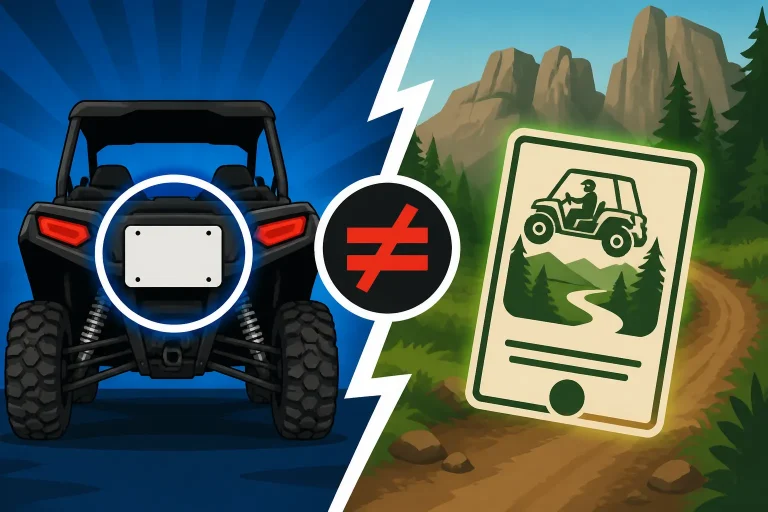
The state permit is not the same as a license plate. It does not register the vehicle for highway use, and it does not make an unplated ATV or UTV street legal. For a quick overview of the application requirements, see South Dakota Nonresident ORV Permit Requirements. For details about what the permit does and does not let you ride, see What the Nonresident ORV Permit Lets You Ride.
The South Dakota Department of Revenue requires applicants to provide a copy of their driver’s license and proof of their Social Security Number. If someone else signs the title and registration application as your authorized agent, the department requires a Power of Attorney document. Confirm the application procedure and required documents with the department before submitting anything.
You can apply online, but the South Dakota Department of Revenue advises submitting an online application at least two weeks before your planned trip. That gives the mailed decal time to arrive. If you are applying closer to departure, check whether another application or purchase option is available and whether you can receive the permit in time. Do not assume that a receipt or a photo of an application will take the place of the required decal.
When the decal arrives, follow the South Dakota Department of Revenue’s placement instructions: put it on the rear of the off-road vehicle in an easily visible location, and attach the expiration sticker to the decal. The department says the expiration sticker must be on the decal for the permit to be valid. Keep the application requirements and decal instructions together so the machine is ready before the first ride.
| What you need to sort out | What it covers | What it does not do |
|---|---|---|
| South Dakota nonresident ORV permit | State permit for a nonresident’s off-road vehicle | Does not make an unplated machine street legal |
| Black Hills Motorized Trail Permit | Required for applicable motorized trails and certain unlicensed OHVs on Forest roads | Does not replace the state nonresident permit |
| Home-state hard plate | The plate requirement for an out-of-state OHV to be street legal in South Dakota | Does not replace a permit required for a designated motorized trail |
The South Dakota Department of Revenue says off-road vehicles must be titled even though they may not be registered and licensed for highway use. That is a separate issue from buying the nonresident permit: a permit is not a title. If the machine has no title or you are unsure what paperwork applies, review Do You Need a Title for an ATV in South Dakota? and confirm the situation with the department.
Riding in the Black Hills: expect a second permit
The state permit alone is not enough for every ride. According to the Forest Service, a Motorized Vehicle Use Trail Permit is required for motor vehicles traveling on motorized-use trails in the Black Hills National Forest in South Dakota. The Forest Service also requires a valid Black Hills Motorized Trail Permit for an unlicensed OHV using a Forest road designated as Open to All Vehicles.
That distinction matters for a Minnesota rider without a plate. An unlicensed machine may be able to use a qualifying Forest road with the Black Hills permit, but the road must be designated Open to All Vehicles. Riding on a designated motorized trail requires the Forest permit too. Check the route rather than treating every road, trail, or open area as interchangeable. Do You Need a Permit on a Black Hills Trail? explains the trail-permit question, while South Dakota Trail Maps and MVUMs can help with route planning.
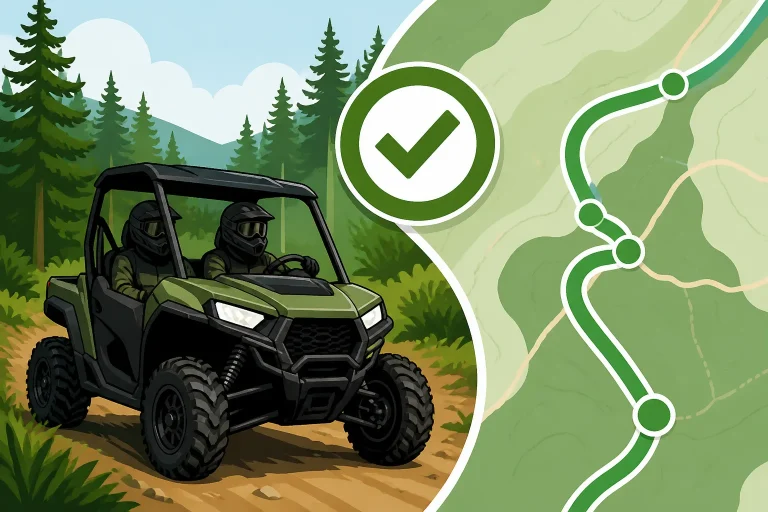
The Motor Vehicle Use Map, or MVUM, is the official map for roads, trails, and areas open to public motorized travel on the National Forest, according to the Forest Service. The map is available free from local Forest Service offices, local vendors, and online. Use the current map to confirm a route’s designation before setting out; a trail visible on a map or app is not necessarily open to your vehicle.
The Forest Service says Black Hills Motorized Trail Permits can be purchased at Black Hills National Forest offices, local vendors, online, or at the visitor center. Permit sales support maintenance of the Forest’s motorized trail system. For purchase options and planning details, see Where to Buy a Black Hills Trail Permit and Black Hills Motorized Trail Permit Cost. Confirm current availability and instructions with the Forest Service or the seller before your trip.
A valid state plate changes some of the Forest permit rules, but it does not eliminate every permit requirement. According to the Forest Service, vehicles with a valid state license plate do not need a Black Hills Motorized Trail Permit unless they are driving on a designated motorized trail. The same agency says a Motorized Vehicle Use Trail Permit is required for any motor vehicle traveling on those trails in the South Dakota portion of the Black Hills National Forest. If you later obtain a plate, check which type of route you plan to ride rather than assuming the plate covers trail access.
The route also determines whether the machine qualifies as street legal. According to the South Dakota Department of Revenue, an out-of-state OHV must have a hard license plate issued by its home state’s DMV to be street legal in South Dakota. The department lists a minimum engine classification of 200 cc for four-wheeled OHVs and 120 cc for two-wheeled OHVs; electric four-wheeled OHVs are permitted to meet the four-wheel engine-classification requirement. A state permit or Forest permit is not a substitute for the required plate. For the reciprocity issue, see Does South Dakota Honor Out-of-State Registration? and Why South Dakota Honors Only a Plated Machine.
Pick the riding area before you buy permits
Permit needs depend on where you plan to ride, so make a route plan before you leave Minnesota. For the Black Hills National Forest, start with the MVUM and identify whether your intended route is a designated motorized trail or a Forest road marked Open to All Vehicles. Then check the applicable permit requirements. The Forest Service says there are over 700 miles of system trails designated for OHVs and available for riding with a valid Motorized Trail Permit, within a larger network of roads and trails.
Some Forest access points are specifically used for motorized riding. For example, the Forest Service describes Antelope Springs Trailhead as primarily serving motorized vehicles and day-use motorized trail users, and says a trail permit is required to use its motorized trails. It is approximately 32 miles northwest of Custer, according to the Forest Service. The Forest Service also notes that potable water is not available at the trailhead, so plan water and supplies before heading out.
South Dakota has other designated riding areas with different access rules. The South Dakota Game, Fish, and Parks says the Oahe Downstream Off-highway Area has nearly 400 acres of terrain, with riding restricted to designated areas only. The same agency says the Revheim Bay Off-highway Vehicle Area features a 1.1-mile track. Check the relevant area’s current rules before riding; a permit does not grant permission to leave the routes or areas designated for motorized use.
Do not confuse riding inside a designated OHV area with operating an OHV in a park or campground. According to South Dakota Game, Fish, and Parks, vehicles inside designated OHV areas do not require a vehicle license or park entrance license. But off-road vehicles operated in parks or campgrounds must have a South Dakota license and a park entrance license, and operators must hold a valid driver’s license. If your plans include a park or campground, confirm which rules apply to the specific place rather than assuming the OHV-area exemption carries over.
Seasonal restrictions matter as well. South Dakota Game, Fish, and Parks says OHVs are prohibited from snowmobile trails during the snowmobile season. The agency also says snowmobiles are allowed in OHV areas exclusively during the designated snowmobile season. Check current closures and seasonal designations before traveling, especially if your trip is planned around a particular trail or riding area.
A practical checklist before leaving Minnesota
Use this sequence to avoid arriving with the wrong permit or assuming a permit covers more than it does:
- Confirm the machine’s status at home. Check Minnesota requirements for your ATV or UTV and whether it has a hard plate issued by the home state’s DMV. South Dakota’s permit does not decide what Minnesota requires.
- Apply for South Dakota’s nonresident ORV permit. The South Dakota Department of Revenue requires a driver’s license copy and proof of Social Security Number. Submit an online application at least two weeks before the planned trip, as the department advises.
- Plan for the decal. Once it arrives, place it on the rear of the machine where it is easily visible and attach the expiration sticker, as required by the South Dakota Department of Revenue.
- Map the actual routes. For Black Hills National Forest riding, use the MVUM and confirm whether the route is a designated motorized trail or a Forest road designated Open to All Vehicles.
- Get the Black Hills permit if your route requires it. The Forest Service requires a permit for motorized trails and for unlicensed OHVs on Forest roads designated Open to All Vehicles. Check purchase options and timing with the Forest Service.
- Check each destination’s rules. A designated OHV area, a campground, a park, and a Forest trail may have different license, permit, and operating requirements.
- Keep the documents accessible. Carry the permit information and the machine’s ownership paperwork with you, and be ready to show the decal where required.
The short version is simple: for an unplated Minnesota machine, get the South Dakota nonresident ORV permit, then check whether your chosen Black Hills roads or trails also require the Forest Service permit. Do not treat either permit as a street plate. If you want to ride on public roads, verify the hard-plate and machine requirements separately. For a broader comparison of road use and trail access, see Riding South Dakota With an Out-of-State Plate.
Sources
- South Dakota Department of Revenue — Off-Road Vehicles | South Dakota Department of Revenue (checked November 3, 2026)
- South Dakota Game, Fish, and Parks — ATVs & Off-Highway Vehicles | South Dakota Game, Fish, and Parks (checked November 3, 2026)
- USDA Forest Service — Black Hills National Forest | OHV Information | Forest Service (checked November 3, 2026)
- Forest Service — Black Hills National Forest | Off-Highway Vehicles (OHV) | Forest Service (checked November 3, 2026)
- USDA Forest Service — Black Hills National Forest | Antelope Springs Trailhead | Forest Service (checked November 3, 2026)
Disclaimer
This article is for general informational purposes only and does not constitute professional advice. Laws, prices and regulations vary by location and change over time. Consult a qualified professional for guidance on your specific situation.