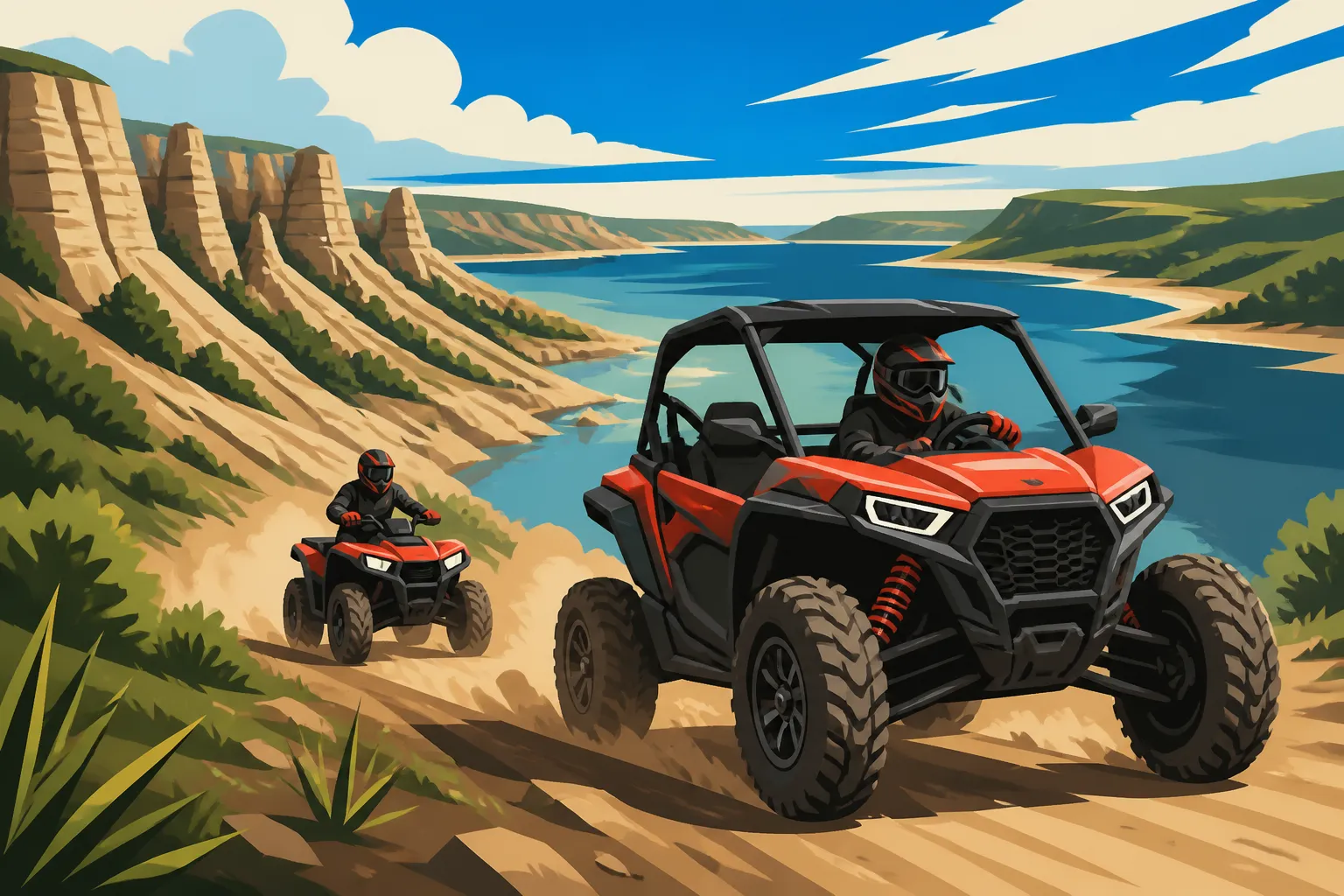
South Dakota’s Revheim Bay Track
Revheim Bay can be easy to misunderstand if you’re expecting a long trail network: it’s better approached as a compact riding destination centered on a track, not a full-day Black Hills route. This guide explains what to expect, how to plan a visit near Pierre, what to check before unloading, and how to make the ride work for your machine and group.
What to expect at Revheim Bay
A compact riding area, not a long-distance trail system
Revheim Bay is associated with a short off-highway vehicle track near the Lake Oahe area, north of Pierre. It’s a different kind of outing from a ride across miles of forest roads in the Black Hills. The track can suit riders who want a place to practice, make repeated laps, or fit in a shorter ride without planning a long route between trailheads.
That distinction matters when you’re choosing where to ride. A track encourages you to cover the same ground more than once, whereas a trail system is about following a route through changing scenery. If your group wants a full day of exploring, look carefully at the area’s available riding opportunities before making Revheim Bay the centerpiece of a long trip. For broader options around the state, compare it with Oahe Downstream OHV Area in South Dakota, and don’t assume two nearby riding locations offer the same experience.
The track’s compact scale can also make it a practical choice for a first outing or a short practice session. Riders can focus on turning, throttle control, braking, and reading the surface rather than navigating a complicated route. Still, “compact” doesn’t mean effortless or risk-free. Conditions, other riders, machine capability, and the posted rules all matter.
A different feel from the Black Hills
The landscape around Pierre and Lake Oahe is not the same as the ponderosa forest, rocky climbs, and winding roads many visitors associate with South Dakota ATV riding. If you’re coming from Rapid City or Deadwood, plan for a change in scenery and riding style. Revheim Bay may be a better fit for a session focused on track riding than for a scenic, miles-long loop.
This can be a plus if your group has mixed expectations. One person may want to work on technique, while another is hoping for a scenic route. Talk it through before loading the machines. A quick track session might be exactly right for riders who want repetition and a close-to-the-vehicle setup, but it may disappoint anyone expecting hours of changing trail conditions.
It’s also worth separating Revheim Bay from South Dakota’s larger motorized riding areas. The state has different facilities and route types, each with its own management and rules. South Dakota's Revheim Bay Track belongs in the “small track outing” column of your planning, while South Dakota's Oahe Downstream Riding Area is a separate option to investigate rather than assume is part of the same ride.
Planning a visit near Pierre
Check access and local conditions before you leave
Before setting out, confirm that the riding area is open and that the track is available for the kind of machine you plan to bring. Access, maintenance, weather, and management decisions can affect a visit. Don’t rely on an old social post or a map pin alone to establish that a facility is open for riding on the day you arrive.
A map app can help you understand the general area and plan the drive, but it should be one part of your preparation rather than the final word on access. onX Offroad can help you review map information and orient yourself around a destination, but compare what you see in an app with current signs and official land-management guidance. A mapped line does not automatically mean that route is open to motorized use.
Give yourself time to find the entrance, read the posted information, and unload without rushing. If you’re traveling with children, first-time riders, or several machines, that extra time makes the start of the day calmer. It also gives everyone a chance to talk about boundaries and riding behavior before the engines are running.
Match the trip to the weather and your group
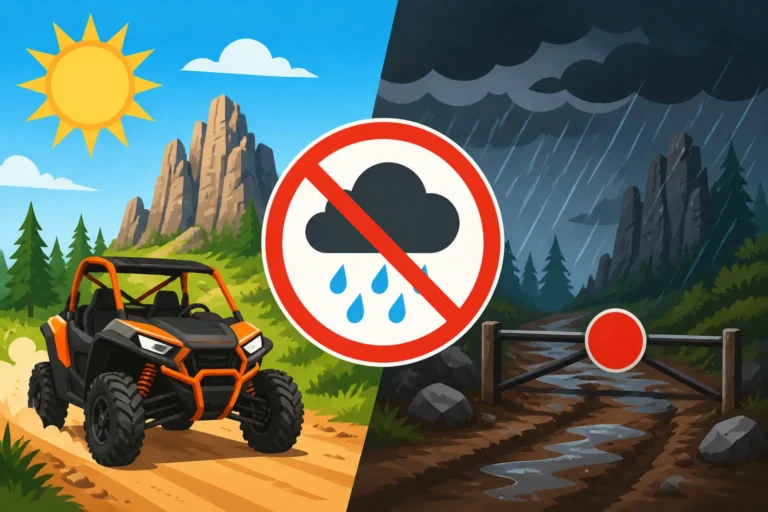
Weather can change the character of a short track quickly. Rain may leave soft or slippery sections, while dry conditions can bring dust and reduce visibility behind other machines. Wind can make dust linger or blow across the riding area. Check the forecast for Pierre and the immediate area, but pay attention to actual surface conditions when you arrive too.
A short track session can be easier to tailor to a mixed group than a remote trail ride. A newer rider can take time to get comfortable, while experienced riders can focus on smooth control rather than speed. Keep the group’s pace appropriate for the least experienced person, and agree on a meeting point if people become separated.
For riders traveling from farther away, build a backup plan into the day. If the surface is unsuitable, access is restricted, or the track doesn’t match your group’s needs, you may want to explore another permitted activity in the region instead. Where to Ride an ATV in South Dakota can help you think beyond one destination, but check each location’s own access rules before changing plans.
Bring a simple arrival checklist
A little preparation prevents the familiar frustration of reaching the unloading area and discovering that something important was left at home. Before leaving, check the machine, fuel, tire condition, protective gear, water, and any paperwork or permits that may apply. If you’re bringing more than one vehicle, make the checklist for each machine rather than assuming the second one is ready.
When you arrive, pause before riding. Look for signs, closures, track direction, staging instructions, and any limits on vehicle types. If the information is unclear, don’t guess based on what another rider is doing. Ask the responsible land manager or use the contact information posted for the site.
| Before the ride | What to check | Why it matters |
|---|---|---|
| Access | Whether the area is open and the track is available | Prevents a wasted drive and helps you respect closures |
| Machine | Tires, brakes, controls, fuel, and visible damage | Catches problems before they become a trackside breakdown |
| Gear | Helmet, eye protection, gloves, boots, and weather-appropriate layers | Helps protect against impacts, dust, and changing conditions |
| Rules | Posted signs, permitted machine types, and applicable permits | Rules can differ between riding areas |
| Group plan | Meeting point, pace, hand signals, and emergency contact | Makes it easier to manage a mixed-experience group |
Choosing the right machine and riding approach
Pick a machine that fits the facility
The right ATV or UTV depends on the track’s rules, surface, layout, and your comfort level. A smaller ATV may feel manageable for repeated turns, while a side-by-side offers seating for passengers and a different handling profile. Neither is automatically the better choice. Confirm that your machine type is allowed and that its width and size suit the designated riding space.
For a UTV, remember that its size can affect how comfortably it handles a compact track. A large, wide machine may not be ideal for a facility designed around smaller vehicles, even if it is permitted. Conversely, an ATV rider may need to pay closer attention to balance and body position than someone driving a side-by-side. Choose for the actual setting, not just what you already own.
If you’re deciding between Revheim Bay and a more extensive network, think about the machine’s strengths. A track session can work well for practicing control in a defined area. A wider trail network may call for attention to width restrictions, route length, navigation, and fuel range. South Dakota Trail Width Limits is useful background when you’re comparing trail destinations, though the track’s own posted rules should guide your choice at Revheim Bay.
Ride within your skill and sight line
The temptation to speed up can creep in after a few comfortable laps. Repetition helps you learn the surface, but it can also create false confidence. Keep your speed appropriate to the conditions and the traffic around you. Dust, a blind section, a sudden stop, or another rider making an unexpected move can change a familiar lap in a moment.
Leave enough space between machines. On a dusty day, following too closely can make it difficult to see the track ahead. If you lose visibility, ease off and create room rather than trying to stay on the rider in front of you. On a mixed-use or shared facility, be especially alert for people who may be learning or riding at a different pace.
New riders benefit from beginning slowly and building comfort in stages. Start with a familiarization lap if conditions and site rules allow it, then practice smooth braking, gentle turns, and controlled acceleration. Experienced riders can set a good example by keeping predictable lines and giving others room. [South Dakota ATV Safety Course Requirements] can help you check whether training requirements apply to a particular activity, while practical instruction remains valuable even when a course is not required.
Make protective gear part of the plan
Helmet and eye protection are basic choices for a track day, not optional extras to think about after you arrive. Dust, flying grit, and small debris can turn a comfortable ride into an uncomfortable one quickly. Gloves and sturdy footwear help with grip and protection, and clothing should suit the weather as well as the possibility of contact with the machine or track surface.
Passengers need properly fitted gear too. A UTV passenger should use the vehicle’s safety equipment as designed and stay seated while the machine is moving. On an ATV, never assume that a passenger can ride safely just because the seat looks long enough. Follow the machine manufacturer’s guidance and applicable rules for passengers.
The track environment doesn’t remove road or land-use requirements that may apply elsewhere. Requirements can differ by location and by the kind of riding you plan to do. If your visit includes a separate road segment or another riding area, review the rules for that specific use. South Dakota Helmet Rules for ATV Riders and South Dakota Eye Protection Rules for Riders are relevant starting points for understanding protective-equipment rules in the state.
Rules, maps, and responsible riding
Don’t assume rules transfer between locations
South Dakota riding rules are not one simple set of instructions that applies identically everywhere. A state riding area, a national forest trail, a county road, private ground, and a managed track may each have different access requirements. A machine’s plate or permit status can matter in one setting and not answer the question in another.
For Revheim Bay, begin with the signs and instructions at the facility, then confirm any uncertain details with the land manager. Don’t assume that because a machine can ride at one public area, it can ride at every public area. Similarly, don’t treat a map label as permission to travel beyond the designated track.
This is especially important if you’re planning a larger trip around Pierre. A route between two points may pass through land with different rules, and riding outside a designated area can create access and safety problems. [South Dakota Rules for Riding Federal Land] offers context for federal riding areas, but it does not replace the rules for a separate facility or parcel.
Use maps as planning tools, not permission slips
A digital map can help with orientation, route planning, and identifying nearby roads or landmarks. onX Offroad can be useful for reviewing map layers and understanding the broader area before you travel. That’s helpful when you’re coordinating a group, planning a drive from town, or comparing a short track session with other riding options.
The important limitation is that a mapped feature is not the same as verified legal access. Map data can be incomplete, boundaries can be confusing, and access conditions can change. Treat the map as one source of planning information, then rely on current posted signs and the responsible agency’s instructions for decisions about where you may ride.
Download or review the information you need before reaching areas with weak mobile service. Even when a phone has a signal in town, coverage can become inconsistent as you travel away from developed areas. Keep a backup plan for navigation and make sure everyone in the group knows the meeting point and the route back to the vehicle staging area.
Leave the area ready for the next visit
Responsible riding is as much about what happens between laps as what happens on the track. Stay in designated areas, avoid creating new routes, and follow instructions about parking, unloading, and waste. If you bring food, tools, or spare parts, pack out what you bring in. Small scraps left behind can make a public riding area unpleasant for everyone.
Be considerate of nearby visitors and local residents. Keep noise and staging behavior within posted rules, avoid blocking access, and give other users space. If the area is busy, patience at the entrance or unloading area is better than trying to rush through a tight space with trailers and machines moving around.
When you finish, take a moment to check your equipment and the ground around your parking spot. Pick up straps, trash, and loose gear before leaving. If you notice damaged signs, an unsafe condition, or a closure that isn’t clear, report it through the appropriate management contact rather than trying to fix or interpret it yourself.
Is Revheim Bay right for your ride?
It works best for a focused outing
Revheim Bay may be a good fit if your goal is a short, track-centered ride near Pierre. It can make sense for practicing, getting familiar with a machine, or adding a riding stop to a trip around the Lake Oahe region. Its compact character may also be appealing when you don’t want to plan a long route through a larger network.
It may be a less satisfying choice if your priority is covering many miles, discovering changing scenery, or spending a full day moving between trailheads. In that case, compare other South Dakota riding areas and check what they allow before you commit. [Best Places to Ride an ATV in South Dakota] can help frame that wider search, while each destination’s current information should settle the details.
The best visit begins with realistic expectations. Think of Revheim Bay as a destination where the track itself is the activity, not simply as a convenient gateway to a larger route. That small shift in planning can make the outing feel intentional instead of leaving your group wondering why the ride is shorter or more repetitive than expected.
A quick decision guide
Before you load up, ask three practical questions: Is the area open? Is your machine allowed? Does a track session match what your group wants today? If you can answer yes to all three, the plan is likely on the right track. If one answer is uncertain, pause and confirm rather than relying on assumptions.
For a family or mixed-experience group, also consider whether the setting gives newer riders a comfortable way to participate. Keep the day flexible, agree on a conservative pace, and make sure everyone understands that they can take a break. A good outing is not measured by how many laps someone completes; it’s measured by whether the group rides within its abilities and gets home safely.
If Revheim Bay isn’t the right fit, don’t force it into a trip plan simply because it’s nearby. Compare the area with other permitted locations, check access conditions, and choose the riding experience your group actually wants. A little advance planning can save a long drive, a frustrating unloading session, and the awkward moment when everyone realizes they expected a different kind of ride.
Disclaimer
This article is for general informational purposes only and does not constitute professional advice. Laws, prices and regulations vary by location and change over time. Consult a qualified professional for guidance on your specific situation.