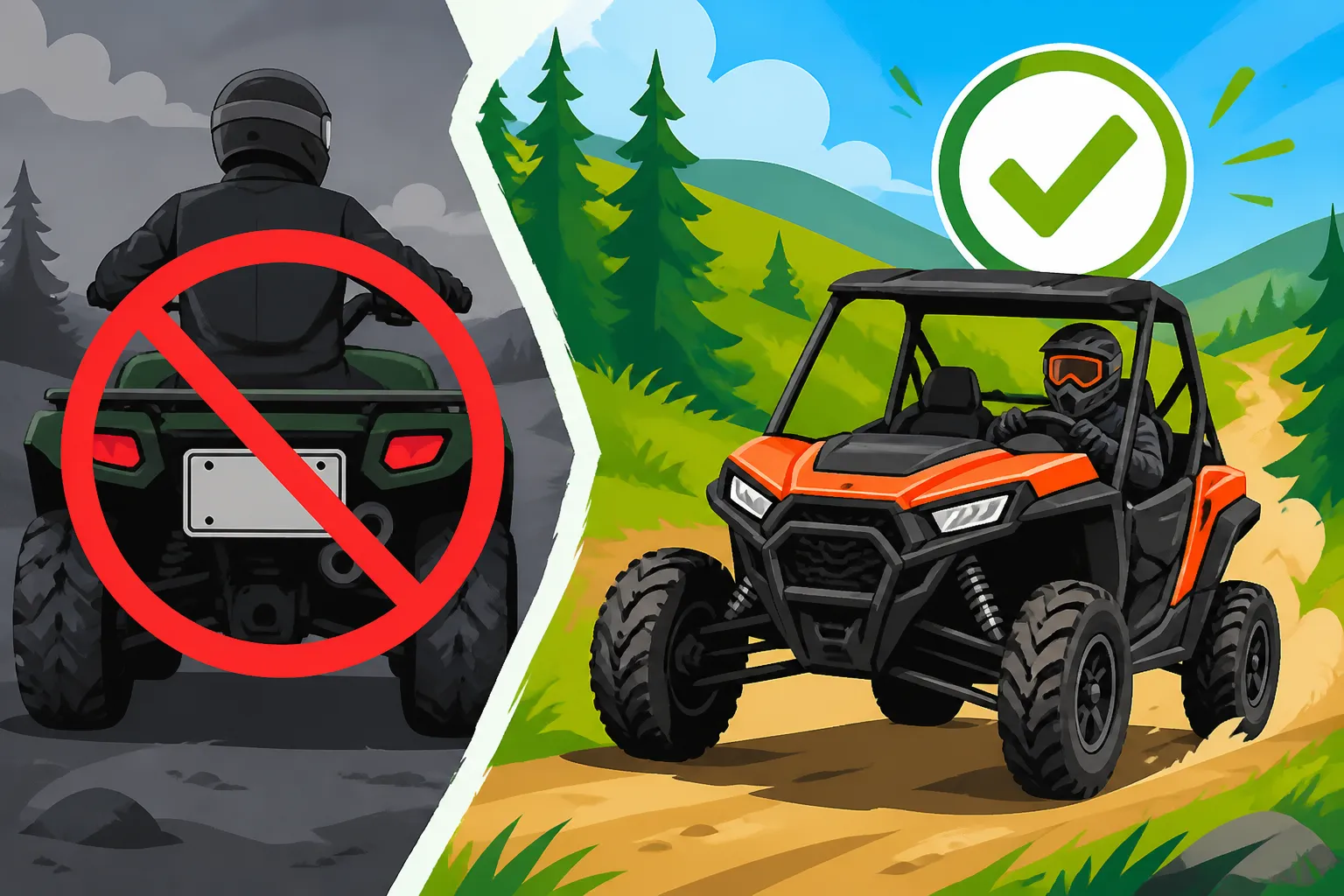
Why No Plate Is Needed Inside a GFP Area
A missing ATV plate can feel like an obvious reason to turn around, especially when you are used to needing registration on public roads. At a designated South Dakota Game, Fish and Parks OHV area, though, the rules for riding inside the managed area can differ from road-use rules. This guide explains when a plate may not be needed, what requirements still apply, and where the exception stops.
Why a plate may not be required inside a designated GFP OHV area
The difference between riding on a road and riding inside a managed area
A license plate or vehicle registration is generally associated with operating a machine on public roads. A designated off-highway vehicle area is different: it is a defined place for off-road riding, with access controlled by the area’s rules. When you keep your ATV or UTV inside that authorized riding area, a road-use plate may not be part of the requirements for that ride.
That distinction is easy to miss when you have just unloaded at a trailhead. You may see plated machines, unplated machines, decals, signs, and riders coming and going, and it is natural to assume the rules are identical for everyone. The important question is not simply whether you are on GFP-managed land. It is whether you are riding within a designated area and following the specific conditions that apply there.
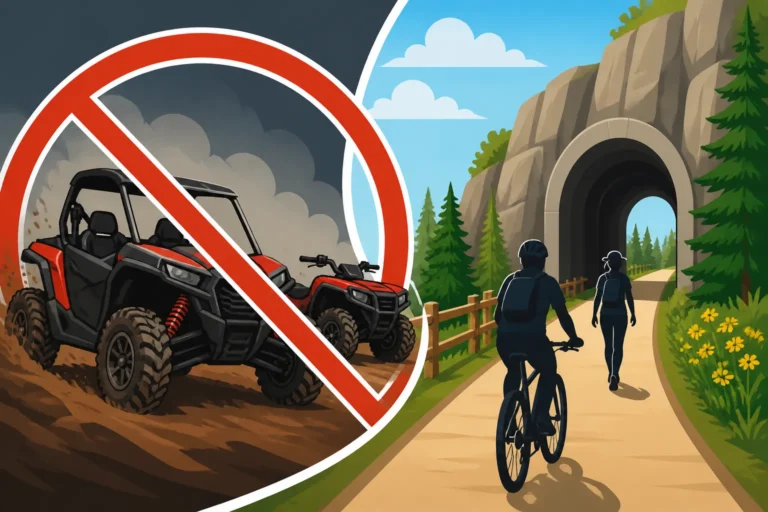
This is a limited, place-based distinction—not a general exemption for every GFP property. A machine that can ride unplated inside an authorized OHV area does not automatically become legal to operate on a nearby road, shoulder, or connecting route. Before unloading, identify the boundaries and access rules for the specific site. [Riding a GFP Area Without a Plate] covers the area-specific distinction in more detail.
A GFP property is not automatically an OHV riding area
“GFP land” can describe different kinds of public land and recreation areas. Some places are designated for motorized riding; others may have no authorized OHV routes, may restrict motorized use to particular roads, or may prohibit riding in certain locations. The agency that manages the land matters, but the land manager’s name alone does not tell you that ATV riding is allowed.
Think of a family arriving at a recreation area with a trailer and an unplated side-by-side. If the site is a designated OHV area, the family should check its entry requirements, marked boundaries, and permitted riding routes. If they are at a different GFP property, they need to establish whether motorized riding is allowed there at all. The same vehicle and the same public agency do not make those two situations interchangeable.
Look for the site’s posted instructions and current information from the managing agency before you ride. A map app can help you understand the general layout, but do not treat an app’s trail line as proof that a route is open or authorized. If you use onX Offroad to plan, compare what you see there with the area’s official map, posted notices, and signs at the entrance. [South Dakota Rules for Riding GFP Land] is also useful for understanding why access depends on the particular place.
What still matters when you ride without a plate
No plate does not mean no permission or permit
A plate and a riding permit answer different questions. A plate or registration is connected with road use and vehicle identification. A site-specific access permit, riding pass, or other entry requirement may govern whether you can use a designated riding area. Being allowed to ride without a plate inside an area does not necessarily mean you can arrive, unload, and ride without meeting the area’s other conditions.
Check the requirements for the exact location before you travel. Find out whether you need an entry pass, an OHV permit, or another authorization; whether the permit must be displayed; and whether separate rules apply to passengers, age, safety gear, or vehicle equipment. Do not assume that a permit used at one riding area will cover another site, or that a permit replaces every other requirement.
This is especially important if you are comparing a GFP OHV area with the Black Hills National Forest. Trail-permit rules for one riding setting do not automatically carry over to another. For example, [South Dakota's Motorized Trail Permit] explains a separate permit system, while [Why a Plate Does Not Replace a Trail Permit] addresses a different but related misunderstanding. Check both the land manager and the type of riding area before relying on a permit or plate you already have.
Boundaries, signs, and route restrictions still apply
Even when a plate is not required within the designated area, the permission to ride is not unlimited. The site may have marked boundaries, restricted zones, one-way routes, closures, or rules about where vehicles may be operated. Staying inside the authorized riding area is part of the reason the plate rule can be different in the first place.
Picture a rider who leaves a marked OHV area to reach a fuel stop or a nearby road. The rider may still be on public land, but that does not mean the same on-site rule follows them. Once the route leaves the designated area, the legal requirements can change. A short connector that looks convenient on a screen may cross a road or land boundary where a different rule applies.
Use posted signs as instructions, not decoration, and do not ride around a closed gate or into an unmarked area because it appears passable. onX Offroad can be helpful for tracing a planned route and noticing where it approaches boundaries, but confirm access with the official site map or land manager. For road riding and roadside enforcement questions, see [What a South Dakota Trooper Checks Roadside].
| Situation | Is a plate necessarily required? | What to verify |
|---|---|---|
| Riding wholly inside a designated GFP OHV area | Not necessarily | The area’s current access, permit, and operating rules |
| Riding on a public road to reach the area | Road-use requirements may apply | Whether the machine and rider may legally use that road |
| Crossing a road or leaving the designated boundary | The on-site exception may no longer apply | The rules for the road or adjoining land |
| Riding at another GFP property | Do not assume the same exception applies | Whether motorized riding is authorized at that specific property |
| Riding on a National Forest motorized trail | Separate rules may apply | Trail permit requirements and route restrictions |
How the rule works at particular GFP riding areas
Oahe Downstream OHV Area
Oahe Downstream is one of the South Dakota riding locations associated with an OHV area. Its designation matters: the relevant question is not simply whether the machine has a plate, but whether it is being operated within the area under the conditions set for that site. A rider should check the area’s own access information before assuming that the same rule applies to an adjoining road, campground, or other part of the recreation complex.
Before setting out, identify where the OHV riding area begins and ends, what entry requirements apply, and which routes are open to your type of machine. If you are bringing a wide UTV, also check any vehicle-size restrictions rather than assuming every route can accommodate it. These details can affect a ride just as much as the plate question.
For a practical overview of the location, start with [Oahe Downstream OHV Area in South Dakota]. If you are using onX Offroad to plan a visit, use it as a planning aid: cross-check the route against official maps, site signs, and current access notices. A mapped line does not override a closure or authorize travel outside the riding area.
Revheim Bay OHV Area
Revheim Bay is another named South Dakota OHV riding location where riders should distinguish between area-specific riding and ordinary road use. The fact that a machine can be used under the area’s OHV rules does not grant permission to ride it along every nearby road or across every adjacent piece of land. Keep your route within the designated riding area unless the rules clearly authorize travel elsewhere.
A useful preparation step is to check the site information before loading the trailer, then read the signs again when you arrive. Conditions may be affected by closures, maintenance, weather, or other site-specific restrictions. If you are meeting friends there, share the boundary and entry details in advance so no one assumes that the easiest-looking approach is an approved riding route.
[Revheim Bay OHV Area] provides more location-specific context. If your plan involves connecting the area to another trail system, treat that as a separate question and confirm the rules for each segment. A plate exemption inside one managed OHV area should never be used as a shortcut for deciding whether a connecting road or trail is open to your machine.
Common assumptions that lead riders into trouble
“It is GFP land, so I can ride there”
Public ownership does not by itself establish permission for motorized riding. A GFP property may serve a different recreational or conservation purpose, and the rules can vary from one site to another. A rider who assumes that all agency-managed land is open to ATVs may accidentally enter a closed area or travel beyond the routes allowed for motorized vehicles.
This mistake can happen when a route appears continuous on a map. A two-track may lead toward a river, campground, or other recreation site, but its appearance does not tell you whether it is an authorized ATV route. Check the official map and watch for signs that mark the end of an OHV area or the start of a restricted zone. When the route is unclear, stop and confirm rather than testing the boundary with your machine.
Using onX Offroad to study the surrounding layout can help you prepare questions and spot possible route changes, but do not treat a map layer as permission. Verify the specific site with GFP information and on-the-ground signs. For location-specific background, compare the details in [Oahe Downstream OHV Area in South Dakota] and [Revheim Bay OHV Area] rather than assuming that every GFP property follows the same pattern.
“If I do not need a plate, I do not need anything else”
This is perhaps the most tempting assumption because it turns a narrow rule into a broad one. A plate requirement, an area access permit, a park entrance requirement, and permission to use a particular trail are not interchangeable. One may apply when another does not, and the answer can depend on the site and the route.
Before riding, make a short checklist: identify the land manager, confirm that motorized riding is allowed, check whether the area requires a permit or pass, and review the rules for the machine and riders in your group. If you plan to leave the OHV area, check the rules for the next part of the route separately. This avoids the frustrating situation of discovering at the entrance—or during a roadside stop—that you prepared for the wrong kind of riding.
A plate exemption also does not settle questions about helmets, age, passengers, lights, insurance, or equipment. Those requirements can vary with the location and how the machine is being used. [Why No Park License Is Needed Inside One] addresses a separate access question; do not read it as proof that all GFP sites have no entrance requirement. [Does South Dakota Register ATVs?] can help you distinguish statewide title or registration questions from the rules for a particular riding area.
A practical pre-ride checklist for an unplated ATV or UTV
Confirm the site, the route, and the equipment
Start by naming the exact place you intend to ride. “GFP land near the lake” is too vague to answer the plate question safely. Confirm whether you are going to a designated OHV area, which entrance you will use, and whether the full route stays within the authorized riding boundary. If your plan includes a road connection, treat that segment as a separate ride with its own requirements.
Next, check the area’s current access conditions and any permits or passes. Review vehicle restrictions, route closures, passenger rules, and equipment requirements that could apply. Bring the documents or proof of access the site requires, and make sure everyone in your group understands where riding is allowed. A quick conversation at the trailer is much easier than sorting out a misunderstanding after someone has crossed a boundary.
Finally, compare your intended route with official information. onX Offroad can help you visualize a route, but use official maps and posted signs to confirm what is open. Keep your phone charged and carry an offline map or another backup when service is limited. If the map, sign, and your understanding do not agree, pause and ask the land manager before proceeding.
What to do if your ride leaves the designated area
If you discover that the route crosses outside the OHV area, stop before continuing and determine what rules apply beyond the boundary. Do not assume that the no-plate rule continues onto a county road, a state route, a National Forest trail, or a different GFP property. The legal status of the machine can change as soon as the location and type of use change.
A common example is riding from an OHV area toward a nearby town for fuel or food. The distance may be short, and the road may look quiet, but a public road is not simply an extension of the riding area. Check whether your machine can legally travel there and what requirements apply. If it cannot, trailer it or choose a route that stays within an authorized riding area.
When in doubt, turn back rather than improvising. Verify the relevant rules before the next trip and update your route plan. For wider comparisons between dedicated riding areas and other public-land routes, [Riding a GFP Area Without a Plate] and [South Dakota's Motorized Trail Permit] are useful starting points. The safest takeaway is straightforward: no plate may be required for riding inside a designated GFP OHV area, but that does not make the plate irrelevant everywhere else.
Disclaimer
This article is for general informational purposes only and does not constitute professional advice. Laws, prices and regulations vary by location and change over time. Consult a qualified professional for guidance on your specific situation.