Riding a Hills Forest Road in Fog
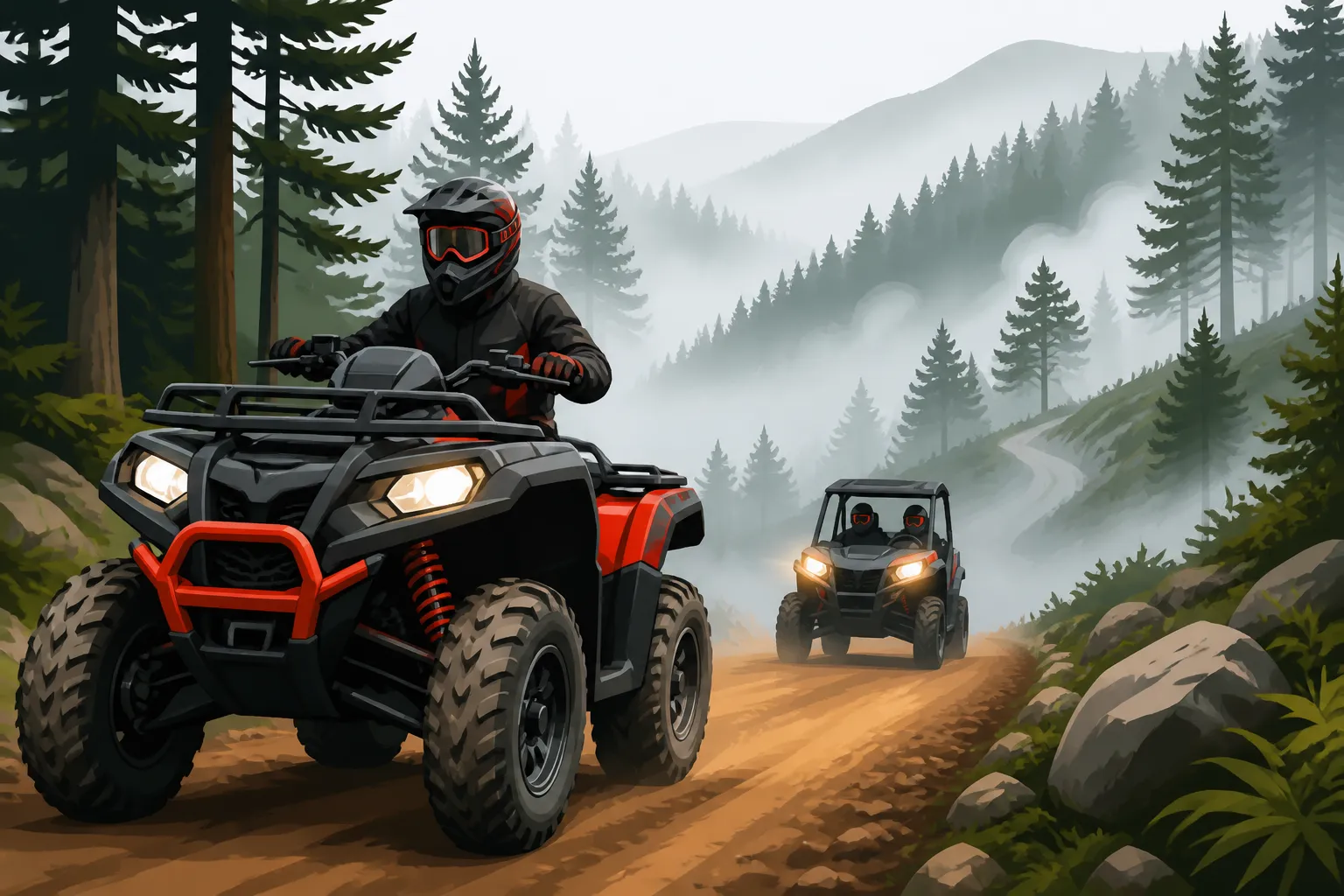
Fog can turn an easy Black Hills forest-road ride into a slow, tiring crawl: visibility drops, gravel hides in the haze, and a bend or oncoming vehicle may appear with little warning. This guide explains how to decide whether to continue, how to prepare your ATV or UTV, and how to ride more safely when mist settles over the South Dakota Hills.
Decide whether the ride should continue
Check conditions before leaving
Fog is especially tricky in the Black Hills because visibility can change quickly with elevation, shade, and terrain. A route that looks clear near Rapid City may be socked in near a higher ridge, while a low spot can hold mist even after nearby roads open up. Before unloading, check the forecast and any available road or area notices, then look at the conditions where you plan to ride—not only in town.
Think about the whole group, too. A confident driver may be comfortable creeping along, but a newer rider, a child, or someone riding an unfamiliar machine may find the same conditions stressful. If the forecast suggests fog is likely to thicken, or your route includes steep grades and tight turns, changing plans is often the safer choice. A ride postponed is frustrating; getting separated or meeting traffic in poor visibility can turn a day out into a much bigger problem.
Fog does not make every forest road unsafe, but it changes how much margin you have. If you cannot see far enough to stop comfortably within the visible road, do not treat the posted or customary speed as a target. Slow down before the road disappears into the haze, and be willing to turn around while you still have a clear place to do so.
Confirm that your route is open and appropriate
A line on a map is not automatically an authorized route for an ATV or UTV. Forest roads, motorized trails, private roads, and closed routes can sit close together, and signs or seasonal restrictions may affect where you can ride. Check the route’s current status and the rules that apply to your machine before setting out. South Dakota Trail Maps and MVUMs is a useful topic to review when planning a ride on public land.
Fog can make it harder to notice a closure sign, junction marker, or route boundary. Plan your turns in advance and avoid relying on a quick glance at a screen while moving. If you use onX Offroad to organize a route, check the map before the ride and make sure you understand how your planned line relates to authorized routes. Treat any digital map as a planning aid, not permission to ride past a gate or sign.
Also confirm the permit and plate rules for the specific road or trail you intend to use. Requirements can differ depending on the route and where it is located. [South Dakota Rules for Riding Federal Land] and Do You Need a Permit on a Black Hills Road? can help you identify what to check before you leave.
Prepare the machine and group for low visibility
Make your ATV or UTV easier to see
Before riding into fog, check that your headlights and brake lights work. Clean lenses and reflectors, and make sure mud, dust, or a loose accessory is not blocking them. A light that seems bright in a driveway may be much less effective when fog scatters its beam, so do not assume stronger or brighter lighting will let you travel at normal speed.
On a UTV, keep the windshield and mirrors clean enough to use, and clear any condensation before starting. A fogged windshield can be just as limiting as fog outside. On an ATV, make sure your helmet eye protection is clean and suited to the conditions; wiping a lens with a dusty glove can leave smears that make it harder to pick out movement.
Avoid adding lighting or making equipment changes without checking that they are allowed for the type of road use you plan. The basic equipment rules still matter when visibility is poor. Review South Dakota Equipment List for Road Use and South Dakota Lighting Requirements for ATVs if your route may involve road use. A trail ride and a ride on a public road are not necessarily governed by identical requirements.
Agree on spacing, signals, and a turnaround plan
A group should travel slowly enough that each rider can see the person ahead without riding close to their rear tires. Leave more space than you would on a clear day. If the lead machine brakes suddenly, that extra distance gives the following rider time to react on loose gravel. Avoid bunching up at corners or stopping where another rider may come around a bend without seeing you.
Before the group starts, agree on what to do if someone loses sight of the machine ahead. A simple plan might be: stop in a safe, visible place, wait for the rider behind, and do not continue farther into the fog alone. Make sure everyone knows the planned route, likely junctions, and the point where the group will turn back if visibility worsens. In a larger group, a last rider can help ensure nobody is left behind.
Keep your phone or navigation device secured and easy to check only when stopped. onX Offroad can be useful for reviewing a planned route and checking your position, particularly if you have prepared the map before leaving. Download or save what you need while you have reliable service, and carry a backup way to navigate. A phone battery can drain faster in cold or damp conditions, and cell service may be inconsistent in the Hills.
| Situation | Safer response |
|---|---|
| You can see only a short distance ahead | Reduce speed until you can stop within the visible distance |
| The group is spreading out | Stop somewhere safe and bring everyone back together |
| You cannot identify the next junction | Stop and check the route rather than guessing |
| Fog is thickening or rain is starting | Turn back or wait in a safe place |
| You encounter a gate or closure sign | Stop and do not continue beyond it |
| Your lights or windshield are obscured | Pull over safely and clear them before moving |
Ride at a pace that leaves room to react
Slow before bends, crests, and junctions
On a gravel forest road, a blind corner can hide an oncoming vehicle, a washout, loose rock, wildlife, or another rider. In fog, the distance you can see may be shorter than the distance needed to brake smoothly. Reduce speed before entering the bend rather than braking hard midway through it, when traction may already be limited by loose gravel.
Approach crests and junctions cautiously, too. You may not see a vehicle coming over a rise, and a junction marker can appear late in the haze. Stay on the correct side of the road and avoid cutting corners, even if the road looks empty. A vehicle coming the other way may be moving slowly for the same reason you are.
Leave room to stop without swerving. Sudden steering can be risky on gravel, especially if the edge is soft, rutted, or sloped. If you meet another vehicle, reduce speed early and choose a safe place to pass. Do not assume the other driver can see your machine or knows which way you intend to move.
Watch the surface, edges, and other road users
Fog softens contrast, making dips, potholes, loose rock, and changing road edges harder to spot. A wet-looking patch may be slick, while damp leaves or pine needles can hide gravel. Keep your attention on the road surface close enough to judge your line and far enough ahead to anticipate changes. Avoid staring into the fog or fixating on the lights of the machine in front.
Be especially careful near drainage dips, narrow bridges, cattle guards, and road edges. If you cannot clearly judge a feature, stop at a safe distance and assess it on foot only if you can do so without stepping into traffic or creating another hazard. Never ride off the road to get around an obstacle unless you know the ground is safe and the route allows it; a shoulder can be soft, steep, or private land.
Wildlife and people can also be harder to notice. Riders may encounter hikers, cyclists, maintenance vehicles, or other motorized users on forest routes. Keep your speed low enough to respond, use lights appropriately, and do not treat a quiet road as an empty one. South Dakota Rules for Riding a Forest Road and South Dakota Trail Etiquette With Tourists offer useful context for sharing routes responsibly.
Know when to stop, wait, or turn back
Use clear limits instead of wishful thinking
It is easy to tell yourself the fog will lift after the next bend or that the trailhead is just a little farther away. Set limits before you ride so you are not making every decision while tired, cold, and frustrated. For example, decide that the group will turn around if riders can no longer keep visual contact, if signs become difficult to read, or if anyone feels unable to control the machine comfortably.
If conditions worsen, stop in a safe place off the traveled line where other vehicles can see you. Do not stop just beyond a blind corner or at the bottom of a narrow hill. Keep the group together, check the map, and decide whether to wait for visibility to improve or return by a route you can identify. Do not continue into unfamiliar territory simply because the navigation screen shows a line ahead.
Use onX Offroad or another navigation tool to confirm your position while stationary, but do not let a mapped route overrule what you can see on the ground. If the map and a posted sign disagree, respect the sign and reassess. If you are unsure whether a road is open or authorized, choosing a known route or returning the way you came is safer than improvising in poor visibility.
Make the return trip part of the plan
A route that seems manageable on the way out can feel different when the group is cold, visibility has changed, or the road is wet. Before leaving, identify a conservative turnaround point and allow enough time to return without rushing. Fog may settle later in the day, so do not assume the ride back will be clearer simply because the morning started well.
Carry warm layers and water, and keep essential items protected from dampness. If a machine has a mechanical problem, fog can make it harder for a recovery vehicle or another rider to find you. Share your route and expected return time with someone who is not on the ride, and tell them where you plan to park. If you change plans, let that person know when you can.
The safest choice may be to wait for visibility to improve or leave the road entirely. On a foggy Black Hills day, turning around is not a failure to finish the route. It is a practical decision that protects the group, the machines, and everyone else using the road. If you are unsure, choose the route with better visibility—or save the ride for another day.
Disclaimer
This article is for general informational purposes only and does not constitute professional advice. Laws, prices and regulations vary by location and change over time. Consult a qualified professional for guidance on your specific situation.